How to Host a Coffee Cupping Event
Host a welcoming coffee cupping with a three-coffee flight, measured setup, a protected 90-minute agenda, simple tasting prompts, and clear guest choices.
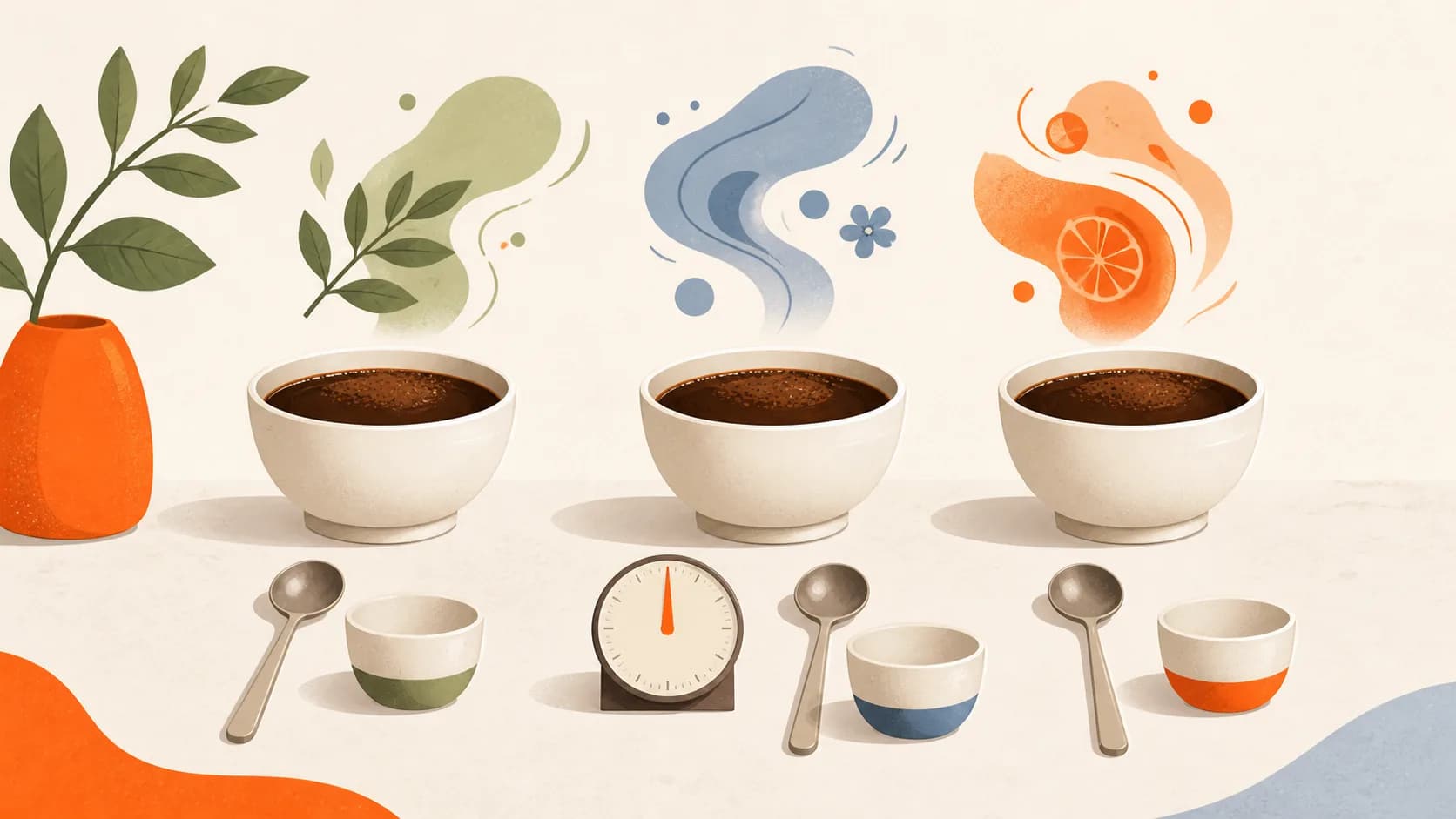
A good beginner coffee cupping is controlled in the preparation and simple in the questions guests answer. The host keeps the cups, dose, water, grind, and clock consistent. Guests move through a much lighter sequence: notice a difference, describe it, then decide what they prefer. That separation preserves the useful discipline of cupping without asking everyone to perform like a professional grader.
For a first event, use three coffees, two sample vessels per coffee, a 90-minute schedule, and a no-mouth-contact transfer method. Reveal the coffee facts after independent notes. Publish the caffeine, ingredient, access, and participation choices before anyone RSVPs. This is a welcoming community tasting, not a certified professional assessment or a commercial quality decision.
Lock These Five Decisions Before You Invite Guests
Keep the flight small, the preparation consistent, the tasting sequence protected, the guest choices explicit, and the event page honest.
- Flight: compare three coffees with one main contrast that beginners can notice.
- Control: use the same vessels, dose, water, grind procedure, pour order, and timer for every sample.
- Service: transfer coffee from shared bowls into personal tasting vessels instead of sharing a mouth-contact spoon.
- Pacing: protect cooling and two tasting passes; shorten host narration first when time slips.
- Invitation: state the format, caffeine, added ingredients, venue conditions, and opt-out choices before registration.
Choose Three Coffees Guests Can Actually Compare
Three coffees give a first-time group enough contrast to compare without turning the table into a memory test. A coffee flight is simply the small set of coffees compared in one tasting. Three samples create three pairwise comparisons, yet guests can still refer to them as A, B, and C without losing track of which cup produced which impression.
Choose fresh coffee that you can grind shortly before the pour. Buy enough from one reliable source to avoid guessing about age or storage. The point is not to find three expensive coffees. It is to create a comparison that has a reason: the same origin with different processing, three origins at a similar roast direction, or one familiar profile beside two clear alternatives. Avoid a flight where origin, process, roast, age, and brewing water all change at once.
Change One Main Variable at a Time
A beginner flight is easiest to read when one main variable creates the contrast and the other preparation choices stay reasonably close. If the lesson is processing, choose coffees where washed, honey, or natural processing can carry the discussion. If the lesson is origin, keep the roast direction similar enough that a dark-versus-light contrast does not dominate every other observation.
Write one sentence that names the comparison before buying the coffee: “We are comparing how three origins express sweetness at a similar roast,” for example. If the three bags cannot support that sentence, simplify the flight. Guests do not need to identify the variable correctly. They need differences that are large enough to notice and a question narrow enough to discuss.
Reveal the Coffee Facts After Independent Notes
Reveal origin, process, roast, and price after guests have written their first notes. Labels can anchor expectations: an expensive coffee may suddenly seem “better,” or a familiar origin may pull the group toward flavors they expect to find. Use neutral sample letters during the first two passes, then place the bags or information cards on the table for the group discussion.
Keep the reveal useful rather than theatrical. Give each coffee a short card with producer or region, process, roast information supplied by the roaster, and one brewing suggestion. Do not ask guests to guess the country as a test. Once the flight is chosen, you can adapt the Neighborhood Coffee Cupping Club template and replace its example coffees, timing, and capacity with the facts of your event.
Build a Small, Repeatable Cupping Kit
Identical vessels and one measured preparation workflow matter more than specialist accessories for a casual event. The current SCA-102 preparation standard uses 8.25 grams of coffee for every 150 milliliters of vessel capacity and water at 93 ± 3°C. Those figures give the host a reproducible baseline; they do not dictate how many guests or samples a community event must have.
| Kit item | Purpose | Planning rule |
|---|---|---|
| Coffee | Three-sample flight | Portion each vessel separately and keep a labeled backup. |
| Six identical cupping bowls or heat-safe cups | Two vessels for each coffee | Match shape and capacity so the samples cool similarly. |
| Scale, grinder, kettle, thermometer, timer | Repeatable preparation | Test every item together before guests arrive. |
| Designated sample spoons | Host-controlled transfer | Keep them at the bowls and rinse them in hot water between dips. |
| Personal cups and spoons | Individual tasting | Give each guest a marked set that is not returned to shared bowls. |
| Rinse cups, discard bowl, towels, water | Clean service and palate reset | Separate clean-water, used-spoon, and waste zones. |
| Simple note sheet and pencils | Independent observations | Use four sensory prompts and one preference question. |
Run a dry setup with cold water. Check that the kettle reaches every bowl without crossing guest seats, the scale fits under the vessels, the grinder can finish all doses before the pour, and the discard container cannot be mistaken for drinking water. For other event-page and facilitation questions, explore more practical host guides after the physical setup is confirmed.
Calculate Coffee Before You Buy a Larger Bag
Three coffees in two 150-milliliter vessels use 49.5 grams before a 20 percent setup buffer, so about 60 grams is a practical planning quantity. The arithmetic is 3 coffees × 2 vessels × 8.25 grams = 49.5 grams; adding 20 percent for grinder retention, a spilled dose, or a reset brings the total to 59.4 grams.
The same six vessels need 900 milliliters of brewing water: 6 × 150 milliliters. The venue needs more for preheating, rinsing sample spoons, and guest drinking water, so do not treat 900 milliliters as the kettle total. This is an illustrative event calculation based on the stated setup, not a professional sample-count rule. Change the formula when vessel capacity or the number of coffees changes.
Use Professional Controls Without Running a Certification
Professional preparation controls can make a community tasting fair without turning it into a certification session. The Specialty Coffee Association's current standards separate sample preparation and tasting mechanics from descriptive and preference-related assessment. That separation is useful here: the host can control preparation while guests remain free to notice and like different things.
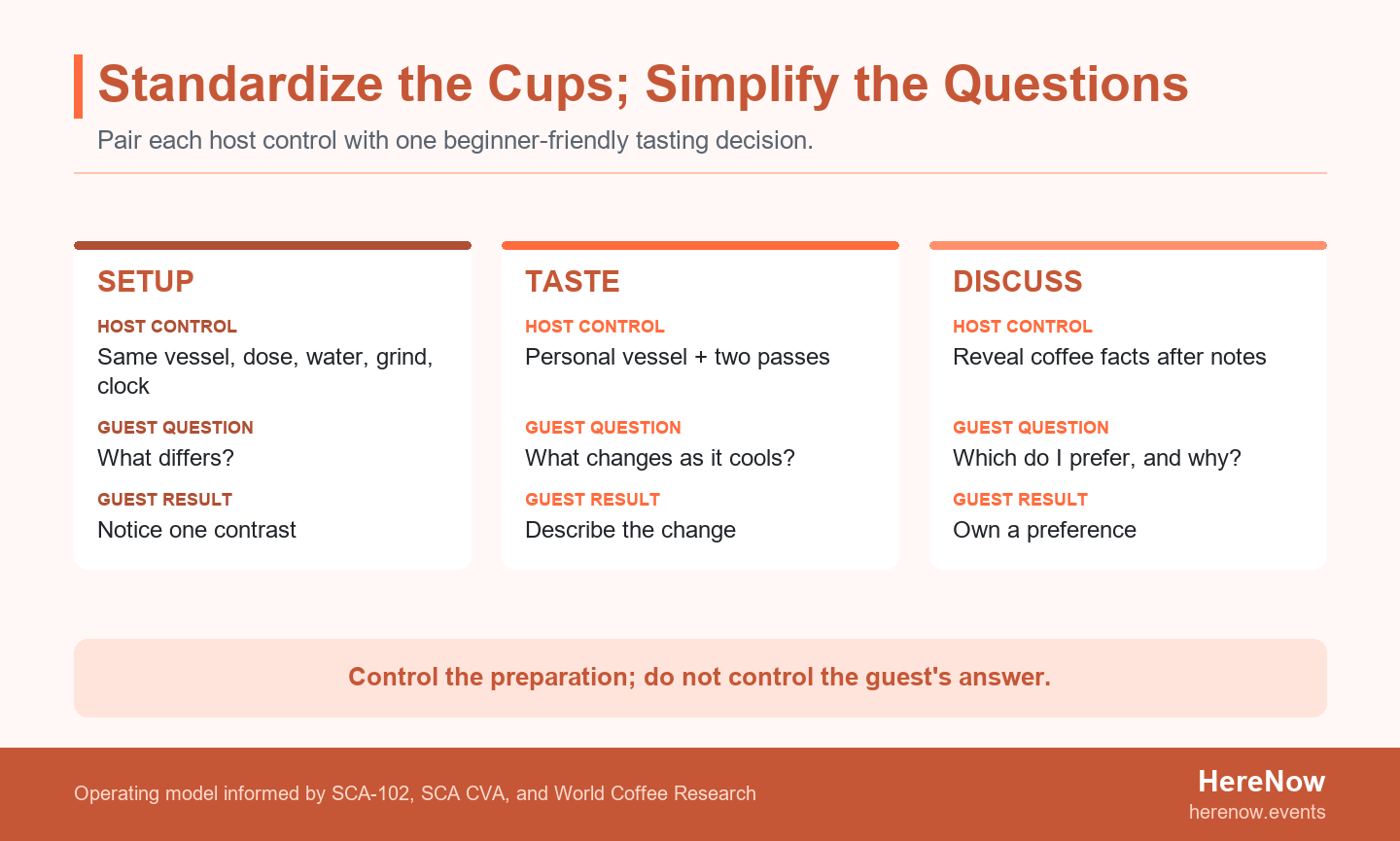
Say this boundary out loud during the welcome: “We are borrowing consistent cupping mechanics so we can compare the coffees; we are not grading them for sale or certification.” It lowers performance pressure and prevents a confident guest from turning a preference into the correct answer. Guests can then disagree without treating the table as an exam with one hidden solution. The same clarity is part of a sustainable hosting practice; see how HereNow supports independent hosts who want to turn a repeatable format into a clear event experience.
Standardize the Cups, Dose, Water, Grind, and Clock
Use the same vessel style, coffee-to-water ratio, water source, grind procedure, pour sequence, and timer for every sample. Record the empty capacity of one vessel, calculate its dose, and label every bowl before grinding. Grind in a fixed order, purge the grinder only as planned, and start one visible timer with the first pour.
Consistency does not mean pretending the setup is a laboratory. It means that avoidable preparation differences are less likely to masquerade as coffee differences. If the kettle cannot pour all six vessels within a tight window, split the table into two clearly timed groups or use a second tested kettle. Do not quietly serve the last bowls several minutes after the first and then ask guests to compare them at the same temperature.
Give Every Guest a Personal Tasting Vessel
A designated sample spoon can transfer coffee into each guest's personal vessel, avoiding direct mouth contact with the shared sample spoon. SCA-102 describes a modified protocol in which the sample spoon moves coffee to a personal vessel, spoon, or shot glass and is rinsed in hot water before it returns to the sample. That method is easier to explain and observe than asking a casual group to manage a shared slurping routine.
The host or one assigned server controls the sample spoons and moves each portion into a personal vessel before tasting. Guests use only their own cups and spoons. Set a clean zone for unused personal vessels, a rinse zone for designated spoons, and a discard zone. Replace any spoon that touches a mouth, table, sleeve, or the wrong container; do not solve an uncertain contact by dipping it again.
Run a 90-Minute Agenda With Cooling Time Protected
Cooling time is part of the tasting, not spare time to recover from a late start. Royal Coffee's practical cupping guide times the surface-stirring stage at four minutes and lets the samples cool before tasting. The host should therefore protect the pour, stir, skim, and cooling sequence instead of filling it with an unplanned lecture.
| Event time | Stage | Host job | Guest job |
|---|---|---|---|
| 0–10 minutes | Arrive and brief | Explain the comparison, hot-water zone, transfer method, and opt-outs. | Choose a seat and mark a personal cup and spoon. |
| 10–20 minutes | Dry aroma | Present the ground coffee as A, B, and C. | Write one difference without discussing it. |
| 20–35 minutes | Pour, break, and skim | Pour consistently; at four minutes, stir through the floating coffee layer to release aroma, then clear grounds. | Stay outside the hot-water lane and observe aroma. |
| 35–50 minutes | Cool and first pass | Transfer small samples when temperature is comfortable. | Notice aroma, flavor, texture, and aftertaste. |
| 50–65 minutes | Second pass | Offer the same order again as the coffee cools. | Record what changed. |
| 65–80 minutes | Compare and reveal | Invite descriptions, then preferences; reveal the coffee facts last. | Share evidence before preference. |
| 80–90 minutes | Close | Confirm the coffee list, clean-up boundary, and follow-up. | Choose one coffee to revisit. |
“Break the crust” means to stir through the floating layer of coffee after brewing so aroma is released and loose grounds can be cleared from the surface. Demonstrate it once, with handles pointed away from guests. When the schedule and service details are stable, use them to write an event page that helps guests choose; do not advertise a tasting length or service style the venue cannot support.
When Ten Minutes Disappear, Cut the Lecture
If setup starts ten minutes late, shorten the welcome and final share before cutting cooling time or the second tasting pass. Give the safety and transfer briefing in five minutes, remove the host's coffee-history story, and reduce the final group share from ten minutes to five. Keep the timed pour, four-minute break, comfortable cooling, and two sensory passes intact.
This fallback protects the mechanism that makes the event worth attending. A rushed first taste can be uncomfortably hot, and a missing second pass removes the chance to notice how the cups change as they cool. If a grinder or kettle problem costs more than ten minutes, pause and reset the schedule visibly. It is better to compare two properly prepared coffees than to serve three samples that are no longer comparable.
Teach Tasting Language in Two Passes
Beginners do not need the full professional vocabulary to make a useful sensory observation. The World Coffee Research Sensory Lexicon contains 110 flavor, aroma, and texture attributes for research use. That depth is valuable for trained work, but displaying all 110 terms at a first community event can turn attention into a word-search exercise.
Use a note sheet with four prompts: What do you smell? What flavor does it remind you of? How does the texture feel? What remains after swallowing or spitting? Accept ordinary comparisons such as cocoa, citrus peel, tea, toasted grain, syrupy, light, or drying. A guest may write “bright but not sour” or “soft like tea” and still contribute useful evidence. If registration is needed, collect RSVPs without attendee accounts and keep the form focused on delivery rather than coffee knowledge.
Ask for Description Before Preference
Guests should describe aroma, flavor, texture, and aftertaste before the group asks which coffee they prefer. The SCA Coffee Value Assessment distinguishes descriptive assessment from personal impressions of quality. A community host can translate that distinction into two plain questions: “What changed?” and only afterward, “Which cup would you choose?”
Collect one independent note from everyone before opening the floor. During the descriptive pass, ask for an observation and where it appeared: aroma, flavor, texture, or aftertaste. During the preference pass, invite “I prefer B because…” rather than “B is best.” This wording protects disagreement. The host can summarize patterns without voting: several guests noticed more fruit in B, while preferences remained split between A and C.
Set Hot-Water, Allergy, Caffeine, and Hygiene Boundaries
A welcoming tasting names the hot-water, shared-sample, ingredient, caffeine, and opt-out choices before service begins. Put the kettle and freshly poured bowls in a host-only zone. Keep handles and cords away from walkways. Tell guests when samples are hot, and wait until a comfortable tasting temperature rather than using the schedule as permission to serve immediately.
Every milk, snack, sweetener, and flavor addition needs an ingredient and cross-contact statement that matches the actual setup. The U.S. Food and Drug Administration identifies nine major allergens in the United States, including milk, peanuts, tree nuts, soy, and sesame, and notes that reactions can be severe. That is a U.S. reference, not a universal legal list; verify local requirements and the venue's food-service rules.
Serve the first comparison black so additions do not change the samples. If milk, plant drinks, syrups, pastries, or chocolate appear afterward, show the package or a complete ingredient list and state what shared tools or surfaces may have contacted them. Never promise “allergy-free” unless an appropriately controlled operation can substantiate it. When the host cannot manage a declared need, say so before confirmation and offer an alternative participation route where possible.
Decaf can expand choice, but it should not be described as caffeine-free. The FDA's caffeine guidance says sensitivity varies and that decaf coffee typically still contains 2 to 15 milligrams per eight-fluid-ounce cup. Do not turn a daily intake figure into an event allowance. Offer tiny samples, water, spitting, aroma-only participation, and a clearly labeled decaf option; guests decide what they consume.
After the event, share the coffee list and ask one question that can change delivery, such as “At which stage did you need more time or explanation?” A single operational question is more useful than a broad satisfaction survey because it points to a specific timing, language, or service adjustment. Then send a focused follow-up.
Publish the Venue and Participation Details Guests Need
Access information belongs on the event page because guests need it before they decide to attend. W3C guidance for accessible presentations and events recommends considering routes, materials, breaks, background noise, and access needs during planning. For a cupping, publish the step-free route, seating arrangement, table height or reach limits, restroom access, event length, scent conditions, and whether a quieter seat is available.
Offer a seated tasting path and place at least one complete flight within comfortable reach. Use large-print or digital note sheets, read sample letters aloud, avoid background music, and do not add candles or decorative scents that compete with coffee aroma. State whether guests may smell only, skip a coffee, spit, or leave the table for a break. These are delivery facts, not special favors.
Ask Only Questions That Change Delivery
Ask about access or ingredient needs only when the answer will change the table, materials, service, or follow-up. A useful field is: “What would help you participate in this tasting?” Pair it with a direct contact route and a statement of what the host can currently provide. Do not collect diagnoses, detailed medical histories, or broad demographic information simply because the form allows it.
Review responses at a fixed deadline before the event. Assign one person to move seats, prepare alternative materials, confirm ingredients, and reply to requests. If an answer exposes a limitation, resolve it before arrival or communicate the boundary honestly. Keep notes from the first event—the parts guests understood, skipped, or wanted repeated—and use them to turn one cupping into a repeatable series with a better next flight.
Close the Loop Before You Schedule the Next Cupping
The next cupping should change because of observed pacing and one focused guest question, not because the host guesses. Record the actual pour time, when guests began tasting, where instructions needed repeating, which sample produced the clearest contrast, and whether the reveal helped the discussion. Keep preference totals separate from format feedback; a favorite coffee does not prove the event was well paced.
Choose only one format change for the next event. You might keep the same three-coffee structure and improve the note sheet, or keep the facilitation and change the comparison variable. Changing the flight, timing, questions, vessel method, and venue together destroys the evidence you just earned. Repeat the variables that worked, revise the one weak point, and tell returning guests what will be different.
Before publishing, confirm that every promise on the page has a clear owner. One person prepares and times the bowls. One person controls the hot-water lane and shared sample spoons. The host answers access and ingredient questions, sends the coffee list, and records the single change planned for the next session. If the venue, equipment, or staffing cannot support that ownership, reduce the flight or postpone publication. HereNow is most useful after these decisions are real: the page can carry the accurate schedule and participation choices, while the next event can reuse what the host learned without copying a format that failed.
Start creating your coffee cupping event.
Frequently Asked Questions
How many coffees should a beginner cupping event include?
Three coffees are enough for a first event because they create comparison without overloading guests or multiplying setup work. Use two matching vessels per coffee when the setup allows it, then keep every preparation variable consistent. A more experienced group may compare additional samples, but the host should expand only when the kettle, grinder, table, timing, and facilitation can still produce a fair sequence.
Do guests need to drink every coffee they taste?
Guests do not need to drink every coffee; they may take tiny sips, spit into a personal cup, skip samples, or participate through aroma only. Put water and discard vessels within reach and explain these options before the first pour. Nobody should have to justify skipping a coffee. The host's job is to protect informed choice and keep personal utensils away from shared sample bowls.
Can I serve milk or food at a coffee cupping?
Milk and food can follow the black-coffee comparison, provided every ingredient and cross-contact limitation is disclosed before guests arrive. Serve additions after the main tasting so they do not change the shared comparison. Retain packages or full ingredient information, use separate tools where promised, and verify the venue and local rules that apply to food service.
Is a home coffee tasting the same as professional cupping?
A home or community tasting is not the same as professional cupping, even when it borrows consistent preparation mechanics. Explain that boundary in the invitation and welcome. If the purpose is professional evaluation, training, or certification, use the current relevant standards and a qualified program rather than treating this community format as an equivalent.