How to Turn a Skill Into a Paid Workshop
Turn one repeatable skill into a bounded workshop offer with a clear guest result, attention-based capacity, cost-aware ticket, and first paid pilot.
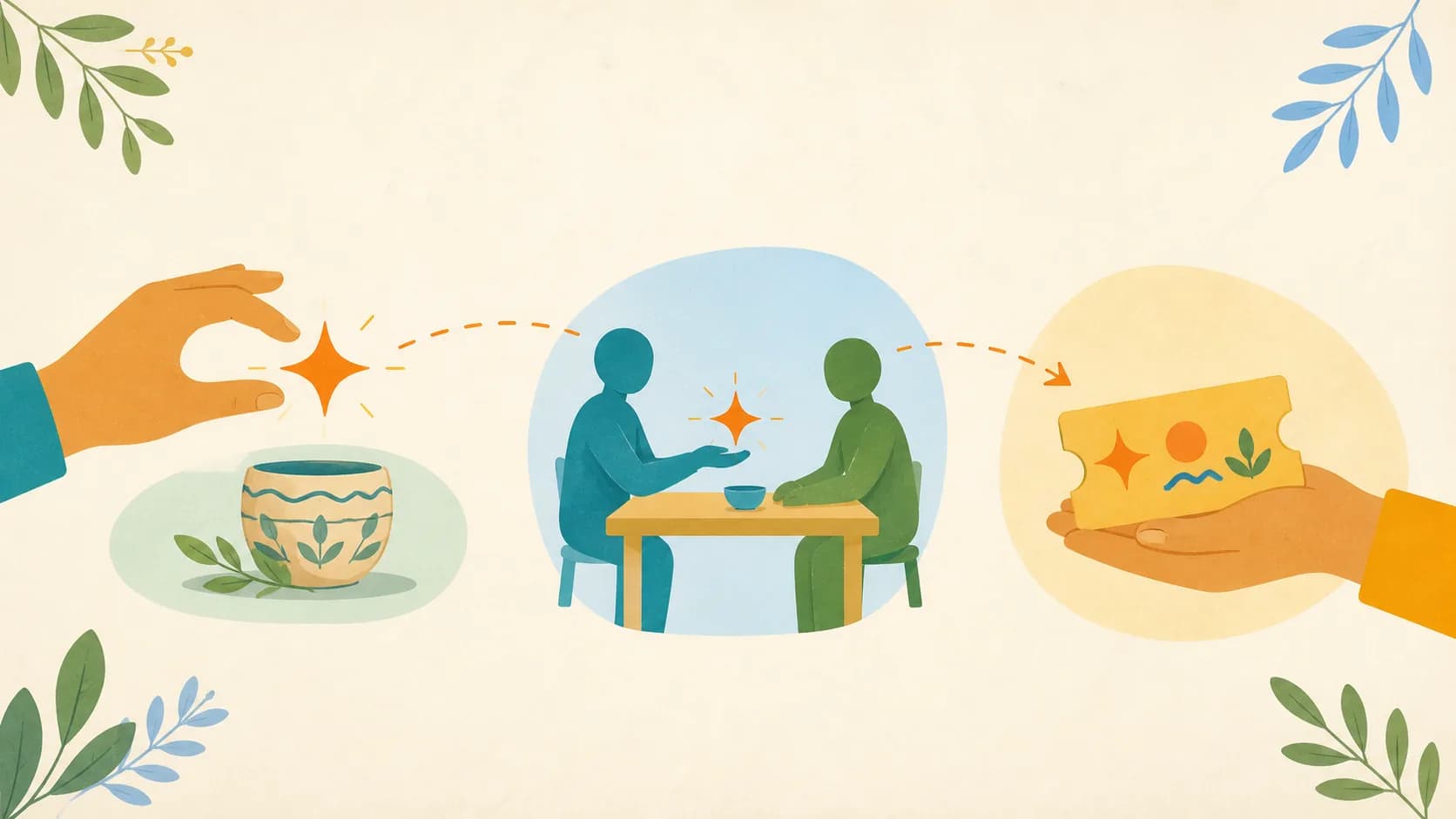
A skill becomes a paid workshop when you compress it into one result a guest can finish in a bounded session. More expertise does not automatically make the offer stronger. It often creates a broader promise, a lecture-heavy agenda, and a group size the host cannot support. Start with what a beginner will make, do, diagnose, or decide. Then derive the practice plan, capacity, pricing boundary, event page, and first paid edition from that result.
The Four Decisions That Make a Workshop Sellable
- A first paid workshop needs an aligned result, practice plan, capacity, and pilot decision.
- Build backward from proof and protect time for practice and feedback.
- Set capacity from the attention promised to each guest, not only the room limit.
- Use one paid edition to decide whether to repeat, revise, or retire the offer.
Choose a Result Guests Can Finish
A guest outcome is the specific result a guest can make, do, diagnose, or decide by the end of the workshop. Learning objectives should be specific, measurable, and achievable. The University of Connecticut’s guidance on developing learning objectives recommends attainable results and observable action verbs. That changes the offer from “learn floral design” to “build and take home one balanced seasonal arrangement using a three-part placement method.”
A narrower result is not a smaller expression of your expertise. It is a usable entrance to it. The rest of your knowledge still helps you choose the right demonstration, spot mistakes, answer questions, and adapt to the room. If you need a concrete page structure while making that choice, browse a workshop template in HereNow and replace its generic promise with the result your guest can actually complete.
Test Whether the Skill Can Be Demonstrated and Practiced
The skill needs a method a beginner can see and try. Ask four questions: Can I demonstrate the critical move? Can a guest attempt it with safe, available materials? Can I notice enough to give useful feedback? Can the guest leave with evidence of progress? “Understanding specialty coffee” is too broad. “Dial in one pour-over recipe and adjust it after tasting” contains a method, a practice loop, and a result. If a skill depends on months of private coaching, expensive equipment, certification, or individualized risk assessment, teach a smaller decision or introductory technique instead of implying mastery.
Write the Promise Around Evidence, Not Expertise
Name the guest's observable result instead of the host's subject breadth. Write from the guest’s side of the table: “By the end, you will…” followed by one action and one visible result. Use verbs such as build, mix, repair, photograph, draft, compare, or choose. Avoid “discover,” “unlock,” and “transform” unless the next words make the result observable. Add the most important boundary in the same paragraph: beginner level, materials provided, physical demands, required device, or what the ticket does not include. A credible promise lets a guest judge fit before paying and gives you permission to cut material that does not help produce the result.
Build the Workshop Backward From Proof
Do not start the agenda with everything you could teach. Start with what would count as proof that the guest completed the promise. Learning outcomes should guide content and activities. Cochrane’s good-practice guide for trainers recommends defining the audience and learning outcomes before building the session. For a paid workshop, that order keeps the ticket promise, live experience, and take-home result aligned.
Decide What Counts as Completion
Choose one visible proof that the promised result was attempted or completed. It can be an artifact, a performance, a diagnosis, or a decision. A candle-making guest leaves with a poured candle and a curing plan. A phone-photography guest captures and edits one image using a repeatable light check. A résumé workshop guest rewrites one achievement bullet and can explain why it is stronger. This is not a formal examination. It is a design test for the host: if you cannot name what will be visible at the end, the promise may still be too abstract. Identify the hardest step that produces the proof and build the demonstration around it.
Protect Practice and Feedback Time
Practical participation and evaluation are planned parts of a workshop. Place the guest’s first attempt soon after the minimum demonstration, then alternate short instruction with work, observation, and correction. The University of Kansas Community Tool Box guide to designing a training session recommends timing each activity, leaving room for questions, trialing the session, and planning evaluation during design. That is a useful warning against a forty-minute introduction in a ninety-minute hands-on offer. Write the fixed blocks first—arrival, safety or setup, demonstration, closing, and transitions—then protect the remaining minutes for practice and feedback.
Set Capacity by Attention, Not Room Size
Useful capacity is constrained by the feedback time promised to each guest. When individual feedback is part of that promise, an attention budget means the coached minutes available after fixed time is removed from the agenda. A room that holds twenty people does not prove that one host can observe twenty attempts. Use two simple calculations before publishing seats:
- Coached minutes = total session time − arrival, demonstration, closing, safety, and transition time.
- Feedback load = expected guests × feedback minutes promised per guest.
Consider an illustrative ninety-minute session. Arrival and setup use fifteen minutes, the demonstration uses fifteen, and closing plus transitions use ten. That leaves fifty coached minutes. At four feedback minutes per guest, eight guests use thirty-two minutes and leave eighteen minutes for shared practice problems. Twelve guests use forty-eight minutes and leave almost no buffer. Fifteen guests require sixty minutes, which exceeds the available time.
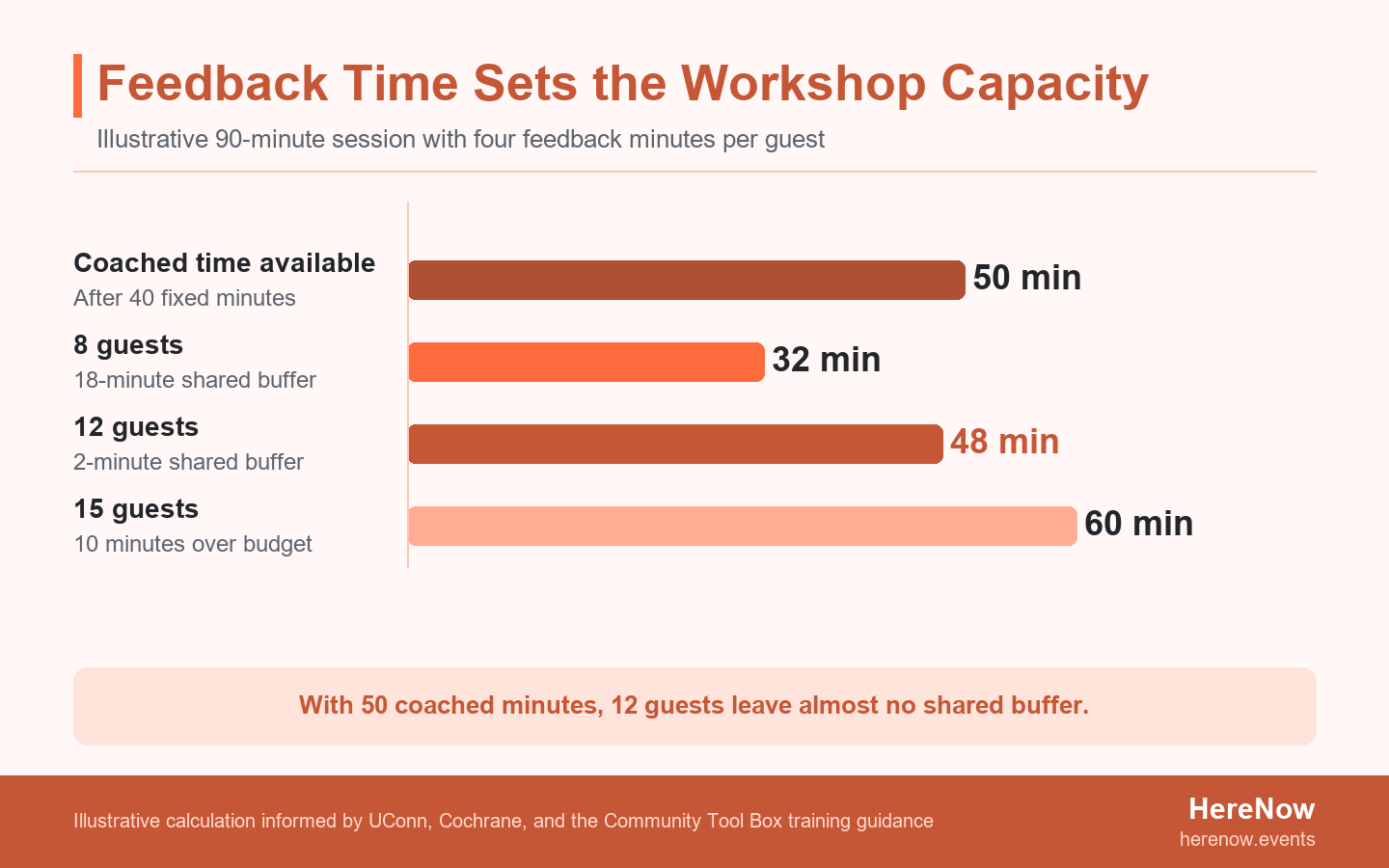
The arithmetic does not declare a universal cap. It exposes the trade-off. In this example, a host might cap the group near eight to ten, add a trained assistant, lengthen the session, or change “individual feedback” to a group review. Venue safety, access needs, equipment, and local rules may require an even lower number. The decision rule is simple: do not add a seat unless the promised experience still fits.
Test Demand Before Building a Series
A paid pilot is the first edition with paid tickets used to test the promise and delivery system. Direct market research can answer questions specific to an offer. Before building a curriculum or booking several dates, show the exact offer to people who resemble the intended guests. The U.S. Small Business Administration’s overview of market research and competitive analysis separates questions about demand, market size, saturation, and pricing. You need reactions to this outcome, in this format, with these constraints.
Send a short offer paragraph with the outcome, level, location or online format, approximate duration, likely price range, and proposed date. Ask what is unclear, what would stop them attending, and what proof would make the result feel worthwhile. A like, compliment, or waitlist entry is not paid demand. A purchase is stronger evidence, but even a sold pilot is only one small sample. Keep the first test easy to revise.
Check Costs Before Setting the Ticket Price
A cost floor is the minimum revenue needed to cover the included costs of the pilot. If payment is still part of the experiment, first compare free RSVPs and paid tickets. List expected costs before launch and separate one-time from recurring expenses. The SBA’s guidance on calculating startup costs recommends identifying expenses before launch. Include venue, materials, equipment rental, payment fees, insurance, permits, travel, preparation, delivery time, and post-event work as applicable.
Fixed costs divided by price minus variable cost equals break-even units. The SBA explains the formula in its guide to the break-even point. For an illustrative workshop with $260 in fixed costs, $14 in variable cost per guest, and a $54 ticket, the contribution per ticket is $40. The calculation is $260 ÷ $40 = 6.5, so seven paid seats cover only the listed costs. Compare that answer with the attention-based cap before deciding whether the format works.
Break-even is a floor, not the final price and not a profit guarantee. It says nothing by itself about guest value, taxes, cancellations, discounts, or costs you forgot to include. If the cost model needs every seat while the attention model can support only part of the room, change the venue, materials, duration, staffing, price, or promise before publishing.
Publish a Page That Makes the Promise and Boundaries Clear
The public page should let a guest decide without messaging you for basic facts. State the result, intended level, format, agenda, date and time zone, location, capacity, materials, access information, ticket price, refund or transfer terms, and what happens after booking. Use a descriptive event name rather than a clever label that hides the skill. If the event includes sharp tools, heat, food, movement, allergens, or outdoor exposure, explain the known requirements in the same decision area as the ticket.
Accessible forms need labels, instructions, validation, and user notifications. HereNow can turn the workshop plan into a public event page, but the host still decides which questions belong in the RSVP. Ask about a material choice only if you will prepare it, experience level only if it changes instruction, and access needs only when you can explain how the response will be handled. W3C’s accessible forms tutorial recommends requesting only needed information and providing clear completion feedback. Each extra field should change a real host action.
Early site and format decisions affect the feasibility of later accommodations. The ADA National Network’s U.S.-focused guide to making temporary events accessible explains why late changes may be harder or more expensive. Publish only confirmed details, give guests a way to ask questions, and check the requirements that apply in your location. This is practical planning guidance, not universal legal advice.
Valid event structured data can make a page eligible but does not guarantee display. Google’s documentation for Event structured data calls for accurate names, dates, locations, and descriptions. Clarity serves the guest first; search eligibility is a possible consequence, not a promise. Keep product setup details separate from the durable offer: screens may change, while the result, boundaries, and ticket terms still need to remain accurate.
Run One Paid Pilot, Then Repeat, Revise, or Retire
Review outcome, delivery, cost, and demand evidence before deciding the next edition. Judge the pilot against the promise, not applause alone. Capture four signals: whether guests produced the intended proof, where delivery lost time, whether the listed economics held, and whether the same audience asks for another date or next-level result. A post-event evaluation can help, but observe behavior too. Which step needed repeated rescue? Did every seat receive the promised attention? Which material or instruction created avoidable delay?
Choose one of three next actions. Repeat when the promise worked and the system needs only minor tuning. Revise when interest exists but the outcome, timing, capacity, or price did not align. Retire when the result is not workshop-sized, the workable capacity cannot support the economics, or the intended guests do not value the offer enough to test again. One pilot is directional evidence, not proof of a stable market.
Do not change the audience, outcome, duration, capacity, and price at once; that makes the next result harder to interpret. Keep the strongest parts stable, name the single friction you want to correct, and review the pilot feedback before your next event.
Turn the Outline Into a Live Workshop Page
Publish only when the offer and delivery plan agree. Read the page once as a guest, then compare it with the working agenda and cost sheet. A “beginner” page with an advanced first exercise is not ready. A ten-seat listing with time for six feedback conversations is not ready. A ticket price that reaches break-even only when every seat is sold needs another look at costs, capacity, or value.
Use this final alignment check before accepting bookings:
- The first two lines name the intended guest and the result they can finish.
- The agenda contains enough practice time to produce that result.
- The seat limit fits the promised feedback, equipment, access, and safety needs.
- The ticket price and cancellation terms match the cost assumptions.
- The materials, prerequisites, physical demands, and exclusions are visible before checkout.
- The RSVP questions each change preparation or delivery.
Do one final stress test with the smallest plausible group. Imagine one late arrival, one material failure, and one guest who needs more explanation. The plan does not need to absorb every possible problem, but it should preserve the promised result without quietly using unpaid extra time or removing feedback from someone else. If it cannot, change the promise or capacity before launch.
If any answer is vague, revise the offer rather than covering the gap with promotional copy. If all six answers are concrete, keep the first edition intentionally small enough to observe and use HereNow to start your paid workshop page.
Frequently Asked Questions
What skills work best for a paid workshop?
The best skill for a first paid workshop produces a result that a beginner can attempt, observe, and discuss in one session. Practical crafts, creative methods, movement practices, cooking techniques, professional tools, and decision skills can all fit. The key is not the category; it is whether you can demonstrate a repeatable method, provide safe practice, notice progress, and describe the result without promising mastery.
How long should a first paid workshop be?
A first workshop should be only long enough to demonstrate the method, let every guest practice, provide the promised feedback, and close with a clear result. Start from those minutes instead of copying another host’s duration. If the useful agenda will not fit, narrow the outcome, reduce capacity, add support, or split the material into separate events.
Do I need an audience before I launch a workshop?
You do not need a large audience, but you do need a reachable group with the specific problem or aspiration your workshop addresses. Begin with direct conversations, relevant communities, prior contacts who gave permission to hear from you, or a partner whose audience fits. Test the complete offer rather than asking whether people “like” the general idea.
Should my first workshop be free or paid?
Use a paid pilot when payment is part of the demand question; use a free test only when you are learning something else, such as whether the instructions work or how long practice takes. A free room can provide delivery evidence, but it cannot answer the same willingness-to-pay question. State the testing purpose before choosing the ticket model.