How to Price a Small Workshop Without Guessing
Price a small workshop using cash costs, host time, break-even seats, service capacity, guest value, and one clear all-in ticket price.

A workshop can sell out, cover every invoice, and still be priced too low to repeat. A defensible price has to clear two floors: the cash needed to run this edition and the cash-plus-time target that makes hosting another edition worthwhile. Calculate both, turn a candidate price into required paid seats, and compare that number with the group size you can serve well. If the required seats exceed that capacity, the spreadsheet is describing a format you should change, not a sales target you should chase.
The Four Numbers to Know Before You Publish
Four inputs make the first pricing pass possible. Record each one beside its source or assumption before comparing candidate prices.
- Fixed cash costs: expenses that do not change when one more guest books.
- Variable cost per guest: the extra cost created by one additional booking.
- Host-time target: the amount you choose for preparation, delivery, and follow-up.
- Expected paid seats: a realistic sales case, not automatically the maximum room capacity.
Build a Cost Sheet Before Choosing a Ticket Number
List costs before choosing a ticket number. Begin with the costs that belong to this edition before testing any candidate. The U.S. Small Business Administration recommends identifying expenses before launch and separating one-time from recurring costs in its guidance on calculating startup costs. For a workshop, fixed cash costs might include a room minimum, equipment rental, insurance, permits, design, or a base transport charge. Variable costs might include materials, refreshments, printed handouts, name tags, or another unit consumed when one more person attends. Check current payment costs for your market and method rather than copying an old fee rate into the sheet.
Use only costs that match the offer you plan to publish. A reusable tool may be a one-time investment, while single-use materials belong to each guest. A refundable venue deposit affects cash timing but may not be a final expense. Sales tax collected for an authority is different from revenue you keep. Record assumptions beside each line, including whether the amount is a quote, estimate, or confirmed invoice. If the workshop itself is still too broad to cost, use HereNow's related Guide to turn a skill into a paid workshop with a bounded outcome, agenda, and capacity.
Calculate the Cash Floor
The cash floor covers stated cash costs at an assumed attendance. It is the per-seat price needed to cover fixed cash costs and per-guest costs in that sales case. If fixed cash costs are $300, the variable cost is $18 per guest, and you expect eight paid seats, the calculation is $300 divided by 8, plus $18. That produces $55.50 per seat before percentage fees and taxes. This number answers a narrow question: at eight sales, what price stops the listed event costs from consuming other cash? It does not pay the host for time, create a reserve, or prove that guests value the workshop at that price.
Add a Host-Time Target for a Repeatable Floor
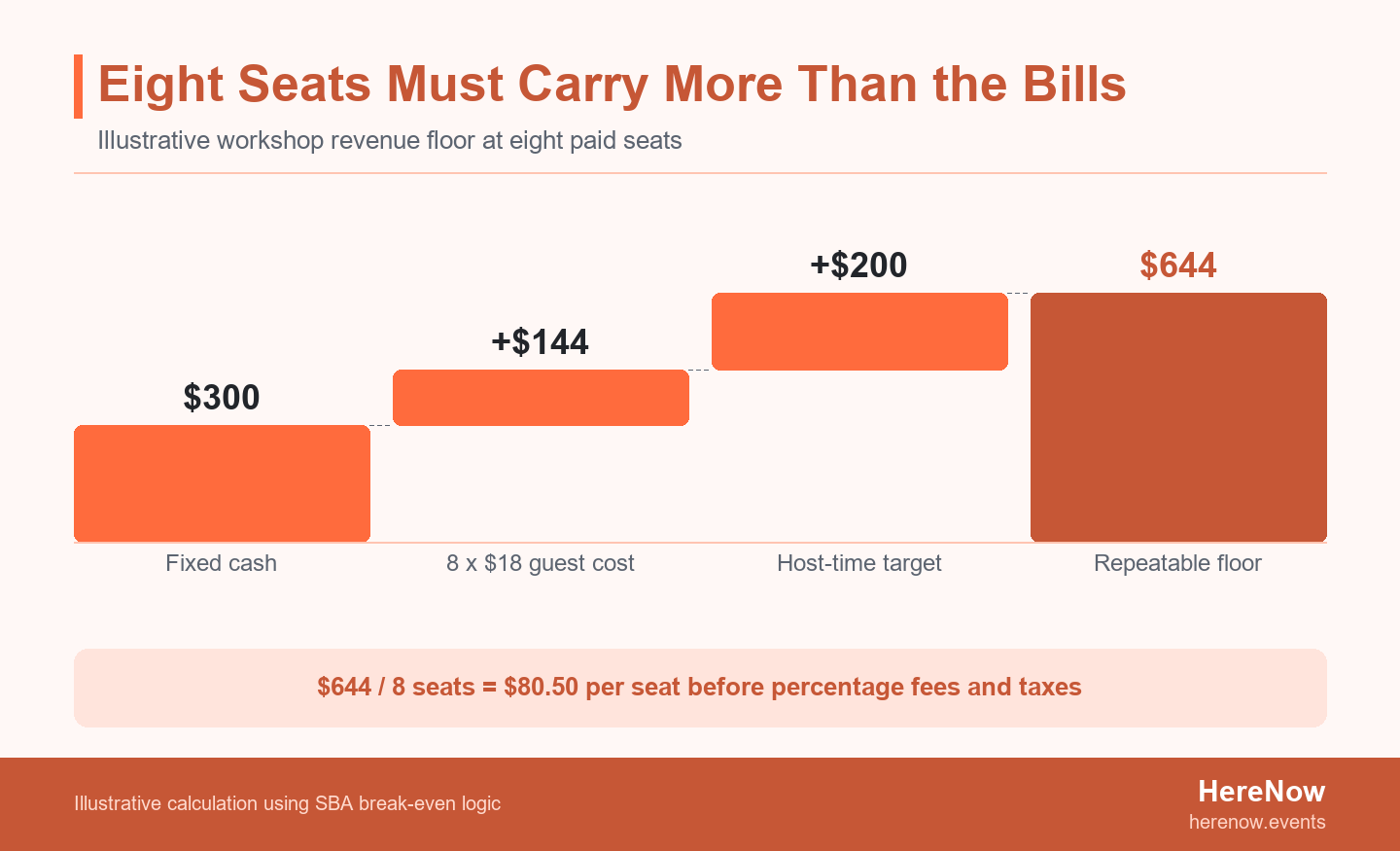
The repeatable floor adds a chosen host-time target. It covers the same cash costs plus an amount for the host time spent preparing, delivering, and closing this edition. Count the work that this edition actually creates: sourcing, preparation, travel, setup, live delivery, cleanup, guest messages, and follow-up. Do not convert every hour of past skill development into a charge for one group; choose a clear amount for the work tied to this edition. With the same $300 fixed cash costs, an $18 per-guest cost, a $200 host-time target, and eight expected seats, the repeatable floor is ($300 + $200) divided by 8, plus $18, or $80.50 per ticket before percentage fees and taxes. A host may choose a lower time target for a deliberately subsidized pilot, but the choice should remain visible rather than disappearing into unpaid work.
Turn a Candidate Price Into Break-Even Seats
Break-even seats equal fixed target divided by price minus variable cost per guest. A candidate price becomes useful only when it tells you how many paid seats are required. The SBA's guide to the break-even point gives the unit formula as fixed costs divided by price minus variable cost per unit. For a workshop, use the cash target when you are testing cash break-even and the cash-plus-time target when you are testing repeatability. Round any partial result up because a fraction of a booking cannot fund the event.
Decide whether paid attendance is part of the question before relying on the formula. A free pilot can test the agenda or materials, but it cannot show whether guests will buy at the proposed price. If that distinction is still open, compare free RSVPs and paid tickets before interpreting a waitlist or sign-up count as price evidence.
Find Contribution per Seat
Contribution per seat equals ticket price minus variable cost per guest. The SBA break-even formula uses that per-unit remainder as the denominator. It is the amount one sale leaves to cover the fixed target after serving that guest. At an $85 ticket and an $18 per-guest cost, each sale contributes $67 toward fixed cash costs and the host-time target. The repeatable target in the example is $500: $300 of fixed cash plus $200 for host time. Divide $500 by $67 to get 7.46, then round up. The workshop needs eight paid seats at $85 to meet that stated target. If a payment fee changes with ticket revenue, model it explicitly rather than hiding it inside the $18 materials estimate. Keep fixed and percentage charges separate so a later price change does not silently make the fee assumption wrong.
Stress-Test Six, Eight, and Ten Sales
At the stated assumptions, the cash floor is $55.50 and the repeatable floor is $80.50 at eight seats. The $25 gap per ticket is the planned $200 host-time target spread across eight guests. That gap is the planned $200 host-time target spread across eight guests. The calculation does not claim that $80.50 is the market price. It exposes what an $85 candidate would have to accomplish before you compare it with guest value.
Six, eight, and ten sales produce different results against the same target. At six sales, $67 of contribution per seat produces $402, leaving the repeatable target $98 short. At eight sales, contribution reaches $536, clearing the target by $36. At the ten-seat cap, contribution reaches $670, or $170 above the target, before percentage fees and taxes. The important pattern is not the apparent upside at ten. It is that eight seats are required. A forecast of six should trigger a format or price decision, while a forecast of eight leaves little room for refunds, discounts, or omitted costs.
| Paid seats | Contribution at $67 each | Result against $500 target | Interpretation |
|---|---|---|---|
| 6 | $402 | -$98 | Below repeatable target |
| 8 | $536 | +$36 | Target cleared with limited buffer |
| 10 | $670 | +$170 | Full serviceable capacity |
Let Service Capacity Veto the Spreadsheet
A price model fails when required paid seats exceed service capacity. Service capacity is the number of guests the host can serve while preserving the promised materials, attention, access, and safety. It can be lower than room occupancy. A ceramics workshop may be limited by wheels, a tasting by prepared portions, and a coaching workshop by the feedback minutes one host can give. If repeatable break-even requires twelve paid seats but the promised experience works for eight, selling harder cannot repair the model. The available levers are price, fixed costs, per-guest cost, scope, duration, staffing, and capacity. Change at least one before publishing.
In the illustrative case, eight required seats fit inside a ten-seat service cap, leaving two seats of headroom. That is workable on paper, not guaranteed in practice. A refund, a late cost, or a discount can use the buffer. Now test the weakest plausible case: if six sales are common for your reach, would you accept a $98 shortfall, lower the $200 host-time target for one pilot, reduce fixed costs, or postpone? Write the answer into the cost sheet. A deliberate pilot subsidy is visible and bounded; an accidental loss is just a missing assumption.
Check Guest Value and Local Alternatives
Guest value is a separate test from cost recovery. Costs create a floor, not a reason for someone to buy. Stripe's comparison of cost-based and value-based pricing separates an input-led floor from a customer-led view of impact. Apply that distinction carefully to a workshop. Ask what the intended guest finishes, what materials or feedback are included, how much uncertainty the host removes, and which alternative the guest would otherwise choose. A beginner leaving with one finished object and a tested method is evaluating a different offer from a two-hour talk on the same subject.
Comparable prices are context to investigate, not numbers to copy. Use comparable workshops as questions, not answers. Australian government guidance on how to choose a pricing strategy recommends aligning price with goals, market, and customers, using competitors as a guide, and testing the market. Compare offers only after matching the audience level, duration, group size, host attention, materials, location, and cancellation terms. A cheaper class may exclude supplies; a more expensive one may include a kit, individual critique, or specialist venue.
Market research should also test demand and alternatives. The SBA's overview of market research and competitive analysis separates demand, market size, location, saturation, and what potential customers pay for alternatives. Show the actual workshop promise and candidate price to people who resemble the intended guests. Ask what they believe is included, what makes the result worthwhile, and what would stop a booking. Compliments are weak evidence; paid sales are stronger, though one edition is still a small sample.
Publish One All-In Price and Clear Terms
Covered U.S. live-event ticket sellers must display total prices including mandatory fees under the FTC rule scope. Put the guest's real payable price where the ticket is first presented, then explain optional extras and ticket terms nearby. In the United States, the Federal Trade Commission's FAQ for the Rule on Unfair or Deceptive Fees explains total-price requirements for covered live-event tickets, including mandatory fees, as well as the rule's scope and exclusions. Hosts elsewhere should check the consumer, tax, and ticket rules that apply locally. This is practical publishing guidance, not legal or tax advice.
Keep four numbers separate in your working sheet: workshop ticket revenue, tax collected, payment or platform costs, and money you expect to retain. Then make the guest-facing page simpler. State one all-in ticket price, what it includes, optional purchases, refund or transfer conditions, the minimum-participation plan, and when guests will be notified of a change. Platform costs are a separate input from what your workshop is worth; check HereNow pricing when completing the cost sheet instead of relying on a copied rate.
Test the same checkout path a guest will use. Confirm that the displayed total, currency, tax handling, refund wording, and included materials still match the public page. Save a dated copy of the cost sheet and terms before sales open, so a later change can be explained without reconstructing the original assumptions from memory.
Set a Decision Date Before Sales Feel Urgent
A predeclared decision date turns low sales into a controlled run, change, or cancel decision. Choose that date early enough to change or cancel the event under the terms you published. On that date, compare paid seats with the minimum required for the floor you selected. If the number is below target, use a prechosen action: run the pilot with a stated, limited subsidy; reduce a cost without weakening the promise; move to a suitable smaller venue; add a later date and transfer bookings with consent; or cancel and refund according to the published terms. Do not invent a last-minute discount unless the discounted seat count still fits the model.
Separate a sales problem from a format problem. If credible guests understand the offer but do not buy at the candidate price, revise the outcome, trust signals, date, audience, or price and test again. If people buy but the required group is too large to serve well, redesign delivery before adding seats. If six sales are below target but still fund a deliberate learning edition, record the $98 subsidy as the cost of that test. Document what would count as a successful test before bookings open: the required paid seats, the maximum subsidy, the guest outcome to protect, and the one assumption you most need to learn. After the event, compare actual revenue and costs with the dated model before changing several variables at once. When the price, minimum seat count, and date are fixed, review the paid-event setup steps.
Keep the chosen floor visible during sales. A strong first week does not justify adding seats beyond the service cap, and a slow week does not automatically justify removing materials or feedback that define the offer. If one variable changes, rerun the seat calculation and update affected guests before the published decision date.
Put the Price on a Page You Can Defend
The public price should match the cost sheet, capacity, inclusions, and terms. Reduce the working sheet to one price card before publishing. Keep the detailed arithmetic private, but make its boundaries visible to guests:
- Ticket price and everything included in it.
- Optional extras that are genuinely optional.
- Capacity and the result or attention that capacity protects.
- Refund, transfer, and minimum-participation terms.
- The date guests will hear about a material change.
Read the page against the cost sheet one last time. If the listing promises materials you did not cost, update the sheet. Ask one uninvolved person to read the price area on a phone and state what they would pay, receive, and need to do if plans change. Any mismatch is a publication defect, even when the arithmetic is correct. If the model requires eight sales but the page caps the group at seven, change the format or price. If the total shown to guests differs from the checkout total because of an unavoidable charge, fix the disclosure before accepting bookings. HereNow can carry the event details, ticket setup, and public link, while the host remains responsible for the assumptions and local requirements. When the two floors, required seats, service cap, and terms agree, start your paid workshop page.
Frequently Asked Questions
Should I include my preparation time in a workshop price?
Yes, if you want the workshop to be repeatable rather than merely cash-neutral. Set a visible host-time target for preparation, delivery, and follow-up, then decide whether the first edition must cover all of it. A deliberately subsidized pilot can be reasonable, but label the subsidy in your sheet and limit it. Do not hide unpaid work by treating cash break-even as the final pricing answer.
What if my break-even seat count equals full capacity?
Treat that setup as fragile. One unsold seat, refund, discount, or omitted cost can put the event below target, and there is no capacity left to recover the difference. Lower a cost, raise the candidate price, adjust the host-time target for a bounded pilot, or redesign the format. Full capacity should be an upside case, not the only case in which the workshop works.
Should an early-bird ticket be below the cash floor?
Usually no. Model the exact number of discounted tickets and confirm that the blended revenue still clears the floor you chose. A limited early-bird price can reward an earlier commitment, but it should not create a shortfall that later guests must repair. Also state when the price changes and avoid presenting a permanent price as a temporary discount.
Can I use a competitor workshop price as my price?
Use comparable workshops as context, not as a number to copy. Match audience level, outcome, duration, location, group size, supplies, host attention, and ticket terms before treating another listing as relevant. Then compare the candidate price with your own costs and service cap. Another host may have free space, different material costs, sponsorship, or a different reason for running the event.