How to Turn One Event Into a Repeatable Series
Build a repeatable event series with a stable promise, sustainable cadence, edition-by-edition learning, and a clear continue-or-pause decision.

A recurring date does not make an event repeatable. A series becomes viable when the first event proves three things at once: guests received value they want again, the experience can be delivered without last-minute heroics, and the host has enough capacity for the entire cycle. Build the next edition from those signals, preserve one recognizable promise, change one meaningful variable, and schedule only what the evidence can support.
The Three Signals That Earn Another Edition
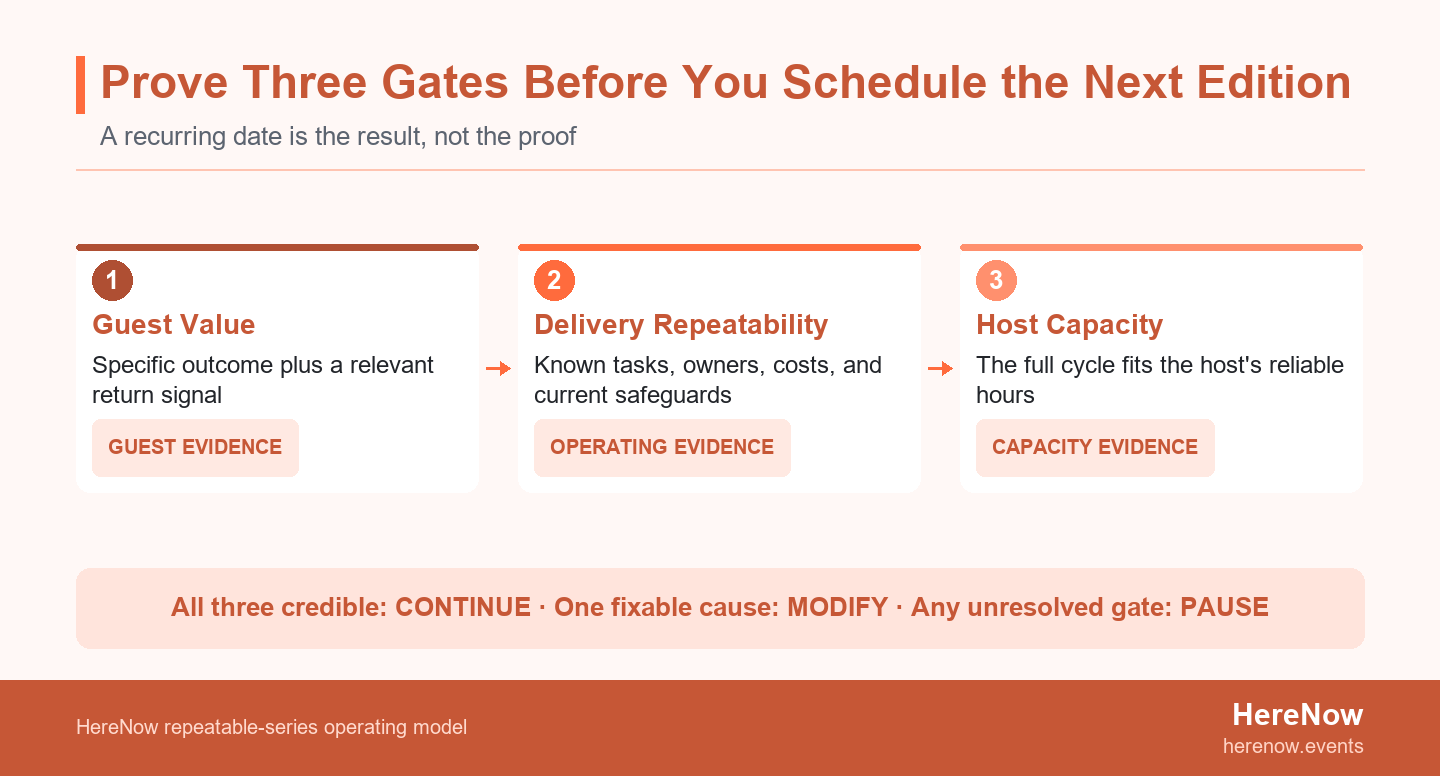
Guest value, delivery repeatability, and host capacity must all support another edition. University of Florida event-planning guidance starts with objectives, audience, and viability, then treats evaluation as more than attendance alone. This three-gate check turns those concerns into an operating decision; it is not an event-industry standard. It prevents one encouraging signal—such as a full room—from hiding an exhausted host, a weak guest outcome, or an unresolved delivery risk.
- Guest value: people can name what they gained and who would benefit from a future edition.
- Delivery repeatability: the essential experience can run again with known tasks, owners, costs, and safeguards.
- Host capacity: the full prep-to-follow-up workload fits the time and energy actually available.
That sequence matters here: before copying the calendar entry, confirm that the purpose still matters to a defined guest and that the operating reality can support it. If the evidence is scattered, use a separate process to turn event feedback into the next event, then bring the resulting decision back to these three gates.
Look for Guest Pull, Not General Praise
Specific value and relevant return intent are stronger directional signals than compliments alone. “That was fun” is kind, but it does not identify what should be repeated. Better evidence sounds like “I finally practiced the technique,” “I would return for the advanced version,” or “My colleague has the same problem.” Return intent is still directional, not a guaranteed registration.
Ask questions that reveal the next decision: What should remain unchanged? Which moment created the most value? What nearly stopped you attending? Who else is this for? Would you consider another edition at the same price and duration? The point is not to manufacture a satisfaction score; it is to find a repeatable outcome and the conditions under which people would choose it again.
Check Whether Delivery Can Repeat Without Heroics
The format is not repeatable when it relies on invisible overwork or unresolved operational risk. Oregon State’s event-planning guidance makes resources, realistic task load, responsibilities, timelines, and evaluation explicit, including the option to modify, abandon, or continue an event. Reconstruct the cycle from the first planning note through the final follow-up. List tasks that took longer than expected, supplies that almost ran out, questions only one person could answer, venue constraints, access needs, safety controls, cancellations, and recovery time. Then separate one fixable cause from a structural burden.
Use that logic before recurrence becomes automatic. A late check-in caused by one unclear role may justify a corrected next edition. A format that requires unpaid all-night preparation every time needs redesign. An unresolved safety problem requires a pause, even if guests are asking for another date.
Separate the Series Contract From the Edition Layer
A repeatable series protects one recognizable promise while allowing a bounded edition-specific change. The series contract is the stable audience, outcome, experience shape, and practical expectations that make editions recognizably related. It is a planning label, not a legal contract. The edition layer contains the topic, date, guest, route, venue, or another defined element that may change for one edition.
| Layer | What belongs here | Urban sketching example |
|---|---|---|
| Series contract | Audience, promised outcome, essential format, duration range, material expectations | Beginners practice observation and complete several location sketches in a small guided walk |
| Edition layer | Date, route, focus, guest facilitator, exact meeting point, weather plan, current price | Edition two tests a market route while preserving the beginner promise and guided practice |
This split avoids two common failures. If everything stays fixed, the series cannot learn or adapt. If everything changes, guests cannot recognize what they are returning to and the host cannot tell which change affected the result. On HereNow, you can then browse event templates for a reusable starting structure and adapt the operational details without copying an unrelated promise.
Write the Stable Promise First
The audience, outcome, essential experience shape, and material expectations form the stable layer. Write them as one sentence a guest could recognize: “A 90-minute beginner urban-sketch walk where a small group practices observation, receives live guidance, and leaves with several completed studies.” This is more useful than “monthly sketch meetup” because it says who the series serves, what happens, and what the guest can expect to take away.
Keep the promise stable only while it remains truthful. Access, venue, safety, legal, or weather requirements may force a material change. If the route becomes inaccessible or the format no longer supports beginners, update the promise instead of hiding the difference under the same series name. Recognition should reduce uncertainty, not preserve a label at the guest’s expense.
Change One Thing That Answers a Real Question
One controlled variable per edition keeps the learning attributable without freezing the format. The Institute for Healthcare Improvement’s testing guidance recommends trying changes on a small scale, studying what happened, and refining them before wider implementation. The variable should answer a real operating question: Does a shorter route improve completion? Does a weekday evening work better than Saturday morning? Does adding a materials kit reduce arrival friction enough to justify the cost?
An event series is not a health-care improvement program, but the bounded learning principle transfers: record the question and expected signal, change only enough to answer it, observe the effect, and decide what the next edition should retain. Do not delay urgent safety, accessibility, or operational corrections merely to protect a tidy one-variable test.
Choose Cadence From Cycle Capacity
The shortest sustainable interval is set by full cycle load plus a buffer, not by a fashionable weekly or monthly label. The UK Health and Safety Executive’s event guidance treats planning, setup, the event itself, breakdown, monitoring, and review as connected responsibilities. Start with the time one complete edition consumes, divide it by the hours the host can reliably give each week, then move to a slower memorable rhythm that leaves room for variation. This calculates a capacity floor; it does not prove that guests want the series at that frequency.
Calculate the Whole Cycle, Not Event Day
In the illustrative scenario, a 14-hour cycle divided by 5 available hours per week requires 2.8 weeks before a buffer. This is an illustrative calculation, not a host benchmark: the cycle uses 6 hours of preparation, 3 hours of promotion and administration, 2 hours of delivery, and 3 hours of follow-up and recovery. Replace every input with the host’s real time.
| Cycle phase | Illustrative hours | What to count |
|---|---|---|
| Preparation | 6 | Venue, route, materials, facilitator work, risk and access checks |
| Promotion and administration | 3 | Page updates, invitations, questions, registrations, reminders |
| Delivery | 2 | Setup, guest experience, close-down |
| Follow-up and recovery | 3 | Messages, reconciliation, notes, storage, personal recovery |
| Total cycle load | 14 | All work required before the next cycle begins |
Cycle load means the total time required for preparation, promotion and administration, delivery, follow-up, and recovery. Replace the example with tracked hours from the first event. If a volunteer or co-host did essential work, include it; moving labor off the host’s calendar does not make the work disappear.
Add a Buffer Before Making the Calendar Promise
A cadence needs room for venue, safety, co-host, supply, and recovery variability. The same HSE guidance calls for monitoring arrangements and reviewing the event when circumstances or information change. A cadence buffer is the extra time between the calculated minimum interval and the public schedule. In the example, 2.8 weeks is already too tight for a reliable two-week rhythm; a four-week cadence is the safer illustrative choice.
Buffer is not permission to reuse old checks. Conditions can change between editions, so revisit the venue, route, staffing, suppliers, access plan, and controls each time. The buffer absorbs normal variability and recovery; it does not replace current risk assessment.
Run a Three-Edition Pilot With a Stop Point
A bounded three-edition pilot can test the promise, one change, and repeat demand without implying a permanent commitment. Here, a three-edition pilot means three related events with one learning purpose each and an explicit review after the third. Three is a practical recommendation for this operating method, not a research-backed universal minimum.
- Edition one establishes the baseline. Capture the guest outcome, total cycle load, delivery failures, and host recovery. Do not call a full room proof of repeatability.
- Edition two tests one repair or opportunity. Preserve the stable promise and change the single variable most likely to improve value or delivery.
- Edition three checks whether the improvement holds. Repeat the improved method under normal conditions and look for renewed guest pull rather than novelty alone.
Define the stop point before publishing the pilot: “After edition three, we will review guest value, delivery repeatability, host capacity, and the tested change before scheduling another date.” That sentence gives the host permission to pause without framing the pilot as a failure. It also keeps public claims honest. A pilot can be named as a limited season or first run; it should not be marketed as a permanent monthly institution when only one venue date and one willing host exist.
Give Every Edition an Accurate Public Page
Every edition needs a current public promise even when the series contract remains stable. HereNow is designed around turning an event idea into one shareable public page; you can see how HereNow turns a rough event idea into a public page. Georgia Tech’s post-event guidance includes updating web information when an event concludes or new dates are added. Create a new or fully updated page for the actual date instead of sending guests to a listing whose date, venue, price, facilitator, capacity, or access information belongs to the previous event. The stable series description can be reused; edition-specific details must be verified again.
Check the page against the current edition:
- date, start and end time, timezone, and registration deadline;
- venue or online access, arrival instructions, and accessibility information;
- price, inclusions, materials, capacity, approval, cancellation, and refund terms;
- host or guest facilitator, edition focus, agenda, weather plan, and contact route;
- one clear registration action and a confirmation path that was tested end to end.
That page does not guarantee attendance or search visibility. Its operating value is simpler: every invitation points to the same current source of truth, while older edition pages can remain honest records of what already happened.
Create a Return Path Without Assuming Permission
Prior attendance supports a relevant invitation opportunity, not unlimited consent for future marketing. In the United Kingdom, the Information Commissioner’s Office guidance on electronic marketing distinguishes consent from limited exceptions and requires attention to opt-outs. Separate messages needed to deliver the completed event—such as materials, receipts, a promised recap, or an important update—from optional promotion for future editions. Tell people what they are choosing, identify the sender, and make refusal or opt-out easy to honor. For the wider sequence, plan the complete post-event follow-up separately from the series decision.
Rules vary by jurisdiction, channel, relationship, and the facts of collection. The ICO page is a UK-specific example, not legal advice. Check the current rules that apply to your audience instead of assuming that an RSVP email address can become a general series list.
A practical return path can be modest: offer a clear option to hear about the next edition, let guests follow the host through an appropriate channel, or include one relevant invitation in a permitted follow-up. Keep delivery messages useful even when someone declines future promotion.
Keep One Series Record Between Editions
A compact record preserves the contract, tested variable, guest evidence, host evidence, and next decision. UCLA’s event-evaluation guide prompts organizers to revisit goals, audience, messaging, logistics, vendors, and attendance status. A small host does not need a reporting system that takes longer than the event. Use one continuing document and add five lines after each edition:
- Stable promise: what this series is meant to preserve for a defined guest.
- Variable tested: the one meaningful change and the question it was meant to answer.
- Guest evidence: outcomes, specific comments, return interest, cancellations, and repeated friction.
- Host evidence: real hours, cost surprises, incidents, capacity strain, and recovery.
- Decision: continue, modify one cause, or pause, with an owner and review date.
Those categories help prevent a memorable guest comment from replacing the operational record. Capture observations while they are fresh, but keep facts separate from interpretation: “nine of twelve guests completed all three exercises” is an observation; “the route was ideal” is a conclusion that still needs context.
The University of Reading’s evaluation guidance emphasizes comparing results with objectives, documenting actions, learning from data, and avoiding duplicated effort. Finish the record with what changes, who owns it, and when it will be checked. Otherwise each edition starts from a vague memory that the last one “went well,” and the same preventable work returns.
Use a Continue, Modify, or Pause Gate
The record should end in one explicit branch instead of automatic recurrence. Oregon State’s planning guidance explicitly includes modifying, abandoning, or continuing an event after evaluation. Apply the three gates together: guest value asks whether the promise landed, delivery repeatability asks whether the experience can run responsibly again, and host capacity asks whether the full cycle fits without relying on exceptional effort. When the branch is Continue or Modify, preview and check the next edition before publishing.
| Decision | Evidence pattern | Next commitment |
|---|---|---|
| Continue | All three gates are credible; the stable promise still fits; no material issue remains unresolved | Publish one next edition at the capacity-based cadence |
| Modify | Guest value is credible, but one bounded delivery or capacity cause needs repair | Change that cause, define the signal to watch, and run another limited edition |
| Pause | The promise repeatedly misses, the workload is unsustainable, or an operational, safety, legal, or access problem is unresolved | Stop scheduling; redesign, obtain the missing capacity or assurance, then review again |
Pause is not the opposite of ambition. It protects guests and the host from a public commitment the current system cannot meet. It can be temporary, with a named condition for review. Urgent safety or legal problems override normal iteration; they are not variables to test on another group.
Write the change into the current page before it goes public. The page should reflect the decision that was actually made, including any new constraint, format change, price, access information, or capacity.
Publish the Next Edition, Not the Whole Future
A passed decision should create one accurate next-edition page rather than an unsupported long schedule. Confirm the host capacity, venue, edition variable, guest promise, and current logistics, then publish that date. Hosts with contracted venues, reliable staffing, and established operations may responsibly publish farther ahead; early-stage series benefit from earning the next commitment one edition at a time.
Before opening registration, compare the page with the series record rather than duplicating the previous listing from memory. The stable promise should still be recognizable, the tested variable should be described only where guests need to know it, and every operational fact should belong to the new date. Set the review point now: who will capture guest evidence, who will record the real workload, and when will the Continue, Modify, or Pause decision happen? That preparation closes the loop before promotion begins and keeps the next result comparable with the evidence already collected.
Carry the same series name and stable promise forward, but update every detail that belongs to the edition layer. Record the hypothesis before registrations open, choose the post-event review date, and avoid announcing later dates merely to make the project look established. When those inputs are ready, start creating the next edition page with HereNow.
Frequently Asked Questions
How many events should run before calling it a series?
You can name a planned sequence a series before every date has run, but keep the initial commitment bounded and truthful. A first season of three planned editions is clear if the dates, capacity, and operating conditions are real. If only the next edition is confirmed, describe the broader idea without presenting an unsupported schedule. The label matters less than whether guests can see a recognizable promise and accurate current details.
Should every edition in a series use the same format?
No. Every edition should preserve the recognizable audience, outcome, and essential experience while allowing a bounded element to change. Change a route, focus, facilitator, time, or another meaningful variable when it answers a real question. If the change alters who the event is for or what guests will receive, update the series promise rather than treating it as a minor edition detail.
How far ahead should a recurring event series be scheduled?
Schedule only the dates whose venue, host capacity, and public details you can currently support with confidence. Use actual cycle-load data plus a buffer to set the interval. An early series may publish one edition at a time, while an established operation with confirmed venues, staff, and safeguards may publish a longer season. Never let a recurring-calendar setting substitute for checking each edition’s current conditions.
When should a host pause or stop a recurring event?
Pause when the event repeatedly misses its guest promise, exceeds sustainable capacity, or presents an unresolved operational, safety, legal, or access problem. Name the condition that would justify review, such as securing a suitable venue, reducing the cycle workload, or redesigning the format. Stop permanently when the promise is no longer valuable or the required operating conditions cannot be met responsibly.