How to Use Event Recaps to Grow Repeat Attendance
A practical guide to turning one event recap into credible proof, useful value, and a clear, respectful reason for the right guests to return.

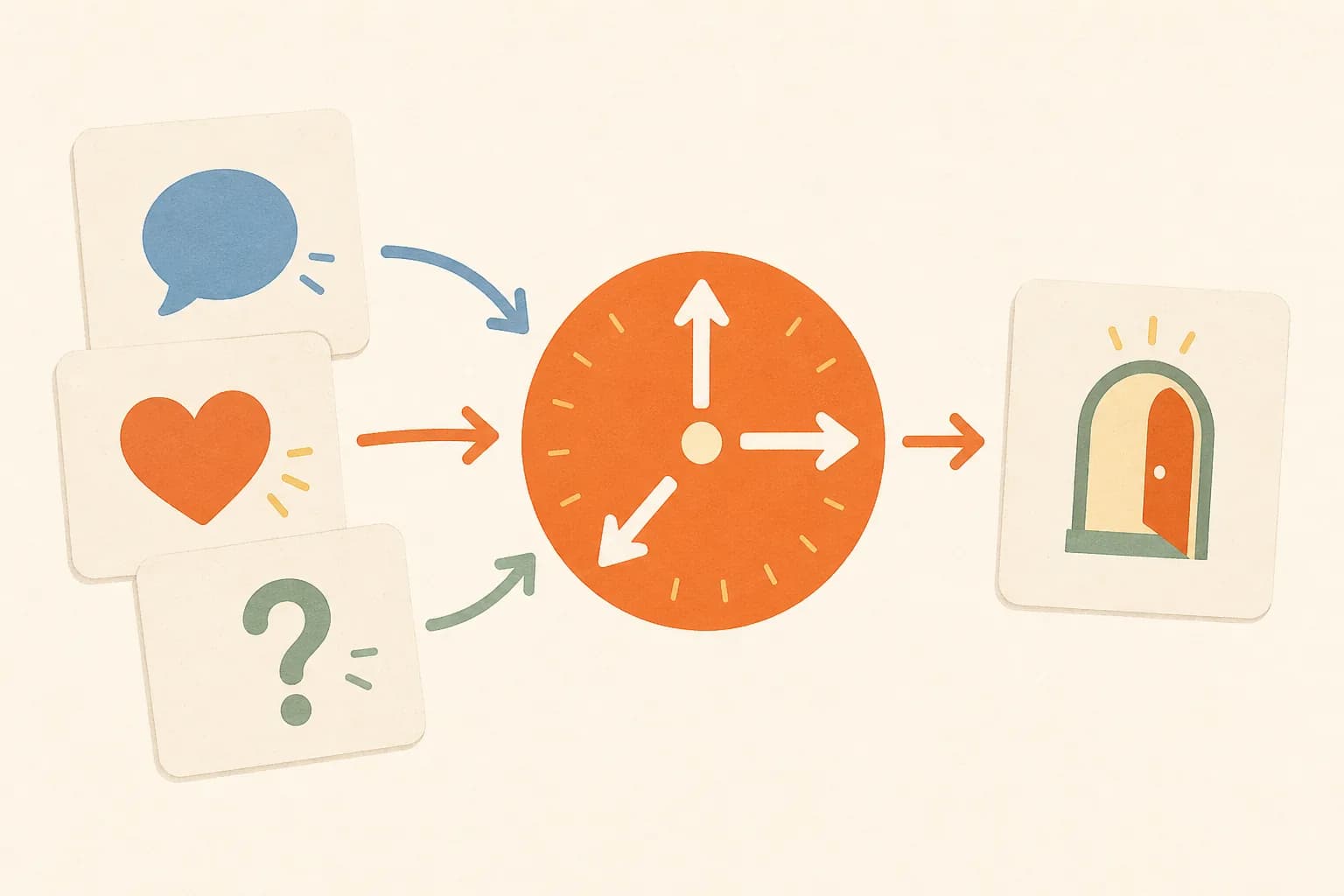
An event recap can make a return visit easier to consider, but it cannot manufacture repeat attendance. Its useful job is more modest: help a guest remember what the event actually delivered, understand what the host learned, and see a real next choice only when one exists. Start there and a recap becomes part of a trustworthy hosting rhythm rather than a highlight reel with an urgent link attached.
For a small workshop, dinner, club night, or class, the best recap is usually short. It names the promised experience, shares only evidence guests could reasonably expect to see, and distinguishes a completed event from an unconfirmed future plan. That clarity gives returning guests a fair basis for deciding whether the next edition belongs on their calendar.
Key Takeaways
- A recap should preserve a truthful outcome, a clear sharing boundary, and only a current next choice.
- Use a few relevant details, not every photo, quote, or behind-the-scenes moment.
- Ask for one useful signal, then make one change you can actually test at the next edition.
- An RSVP, a guest's response to an event invitation, belongs on a current page with confirmed details, not on a vague promise.
Start With the Return Decision, Not the Highlight Reel
An event recap can support repeat attendance only when it helps a returning guest compare the completed format with a current next event page and its RSVP choice. It is not a report card on whether the event was popular. Before selecting photographs or drafting a thank-you, write one private sentence: “What should someone who enjoyed this understand before deciding about the next edition?” The answer might be the pace, the finished outcome, the level of participation, or the kind of conversation the format supported.
According to the University of Glasgow's event toolkit, post-event review belongs in future planning: Post-event evaluation can compare an event with its objectives and identify improvements for future planning. That is a more useful starting point than trying to prove excitement to every reader. Define the purpose of the recap before you decide which evidence earns a place in it.
For example, a first drawing class may promise a calm introduction to materials and a completed study. The recap does not need to call the room “unforgettable.” It can show that people worked through the exercise, name the material they explored, and say what the host will keep or adjust. A guest who wants that format now has concrete information; a guest seeking something else is not being misled.
Show the Promise Being Kept
A recap earns trust when it shows one relevant outcome instead of making a popularity claim.
Choose proof that maps to the original invitation. If the event promised a beginner-friendly exercise, show the finished exercise or describe the step guests completed. If it promised a small discussion, share one non-identifying theme that emerged and the format that made room for it. Do not turn a head count, a cropped photo, or a burst of applause into evidence that every guest had the same experience.
When a next edition is ready, that same promise can move from recap to action. On HereNow, a public event page for the next edition gives the returning guest one place to check the date, location, capacity, and current description. The recap establishes continuity; the event page carries the decision. Keep those jobs separate so a reader never has to guess whether a link reflects confirmed information or hopeful intent.
Choose Evidence Guests Can Understand and Expect
Build a small evidence plan before the event begins. For many hosts, that means one image of the activity, one factual note about what was made or discussed, one host observation, and an optional feedback question. It is enough to create context without turning the room into content inventory. A survey is not the only source of insight, and it should not be used as a popularity contest.
The event-profession standards maintained by the Events Industry Council include post-event survey distribution and collection as part of the post-event stage. In practical terms, Post-event survey distribution and collection can provide one optional guest signal alongside host observations. Ask a question that can inform a decision, such as whether the pace left enough time for independent practice.
A guest should not discover after the fact that a candid moment became promotional material. George Washington University's privacy guidance is an institutional example, not global legal advice, but it reinforces a sound operating boundary: Photography plans should tell guests when capture is taking place and take extra care with recognizable promotional images. Check the rules that apply to your venue and location, and give guests a practical way to opt out where appropriate.
The questions matter as much as the collection method. The University of Nebraska's post-event evaluation resource supports a focused approach: Feedback questions are most useful when they connect to event goals and to changes a host can actually make. “What made the session easier or harder to follow?” can be more actionable than “Did you like it?”
Capture Only What Clarifies the Experience
Useful recap material is limited to what clarifies the experience and fits the sharing boundary.
Use a simple filter before you publish anything: does this item explain the original promise, document the format, or help a future guest understand the choice? If the answer is no, leave it in the host archive. A bright room photo may be appealing but still say nothing about whether the event was hands-on, quiet, social, accessible, or suited to beginners.
A good limited set might include one wide image that establishes the activity, one detail that shows the work, and a short caption explaining the outcome. Do not publish private comments, identifiable details, or images that make a guest uncomfortable merely because they are visually strong. The host's responsibility is to tell the truth about the event without treating participation as permission to be used in every future promotion.
Build One Factual Core Before You Personalize the Next Step
The recap should be proportional to the event and to the decision it needs to support. A two-hour workshop does not require an impact report; a multi-session program may need a fuller summary, an evaluation note, and follow-up materials. Match the effort to the stakes. The host's task is not to document every detail. It is to leave a dependable record that can be reused in a thank-you, a public post, and the planning of the next edition.
The National Library of Medicine's evaluation guidance makes the general principle explicit: The depth of post-event evaluation should fit the event's complexity and the decision the host needs to make. For an independent host, that can mean a concise factual core before any channel-specific wording is added.
Draft that core while the details are fresh. Include the event name, the original promise, what guests did, one observable outcome, and any confirmed next step. Keep the tone specific enough to be useful and restrained enough to remain accurate. Once this core is sound, you can adapt it for a public recap, a thank-you email, or a future invitation without rewriting the event from memory each time.
Use a Four-Part Note, Not a Sales Story
A concise recap can cover outcome, context, learning, and the next choice without becoming a sales story.
- Outcome: State what guests made, practiced, discussed, or completed.
- Context: Name one detail that explains how the room worked, such as a small table format or guided work time.
- Learning: Share one host observation or the single change you will test next time.
- Next choice: Link to a confirmed next event, or say plainly that the next date is not ready to announce.
This structure leaves room for a real thank-you without disguising a promotion as one. It also keeps promised materials, photos, or notes from being forgotten after the public post is live. For timing, delivery, and guest care around that work, plan the complete post-event follow-up before you write a future invitation.
Keep Delivery, Recap, and Invitation as Separate Jobs
Guests read a message differently when it fulfills a commitment, documents an event, or asks them to act again. A delivery message sends the slides, recipe, recording, or other item they were promised. A recap records what happened. An invitation asks someone to consider a future event. Blending all three can make a useful thank-you feel conditional and can obscure the real purpose of the message.
Compliance depends on the audience and jurisdiction, so get local advice when you need it. As a specific UK example, the Information Commissioner's Office explains that UK electronic marketing guidance has distinct conditions and opt-out expectations for future promotional email. Treat that as a reason to label the invitation honestly, not as universal legal advice.
Operationally, separate messages also reduce your own confusion. You can send materials when they are ready, publish a recap when it is accurate, and invite guests back when dates and logistics are confirmed. That sequence respects different guest expectations and makes it easier to audit what you promised.
Make the Message Purpose Obvious
A thank-you, a recap, and an invitation should keep their separate jobs clear.
A service message is the delivery of something promised to a guest after the event. Put the promised item and access instructions first. A recap can then tell the factual story of the event without implying that a guest must register again to receive what they were owed. An invitation should identify itself as an invitation and link only to a page that has current details.
| Message | Primary job | What it should contain |
|---|---|---|
| Thank-you or delivery | Fulfill a promise | Materials, access, deadline, or next support step |
| Public recap | Document the experience | Outcome, context, sharing boundary, and one learning |
| Future invitation | Offer a new choice | Current date, format, capacity, logistics, and RSVP path |
One email or post can contain more than one element when that is appropriate, but use headings or clear transitions so the recipient can tell which job is being performed. Clarity is more valuable than squeezing every post-event task into one message.
Turn One Signal Into One Next-Edition Commitment
Feedback is useful when it helps you choose, not when it creates an endless list of impressions. Consider three small sources together: process measures, such as whether the schedule held; outcome measures, such as whether guests completed the activity they came for; and host observations, such as where the room slowed down. According to the Community Tool Box's evaluation planning guidance, Process measures, outcome measures, and observations answer different post-event questions.
Do not force all signals into one conclusion. If a few guests wanted more time, ask whether that came from the room layout, the instructions, the material complexity, or the session length. Choose the smallest change that addresses the repeated friction and that you can state accurately on the next page. A narrow commitment protects the original format from being redesigned by a single loud comment.
Turn a Signal Into a Small Test
An illustrative host can turn one repeated friction into one limited next-edition test.
Illustrative example: A 2-hour, 18-seat watercolor workshop promised that beginners would leave with a finished color study and twenty minutes of quiet practice. In the recap, the host records that the color-mixing table became crowded and 5 respondent notes asked for less rushed mixing time. The host does not conclude that the entire workshop failed or promise a transformed experience. Instead, the next edition adds a second mixing palette and a four-minute swatch video sent in advance.
The test is concrete: did the extra setup leave the planned independent-practice time intact, and did the same friction appear again? The revised page can say “two mixing tables and twenty minutes of independent color practice” because those details are within the host's control. To make this review habit repeatable, use the guide on how to turn event feedback into a better next event after you have one clear signal rather than a pile of raw comments.
Invite Again Only When the Next Page Is Current
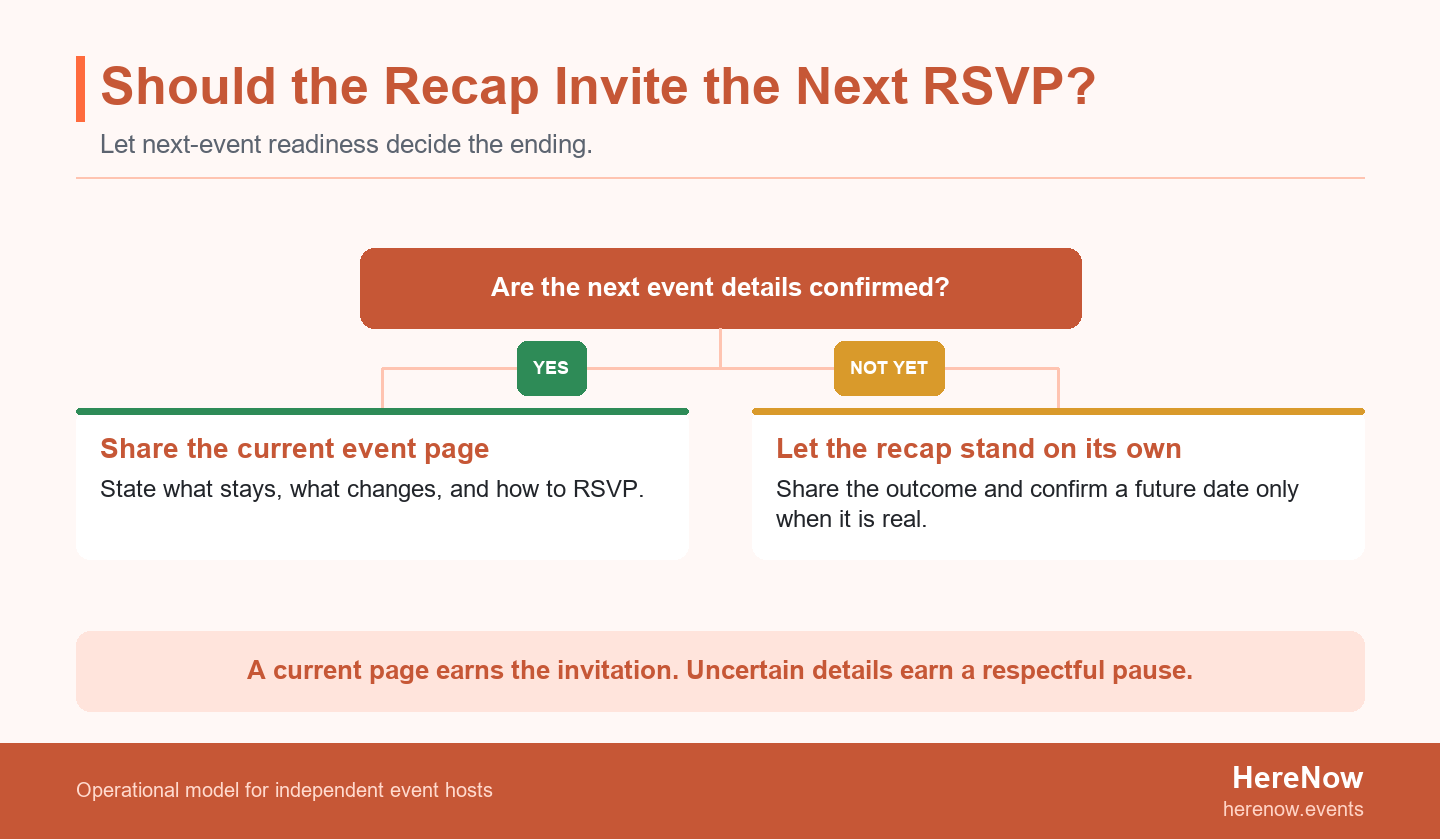
There is no obligation to attach a next RSVP to every recap. If the date, venue, capacity, accessibility information, or format is unsettled, the honest ending is a recap with no invitation. You can still thank guests, share the result, and say that future details will be announced when confirmed. This protects guests from holding space for an event that has not yet become a real choice.
Oregon State University's event-planning guidance links event assessment to anticipated outcomes and planning. Applied to a small host workflow, Post-event assessment can connect feedback with goals and anticipated outcomes before the next event is shared. Assess first, then publish the page that reflects the decision you actually made.
Use a simple readiness check: is the continuing promise clear, is the one change described accurately, and are the logistics confirmed? If any answer is no, let the recap stand on its own. If every answer is yes, the invitation can be a useful continuation rather than a premature push.
State What Stays Before You Announce What Changes
A next event page should state what stays and what changes before it asks for an RSVP.
Returning guests do not need a vague “back by popular demand” message. They need a quick comparison. Start with the continuing promise: the same beginner level, small group size, or hands-on format. Then name the one material change: a new date, a second facilitator, a longer practice block, or a different location. Finally, make practical details easy to verify, including the date, time zone, capacity, price when applicable, and any access needs.
Before the invitation goes live, preview the next event page before sharing it as though you were a returning guest who only has the recap for context. Check whether the promise, change, and logistics agree with each other. A clear comparison will not guarantee registrations, but it does allow guests to make an informed decision without chasing the host for missing details.
Put the Recap-to-Next-Page Workflow to Work in HereNow
A current page works best after the host has decided the continuing promise, one change, and confirmed logistics.
In HereNow, make those decisions before you create the next link. Begin with the promise that remains true, add the limited change you can support, and fill in only logistics you have confirmed. The public page then becomes the clean destination for the new date and RSVP choice, while the recap remains a truthful record of the event that has already happened.
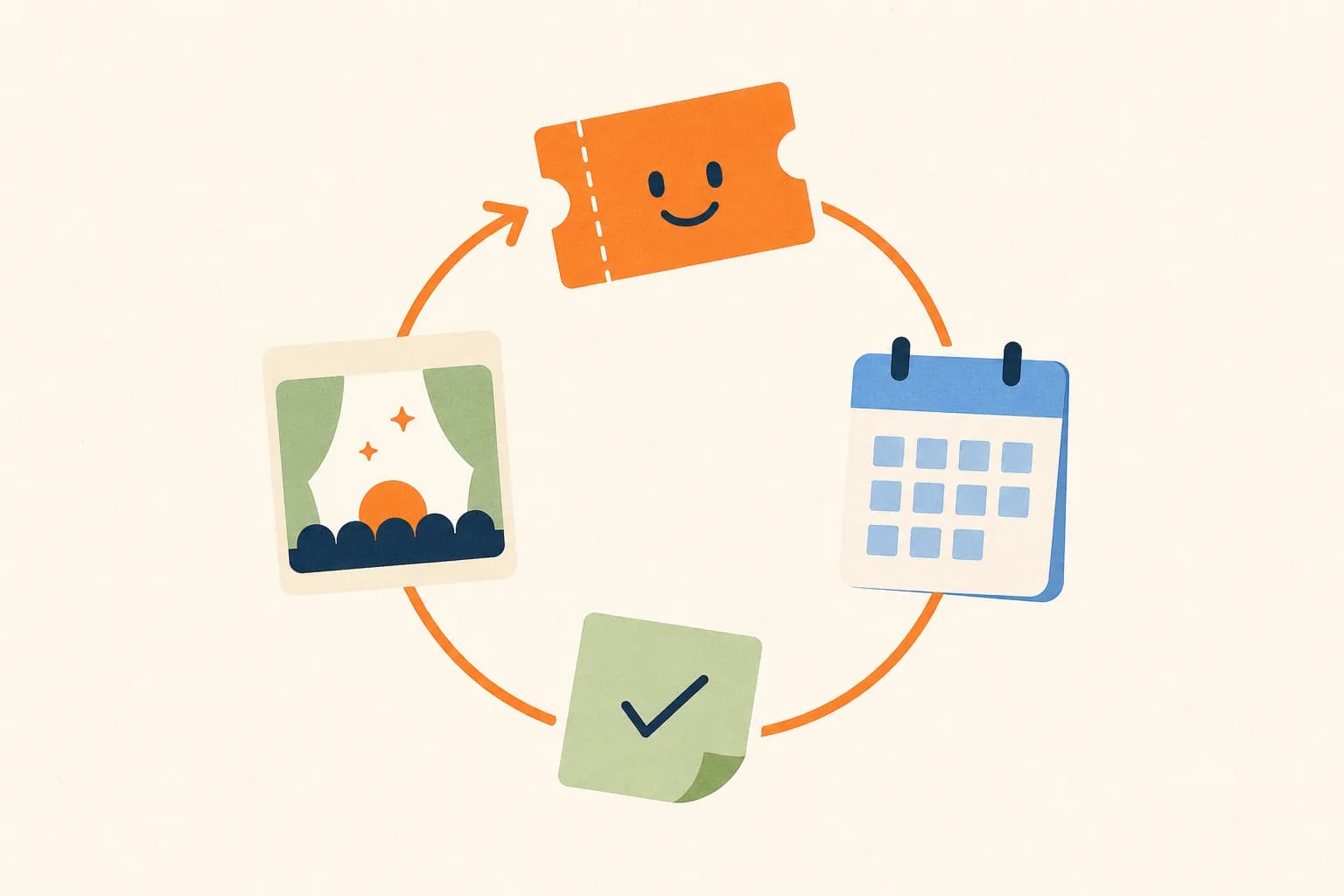
Use the workflow in this order: review the event, select one shareable outcome, decide whether a next edition is ready, and publish a current page only when it is. Give the page a direct title, the promise that continues, the one tested change, and every confirmed logistical detail. Read it once as a returning guest: could someone tell what the event is, who it is for, what happens in the room, and what has changed since last time? If not, improve the page before the recap points to it. When the page answers those questions, it becomes the accurate home for the new date and RSVP choice. A host can create a current public next-event page after deciding the continuing promise, one change, and confirmed logistics. When you are ready to act on that decision, start a current event page.
Frequently Asked Questions
When should I publish an event recap?
Publish an event recap only once you can accurately describe the outcome and honor the sharing boundaries you set. For a small event, that may be later the same day or within a few days, once promised materials, guest expectations, and any image checks are clear. Do not rush to publish only because you want to announce another date. A factual recap remains useful even when the next edition is not ready.
Should every event recap include a link to the next event?
No. Include a next-event link only when the future page has confirmed, current details that a guest can use easily. If the date, format, capacity, or location is still unsettled, end the recap with the completed event and a clear statement that future details will be shared later. That gives guests useful context without presenting a provisional plan as an available invitation.
What should I ask in a post-event feedback question?
Ask one question that connects directly to the promise and to a change you could actually make. For example, ask whether the pacing left enough time for practice, whether the instructions were easy to follow, or which part of the format felt least accessible. Avoid broad satisfaction questions when you do not know what action a response could influence. Pair feedback with your own observations before changing the next edition.
How can I share event photos without making guests uncomfortable?
Set expectations before or at the event, capture only what supports the recap, and check whether identifiable promotional use needs extra care. Choose wide activity shots, hands, materials, or non-identifying details when those explain the experience just as well. Make a practical opt-out route visible when appropriate, follow venue and local requirements, and do not assume attendance alone means every guest wants a recognizable image used later.