How to Turn Event Feedback Into the Next Event
A practical feedback filter for choosing what to keep, change, or test before you publish the next event page.
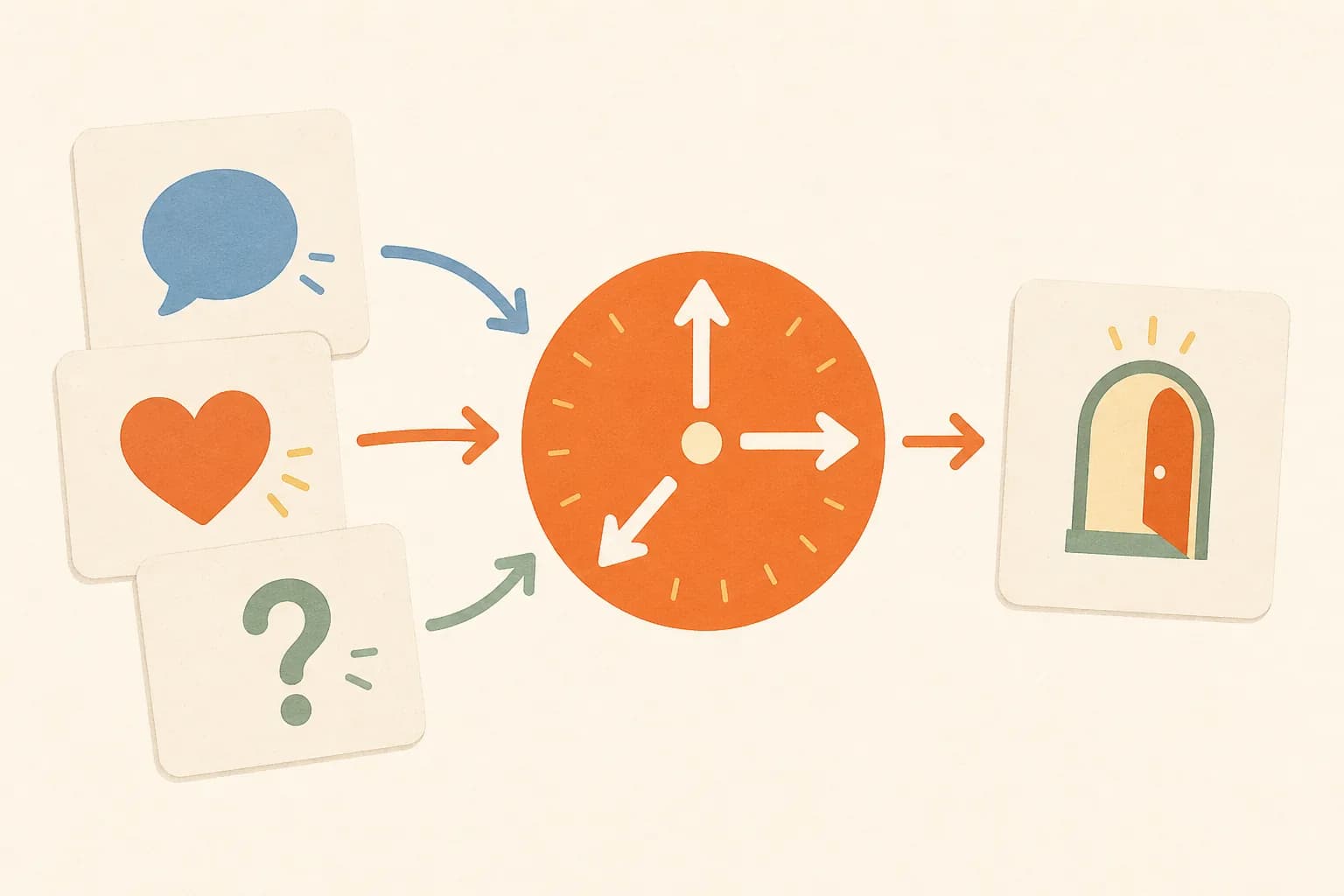
Event feedback is useful when it helps you make one better decision about the next event. It is not a vote on every detail, and it does not need to become a larger survey project than the event itself. Start with the promise guests chose, collect only the signals that can answer a real question, then decide what to keep, change, or test in the next edition.
That sequence is especially useful for independent hosts. A workshop, club night, dinner, walking group, or class can produce a mix of kind comments, individual preferences, and genuine operating problems. Treating all of those notes as equal leads to an unstable format. Reading them against the original promise gives you a clearer basis for deciding what a returning guest should experience next time.
What Should Carry Into the Next Event?
- Ask for feedback only when you can name the next-event decision the answer could inform.
- Use a mix of guest comments, host observations, and practical records instead of treating one survey score as the whole story.
- Separate a barrier to the promised experience from a reasonable personal preference or a future idea.
- Make one bounded keep, change, or test decision so you can learn what altered the next edition.
- Update the public event page only when a guest needs the new information to decide whether to RSVP, a response to an event invitation.
Choose the Next-Event Decision Before You Collect Feedback
Before sending a question, decide what one next event decision you need event feedback to inform. Start with the guest promise: you may need to know whether a beginner group needs a clearer first ten minutes, whether the arrival instructions are working, or whether the activity leaves enough time for an intended outcome. Those are decisions a host can eventually act on. "Did everyone enjoy it?" may feel welcoming, but it cannot tell you what to protect or alter.
The CDC's evaluation guidance starts by matching evidence to evaluation questions, including what information is needed and how it will be gathered. That principle scales down well. For a small event, a single focused question and one host observation can be more usable than a long form that no one has time to interpret.
Write a Decision Sentence Guests Could Not Answer for You
A useful feedback prompt begins with a host-owned choice, not a request for a general verdict. Try a sentence such as: "For the next edition, I need to decide whether the opening instructions should be simpler." The guests can describe what made the opening easy or hard to follow. The host still decides what fits the room, the budget, access needs, and the format.
This boundary protects guests from a hollow consultation exercise. Do not ask about a change you cannot consider, such as a different venue when the season is already contracted, or a longer session when the room must close at a fixed time. You can still invite comments, but make clear whether you are learning about the experience, choosing between options, or testing a specific improvement.
Collect a Small Set of Signals That Can Answer the Decision
One type of input rarely tells the whole story. A rating can show that something felt off but not why. An open comment can explain a problem but may reflect one person's circumstances. The host's own run sheet can reveal that the welcome started late or that materials were not ready. Put those pieces next to each other before you make a format change. Whether you keep the record beside a HereNow page or in a simple notes file, the useful unit is the evidence behind one choice.
The University of Nebraska's post-event evaluation guidance advises organizers to keep goals in mind when planning feedback opportunities and to consider what they are able or willing to change. In other words, questions work best when they connect a guest experience to a change the host can actually make. For a first-time host, that can be as simple as one multiple-choice question and an optional comment field.
Use the moment after an event for the operational follow-up it deserves: send promised resources, thank contributors, and ask the focused question while the experience is still clear. Our guide to following up after an event helps keep that message useful even when no invitation for the next edition is ready.
Match the Method to the Information You Need
Use a short survey when you need a comparable response from several guests. Use an open comment when you need language for an unfamiliar problem. Use a host note when the question is operational, such as whether people found the entrance or whether the agenda stayed on time. The Community Tool Box starts evaluation planning with goals, questions, methods, and a timeline, so the practical task is to choose the lightest method that can answer your decision.
Do not add questions merely because a survey tool makes them available. Ask about the pace if you might shorten, lengthen, or re-sequence the session. Ask about materials if you can change the list, setup, or instruction. Keep an optional open field for a surprise you did not anticipate, but do not confuse unexpected ideas with evidence that the core offer needs a new shape.
Read Feedback Against the Promise and the Actual Event
Once notes begin to arrive, return to the event page. What did the page promise a guest would do, learn, receive, or experience? Feedback is strongest when it points to a gap between that promise and the actual room. A beginner workshop that felt rushed, a walking group whose meeting point was hard to find, or a discussion where half the time disappeared in introductions all deserve closer attention because they affect the public expectation.
The UCLA Events Office recommends reviewing original goals, whether the purpose was communicated, the event's logistics, and feedback from attendees and vendors. That makes the original promise a better sorting tool than the loudest comment. The same note can matter differently in two formats: a request for more networking may be central at a professional salon and beside the point at a quiet drawing class.
Separate a Barrier From a Preference or a Future Idea
A barrier makes the promised experience harder to receive. It might be unclear access information, an activity that requires unstated materials, or a pace that leaves beginners behind. A preference is a valid wish that may not fit the intended audience, such as a later start, a different snack, or a more advanced topic. A future idea is something interesting that has not earned a change yet, such as a second level, a guest speaker, or a larger room.
This distinction is not a way to dismiss people. It is a way to answer proportionately. Fix a barrier when it weakens the promise. Record a preference and look for a repeated fit problem among the people you intend to serve. Hold a future idea until the current format is stable enough to test one new variable without losing the ability to learn from the result.
Make One Bounded Keep, Change, or Test Decision
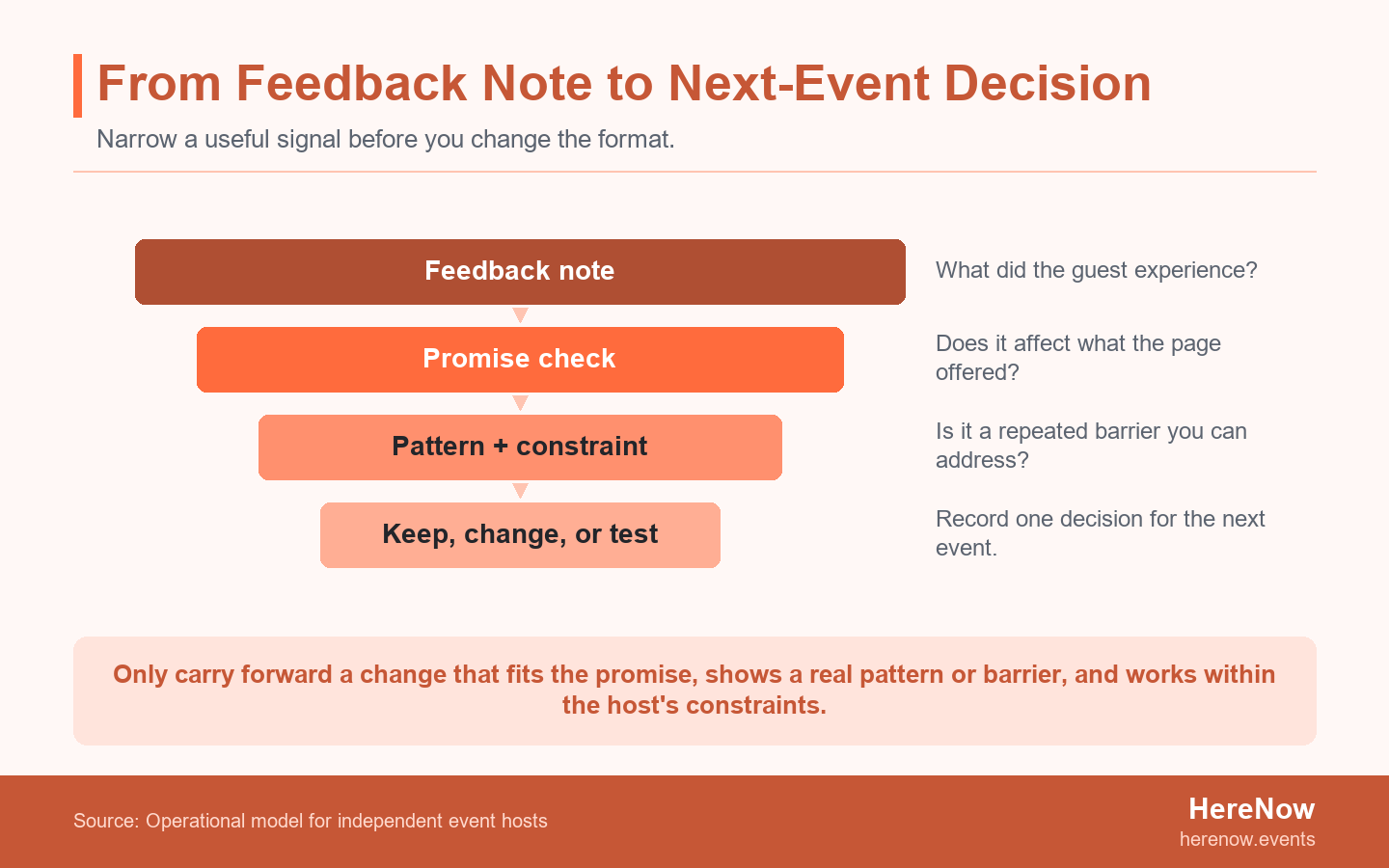
After sorting the evidence, choose one verb. Keep something when it supported the promise and guests noticed its value. Change something when it repeatedly created a barrier you can remove. Test something when the idea is plausible but the evidence is mixed or the effect on the format is uncertain. The goal is not to improve everything at once. It is to make the next edition more legible and to learn what the one deliberate adjustment actually did.
| Decision | Use it when | What to record |
|---|---|---|
| Keep | The element supported the promise and is practical to repeat. | What it protected for guests. |
| Change | The same barrier appeared in the experience or the operating record. | The precise change and the constraint it respects. |
| Test | The idea may help, but its effect is uncertain or context-dependent. | What you will observe before deciding again. |
The University of Florida's event-planning guidance treats evaluation as a way to learn what worked, what did not, and what can be improved, while accounting for circumstances a host could not control. That is why a single difficult evening should be read in context before it becomes a permanent redesign. The CDC's guidance on acting on findings similarly distinguishes among making an adjustment, gathering more information, and taking no action. Rain, a transit disruption, an unusual group mix, or a last-minute room issue can be true and important without being the defining feature of every future edition.
Protect the Part Guests Chose Before You Test the Edge
A useful next-event decision names both the adjustment and the part that stays. If you extend the practical portion of a class, say that the beginner level and small group size remain. If you move the welcome earlier, keep the advertised activity time accurate. When you change time, venue, capacity, agenda, price, and topic together, guests cannot tell whether it is still the event they meant to choose, and the host cannot tell what caused the next result.
Write the decision in one line: "Keep the 14-seat conversation circles; test a five-minute host-led prompt before guests pair up." That sentence is small enough to use in your next run sheet, event description, and review note. It also gives you a defined observation for the following edition: did newcomers settle into conversation more easily without reducing the open exchange that regulars value?
Keep a Small Decision Record Between Editions
A useful record does not need a dashboard. After the room clears, note the promise, the signal, the decision, the constraint, and what you will look for next time. Keep the note private unless a change affects what a future guest needs to know. This gives a co-host or future you enough context to distinguish a recurring pattern from a one-off memory.
Georgia Tech's post-event guidance recommends recording ideas and lessons learned after each event, then updating web information when an event has concluded or new dates are ready. That supports a simple rhythm: capture the lesson while it is specific, then carry only the guest-relevant change into the next public page. For more practical patterns around hosting before, during, and after an event, explore the HereNow host guides.
Example: A 14-Seat Language Exchange Changes the Opening, Not the Whole Format
Illustrative example. A host runs a 14-seat language exchange for conversation learners. The public page promises short, low-pressure rounds for people who are comfortable making mistakes. In the host notes, the first pairings take eleven minutes because several newcomers do not understand where to begin. Four guest comments mention the opening felt awkward, while six guests separately praise the small circles and the easy pace later in the session.
The host does not conclude that the whole format failed or that every guest needs a different level. The repeated point is a barrier to the beginner-friendly promise: newcomers need a clearer way into the first exchange. The decision is to keep the 14-seat circles and test one five-minute welcome prompt with example questions on each table. The host records the constraint too: the room is booked for two hours, so adding a longer orientation would require removing conversation time.
At the next event, the host watches whether the first round begins on time and asks one focused question: "Did the opening make it clear how to start your first conversation?" If the prompt helps, it becomes part of the stable format. If it feels too scripted, the host can revise it without falsely assuming the guests wanted a completely different event.
Update the Public Page When the Change Affects a Guest Choice
Not every internal decision belongs on the next event page. A guest does not need a private summary of staff debrief notes. They do need information that changes the decision to attend: a new arrival instruction, a different pace, a required item, a capacity change, an access detail, or a material change to the format. State the practical difference in the language a new guest can use before they RSVP.
Utah Tech's event-planning guide connects post-event evaluation with reviewing goals, communication, logistics, and guest feedback. That is why the public page should reflect the actual experience you are now prepared to deliver, rather than a private decision record no guest can see. A current HereNow public event page gives that change one clear place to live before a guest decides whether to RSVP.
Name the Relevant Change Without Publishing a Changelog
Make the page clearer, not more defensive. "We begin with a short starter prompt so new guests can enter the first conversation easily" tells a prospective guest what to expect. "We have improved the event based on feedback" does not. A returning guest should be able to spot what stays and what changes in the description, agenda, arrival note, or capacity detail.
For the rest of that page, use the same direct promise that brought the right guests to the first edition. Before publishing, compare the revised promise, timing, capacity, and practical information against the decision record so the event page does not quietly promise the old experience. That short comparison also prevents a private debrief from turning into an unclear invitation.
Put the Chosen Improvement Into the Next HereNow Event
A decision is not complete until the public event information matches it. Start with the stable promise, update the one guest-relevant change, then check the date, time zone, location, capacity, and any access or materials details. Keep the page specific enough for a returning guest to recognise the format and for a first-time guest to understand what they are choosing.
When those details are current, HereNow gives a host a place to create the next public event page and share an RSVP path without asking guests to create a HereNow account. When the promise, one change, and real logistics are ready to stand together, Create an event.
Frequently Asked Questions
How much feedback should I collect after a small event?
Collect only enough feedback to answer a real next-event decision, which is often one focused question plus an optional comment field for a small format. Add a host note about what happened operationally, then stop before the collection creates more reading than the decision deserves. You can ask a different focused question at the next edition when a new uncertainty matters.
What should I do when guest feedback conflicts?
Return to the public promise and the intended guest before treating conflicting preferences as a reason to redesign the whole event. A conflict may show that two audiences want different things, not that either person is wrong. Preserve the promise, record the tension, and test only a change you can observe without removing the part the original audience chose.
Should I respond publicly to negative event feedback?
Respond directly and privately when a guest has reported a specific problem and a reply is appropriate, especially when it concerns access or a barrier. On the next public page, mention only the change that helps a future guest decide, such as clearer arrival information or a different pace. Do not publish individual comments, argue with the guest, or promise a change before it is real.
When should feedback change the next event page?
Feedback should change the next event page when the resulting decision alters what a guest needs to know before they respond, including timing, capacity, materials, arrival, access, or the activity's pace. Keep an internal decision private when it affects only host coordination. The page is not a report on every comment; it is an accurate invitation to the experience now being offered.