How to Follow Up After an Event
A practical post-event plan for thanking guests, delivering what you promised, gathering useful feedback, and choosing a respectful next step.
Good event follow-up is not a sales sequence disguised as a thank-you. It is the part that lets guests feel the event has been properly held: they know what happened, receive anything you promised, have an easy way to respond, and can choose whether they want another invitation. For a small host, that same follow-up also turns fuzzy memories into one or two useful changes for next time.
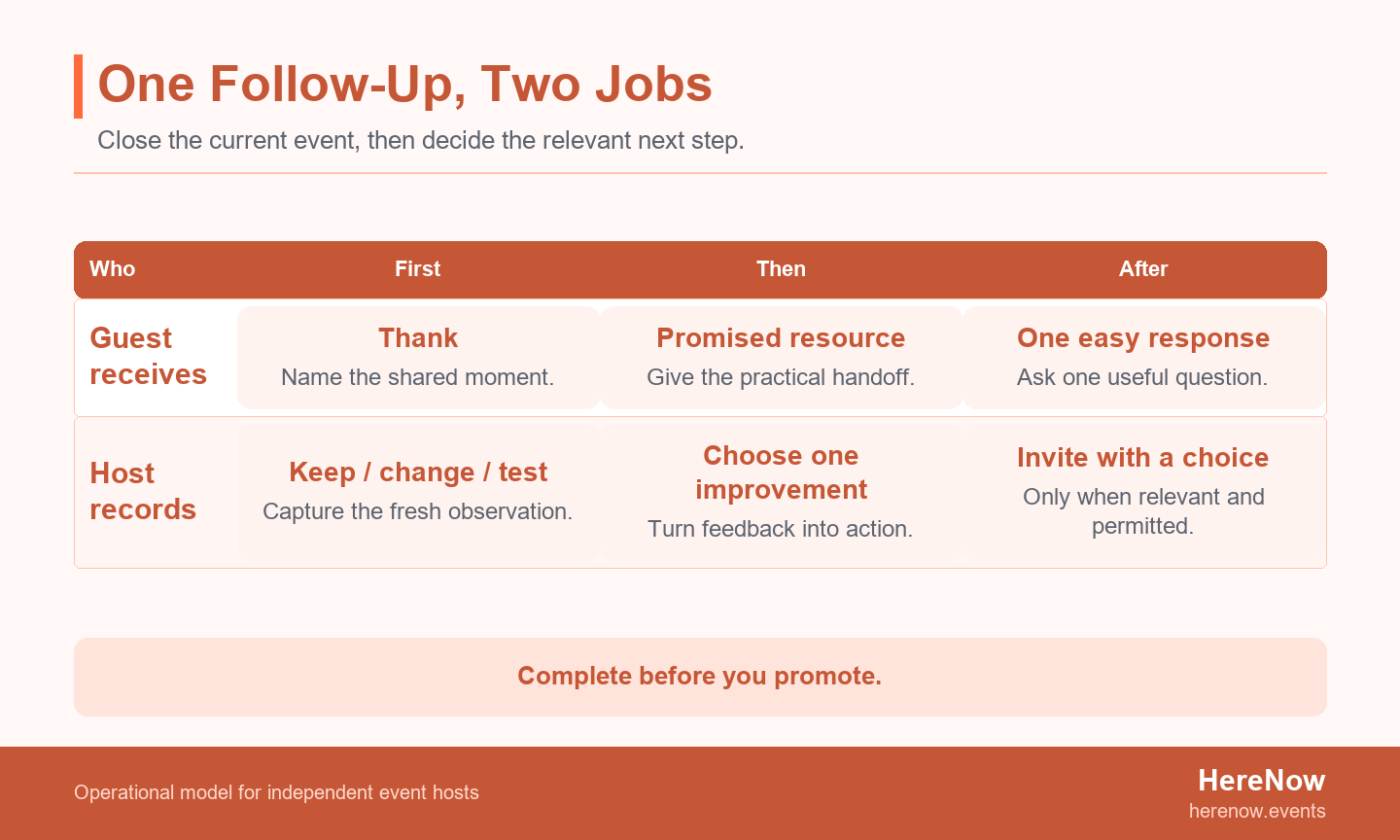
Use this order: complete the present event, thank the people who made it possible, learn what mattered, then invite a relevant next step. That order protects trust. It also gives you a practical record to use when you host again.
Key Takeaways
- Follow up to finish the event for guests before you ask them to consider another one.
- Send a short thank-you with one clear practical handoff: a resource, answer, photo link, receipt, or next instruction.
- Ask one feedback question only when you know what decision the answer will help you make.
- Keep guest feedback and host observations separate, then turn both into a short keep, change, test list.
- Make any future-event invitation relevant and separate from the message guests need in order to close the current event.
Complete the Event Before You Promote the Next One
The public schedule may be over, but the guest experience is not automatically complete when people leave the room or close the call. A guest may still be waiting for the promised slides, a recipe, an accessibility answer, a refund clarification, a way to share a photo, or simply confirmation that they were in the right place. Start by asking one plain question: what did a guest reasonably expect to receive after this event?
That expectation comes from the event page, the invitation, and anything you said during the event. The UCLA Events Office frames post-event analysis as the step that checks whether goals and logistics worked, rather than an optional extra after guests depart. Its event evaluation guidance also calls for thanking everyone involved. For a small host, you do not need a formal report to act on that idea. You need a short closing message and a place to record what happened.
Write a three-line completion note before you write a promotional sentence:
- What happened: name the session, date, or shared outcome.
- What is available now: link or attach the promised material, if there is one.
- What guests can do if something is missing: give one human contact path and a clear time boundary if you need one.
This is not about producing a polished recap for every gathering. A two-hour conversation may only need a warm thank-you and a note that the reading list is attached. A paid workshop may need material instructions, a receipt, and a way to ask a question. Match the follow-up to the promise. When the handoff is clear, guests do not have to chase you for the practical end of the experience.
Send a Thank-You That Helps Guests Close the Loop
A useful thank-you is specific enough that people recognize the event they attended. Avoid a generic "Thanks for coming" sent to everyone in your contact list. Refer to the shared activity, thank people for the contribution they actually made, and make the next useful item easy to spot. The Utah Tech event planning guide includes thanking attendees, volunteers, and vendors among its post-event tasks. That distinction matters: guests, helpers, speakers, and venue partners should not receive the same message with only the name changed.
A Short Follow-Up Formula
For attendees, use four compact moves: thank them for the specific shared moment; name one thing they can keep or use now; ask one low-effort response; then place any optional next step at the end. For a volunteer, thank them for the shift or responsibility they took on and mention one impact you noticed. For a speaker or partner, add a personal note about the audience or logistics, plus the practical information they may still need. This structure works because the recipient can scan it without having to decode why you are writing.
Keep the email or message short enough to read on a phone. Subject lines such as "Thank you for joining the beginner printmaking session" or "Your notes from Saturday's neighborhood walk" say what the message is for. Do not hide a major announcement inside the first thank-you. Guests should be able to leave the exchange feeling that their time was respected, even if they never attend again.
Example: A 12-Person Beginner Printmaking Workshop
Imagine that twelve people attend a beginner printmaking workshop. The host promised a one-page care guide and said they would share the name of the ink used. The next morning, the attendee note can say: "Thank you for bringing such patient attention to the first prints. Here is the care guide and the ink list we mentioned. One quick question: was the first demonstration clear enough to help you begin? Reply with yes, mostly, or not yet." The message completes the stated promise, gives guests a light response path, and asks about a real teaching decision.
The host sends separate notes to the studio helper and instructor. The helper receives thanks for resetting tables and a question about arrival bottlenecks. The instructor receives the attendance count, the guest question theme, and an invitation to flag anything that should change before another session. Everyone gets a message that fits their role. No one is asked to do unpaid marketing work in the first line of a thank-you.
Deliver the Resource or Next Step You Promised
A resource is useful only when the recipient can tell what it is and use it without hunting. Put the most important item near the top of the message, name the file or link in ordinary language, and say whether it will remain available. If the promised material is not ready, say so directly and give the date or condition under which you expect to send it. Silence is more confusing than a brief, honest update.
Post-event guidance from the University of Reading emphasizes gathering feedback and recording actions after an event. For a small host, that record can be modest: a folder with the shared resource, a one-page note, and the final version of the event details. The value is not in the software. It is that the next event does not start from memory alone.
If you hosted the event on HereNow, keep the published event page as the source of truth while the event is still fresh. If you publish a recap, make it answer the practical questions a past attendee will have: what was covered, which materials are available, and what will happen next. A guest who missed a detail should not need to search an old social post, a private chat, and three email threads to find it. The principle is the same one behind a clear attendee experience: reduce needless uncertainty at the moment a person needs an answer.
Ask One Feedback Question With a Decision Behind It
Feedback becomes useful when it helps you decide something. Before you send a survey, finish this sentence: "If guests answer this, I will decide whether to _____." If you cannot complete the sentence, do not ask yet. You may collect vague compliments, but you will not learn how to improve the next event.
The University of Glasgow's post-event toolkit recommends concise attendee feedback soon after an event and pairs it with operational debriefs from people who saw the work behind the scenes. That combination is valuable for independent hosts because guests can describe the felt experience while helpers can identify the hidden friction that caused it. Neither view is complete by itself.
Let the Question Match the Decision
If you are deciding whether to lengthen introductions, ask whether guests understood how to join the first activity. If you are deciding whether a higher ticket price could include materials, ask whether the included materials made the session easier or more valuable. If you are deciding whether to repeat the format, ask what guests would keep unchanged. Use one rating scale only when you know what a low or high answer will change. Then add one optional open question for a detail you did not predict.
For a small event, one focused question usually beats a long survey. You are not trying to produce a statistically complete study. You are trying to make a better hosting decision with enough context to avoid guessing. The Oregon State event planning guidance similarly frames evaluation around reviewing outcomes against goals and deciding what to modify, continue, or stop. Treat feedback as input to that next choice, not as a scorecard on your worth as a host.
Run a Ten-Minute Host Wash-Up
Guest feedback arrives after the event. Your own observations start fading as soon as you clean up, travel home, or begin answering messages. Take ten minutes as soon as you reasonably can to make a host note. A post-event wash-up is a short host debrief made while observations are still fresh. The UK Health and Safety Executive recommends a post-event debrief that listens to both problems and successes so future events can improve; it also notes that a simple checklist can be enough for small-scale events. That is a useful model even when your gathering has no formal production team.
Write Keep, Change, Test
Make three headings in a note. Under keep, record something that worked and the condition that made it work: "Keep the ten-minute arrival buffer because every guest found a seat before the introduction." Under change, record one observed friction point: "Change the signage because two guests entered through the service door." Under test, write one small experiment for the next event: "Test a printed materials card at each table instead of explaining supplies twice." This turns a messy memory into actions you can actually use.
Do not wait for perfect data. A small event gives you close-range information: what guests asked, where attention dropped, what a volunteer had to repeat, what took longer than expected, and what felt generous. Add the attendance and no-show count if that matters to your format, but do not reduce the wash-up to a number. The useful question is what the number, the comments, and your observation together suggest you should do next.
When a venue, co-host, or supplier was involved, share the relevant note instead of sending a vague "all good" message. The HSE's event-management guidance describes debriefing as a way to capture problems and successes and improve future events. In a small partnership, that can mean confirming what you will keep, what needs a fix, and who owns the next action.
Invite the Right Next Step, With a Real Choice
Only after the current event feels complete should you mention another event, a waitlist, or an invitation list. The next step should be relevant to the experience someone just had. A guest who attended a beginner workshop may welcome a second beginner date or a practice session. A person who attended a one-off community conversation may only want the notes. Treat those as different choices.
Permission Is Its Own Question
Do not treat attendance as a blank check to send future promotions. An RSVP is an attendance response, not a marketing opt-in. Keep the service message separate from the optional invitation: "Would you like to hear about the next beginner printmaking session?" gives the guest a clear decision. Rules vary by location and situation. The UK Information Commissioner's Office explains specific requirements for electronic direct marketing in its PECR email marketing guidance; use that as a reminder to check the rules and policies that apply to your audience rather than as a universal rulebook.
For ongoing host relationships, build a permission-based habit from the start. Our guide on building an audience from event RSVPs explains how useful follow-up and voluntary sharing can support that longer path. Let people leave the current event with dignity, clarity, and a real choice about what happens next.
Turn Your Notes Into a Better Next Event
At the end of follow-up, you should have a small decision record: the guest question and its pattern of answers, the host's keep/change/test note, any partner action, and a clear list of materials or copy to reuse. Save it where you plan the next event. When you return to the idea weeks later, it will be more useful than a folder of unlabelled photos or a memory that the event "felt good."
Choose one improvement to carry forward. You might clarify the first instruction, add a location detail to the page, shorten an activity, change capacity, or repeat an element guests named as helpful. One intentional change makes learning visible. Five changes at once make it hard to tell what improved the experience.
This is also where a repeatable format begins to emerge. A follow-up note is not administrative debris. It is the bridge between one event and a stronger next version. The Penn GSE event planning guide recommends keeping planning documentation and task ownership organized; independent hosts can apply the same principle lightly by preserving the decisions that matter rather than rebuilding the whole event from scratch.
Build the Follow-Up Into Your Next HereNow Event
Before you publish again, add the post-event handoff to the plan. Decide what guests will receive, where the information will live, what question you will ask, and what invitation will be optional. Starting from an event template can make the public promise easier to structure. The HereNow preview and publish guide can help you check the next page before guests see it.
HereNow is built for independent event hosts who want the public promise and real guest experience to support each other. When the details are ready, use HereNow to create your next event page with the promise, practical information, and guest experience aligned from the start.
Frequently Asked Questions
How soon should I follow up after an event?
Follow up while the details are still easy for guests and your team to remember, ideally before the experience has blurred into a vague memory. Send the practical thank-you and promised resource as soon as you can responsibly do so, then collect focused feedback while the experience is still clear. If a resource needs more time, send a short update instead of waiting in silence.
Should every event have a post-event survey?
No, not every event needs a survey; use one when the answer will change a decision you cannot make from observation alone. For a very small gathering, one well-chosen question in a thank-you message may be enough. A longer survey is useful only when you can act on the additional feedback and explain why you are asking.
What should I say in a post-event thank-you message?
Name the event, thank the person for a specific kind of participation, provide any promised material, and give one simple path for a question or response. Put any future-event invitation at the end and make it optional. The message should feel complete even if the recipient never clicks another link.
Can I invite attendees to my next event?
Yes, when the invitation is relevant and your contact method and consent approach fit the applicable rules and policies. Keep the invitation separate from the information guests need after the current event, and make the next step easy to decline. Trust grows when people know they can say no without losing access to what was promised.