How to Build an Audience from Event RSVPs
A permission-based guide for turning event RSVPs into a repeatable audience through useful follow-up, relevant invitations, and voluntary sharing.
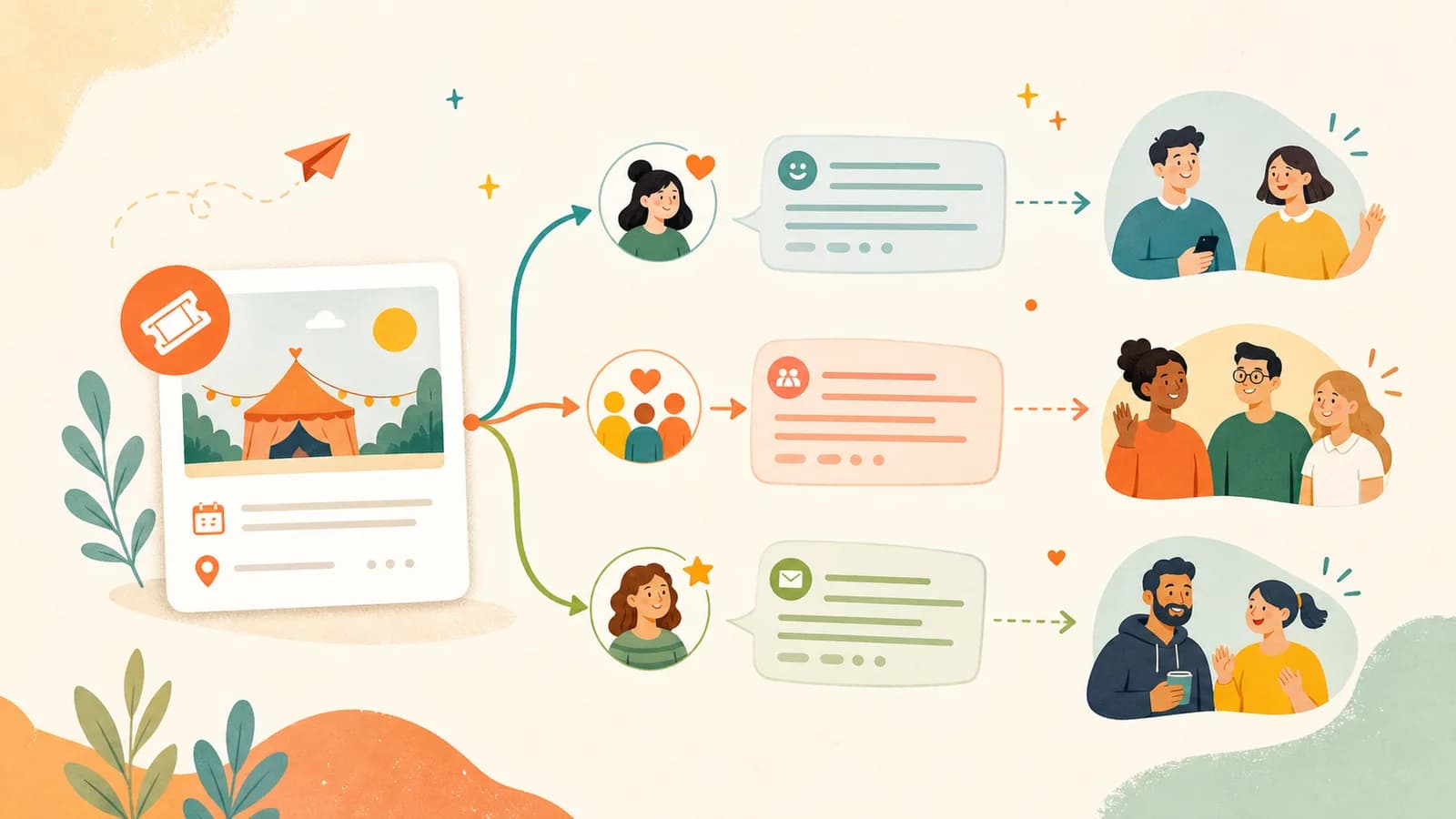
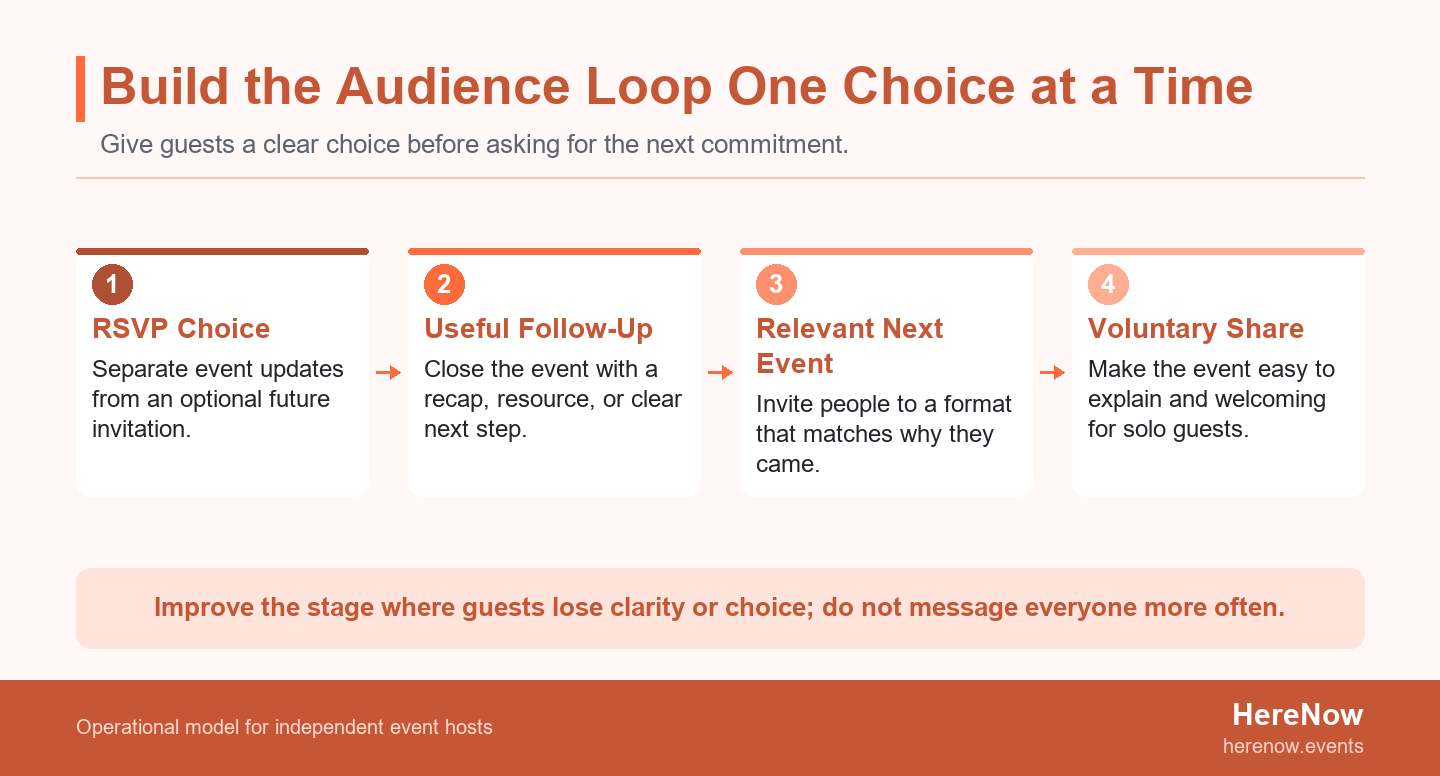
An RSVP list is not automatically an audience. It becomes one when guests understand what they will hear from you about, can choose whether to stay connected, and receive invitations that fit the reason they first came. Start with a useful follow-up, make the next invitation relevant, and let referrals remain voluntary. That creates a repeatable relationship without treating one event registration as permission to market to someone forever.
Key Takeaways
- Separate messages for the current event from future promotion, then make the choice to hear from you again clear.
- Record the event promise a guest responded to, not a vague label such as “lead.”
- Send a useful follow-up before you ask for another commitment.
- Build the next invitation around a familiar format, a clear outcome, and an easy way to decline.
- Make it simple for a happy guest to share the event without turning them into an unpaid sales channel.
Start With Permission, Not a Contact List
A person who RSVPs has agreed to information needed for that event. They have not necessarily agreed to a general stream of future marketing. An opt-in is a clear choice to receive future invitations; event operations are the messages and information needed to run the current event. That distinction protects trust and gives you a better audience over time: people who know what your invitations mean and have actively chosen to receive them. The rules vary by location and message type, so this is not legal advice. Still, official guidance is consistent about treating promotional outreach differently from event operations. The US Federal Trade Commission’s CAN-SPAM guide distinguishes commercial messages and requires a clear way to opt out. In the UK, government guidance on direct marketing says marketing emails to individuals require permission and an unsubscribe path.
Name the Exchange at the Point of RSVP
Use a short, ordinary-language choice where you collect the RSVP. For example: “Send me occasional invitations to future beginner printmaking sessions.” The important parts are the topic, frequency expectation, and the fact that the guest can say no without losing their place at the current event. Do not hide the choice inside a long privacy paragraph or make it a condition of attendance. The UK Information Commissioner’s Office guidance explains that marketing consent should be a positive, informed action and should not be bundled with unrelated requests. Even where a different rule applies, that is a good design standard for a small host: guests should be able to tell the difference between “here is your event information” and “I would like to hear from you again.”
Keep Event Messages Useful on Their Own
A confirmation, arrival update, or schedule change should do the job the guest expects. Put the practical event information first. If you also mention a future series, make it clearly secondary and avoid implying that the current RSVP enrolled them in it. This matters most when your event is free or community-led, where the guest may have joined to try one specific activity rather than enter a brand relationship. Keeping the current event useful makes a future invitation feel like a new choice, not a surprise charge against the trust they gave you.
Remember What Each Guest Came For
Audience building gets noisy when every person who attended anything receives every invitation. Instead, start with the event promise: the outcome, format, level, location, and social shape that made someone RSVP. This is a small audience record, not a surveillance project. A practical privacy framework from the National Institute of Standards and Technology frames privacy as a risk-management concern, which is a useful reminder to collect and use only information that serves a clear purpose.
Capture the Reason, Not Just the Email
For a first event, you often need only a few durable signals: what format they joined, whether they came as a beginner or returning participant, and whether they opted into future invitations. You can derive the first signal from the event itself rather than asking another form question. A “Sunday sketch walk for beginners” already tells you more than a generic “arts audience” tag. Add preferences only when they change a real hosting decision, such as whether someone wants weekday evenings, daytime sessions, or online follow-ups. If a data point will not change the next invitation, venue plan, or guest experience, do not collect it.
Use Small Groups for Better Invitations
Small groups make invitations more legible. A host might keep three plain categories: people who joined a first-time workshop, people who returned to a monthly practice session, and people who asked for advanced work. That is enough to avoid sending a technical class to someone who only wanted an introductory social evening. Research on regular events has found associations between event quality, event image, and intention to revisit; a peer-reviewed study of 173 regular-event visitors is useful here as a boundary, not a growth forecast. The host’s practical job is to make the next experience recognizable and relevant.
Send Value Before the Next Ask
The first follow-up after an event sets the tone for the relationship. If every message immediately asks for another RSVP, guests learn that attending once creates more pressure. Send something that completes the experience first: a recap, a resource mentioned in the room, a photo only where you have permission to share it, or one prompt that helps people use what they learned. This is especially important for community formats, where the perceived value includes the feeling of being welcomed back into a shared interest rather than processed through a campaign.
Close the Event Loop While It Is Still Fresh
Within a reasonable window after the event, send a short note that answers three questions: what happened, what is available now, and what comes next only if it is already clear. A cooking class might share the recipe and the date of the next seasonal session. A language exchange might share the host’s conversation prompts and ask which day works better next month. Keep the note concise enough to scan on a phone. An academic study of festival attributes found that programs, amenities, and entertainment quality shaped visitors’ experience and satisfaction; that festival-experience research does not prescribe a follow-up email, but it reinforces a grounded point: the invitation to return cannot compensate for an experience that felt unclear or careless.
Ask One Question That Changes Your Next Decision
Ask for feedback only when you know what you will do with it. A broad “How was it?” can produce kind but unusable replies. Instead ask one decision question: “Would you rather join this format on a weekday evening or Saturday morning?” “Was the beginner pace right for you?” “Would you come back for a four-session version?” Give an optional open field for nuance, then read it. The response is not a vote that obliges you to run every suggested format. It is evidence about what a small group of real guests may find useful next. For adjacent planning help, explore more Host Playbooks when you are deciding what to improve before the next invitation.
Make the Next Invitation Easy to Recognize
An audience grows through repeated clarity, not through constant novelty. The next event should tell a past guest why it connects to the first one and what is different this time. “Return for another session” is weak because it asks the guest to remember the value for you. “A second sketch walk with indoor café time if it rains” is stronger because the format, outcome, and practical contingency are visible.
Repeat the Useful Shape, Then Change One Thing
For early series, keep most of the shape familiar: similar duration, room size, skill level, and host tone. Change one meaningful element, such as a new technique, neighborhood, guest prompt, or seasonal theme. This helps a guest decide quickly whether the event is for them without making every invitation look copied. It also makes your own learning cleaner. When a familiar format fills slowly, you can inspect the date, promise, or access details instead of wondering whether the entire concept changed at once. A repeatable shape should still leave room to revise what the last group actually needed.
Make the Event Page the Home for Each Invitation
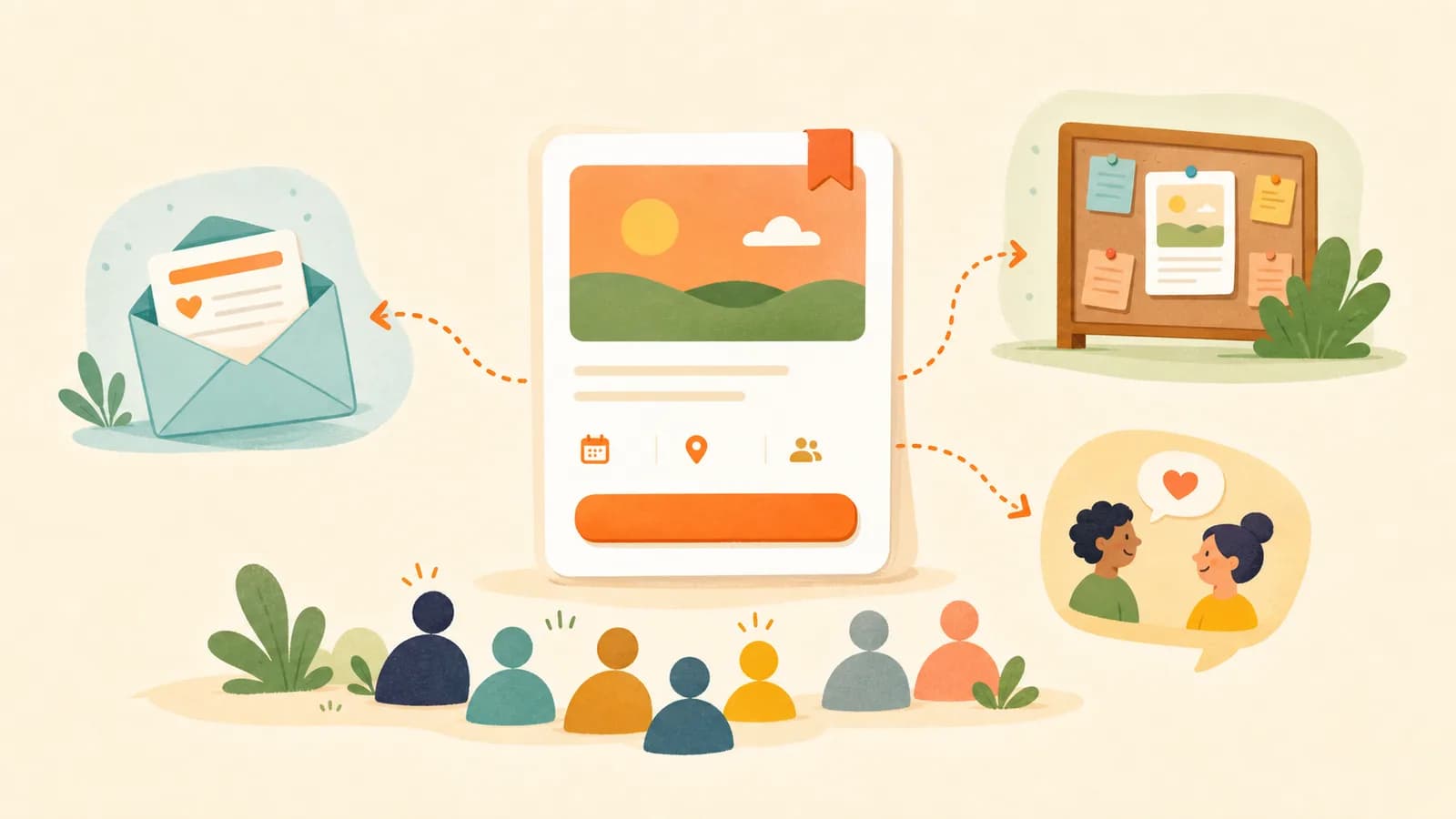
Every invitation should lead to one current page that states the outcome, who it is for, the schedule, location or online access, capacity, and RSVP path. That reduces the amount of information carried in an email or social post and lets guests decide at their own pace. HereNow helps independent hosts publish an editable public page and RSVP flow without requiring attendees to create an account. The aim is a low-friction current-event decision, not an automatic future subscription. A returning guest should recognize the series, while a new guest should still have enough context to make a confident first decision.
Make Sharing an Invitation, Not an Obligation
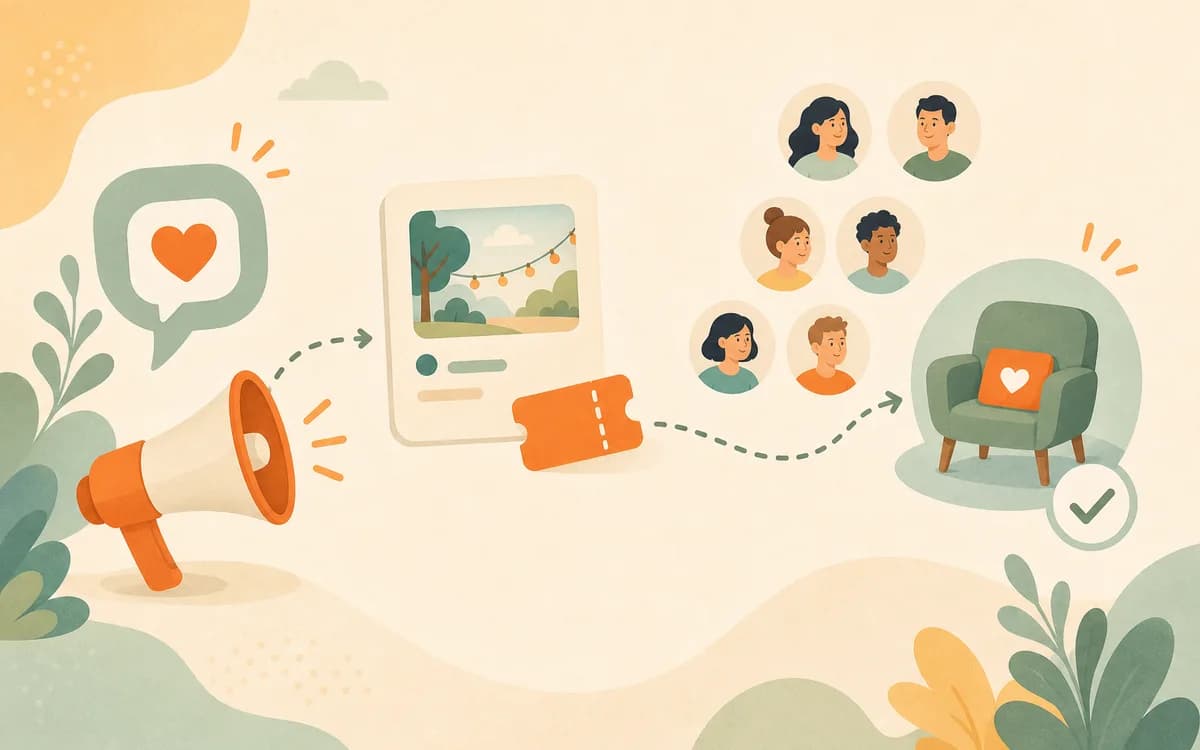
People often bring a friend when they can explain the event simply and believe the experience will suit that person. Your role is to provide a shareable reason, not to demand promotion. Social factors can affect real-world event participation; a research paper on location-based social services found that social aspects played a major role in participation, but its model is not a guarantee for a small host’s attendance. Use the evidence as a prompt to make the social choice clear: can someone come alone, bring one person, or meet others there?
Give Guests One Shareable Line
Write one sentence a guest can send without editing: “I’m going to a beginner-friendly sketch walk on Sunday; we start with simple prompts and finish with coffee nearby.” It contains the audience, activity, and emotional shape. Add a public page link, then let the guest decide whether to share it. Avoid referral contests or public pressure in the first stages of a community. You need the right guests more than the largest possible list, and a misaligned referral can create extra host work for everyone. The shareable line should describe a real experience, not manufacture urgency or imply that a friend must attend to make the event worthwhile. When a guest is ready to decide, they should be able to collect an RSVP without creating an attendee account.
Design for People Who Come Alone
A friend invitation should not be the only way someone feels comfortable attending. State that solo guests are welcome and show how the first minutes will work. A simple host welcome, name tags when appropriate, a paired first exercise, or a clear check-in point can make the event easier to enter. Research on local festival participation has linked informal social ties and participation, but that relationship does not mean a host should rely on existing networks alone. A good invitation gives both a returning guest and a newcomer a credible picture of belonging.
Treat Guest Data as Event Operations, Not a Growth Toy
Keep a deliberate boundary around the records you use. HereNow’s guidance treats registration data as operational data for the host managing that event, and guests should not be forced into unrelated platform marketing. That ownership is a responsibility as well as a benefit. Keep your own follow-up list purposeful, secure it, honor preferences, and do not pass it around because a collaborator asks for “the audience.”
Use a Simple, Explainable Audience Record
A lightweight record might include name, email, event attended, opt-in status, format preference, and a note that explains why the person is receiving the next invitation. You should be able to answer, in a sentence, why each field exists. This makes it easier to clean the list after a series ends and easier to keep your follow-up aligned with guest expectations. It also gives a collaborator a simple boundary: they can help run the current event without inheriting a vague right to contact every past guest. For a product-specific view of the boundary, read HereNow’s guide to attendee data ownership.
Review the Loop After Each Event
After the event, look at four small signals: how many guests opted in, how many opened or replied to the useful follow-up, how many chose the next relevant invitation, and what people said when they declined. Do not turn these into a universal benchmark. Use them to notice friction. If people attend but do not opt in, your future value may be unclear. If many opt in but ignore the next event, the invitation may not match the first promise. If guests share but newcomers do not return, the room experience may need more attention than the promotion.
Run a Simple 30-Day Audience Loop
A small audience does not need a complicated funnel. It needs a steady sequence that respects guest choice. Start with a current event people can join easily, then adjust the sequence to your event cadence, local rules, and the amount of real value you can provide between gatherings. The example below is illustrative.
Illustrative Example: A Monthly Language Club
Imagine a host who runs a 14-person beginner conversation club. At the RSVP stage, guests can separately choose to receive future invitations to beginner conversation sessions. Two days after the event, the host sends the discussion prompts and a short note about the next theme. One week later, only the people who chose future invitations receive a page for the next session, which uses the same 90-minute format but a different topic. The page says that solo guests are welcome and that each person may bring one friend.
The host does not claim that 14 RSVPs became an audience. They look at the choices: who opted in, which time preference repeated, and whether the returning format made sense. If several guests say weekday evenings are easier, the next page tests that scheduling change. If guests share the page but no one joins, the host checks whether the invitation explains the beginner level and first ten minutes clearly. They can also use event templates to preserve the useful parts of the first page while testing one clear change. Each signal changes one next decision rather than becoming an excuse to send more messages.
Turn the Next Invitation Into a Clear Public Page
Before you invite anyone back, make sure the new event page can stand on its own. A former guest should recognize the connection, but a newcomer should not need a previous email thread to understand the event. State the outcome, who the format is for, the time commitment, the social plan, and the RSVP action. That is how a familiar series becomes accessible rather than insular.
- Write one sentence that connects this event to the previous format.
- State the guest outcome and level in the first screenful of the page.
- Keep operational updates separate from optional future-event communication.
- Give guests an easy way to say no or stop receiving promotional invitations.
- Offer one shareable explanation for people who may want to bring a friend.
Before the page goes out, read it as someone who never attended the first event. They should not need to understand your history, mailing list, or group culture to decide. Check that the page explains the commitment, the welcome, and the practical details without relying on a private follow-up message for essential context.
When the next format is ready, make the plan clear before you send the invitation. A visible page makes your follow-up more useful for returning guests and more understandable for people hearing about the event for the first time. Start your event page with HereNow.
Frequently Asked Questions
Can I Email Everyone Who RSVPed About My Next Event?
Only send future promotional invitations in a way that matches the permission you obtained and the rules that apply to your audience. Event confirmations and operational updates are different from marketing. A practical approach is to give guests a separate, clear choice to receive future invitations, then honor that choice and provide an easy opt-out. When in doubt, check the rules for your location and the channel you plan to use.
How Large Does My RSVP List Need to Be Before It Counts as an Audience?
There is no minimum number. A small, responsive group of people who understand your format is more useful than a large list built from unclear permission. Start by noticing whether people choose to hear from you again, return to a related event, or voluntarily share a clear invitation. Those are relationship signals, not a scorecard you need to optimize immediately.
How Often Should I Invite Past Guests?
Invite people when you have a genuinely relevant next event or a useful update, not on a fixed schedule that forces filler. A monthly series may make a regular rhythm clear. A one-off workshop may only justify a follow-up when the next session answers the same interest. Tell guests what cadence to expect when they opt in, then make it easy for them to change their mind.
Should I Offer a Referral Reward for Small Community Events?
Start with a shareable event and a welcoming room before adding incentives. A reward can make sense when it fits a paid format and you can explain it plainly, but it can also attract people who are not a match for the event. For an early community series, a clear invitation, an easy guest experience, and permission to bring one friend are usually the more durable foundation.