How to Promote a Small Event Without Paid Ads
A no-paid-ads promotion plan for using your event page, warm networks, partners, and repeatable follow-up without sounding spammy.
Promoting a small event without paid ads is not mainly a reach problem; it is a trust and fit problem. A paid campaign can put an unclear event in front of more people, but organic promotion only works when the right people quickly understand why the event is for them, why the host can run it, and why now is a reasonable time to register.
Key Takeaways
- Organic promotion works best after the event page clearly explains audience fit, concrete activity, logistics, and registration action.
- Choose channels by trust and context, not by follower count alone.
- Write separate invitations for direct messages, communities, partners, email, and social posts.
- Use a short campaign rhythm that starts with warm invitations before broader posting.
- Measure registrations and referral quality, not only likes, views, or comments.
- Respect permission, group rules, and email compliance when asking people to share.
Fix the Event Page Before You Promote It
The event page is the landing point for every invitation. If people click and still cannot answer "Is this for me?", promotion will leak attention. Before outreach, the page should make the event easy to understand in one scan: the promise, audience, date, place, price or RSVP type, capacity, agenda, inclusions, host context, and registration action.
Google's guidance on creating helpful, reliable, people-first content is written for search, but the principle applies to event promotion too: content should help people complete the task they came for. For an event page, that task is deciding whether to attend, not admiring the host's backstory.
Make the first screen answer the real decision
The first screen should not merely announce the event name. It should show the practical decision inputs: what the event is, who it is for, when it happens, where it happens, and what action the guest can take. Nielsen Norman Group's research on how users read on the web explains why scannable structure matters: people often scan headings, bullets, and visible cues before committing to reading. If the event page hides the date, audience, or registration action below long paragraphs, promotion asks people to work too hard.
Use one promise sentence as the promotion anchor
Write one sentence before you write any post: This event helps [specific person] do [specific thing] in [specific time] without [common obstacle]. For example, "This workshop helps complete beginners make two hand-poured candles in two hours without bringing any materials." That sentence can become the event title, short description, direct invitation, partner blurb, and community post. It also prevents the page from drifting into vague copy such as "join us for a fun experience."
You can use HereNow to create an event page, then refine the promise, audience fit, agenda, and RSVP fields before sharing the link. For deeper page work, use how to write an event page that gets signups and what to include before someone buys.
Choose Channels by Trust, Not Volume
Without paid ads, every channel has to borrow existing trust. The strongest channel is not always the one with the most people; it is the one where your event feels relevant, allowed, and easy to recommend. A small studio newsletter, a trusted community moderator, or a personal message can outperform a large generic post because the audience already has a reason to listen.
Business.gov.au's guide to developing a marketing plan frames marketing around audience, position, goals, and channels. A small event can use the same logic at a lighter scale: define the audience first, then pick the channels that already contain that audience.
Map each channel to a job
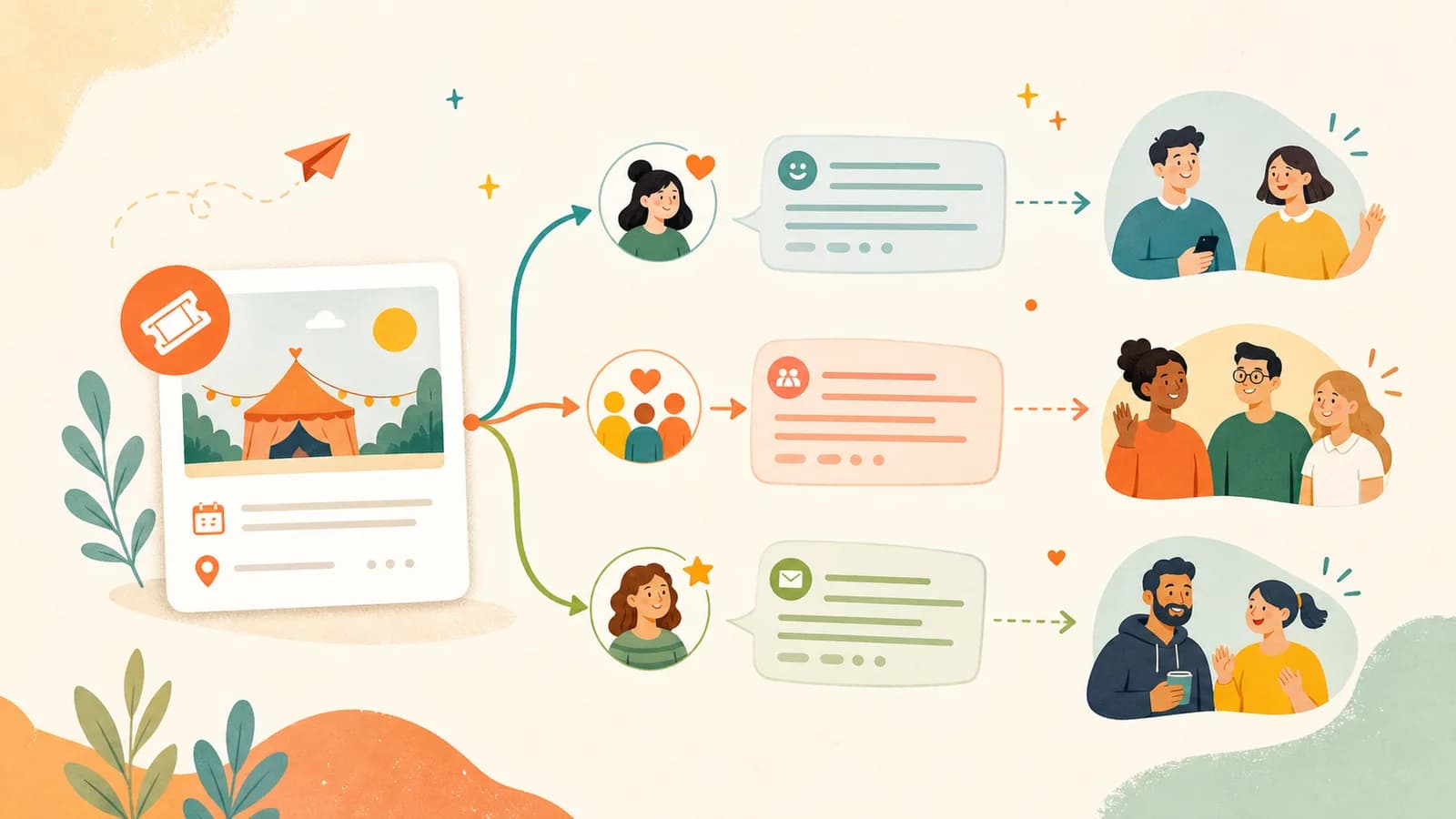
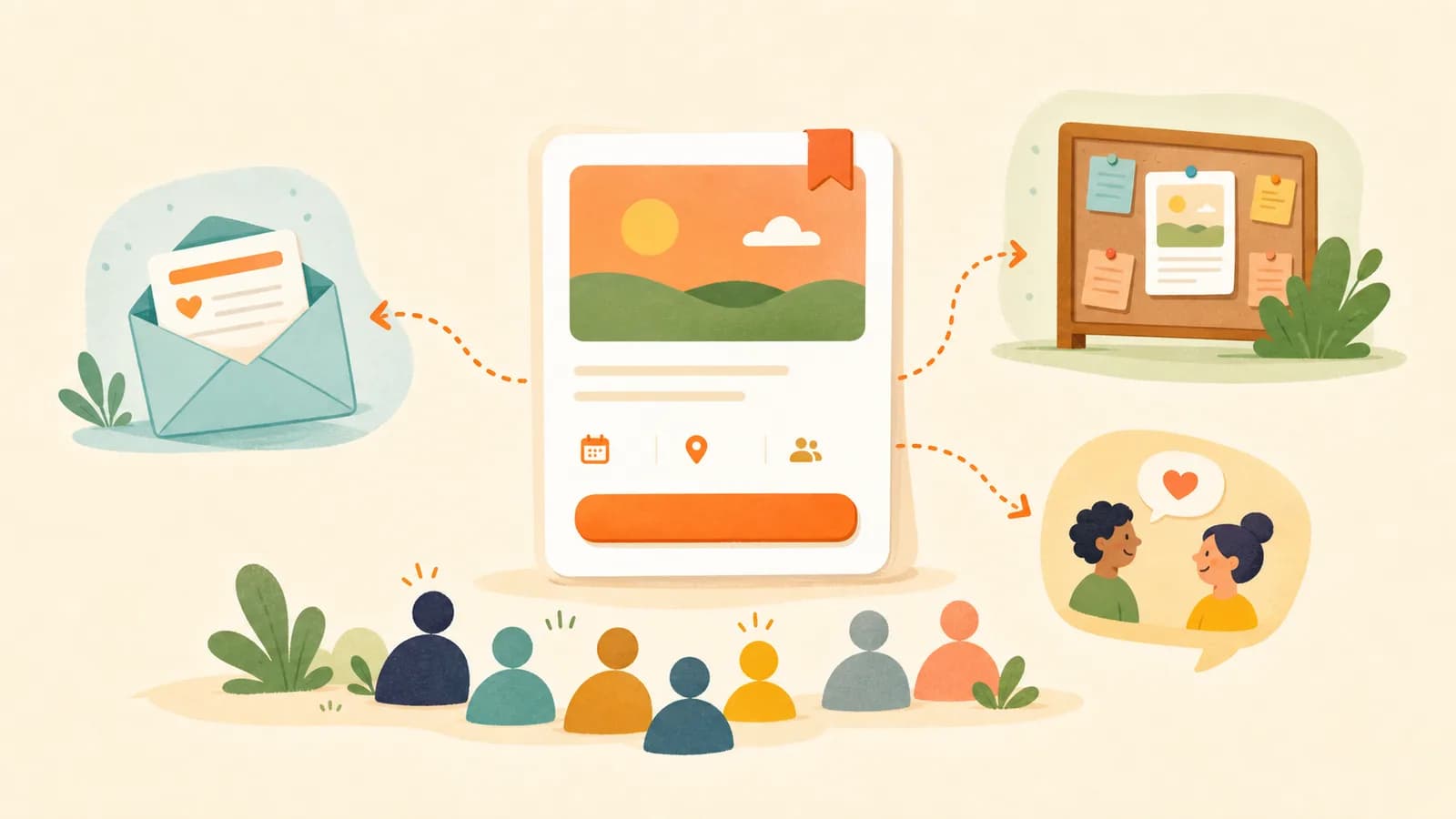
Do not make every channel do the same job. Direct messages are good for early, high-trust invitations. Community groups are good for reaching people with shared interest, but only if the event fits the rules and culture. Partner channels are useful when a venue, instructor, newsletter, or club shares the audience. Social posts are often better for visibility and story than for final commitment. Email can work when people have actually agreed to hear from you.
| Channel | Primary job | Best message shape | Risk to avoid |
|---|---|---|---|
| Direct messages | Early trust and first registrations. | Personal note with a reason you thought of them. | Making a generic broadcast feel personal when it is not. |
| Community groups | Relevant discovery beyond your own circle. | Audience fit, useful context, and a clear link. | Ignoring rules or posting a sales pitch in a discussion space. |
| Partner channels | Borrowed trust from a venue, club, teacher, or newsletter. | Short copy they can paste without rewriting. | Asking partners to "promote" without giving them usable copy. |
| Clear invitation to people who gave permission. | Specific subject line, short body, one event link. | Sending commercial email without consent or required details. | |
| Social posts | Story, preparation updates, and visible momentum. | Behind-the-scenes proof plus the event link. | Judging success only by likes or reactions. |
Separate discovery channels from commitment channels
A person may first notice the event in a social story, then register after a direct message, email, or partner recommendation. Treat that as normal. The promotional mistake is expecting one public post to perform every role: awareness, trust, objection-handling, urgency, and checkout. Business.gov.au's overview of marketing and advertising is useful here because it separates different marketing methods instead of treating promotion as one generic activity. For a small event, your job is to connect the right method to the right moment.
Write the Message for the Context
The core event promise should stay consistent, but the invitation should change by channel. A direct note can say why you thought of someone. A community post should respect the group's topic and rules. A partner blurb should be copy-ready. An email should make the subject line specific enough that the reader recognizes the event before opening.
Nielsen Norman Group's article on email subject lines is relevant even outside email because the same principle applies to social captions and message previews: vague openings cost attention. "Beginner candle workshop next Saturday" is more useful than "You're invited."
Use the five-part invitation structure
Most small-event invitations can use five parts: audience fit, concrete promise, logistics, reason to act, and link. The reason to act should be honest. Limited seats, material preparation, venue count, or a registration deadline can be useful. Fake urgency damages trust, especially when the host is trying to build a repeatable audience. If the event is paid, make the ticket value visible before asking for commitment.
Example community post:
Sharing in case this fits people here: I'm hosting a beginner-friendly candle workshop next Saturday for adults who want a relaxed creative evening. We'll make two hand-poured candles, choose simple scent blends, and package them to take home. It is a small group, all materials are included, and details are here: [event link]
Make partner copy easy to reuse
Partners are often busy. If you ask a venue, studio, club, or newsletter to share your event, give them a short paragraph, a one-line version, and the event link. Do not make them translate your idea from scratch. A good partner blurb names the host, audience, date, activity, and link in one clean paragraph. If the partner has their own audience rules, offer to adapt the copy rather than pushing a fixed sales message.
Example partner blurb:
Local host Mina Park is running a beginner flower-arranging workshop on Sunday afternoon for people who want to make a seasonal table piece without needing prior experience. The workshop includes materials, guided arranging time, and a take-home arrangement. Details and registration: [event link]
Use a Two-Week Organic Promotion Rhythm
A useful promotion rhythm creates enough repetition for people to notice without making the host sound frantic. For many small events, two weeks is a practical window. It gives warm contacts time to respond, partners time to share, and interested guests time to decide.
| Timing | Action | Reason |
|---|---|---|
| 14 days before | Publish the event page and send 10-20 personal invitations. | Warm invites test whether the promise is clear. |
| 10 days before | Ask one or two partners whether the event is relevant to share. | Partner channels need lead time and ready-to-use copy. |
| 7 days before | Post a preparation update, agenda preview, or material photo. | Proof of preparation makes the event feel real. |
| 4 days before | Ask for one-person referrals from trusted contacts. | Specific referral asks are easier than broad promotion asks. |
| 1-2 days before | Send a final relevant reminder where permission and context allow. | Some interested people need a decision cue close to the date. |
Use an illustrative conversion model to set outreach volume
Here is a scenario estimate, not a guarantee: if 30 people receive relevant invitations, 12 click the event page, and 5 register, the limiting factor may not be reach; it may be message fit or page clarity. If 30 people receive the invitation, 25 click, and only 1 registers, the problem is likely the page, price, timing, or event promise. This is why tracking the path matters. Likes and views can feel encouraging, but registrations reveal whether the invitation and page are doing their jobs together.
Do not let reminders become pressure
A final reminder should help people who already showed interest, not chase people who ignored the first message. If the reminder goes by email and has a commercial purpose, check the rules that apply to your audience and location. In the United States, the FTC's CAN-SPAM Act compliance guide is a useful starting point for commercial email expectations. For an international audience, treat this as one jurisdiction's guidance, not a global legal answer.
Ask for Referrals in a Way People Can Actually Use
Broad asks create friction. "Can you promote this?" makes the other person decide where to post, what to say, and whether the event fits their reputation. A better ask is smaller: "Do you know one person who would enjoy this?" That lets the other person help without becoming your marketer.
Give people a forwardable message
A forwardable message should be short enough to send without editing and specific enough that the recipient understands the event. Use the same event page link every time so registrations collect in one place. If the event needs dietary details, accessibility notes, or material choices, make sure the event page asks for those details rather than leaving the referrer to explain them manually.
Forwardable message:
A small beginner-friendly [event type] is happening on [date] in [place]. It is designed for [audience], and guests will [specific activity or outcome]. Details and RSVP: [link]
Respect community and inbox boundaries
Organic promotion is not permission to post anywhere. Community moderators, newsletter owners, and group members protect the quality of their spaces. Before posting, check whether events are allowed, whether paid events require disclosure, and whether the community expects a value-first explanation. Nielsen Norman Group's guidance on newsletters also reinforces a useful point for hosts: readers stay engaged when messages remain relevant and scannable. Relevance is a trust asset, not a cosmetic detail.
Track What Actually Created Registrations
The simplest organic promotion tracker has four columns: channel, message, registrations, and lesson. The lesson matters because the first event is also research for the next one. If direct messages worked and broad posting did not, the next event may need a narrower audience or stronger partner channel. If people clicked but did not register, the event page may need clearer inclusions, price framing, agenda, or capacity.
| Signal | What it might mean | Useful next action |
|---|---|---|
| Many replies, few registrations | People are interested but not ready to commit. | Clarify price, timing, inclusions, or deadline. |
| Many clicks, few registrations | The page may not answer buyer questions. | Improve agenda, host context, FAQ, and registration form. |
| Few clicks from a large post | The channel may be wrong or the opening weak. | Test a more specific audience sentence. |
| High conversion from personal notes | Trust is carrying the event. | Ask for one-person referrals from those contacts. |
When the tracker shows weak registration, avoid blaming the audience first. Check the promise, page, channel, and timing in that order. HereNow can help by keeping the event page, RSVP action, capacity, and public link in one place, so you are not sending people through disconnected forms and scattered updates.
Build the Promotion System in HereNow
Use HereNow as the single public link for the event, then let each promotion channel point back to that page. Browse event templates if you need a starting format, and review how to preview and publish your event page before sharing it broadly. If registration friction is a concern, use collecting RSVPs without forcing account signup to keep the guest path simple.
For the next practical step, pair this promotion plan with how to get your first 10 attendees and event invitation message examples. Those guides turn the channel plan into outreach lists and copy you can adapt.
FAQ
Can I fill an event without paid ads?
Yes, a small event can often start with organic promotion when the audience is specific and the host has some trusted channels. Organic promotion is not guaranteed, but a clear page, personal invitations, partner shares, and relevant community posts can be enough for a small room before paid ads make sense.
How many channels should I use for a small event?
Start with three to five channels that match the audience. A useful mix is direct invitations, one partner or venue channel, one relevant community, one email list if you have permission, and one social channel where your audience already pays attention.
Should I post the same event message everywhere?
No. Keep the same core promise, but adapt the invitation to the context. A direct message should explain why you thought of that person, while a community post should show why the event belongs in that space.
What should I do if nobody signs up after sharing?
First check the event page, then the audience sentence, then the channel. If people clicked but did not register, improve the page. If few people clicked, rewrite the opening message or choose a more relevant channel.
When should I use paid ads for an event?
Use paid ads only after warm promotion shows that the event promise and page can convert relevant traffic. Ads can amplify a working message, but they usually do not fix unclear positioning, weak trust details, or a registration path that feels confusing.