How to Host a Pottery Workshop
Plan a beginner pottery workshop around format, firing, materials, cleanup, capacity, registration, and a realistic two-hour run of show.

A pottery workshop is not finished when the making session ends. It is finished when each guest receives the right piece—or knows exactly why that piece could not be returned. Plan backward from that handoff: secure a qualified instructor and firing partner, choose a format the room can support, approve the clay and finish, label every kept piece, reserve time for wet cleanup, and publish only the return process you can actually deliver.
Close the Whole Workshop Chain Before Registration
A pottery workshop needs aligned owners for instruction, room operation, firing, piece tracking, and guest communication before registration opens. The same person may own several roles, but every role needs a name, an accepted method, and a fallback before guests can book. In HereNow, keep the event page in draft while any owner remains unresolved.
- Choose one beginner result: define what guests will make, how many pieces they may keep, and what “finished” means.
- Close the studio handoff: confirm materials, drying, firing, glazing, storage, damage reporting, notification, and pickup.
- Protect the room: set station, access, supervision, and wet-cleanup limits before setting the seat count.
- Publish the real promise: separate what happens in the room from what arrives weeks later.
Choose the Format by Stations and Beginner Success
The first format should be chosen by simultaneous station access, coaching load, cleanup, and the beginner result rather than by the most impressive technique. If the project is still open, compare six pottery workshop formats and select one object that can be taught, finished, labeled, and moved safely within the session.
| Decision | Handbuilding | Wheel throwing |
|---|---|---|
| Making access | Guests work together at tables | Each active guest needs a wheel |
| Coaching pattern | One demo can start the room | Frequent individual correction is common |
| Best first use | A shared beginner project | A small studio-led experience |
| Capacity check | Tables, tools, drying space | Wheels, instructors, cleaning time |
Start With Handbuilding When Everyone Needs Simultaneous Making Time
Handbuilding lets a group work at the same time with tables and simple tools, making it a practical first format when wheel stations are limited. Mudflat’s private workshop information presents handbuilding as a distinct group option alongside wheel throwing, then describes drying, trimming, two firings, glazing, boxing, and pickup over 4–5 weeks. That makes handbuilding useful when the guest outcome is a small bowl, cup, planter, tile, or sculptural object and the instructor can demonstrate one repeatable construction method.
It does not remove the back-end work. The host still needs approved clay, piece limits, drying space, firing, a label that survives handling, and a return plan. Choose handbuilding because it reduces station dependency, not because it turns ceramics into a no-studio craft.
Use Wheels Only When Stations, Instruction, and Cleanup Scale Together
A wheel workshop is workable when the number of wheels, instructor support, participant age rules, and cleaning time all fit the same seat count. Scenic City Clay Arts, for example, publishes private handbuilding for up to 20 people, wheel throwing for up to 8, and a typical pickup range of 4–6 weeks. Those figures belong to that studio, not every venue, but the contrast exposes the real constraint: a room with eight wheels does not automatically support eight beginners at the same time.
Ask the instructor how many first-timers one teacher can watch, whether guests rotate through stations, what happens to unsuccessful pieces, and how long each wheel takes to clean. If any answer lowers the serviceable group size, use that lower number.
Confirm the Firing and Pickup Promise Before You Buy Clay
The host should not buy materials or publish a pickup date until the qualified firing operator accepts the exact material system and return workflow. The first kiln firing that hardens dried clay before glaze is commonly called bisque firing; whether your project uses that sequence, another finish, or no glaze is the operator’s decision. Studio procedures show why the back end is part of the offer: storage locations, identifiers, logs, firing carts, pickup notices, and collection deadlines all require rules.
If the operator’s accepted service makes the offer too costly or slow, pause execution and check whether the pottery offer is commercially workable. Do not solve an operating mismatch by hiding firing or pickup from the event page.
Get the Exact Clay, Glaze, and Piece Limits Approved
Clay body, finish options, piece size, number of kept pieces, firing stages, timing, and damage boundaries should be accepted in writing by the operator. Treat that approval as a purchase gate, not as a note to confirm after supplies arrive.
- Project: one named object, maximum dimensions, wall-thickness guidance, and allowed attachments.
- Materials: exact clay body, any slips or underglazes, and who supplies each item.
- Finish: guest choices, host-applied choices, studio-applied choices, or no glaze.
- Service: drying, firing stages, storage, expected range, and who transports the work.
- Exceptions: what happens to cracked, broken, late, unsafe, or unclaimed pieces.
This is a host handoff checklist, not a kiln specification. The qualified operator controls technical compatibility and may reject a material, decoration, shape, or promise that does not fit the current studio process.
Give Every Piece an Identity That Survives the Workshop
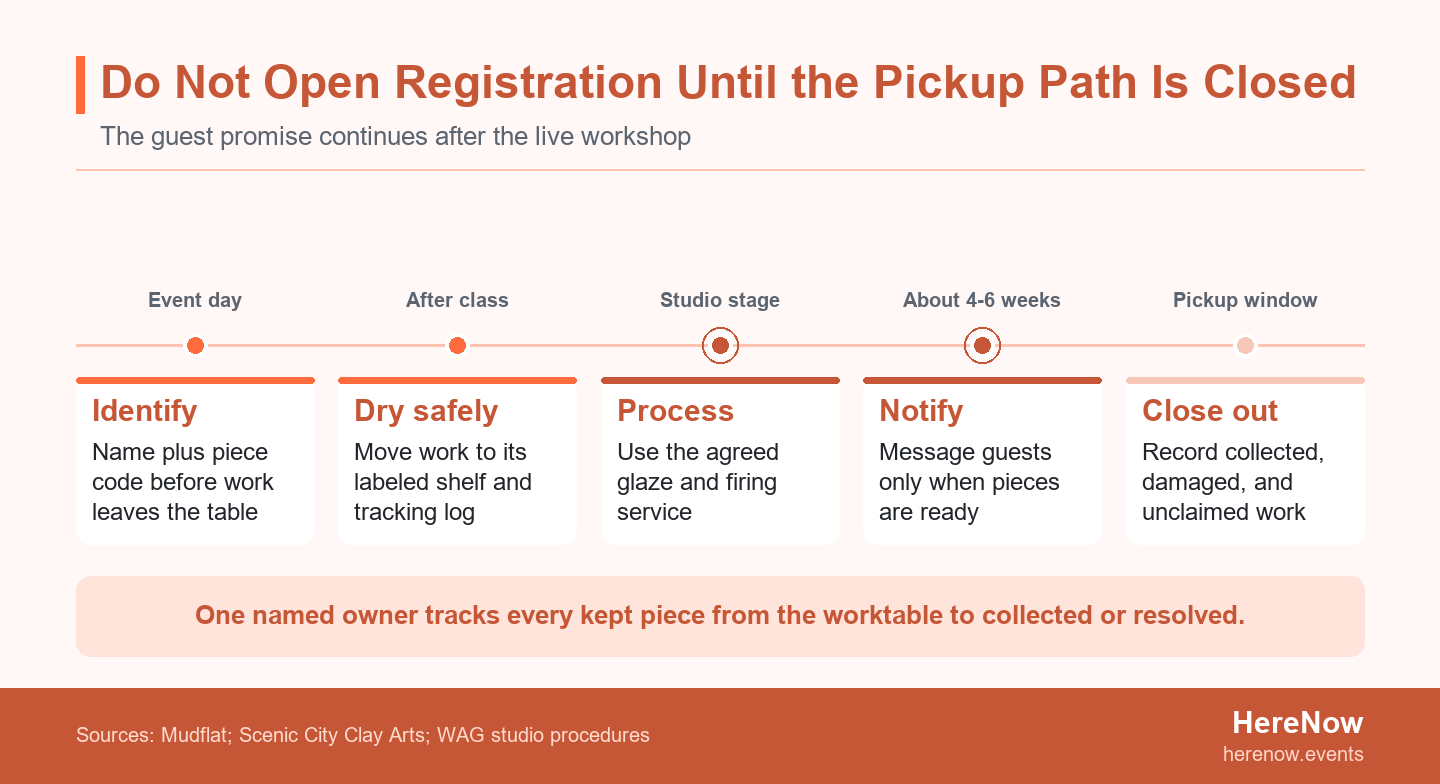
Each kept piece needs a durable identifier tied to a guest record, photo, finish choice, current stage, and pickup outcome. The WAG clay studio procedures use assigned shelves, labels, a photo or written log, firing carts, pickup messages, and collection windows. A guest name written on loose paper is weak because similar unfired clay work can pass through each of those locations before collection.
Agree on the studio’s physical marking method, then use one private record with a piece code, guest contact, photo, finish, current location, status, exception note, notification date, and pickup result. Assign one person to reconcile the worktable against that record before guests leave. The same owner should record breakage or delays and close out collected or unclaimed work. That creates one traceable path from the room to the guest without publishing personal details on the piece.
Build the Room for Making and Wet Cleanup
The room plan must support repeatable guest stations and a timed wet-cleaning route under the venue's ceramics safety rules. Approve it by walking a piece through arrival, making, temporary storage, cleanup, and removal—not by counting chairs alone.
Pack One Repeatable Station Kit Per Guest
A first handbuilding station should contain only the approved clay allowance, stable work board, minimum tools, small water supply, sponge, identifier, and protected place for the finished piece. Build one complete station first and have the instructor test it before copying the kit for the group.
Cal Poly’s handbuilding course information makes materials, tools, firing access, clothing, and closed-toe footwear visible parts of the class setup. Your exact kit may differ, but guests should not have to share one essential tool in a way that stops the whole room. Keep extra clay and specialist tools at a controlled supply point rather than crowding every station.
Treat Cleanup as a Timed Safety Block
Use wet wiping or wet mopping and the venue's approved vacuuming method rather than dry sweeping clay residue, with cleanup owned by named people and protected agenda time. Washington State Department of Health ceramics guidance recommends wet methods and HEPA-filtered vacuuming instead of sweeping, while the U.S. Consumer Product Safety Commission art-safety guide covers ceramic materials, housekeeping, and kiln ventilation. Together, those boundaries make cleanup a room requirement rather than a courtesy.
A first-time host should use the venue’s current controls rather than inventing a dust or kiln procedure. Before the event, confirm water access, sink rules, waste containers, floor method, approved vacuum, tool-washing sequence, wet-floor signs, and who performs the final room check.
Let the Tightest Live or Back-End Limit Set Capacity
Working capacity is the lowest defensible limit across stations, supervision, access, cleanup, drying, firing, storage, and piece handoff. Write a number beside each limit, then use the lowest confirmed number. A venue occupancy of twenty is irrelevant if the instructor can support eight beginners or the studio can safely store only ten projects.
Handoff load means the time and tracking needed to receive each kept piece after making.
For ten guests, one kept piece at 90 seconds per handoff uses 15 minutes, while two kept pieces use 30 minutes. The arithmetic is simple: guests × kept pieces × handling time. Under these illustrative assumptions, a 20-minute closing block can hold one piece per guest but not two.
The decision is not “work faster.” Cap the kept pieces, extend the close, add a trained handoff owner, reduce the seat count, or change the project. The 90-second input is a planning assumption, so rehearse the actual labeling and storage move. Then check the full event capacity against room, staffing, activity, and access constraints before publishing the final cap.
Ask Only for Details That Change Preparation
Every custom registration field should trigger a specific preparation, instruction, access, finish, or pickup action. The W3C forms guidance emphasizes clear labels, instructions, validation, and asking only for needed information. For this workshop, “needed” means the answer changes what the host does.
| Field | Why ask | Host action |
|---|---|---|
| Name and contact | Registration, changes, pickup notice | Link the guest to one private piece record |
| Experience level | Beginner pacing and support | Adjust the demo; do not screen out beginners |
| Access requirement | Seating, route, communication | Confirm an accommodation with the venue |
| Finish choice | Only if offered before class | Prepare and record the approved option |
| Pickup delegate | Only if the studio allows it | Record the authorized collection method |
Test each answer path before publishing. If a guest requests step-free access, who confirms the route and by when? If a finish option sells out, who updates the form? If someone cannot collect in person, does the studio permit a delegate or shipment? Remove any field whose answer disappears into an inbox. Add a short instruction wherever the guest might otherwise guess, and make errors specific enough to correct without starting over.
Do not collect a broad medical history, a vague “tell us about yourself” essay, or data with no owner and no action. Explain what is mandatory, what is optional, how guests can request support, and when pickup contact details will be used. Once the operational fields are settled, HereNow can help you turn the confirmed plan into a public event page and a focused registration flow.
Use a 120-Minute Run of Show With Protected Cleanup
A first two-hour handbuilding workshop should protect orientation, a compact demonstration, long making time, finish-and-label work, cleanup, and the pickup briefing as separate blocks. The sequence adapts the operational elements visible in the NWTC Ceramic Fundamentals class plan, including sign-in, safety, labeling, storage, making, cleaning, and pickup. It is an example agenda, not a universal ceramics curriculum.
| Time | Block | Required output |
|---|---|---|
| 0–10 min | Welcome and room rules | Guests know movement, water, tool, and cleanup boundaries |
| 10–25 min | Project demo | One achievable form, thickness rule, and stop point |
| 25–80 min | Guided making | Instructor coaches while the host watches time and supplies |
| 80–95 min | Finish and identify | Approved finish selected; every kept piece logged |
| 95–110 min | Wet cleanup | Tools, tables, water, waste, and floors follow venue rules |
| 110–120 min | Pickup briefing and close | Guests know the return range, message channel, and collection rule |
Protect the last 25 minutes. If making runs late, simplify the optional decoration or stop adding clay; do not delete labeling, wet cleanup, or the return briefing. Rehearse the project with the actual clay allowance and station kit, then let the instructor change the timing when the technique, group, or venue requires it.
Publish the Handoff, Not Just the Fun Part
The event page should distinguish the same-day experience from later drying, firing, glazing, notification, collection, and unclaimed-piece handling. Write the live promise and the later promise as separate blocks so a guest can understand what leaves the room and what returns.
- In the session: project, format, beginner suitability, duration, instruction, included materials, clothing, access, and cleanup participation.
- After the session: who processes the piece, which finish is included, the honest time range, how readiness is announced, where pickup happens, and the collection deadline.
- Exceptions: the confirmed policy for cracks, breakage, firing changes, delays, cancellation, and unclaimed work.
Avoid “take home your finished piece” when guests leave with empty hands. Say that the studio will dry and process accepted work, give the current estimated range, and explain that ceramics can change or fail during drying and firing. Publish only stages your named partner provides, and update registered guests if that process changes.
Open Registration Only After Five Owners Are Named
Registration should remain closed until instruction, room operation, firing, piece tracking, and guest communication each have an accepted owner. For each role, write the person or studio, the handoff they accept, the date they confirmed it, and the fallback if they become unavailable. This is an operating release check, not an allocation of legal liability.
When all five are closed, replace the sample agenda, firing, collection, and registration copy with the exact commitments you confirmed; if even one owner is missing, keep the page in draft. Use the HereNow beginner pottery workshop template.
Frequently Asked Questions
Can I host a pottery workshop without owning a kiln?
Yes, you can, if a qualified ceramics studio or firing service accepts the exact clay, finishes, piece sizes, and delivery process. Put in writing who dries, fires, glazes, stores, reports damage, contacts guests, and handles pickup. Do not bring outside clay to a kiln operator without approval, and do not promise a return date until that operator confirms the current service range.
Is handbuilding or wheel throwing better for beginners?
Handbuilding is usually easier to scale for a first group because guests can work together at tables. Wheel throwing can be excellent for beginners when every active guest has a wheel, the instructor can give timely individual support, and the venue has enough cleaning time. Choose the format that gives each person a realistic beginner result within the actual station and staffing limits.
How long does pottery usually take to be ready for pickup?
Many public studio examples give a return window of roughly four to six weeks, but there is no universal turnaround. Drying, firing schedules, glazing, studio workload, and unexpected breakage can change it. Publish the range your firing partner confirms, say that it is an estimate, and contact guests only when their pieces are actually ready.
What should guests wear to a pottery workshop?
Ask guests to follow the venue’s current rules and wear clothes that can get clay on them. Secure footwear, short or tied-back hair, trimmed nails, and removing loose jewelry may make some projects easier or safer. State the actual requirements on the event page and in the reminder rather than assuming every pottery venue uses the same dress policy.