How to Turn Pottery Skills Into a Paid Workshop
Choose a beginner pottery format, map firing and material costs, set capacity, and test one paid workshop without opening a full studio.
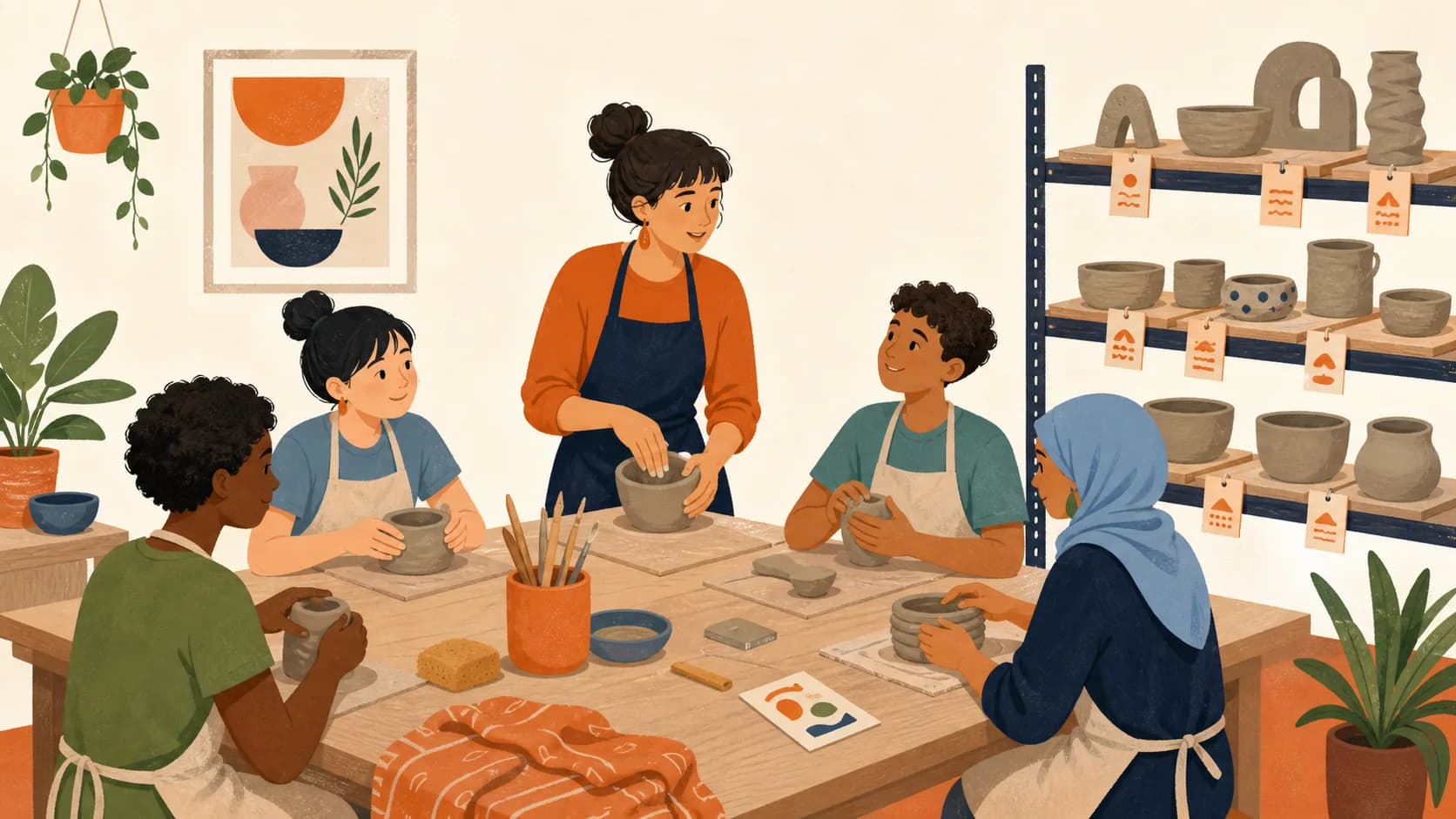
A pottery skill becomes a credible paid workshop when one beginner result fits one room, one supervised making session, and one explicit firing-and-return process. Start smaller than your full expertise: a handbuilt pinch pot, small planter, or textured tray is easier to price and deliver than “an introduction to ceramics.” Before selling a seat, confirm the safe capacity, the person responsible for firing, the pickup date, and whether the minimum paid attendance fits the real production limit.
What Has to Be True Before You Sell a Seat?
- The result is narrow: a beginner can attempt one named piece in the available session, without a promise of mastery.
- The production chain has owners: you know who handles setup, drying, firing, glazing if included, cleanup, and return.
- The economics fit the room: the paid attendance needed to cover entered costs does not exceed safe delivery capacity.
- The handoff is public: guests know what they receive on the day, what comes later, when pickup happens, and what can go wrong.
If one condition is missing, change the offer before calling it a business. A first event is a small paid test, not proof of stable demand or future income.
Choose a Format Your Production Chain Can Finish
Choose the smallest production chain that named owners can complete. Here, the firing chain means the sequence from drying through kiln firing, glazing when included, and the return of the finished piece. The class may last two hours, but the promise often continues for days or weeks after guests leave.
Use this comparison to choose the first version. The table is not a ranking: a trained studio can make a wheel format practical, while a hired room without ceramics infrastructure may make even a simple glaze promise unrealistic.
| First format | What the guest can expect | Main constraint | Use it when |
|---|---|---|---|
| Handbuilding, one visit | Make one small piece; host or partner finishes firing later | Drying, storage, firing, and pickup | You need a lower-equipment test with a narrow result |
| Partner-studio workshop | Use approved clay, tools, glazes, and the studio firing service | Studio schedule, material rules, and station count | The venue already owns the production system |
| Two-visit workshop | Build first, then return to glaze after the initial firing | Two-date commitment and work tracking | Glazing is essential to the promised experience |
| Wheel demonstration plus guided try | See the technique and take a short supervised turn | One wheel, cleaning time, and limited practice | The promise is exploration, not a finished wheel-thrown piece for everyone |
A simple branch makes the choice clearer:
- If a trained studio partner provides approved materials, stations, firing, and storage, design within that partner's system.
- If you have firing support but few specialized stations, choose a handbuilding result that all guests can attempt together.
- If you have neither a confirmed firing route nor a same-day material designed for the purpose, do not promise a finished ceramic piece yet. Run a demonstration, find a partner, or change the material.
For more variations, browse these pottery workshop ideas, then reject any idea whose back-end work you cannot own.
Start With Handbuilding When Equipment Is the Constraint
Ceramic Arts Network describes handbuilding as forming clay without a wheel, using hands, fingers, and simple tools; common methods include pinch, coil, and slab work. That makes a handbuilding event easier to scale across one table because every beginner does not need a powered station.
The lower equipment load does not remove the difficult parts. Wet pieces still need protected drying space, labels that survive handling, a compatible firing plan, and a return system. Choose a result that is small enough to move safely and distinct enough that pieces will not be confused. A good first promise is “build and texture one small planter,” not “learn pottery.”
Use a Partner Studio When Firing Is Part of the Promise
A partner studio can remove the need to own a kiln, but only if it accepts responsibility for the exact material system. Georgia Tech's Paper and Clay studio publishes a staged create, bisque, glaze, final-fire, and pickup schedule. Bisque firing hardens dried clay before glazing. Material rules can be equally strict: University of Maryland Studio A includes access, firings, glazes, and tools while prohibiting outside clay and glazes. Together, these examples show why “workshop finished” and “piece ready” are different dates.
Ask a potential partner which clay bodies, glazes, sizes, kiln temperatures, labeling methods, turnaround times, and damage policies it accepts. Do not buy materials or publish pickup dates until those answers are written down.
Validate the Beginner Promise Before Buying Equipment
Test the exact offer with reachable beginners before leasing space or buying major equipment. The U.S. Small Business Administration separates demand, location, market saturation, and the prices of alternatives into distinct research questions. For a pottery workshop, that means “people like ceramics” is not enough. You need to know whether a specific group wants this result, at this place, with this return process, near this price.
Write a one-screen test message containing the finished result, intended beginner, duration, approximate price range, location area, and pickup timing. Send it personally to a small qualified group, a relevant local community, or people who have already asked about your work. Ask one decision question: “Would you reserve this format on either of these dates?” A waitlist or refundable deposit can create a stronger signal than likes, provided the terms are clear.
Set a threshold before asking. For example: continue to a dated page only if at least twelve relevant people request details and at least six accept the stated price range. Those numbers are planning assumptions, not a conversion benchmark. Choose them from your actual reach, minimum viable capacity, and cancellation risk.
The broader method in turn any repeatable skill into a paid workshop can help narrow the guest result. Pottery needs the added production test: every interested person adds not only a seat, but also clay, drying space, firing volume, tracking, and pickup work.
Build the Price From One Seat and One Firing Chain
A useful first price starts with two lists. Fixed costs do not change when one more guest joins: room hire, planned host time, setup, admin, insurance allocated to the event, and a contingency. Variable cost rises with each guest: clay, underglaze or glaze, consumables, firing, packaging, payment fees when charged per sale, and any per-piece partner fee.
The same SBA planning resource gives the unit break-even formula: fixed costs divided by price minus variable cost per unit. For an event, break-even seats are the number of paid seats needed for the entered ticket revenue to equal the entered costs. The formula does not tell you what guests value, and it cannot cover an expense you forgot to enter.
When the production and cost answers agree, HereNow can turn the confirmed pottery offer into a public page without changing the promise. The page should carry the same seat cap, inclusions, timing, and handoff that made the calculation viable.
Replace every assumption with quotes and obligations from your room and firing partner. The workshop pricing calculator can keep fixed costs, per-guest costs, host time, fees, capacity, and buffer visible while you compare versions.
Illustrative Eight-Seat Cost Model
This example is a decision aid, not a suggested market price:
- Room: $120
- Planned host time: $180
- Setup and contingency: $30
- Clay, consumables, partner firing, and simple packaging: $18 per guest
- Proposed ticket: $65
- Working capacity: 8 guests
Under these assumptions, fixed costs are $330 and contribution per ticket is $47. The calculation is $330 ÷ ($65 − $18) = 7.02, so the event crosses break-even only at the eighth paid seat. At eight seats, revenue is $520 and modeled cost is $474, leaving $46 before taxes, refunds, any unentered payment fee, breakage, extra cleanup, or additional labor.
Decision: if the complete production chain cannot safely serve eight guests, change the price, cost, or format before publishing.
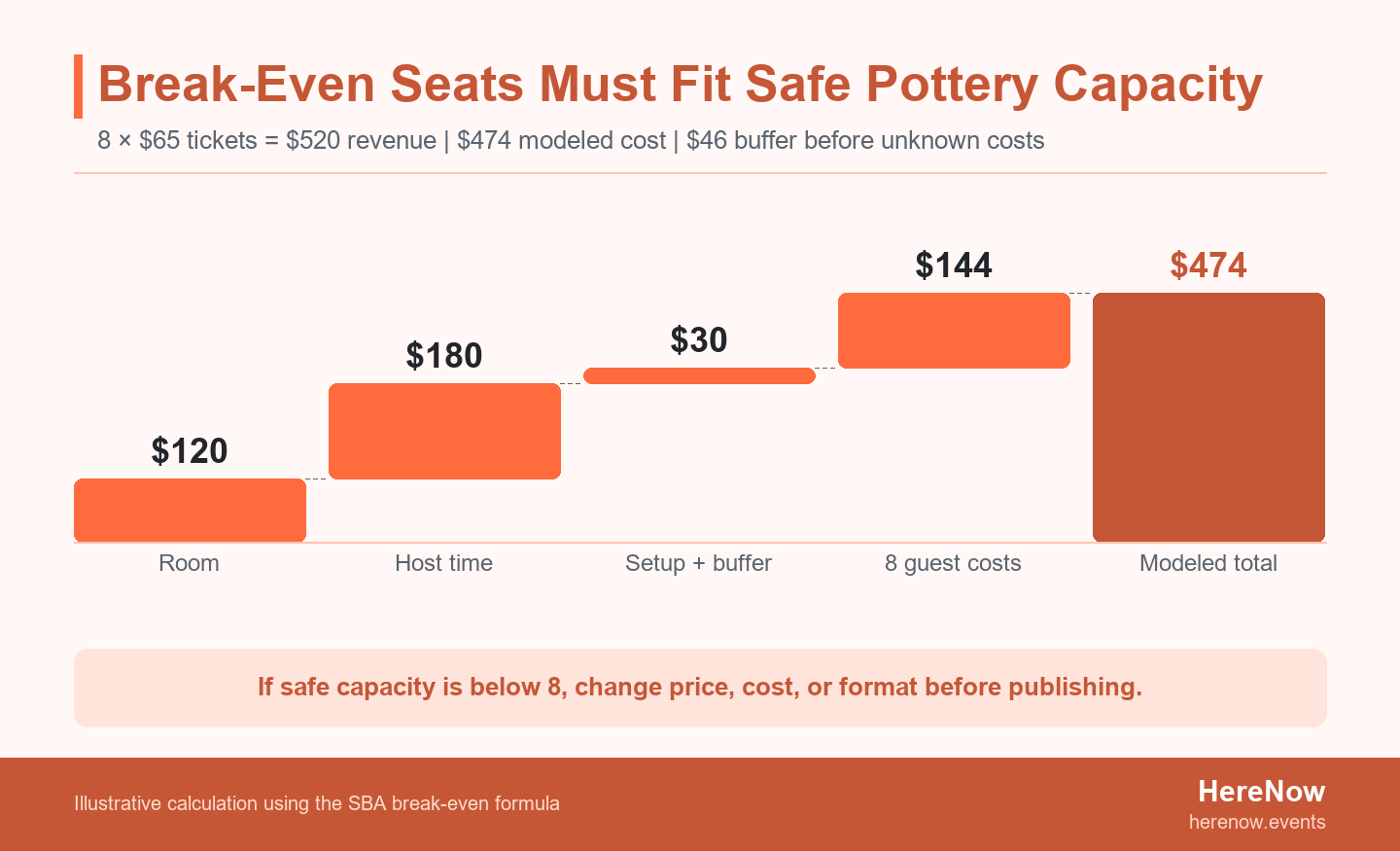
That result creates a go-or-change rule. If your safe capacity is six, this version does not work merely because six people want it. Raise the ticket price, reduce a real cost without weakening delivery, find a better format, add another revenue source that guests understand, or stop. Do not quietly remove host time from the model to make the arithmetic look profitable.
Let the Tightest Production Constraint Set Capacity
The lowest limit across supervision, workstations, drying shelves, kiln load, cleanup, and pickup controls the event capacity. A room may legally hold twenty people while the host can safely supervise eight beginners, the partner can fire ten small pieces, or the drying shelf can protect only six. The smallest defensible number wins.
Walk through one guest from arrival to pickup and ask where the line forms. Count tool sets, water access, stable table space, safe movement around wet floors, pieces per kiln load, labeled storage positions, and minutes of individual help. Then repeat the walkthrough for every additional seat. If adding the ninth person makes cleanup rushed or pushes firing into a second charged load, that seat changes both risk and cost.
Capacity can change when the promise changes. A demonstration with short guided turns may support more people than a finished-piece workshop. A second trained facilitator may raise the supervision limit, but it also adds cost and needs a defined role. Use the event capacity planner to compare room, staffing, activity, accessibility, and service constraints; keep the pottery production limit as an explicit extra input.
Make Dust, Kiln, Glaze, and Pickup Someone's Job
A first paid event should use the safety system of a suitable ceramics venue or an experienced partner. It should not turn a hired meeting room into an improvised clay studio. Confirm ventilation, surfaces, water, cleanup equipment, material storage, waste disposal, first aid, accessibility, insurance, and local requirements with the venue before accepting bookings.
Clay dust needs a concrete cleanup rule. The Washington State Department of Health recommends wet mopping or wet wiping and a HEPA-filtered vacuum instead of sweeping dust. Keep clay damp, prevent dry scraps from being crushed underfoot, and assign cleanup to someone who has the right equipment and enough time after guests leave.
Kiln and glaze work also need named ownership. The CPSC Art and Craft Safety Guide covers ceramics hazards, kiln ventilation, and dust controls. A real studio may set an even clearer operational boundary: UC San Diego's Craft Center restricts kiln-room access and requires members who want to load and fire kilns to complete training and pass a safety test. For a first event, letting the trained venue operator own firing is usually more credible than adding kiln operation to the host's promise.
Write a responsibility list before publication:
- Host: instruction, attendance cap, guest briefing, piece labels, and the promised contact path.
- Venue or studio: approved materials, ventilation, cleanup system, kiln schedule, firing decisions, and storage limits.
- Guest: following studio rules, using provided materials, and collecting work by the stated deadline.
Also decide what happens when a piece cracks, glaze changes, firing is delayed, or a guest misses pickup. Ceramics has normal process uncertainty. Describe it without hiding it and without promising food safety, durability, or a finish the material and firing process have not established.
Publish the Result, Boundaries, and Return Date
A trustworthy event page follows the piece all the way to the guest. State the exact beginner result, whether the session uses handbuilding or wheels, what materials and firing are included, what guests should wear, the access details, the seat cap, and who the event is not designed for. Then name the estimated firing or pickup window and how updates will be sent.
Avoid “take home your handmade ceramic” if the item stays behind for firing. Better copy is specific: “Build one small textured planter during the event. The studio will dry and bisque-fire it, apply the selected studio glaze, and email you when pickup opens, currently estimated within three weeks.” Replace that example with your actual process and include the partner's uncertainty policy.
Use focused registration questions: name, email, relevant access request, and any material or participation information the venue genuinely needs. Do not turn the form into a survey. If the format is ready, HereNow's current help page explains how to set up a first paid event. The platform can publish the page and collect registrations, but the host remains responsible for truthful terms, local compliance, and safe delivery. If you want to understand the company behind the workflow, read the HereNow story.
Review the First Firing Cycle Before You Repeat
Do not judge the first workshop when the room empties. Review it after the firing and pickup cycle ends. Compare the promised result with completed pieces, planned minutes with actual bottlenecks, entered costs with paid invoices, the expected return date with the real date, and registration interest with paid attendance.
Choose one of three next decisions. Repeat when the result was clear, the production chain stayed inside capacity, costs were captured, and pickup worked. Revise when one constrained input can be changed, such as piece size, seat cap, glazing method, partner terms, or price. Retire the format when the required economics keep exceeding safe delivery or the partner chain cannot support the promise.
One event is directional evidence, not a stable business. Record what changed and test only the next version you can explain.
Use a Go-or-Change Check Before Publishing
Publish only when five answers agree: what the beginner makes, who owns firing, when the piece returns, how many guests the full chain can support, and how that capacity compares with break-even seats. If any answer is missing, change the format before accepting money.
When those answers are concrete, open the beginner pottery workshop template and replace every placeholder with the real venue, materials, timing, and return terms. Then create your pottery workshop page for one bounded first event.
Frequently Asked Questions
Can I run a pottery workshop without owning a kiln?
Yes, if a partner studio or firing service accepts the exact clay and glaze system and takes clear responsibility for the firing process. Confirm material restrictions, piece-size limits, price per piece or load, turnaround time, labeling, storage, damage handling, and pickup before publishing. If no partner accepts the work, remove the finished-fired-piece promise rather than assuming you can solve the kiln step after people pay.
Is handbuilding better than wheel throwing for a first workshop?
Handbuilding is often easier to test because it needs fewer specialized stations and lets beginners work at the same time. Wheel throwing can still be a strong format when a studio has enough wheels, trained support, cleaning time, and a realistic promise. Choose by production capacity and guest result, not by which technique looks more impressive in promotion.
How should I price a beginner pottery workshop?
Start with fixed event costs, per-guest clay and firing costs, host time, fees, and a visible contingency. Divide fixed costs by ticket price minus variable cost to find the break-even seat count, then compare that number with safe capacity. A cost floor is not the final value-based price, and a full event does not guarantee profit if taxes, refunds, breakage, or labor were omitted.
Can guests take their pottery home on the same day?
Only unfired or purpose-made air-dry projects normally leave the same day. Kiln-fired ceramic work needs drying and firing, and a glazed result may need an additional stage. Tell guests what stays behind, who tracks it, the estimated return window, how pickup or shipping works, and what happens if a piece cracks or the kiln schedule changes.