Recurring Events: Meaning, Examples and Planning
A recurring event repeats on a planned schedule. Compare weekly, monthly, and fixed-series examples, and learn how to handle RSVPs and date changes.
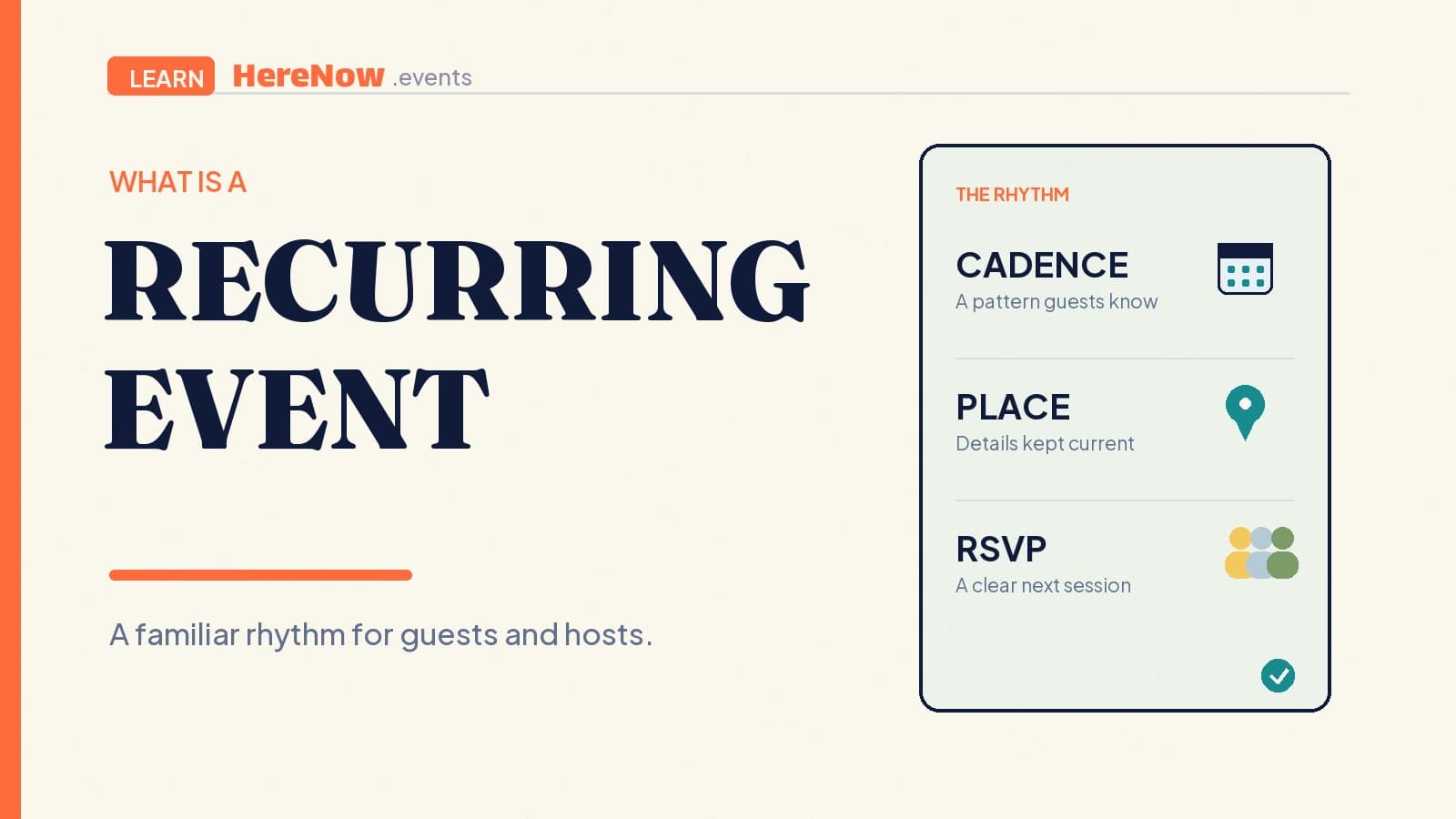
A recurring event is a gathering that follows a planned rhythm: every week, every other Thursday, the first Sunday of each month, or another stated pattern. The format may stay familiar while the details change from session to session. For an independent host, a recurring event is less about filling a calendar indefinitely and more about giving guests a dependable reason to come back, while creating a repeatable hosting habit that gets easier to run.
Recurring event examples at a glance
- Weekly run club: a Saturday morning run followed by coffee. Guests can choose individual dates; pace and meeting point stay easy to find.
- Monthly supper club: the first Friday of each month, with a changing menu. Each date has its own capacity and dietary-information deadline.
- Fixed workshop series: six Tuesday evening pottery sessions. Explain whether registration covers the entire series or one session.
- Annual neighborhood picnic: one gathering each year. Publish the confirmed date rather than assuming last year's date still applies.
Recurring does not mean automatically booked. Say whether guests must RSVP for each date, whether one ticket covers several dates, and what happens when a session moves or is cancelled. To plan a first edition, start with the run-and-coffee event template and give that edition its own confirmed date.
The short definition
A recurring event is a series of related event instances scheduled according to a frequency and a timeframe. A weekly run club, a monthly supper club, a six-week pottery class, and an annual neighborhood picnic can all be recurring events. What makes them recurring is the deliberate pattern, not the size of the audience or whether every session has identical content.
Calendar systems treat recurrence in the same practical way. The iCalendar standard describes a recurrence set as a group of instances generated from a start date, recurrence rules, added dates, and excluded dates. Hosts do not need to learn calendar syntax, but they do need the underlying discipline: tell people when the pattern begins, how often it happens, and what changes when one date is different.
A series is not the same as a repeated idea
You can host two unrelated workshops about bread and still have two standalone events. You have a series when guests can recognize a continuing promise. That promise might be “a relaxed Monday language exchange for intermediate speakers,” “one local maker and one skill each month,” or “a sunrise walk on the first Saturday.” The topic can evolve, but the guest should know what remains reliable.
That is why a recurring event needs both consistency and room to adapt. Consistency comes from the host’s point of view, a familiar cadence, and a clear way to join. Adaptation comes from changing the guest speaker, route, lesson, or seasonal theme. Without consistency, each date feels like a fresh marketing problem. Without adaptation, guests may not have a reason to return.
Choose a rhythm guests can understand
Frequency is part of the invitation. A weekly format can work well for a run club or a co-working table because the activity is easy to repeat and guests can miss a date without falling behind. A monthly format often suits supper clubs, salons, and community workshops because it gives the host more time to prepare. A fixed-length series, such as four Tuesday evenings, is useful when sessions build on one another.
Set an ending point whenever it would make a guest’s decision easier. Google Calendar’s guidance for repeating events asks organizers to choose both how often an event repeats and when it ends. That same clarity helps in a public event page. “Every Wednesday, April through June” means something different from “weekly, ongoing.” Neither is better; the important part is that the promise is accurate.
What should repeat, and what can change?
- Keep the core promise: the audience, tone, and reason to gather should be recognizable from one date to the next.
- Keep the joining path simple: guests should find the next session, time, place, and RSVP action without searching through old posts.
- Vary one meaningful detail: rotate a prompt, route, maker, reading, or seasonal theme so the format stays alive.
- State exceptions early: if a holiday changes the location or skips a date, say so on the current event page and in the reminder.
This balance is especially useful for a community event. Guests often return because the social environment feels familiar, while a small change gives them something new to talk about. Regularity can support connection, but it is not automatic: the host still has to make newcomers feel included rather than assuming returning guests will do that work.
A practical example: a six-session workshop series
Consider a host who wants to run a beginner printmaking program. Rather than listing six disconnected classes, they publish “Printmaking After Work,” meeting every second Thursday for three months. The first session covers materials and safety; later sessions introduce texture, color, and simple editions. Each page keeps the same arrival details, accessibility notes, and RSVP process, while the session description explains the week’s focus.
The host can learn after each date: Was the evening convenient? Did newcomers know what to bring? Did the pace work? Those observations improve the following session and the next series. This is the operational benefit of recurrence: it gives a host a bounded loop for learning, not a promise that every date will be full. If you are deciding whether the format is instruction-led, this guide to what a workshop is can help clarify the guest expectation.
Design for regular contact, not pressure
Recurring events can create repeated opportunities for people to meet, but hosts should not overstate what that means. University of New Hampshire Extension notes that recurring community events can help maintain social capital because people meet and interact regularly, while also warning that organizers may need targeted efforts to reach beyond existing circles. In practice, that can mean a short welcome at each session, a clearly marked low-pressure RSVP, or an invitation that explains whether first-timers can join.
Research from the National Endowment for the Arts also reports associations between arts attendance and participation in social groups. An individual event cannot guarantee connection or belonging. A host can, however, make the next step kinder: name the format, keep the logistics current, and give each guest a clear place in the room.
When the format is ready, create a shareable event page for the next session with the current date, location, and RSVP path. Use the same language across the series so guests recognize it, then update the details that truly change. A recurring event should feel dependable, not stale.
FAQ
How often should a recurring event happen?
Choose the rhythm your guests and your preparation can genuinely support. Weekly works when the activity is light and easy to join; monthly gives more room for planning; a fixed six-session series suits learning that builds over time. Start with a short, stated run of dates if you are unsure. You can continue after learning what the format asks of everyone.
Should every recurring event use one RSVP page?
It depends on what changes. One overview page can explain the series, but each date should make its own time, location, capacity, and joining terms clear. A separate current-session page is often easier for guests, especially if attendance is limited or the venue changes. The useful test is whether a guest can tell exactly what they are joining today.
What happens if I need to skip or move one session?
State the exception as soon as you know it, rather than silently editing an old post. Update the current session’s event page, tell registered guests through the channels you have promised, and make the next regular date visible. A one-off change does not break a series; unclear information does. Protect the pattern by being specific about the exception.