Event Agenda: Meaning and a 2-Hour Workshop Example
Build an event agenda with a two-hour workshop example. Learn what guests need to see and how an agenda differs from a schedule or run of show.
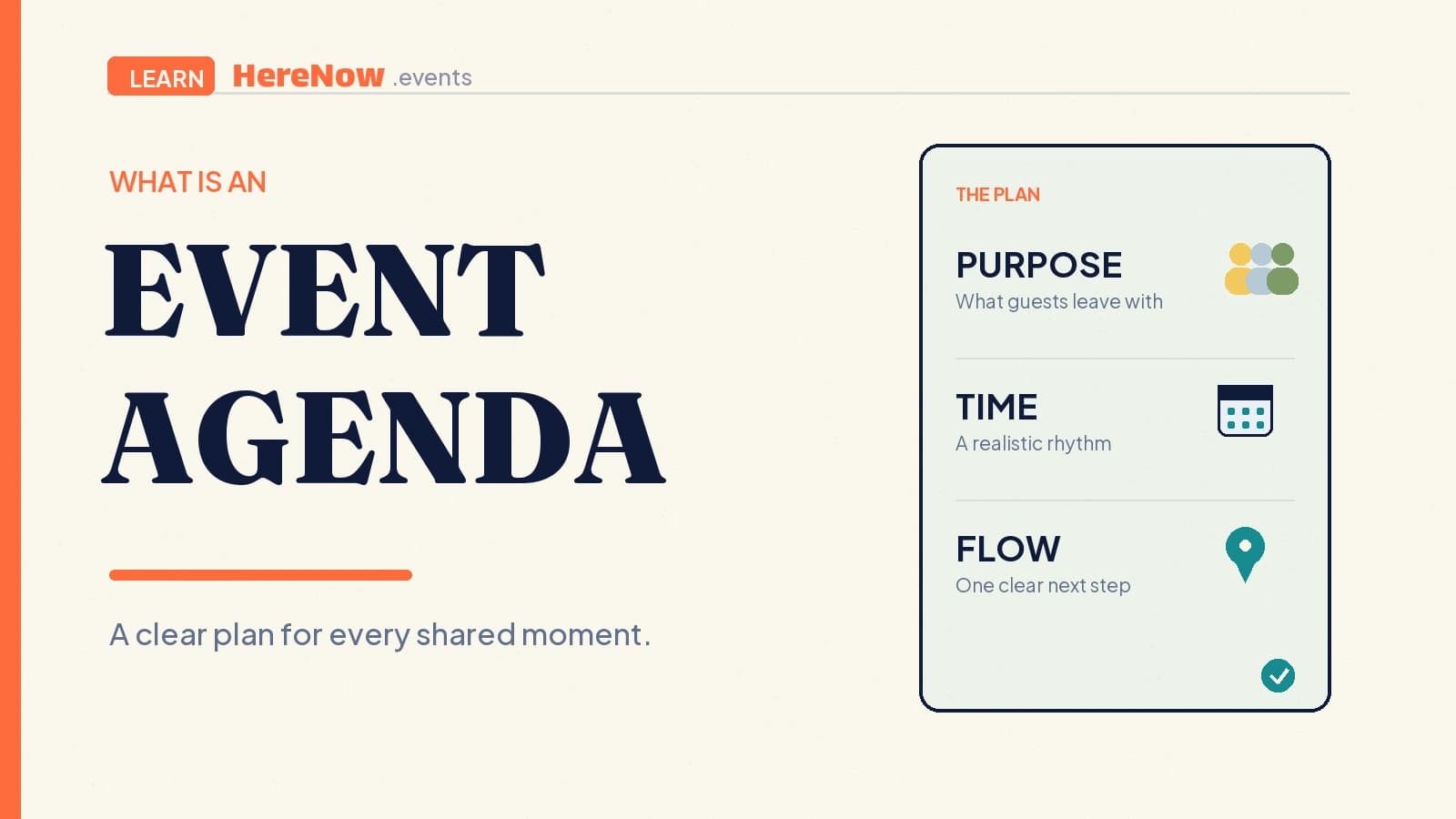
An event agenda is a timed plan for what will happen during a gathering, in the order guests and hosts need it to happen. It turns an event idea into a sequence of arrivals, activities, breaks, transitions, and a close. For a small workshop, supper club, language exchange, or walk, a good agenda tells guests what to expect while giving the host a practical guide for making the time feel intentional rather than improvised.
Example: a two-hour beginner workshop agenda
This sample gives guests a clear sequence and leaves the host time for practice, questions, and cleanup. Adjust the durations to the skill, venue, and group size.
- 10:00–10:10 — Welcome: introductions, the finished result, and practical guidance.
- 10:10–10:30 — Demonstration: show the technique and explain materials.
- 10:30–11:15 — Guided practice: guests work while the host helps individually.
- 11:15–11:25 — Short break: refreshments and informal questions.
- 11:25–11:45 — Finish and share: complete the work and compare approaches.
- 11:45–12:00 — Cleanup and next steps: pack away, explain collection or follow-up, and close on time.
Before sharing, add the actual date, time zone, venue, and any arrival instructions. Use an event template with an editable agenda to keep the plan alongside the RSVP details, or check the workshop price before publishing.
An event agenda is a plan for the experience
An agenda is more than a list of topics. It joins the purpose of a gathering to the time people will spend together: what comes first, how long each part has, who leads it, and what should be different by the end. The University of Nevada, Reno Extension makes a useful distinction: the purpose is the destination, while the agenda is the path participants take to reach it.
That path can be simple. A neighborhood photo walk might have only welcome, route briefing, walking time, a sharing circle, and goodbye. A skill class may need materials setup, a demonstration, practice time, questions, cleanup, and next steps. The right level of detail comes from the promise you made to guests, not from a generic event template.
Agenda, schedule, and run of show are different tools
People often use these terms interchangeably, but each helps a different person make a decision. A guest-facing agenda explains the shape of the experience. A schedule may simply state start and end times. A run of show is the host or team’s operational version, with setup cues, handoffs, supplier arrivals, and contingency notes that guests do not need to read.
For example, a workshop page can show “Welcome and materials orientation, 6:30–6:45” while the host’s run of show also records “open doors at 6:15,” “put drying racks by the sink,” and “begin cleanup reminder at 8:05.” Keeping the public agenda clear and the working notes separate avoids overwhelming first-time guests without leaving the host to remember every transition.
What guests should see before they RSVP
The public version should answer the questions a potential guest is already asking: What will I do? When should I arrive? How much of the time is participatory? Will there be a break? What happens at the end? A community event agenda can be short, but it should still make its rhythm visible enough for someone to decide whether it fits their time, energy, and comfort.
- Start and arrival: state the arrival window and whether a late arrival is workable.
- Core moments: name the few activities that make the gathering worth joining.
- Time boundaries: show realistic start, break, and finish times rather than optimistic placeholders.
- Next step: say whether the group will share resources, choose a future topic, or simply close.
Sending this structure in advance can help people prepare. The University of Minnesota Extension recommends beginning with the intended result, then choosing the time frame, topics, participation approach, and a few minutes for closure. That is a useful host check, not a promise that every minute will run perfectly.
The host's working agenda needs owners and choices
A host-facing agenda is where a pleasant outline becomes runnable. For every meaningful item, add the outcome, a time box, a lead person, and the method. MIT Human Resources demonstrates the structure as item, desired outcome, priority, time, who, and how. Its sample agenda is designed for meetings, but the same logic helps an independent host decide whether a 15-minute discussion, a partner exercise, or a demonstration has enough room to do what it is meant to do.
Use this version to protect the essential parts of the event. If a welcome runs long, the host can shorten an optional prompt instead of silently taking time from the hands-on activity. If a co-host is late, the agenda makes it clear which segment can move first. It is not a script to obey at all costs; it is a shared reference for making calm choices when real life changes the plan.
Build an agenda backwards from one guest outcome
Start with a sentence that describes what a guest should leave with: “I have learned one printmaking technique,” “I have met three nearby readers,” or “I know the route and feel comfortable joining the next walk.” Then work backwards. What activity gives that outcome a real chance to happen? What instructions or materials must come before it? How much transition time does the room or group need?
Michigan State University Extension’s agenda guidance includes a clear purpose, planned inclusion, start and end times, estimated timing for discussion items, action items, and advance distribution. Those elements are especially useful when a gathering includes people who do not already know one another. They help a host make participation an intentional invitation, not a vague hope.
Leave a little slack around the parts that depend on people: arrivals, questions, moving between spaces, serving food, and packing up. A two-hour agenda that contains exactly 120 minutes of activity has no room for the ordinary delays that make guests feel rushed. A calmer plan is usually a smaller plan with a clear priority.
Example: a 90-minute language-exchange agenda
Imagine a host running “Sunday Spanish for Beginners” in a café back room. The guest-facing agenda says: arrive from 3:00; welcome and simple introductions at 3:10; guided pair prompts at 3:25; a short break at 4:00; a group word game at 4:10; and a closing circle at 4:25, ending at 4:30. That tells a newcomer that the event is participatory, beginner-friendly, and bounded.
The host’s copy adds the outcome for each part: introductions should help each person say their name and one interest; pairs should practice a small set of prompts; the closing circle should let guests choose next week’s theme. It also assigns a co-host to welcome late arrivals and puts a five-minute buffer before closing. On HereNow’s event-creation flow, a host can begin with that simple idea, make the public agenda editable, and share a clear RSVP path once the details are ready.
Frequently asked questions
How detailed should an event agenda be?
Give guests enough detail to understand the experience and decide whether to join. Give the host more detail: owner, intended outcome, materials, timing, and backup choice. A small social gathering may need only five public lines, while a hands-on class may need a fuller sequence of setup, demonstration, practice, and cleanup.
Should an agenda include breaks?
Usually, yes, when the event is long enough for attention, movement, food, or conversation to need a reset. Name the break when it matters to a guest’s decision, such as a long workshop or a dinner event. In the host copy, include what happens immediately before and after it so the restart feels clear.
What if the event does not follow the agenda exactly?
That is normal. Treat the agenda as a guide for choices, not a promise that every minute will be exact. Protect the core activity and the stated end time first. If something needs to move, give guests an explanation, choose the smallest adjustment, and update the next event with what you learned.