What is a community event?
A community event brings people together around a shared place, interest, identity, or concern. Learn what makes the format meaningful and how to invite people clearly.
Community event, in plain English
A community event is a gathering built around people who share a place, interest, identity, practice, or local concern. It gives those people a reason to meet, take part, and contribute to something together. That can be a neighbourhood repair café, a monthly run club, a language exchange, a cultural celebration, or a small public conversation about a shared space. The event may be free or paid, open or invitation-based; what makes it community-led is the relationship and participation it is designed to support.
It is not simply an event with a public link. A community event starts from a real group and makes room for that group’s interests, knowledge, and needs. The result can be small and simple, as long as the invitation is honest about who it is for, what happens there, and how people can join.
What makes an event feel connected to a community?
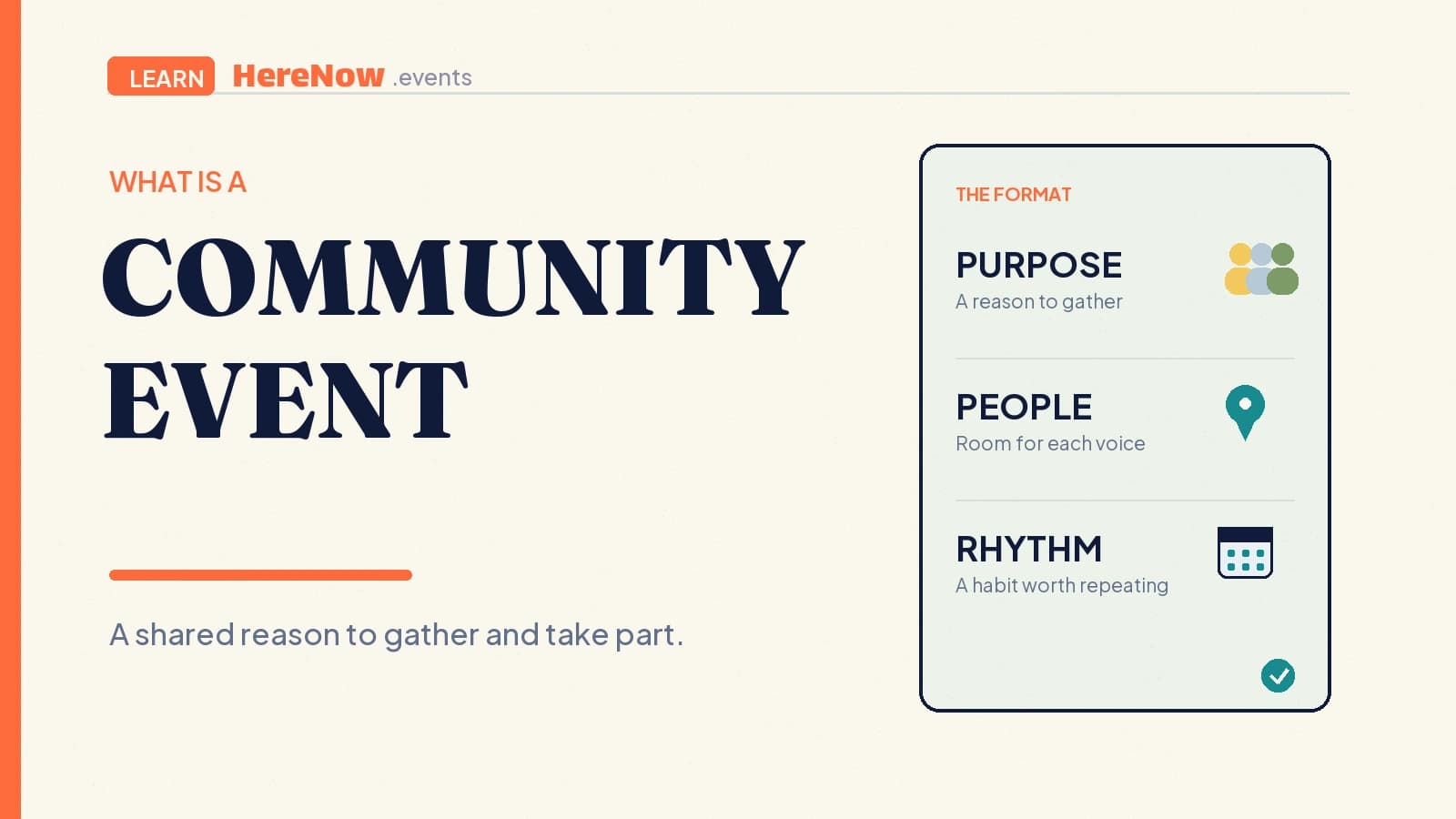
Three things usually matter more than elaborate production: a shared reason to gather, a role for participants, and a relationship that can continue after the day ends. People may come to learn a local skill, meet neighbours, trade knowledge, celebrate a tradition, or solve a practical problem together. The host’s job is to give that purpose a visible form, rather than assume that a collection of strangers will automatically become a community.
Government guidance on community engagement principles emphasises broadening engagement so diverse voices are heard. A small event host can adapt that principle without turning a gathering into a consultation: ask what people want from the format, avoid treating the group as uniform, and make it possible for different kinds of guests to participate.
Start with listening, then name the shared purpose
Before choosing a venue or writing a title, speak to a few people already connected to the group. What do they enjoy doing together? What has made prior gatherings hard to join? What would a useful first session look like? Those conversations give a host better material than generic promises about “networking” or “bringing everyone together.”
Turn what you hear into a short event promise. “Bring one garment and learn a simple repair beside your neighbours” is more useful than “sustainability community meetup.” “Walk slowly through the riverside park and share bird sightings” tells a different community exactly what to expect. The first version does not need to solve every need. It needs one clear purpose that people can recognise and respond to.
An illustrative repair-café gathering
Imagine a small local repair café hosted in a library meeting room. Volunteers who enjoy mending clothes and fixing simple household items invite neighbours to bring one object they would like to understand better. The page explains that it is a shared learning session, not a guaranteed repair service. It lists the time, step-free entrance, available tables, quiet corner, and the kinds of items volunteers can reasonably help with.
During the session, guests work beside each other, swap tips, and decide whether they want to meet again next month. That is community-event thinking in practice: the host makes an occasion for people to contribute, not merely consume. A realistic event capacity lets the hosts offer attention without overpromising, while a clear registration form can collect only the practical information needed to prepare the room.
Make the invitation welcoming and usable
Community is strengthened when people can tell whether the event is workable for them. Put the purpose, date and time, exact location, arrival instructions, cost, language, and accessibility information on one readable event page. Say whether someone may come alone, bring a child, or invite a neighbour. If the event has a conversation or activity, explain how a first-time guest can take part without already knowing everyone.
Inclusion should be part of the plan, not a last-minute note. The Government of Canada’s inclusive event-planning guidance recommends considering barriers to access and participation, gathering diverse perspectives, and sharing logistics in advance. The City of Sydney’s accessible-event guidelines make a similarly practical point: this work applies to small community events as well as larger ones. Ask rather than assume, and describe the supports that are actually available.
Give the community a repeatable rhythm
One gathering can be valuable, but a simple repeatable rhythm helps people know when and how to return. Keep the parts that made the event recognisable: the welcome, the activity, the host contact, and the way guests share feedback. After each edition, write down what participants asked for, what was difficult to access, and what should change next time. That is a small host habit that makes a community event more responsive over time.
Carnegie Mellon’s event-planning cycle moves from brainstorming through planning, promotion, delivery, and assessment. For an independent host, the useful part is the final reflection: keep a short note while the experience is still fresh. On HereNow, you can turn that next idea into an editable event page, make the joining details clear, and create a community event when the invitation is ready.
Frequently asked questions
Does a community event have to be free?
No. A community event can charge for a seat, materials, food, or a facilitator’s time if the price and inclusions are explained clearly. Free access is only one way to lower a barrier. The important question is whether the format, information, and joining process make sense for the people the gathering is meant to serve.
Can a community event be online?
Yes. An online event can support a shared interest or local connection when people know how to participate and what the gathering is for. State the time zone, platform, joining link process, and any preparation. For discussion-based events, a simple structure and clear conversation norms can help first-time guests feel less like observers.
How do I know who to invite?
Begin with the people who share the purpose of the gathering, then write the invitation so others can decide whether it fits. Avoid claiming that an event is “for everyone” if the activity, location, language, or capacity creates real limits. A specific invitation is more welcoming than a broad promise that hides practical barriers.