What is event capacity?
Event capacity is the number of people an event can safely and comfortably accommodate. Learn how venue limits, operational needs, and guest registration caps work together.
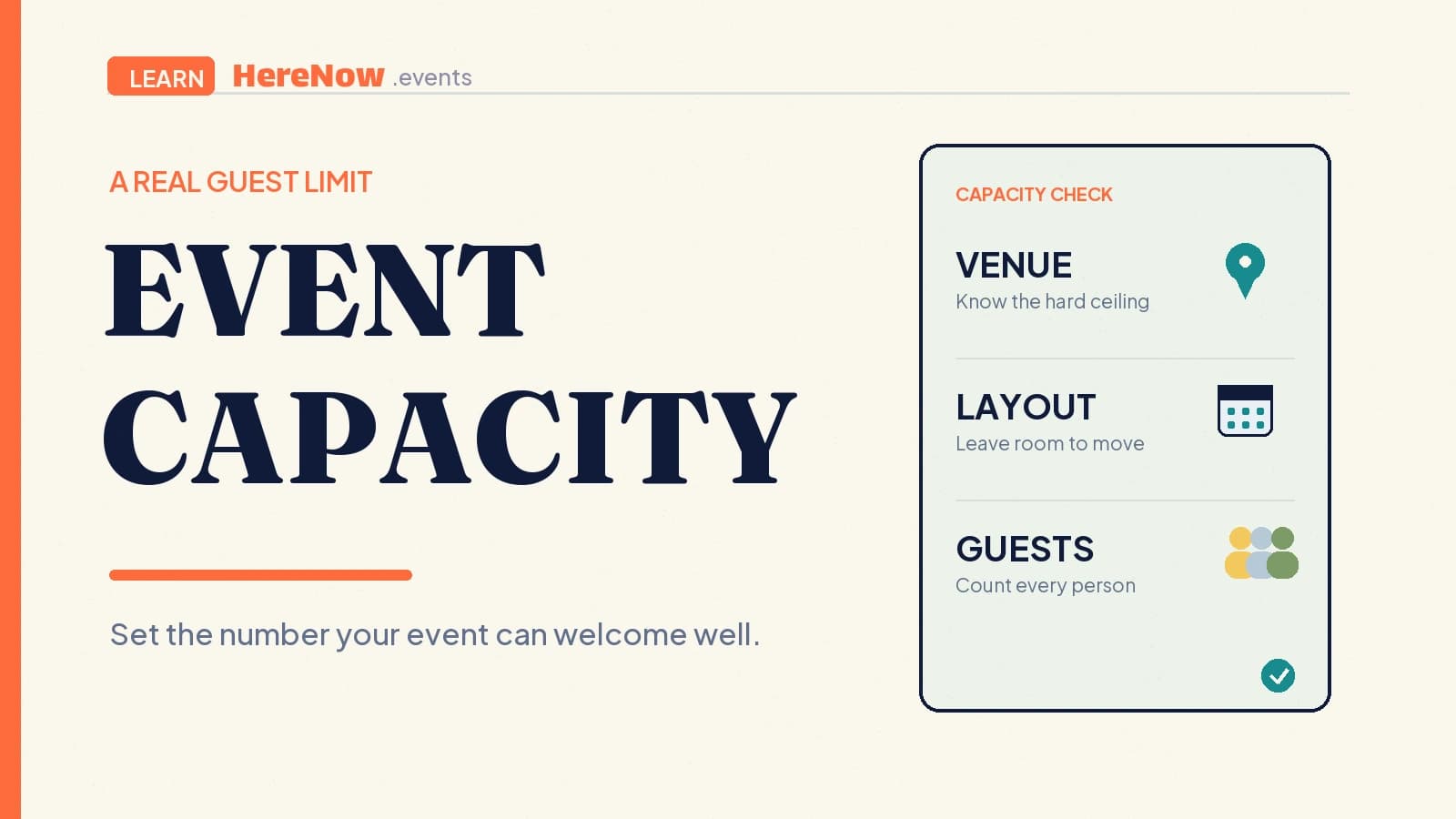
Event capacity is the maximum number of people an event can accommodate safely and comfortably at one time. It is more than the number of chairs in a room. A useful capacity accounts for the venue’s approved limit, exits, layout, staff, materials, accessibility, and the kind of experience a host wants guests to have.
The short answer
- Capacity is a limit, not a target. It tells a host when to stop accepting new guests.
- The venue’s limit comes first. A host cannot make a room safe simply by planning carefully or selling fewer chairs.
- The working limit may be lower. A workshop can need more room, materials, or attention per person than the venue allows at most.
- The published limit should match reality. Guests need an honest count before they RSVP or register.
For a small independent event, a good capacity is the number at which people can arrive, move, take part, and leave without the gathering becoming cramped, unsafe, or harder to host well.
Capacity is more than room size
Start with the venue’s documented occupancy limit and requirements set by its operator, license, insurer, or local authority. Treat those as a hard ceiling and confirm they apply to the specific area and layout you will use.
Official guidance for small and medium assembly spaces says escape routes must serve the people likely to use them and that numbers may need restricting when they cannot be evacuated safely. The UK guidance is specific to England and Wales, but its principle travels well: capacity is about the actual place and guests, not only floor area.
Capacity also includes everyone present. Count the host, helpers, speakers, vendors, and companions whenever the venue or local rules require it. The page’s number should not quietly exclude people who will still use the room and its exits.
Separate the three numbers
Hosts often use one word for three different numbers. Separating them prevents accidental overbooking.
- Legal or venue maximum: the highest permitted number for that space and setup. Do not exceed it.
- Operational capacity: the number the host can welcome well with the planned room layout, materials, staffing, and format.
- Registration cap: the number of guest places shown on the event page. It is normally the operational capacity after subtracting non-guest people who must be counted.
For example, a venue may permit 30 people, but a hands-on class with twelve workstations may accommodate 12 guests. Its registration cap should be 12, not 30. Nottinghamshire Fire and Rescue Service notes that occupancy is constrained by both safe usable space and exit routes. Its occupancy guidance is a reminder not to turn every square metre into guest space.
Set capacity from the hard limit backwards
First, confirm the venue’s maximum for your planned layout. Next, list what the format needs: chairs, tables, aisle space, staff positions, equipment, check-in room, and any area that must remain clear. Then ask what a guest needs to participate comfortably. A seated supper, a standing talk, and a screen-printing workshop may use the same room very differently.
Check the plan against the people most likely to attend, not an imaginary average guest. Government fire-safety guidance says an assessment should consider emergency routes, evacuation, and the needs of vulnerable people, including children, older people, and people with disabilities. That checklist is not a substitute for local advice, but it is a good prompt to leave clear routes and plan for the group you are actually inviting.
A five-minute capacity check
Before you publish, walk the room as a guest would. Where will people queue, sit or stand, use the restroom, and leave if the event ends at once? Put furniture in its event layout. Count the people working the event, then decide how many guests can move and participate with ease. If the answer feels tight, reduce the cap. A smaller gathering that runs smoothly is more useful than a full room where people wait, squeeze past one another, or miss the activity.
Example: a language exchange in a café
A host is planning a two-hour language exchange in a café’s side room. The venue confirms a maximum occupancy of 24 for the room. The host and one volunteer will be present, and the café needs a clear route to a service door. The host wants pairs to change tables halfway through, so six two-person tables are the practical setup.
The operational capacity is 12 guests, not 22. Twelve people can form six pairs, hear one another, switch partners, and leave the doorway clear. The event page uses a 12-guest registration cap and states that the room is intentionally small. When the cap is reached, the host can close registration or use a separate waitlist process; neither option should raise the number beyond the capacity already chosen. The event page makes this expectation visible before a guest decides to join.
What capacity tells guests
A published cap helps guests make an informed decision. It can explain why a workshop has only eight places, why a walk needs an RSVP, or why late arrivals may not be able to enter. It also gives the host a number to monitor at check-in. Dover District Council’s public-entry guidance recommends accurate head counting when an event has a limit so overcrowding can be prevented. For a small event, that can be as simple as one reliable guest list and one person responsible for marking arrivals.
Capacity should be visible without turning into pressure. Say “12 guest places” when that is true; do not imply scarcity that does not exist. If you expect to make room for a support person or need to adapt the setup for an accessibility request, explain how a guest can contact you before registering. Keep the event’s visibility aligned with who may see and join it, then create an event in HereNow with details that let guests choose confidently.
FAQ
Is event capacity the same as the number of registrations?
Not necessarily. Capacity is the total number the event can safely and practically accommodate. Registrations are the guest places you offer within that limit. If hosts, volunteers, or staff count toward occupancy, subtract them before setting the guest registration cap. The two numbers may match for a simple gathering, but they should not be assumed to match.
Can I raise capacity after publishing an event?
Only after checking that the venue, layout, exits, staffing, materials, and guest experience can support the larger number. Do not raise a cap merely because demand is high. Update the event page promptly, tell confirmed guests if the setup changes in a meaningful way, and keep the revised number below any venue or legal maximum that applies.
What if more people arrive than registered?
Use the capacity you set, not a last-minute guess. Keep an accurate arrival count and avoid admitting extra people if it would exceed the safe or workable limit. A host can politely explain that the event is at capacity and invite the person to a future session where appropriate. A clear limit is kinder than creating an overcrowded room for everyone.