What is an event waitlist?
An event waitlist is a queue for interested guests once capacity is full. Learn how it differs from a confirmed place and what a fair waitlist needs to say.
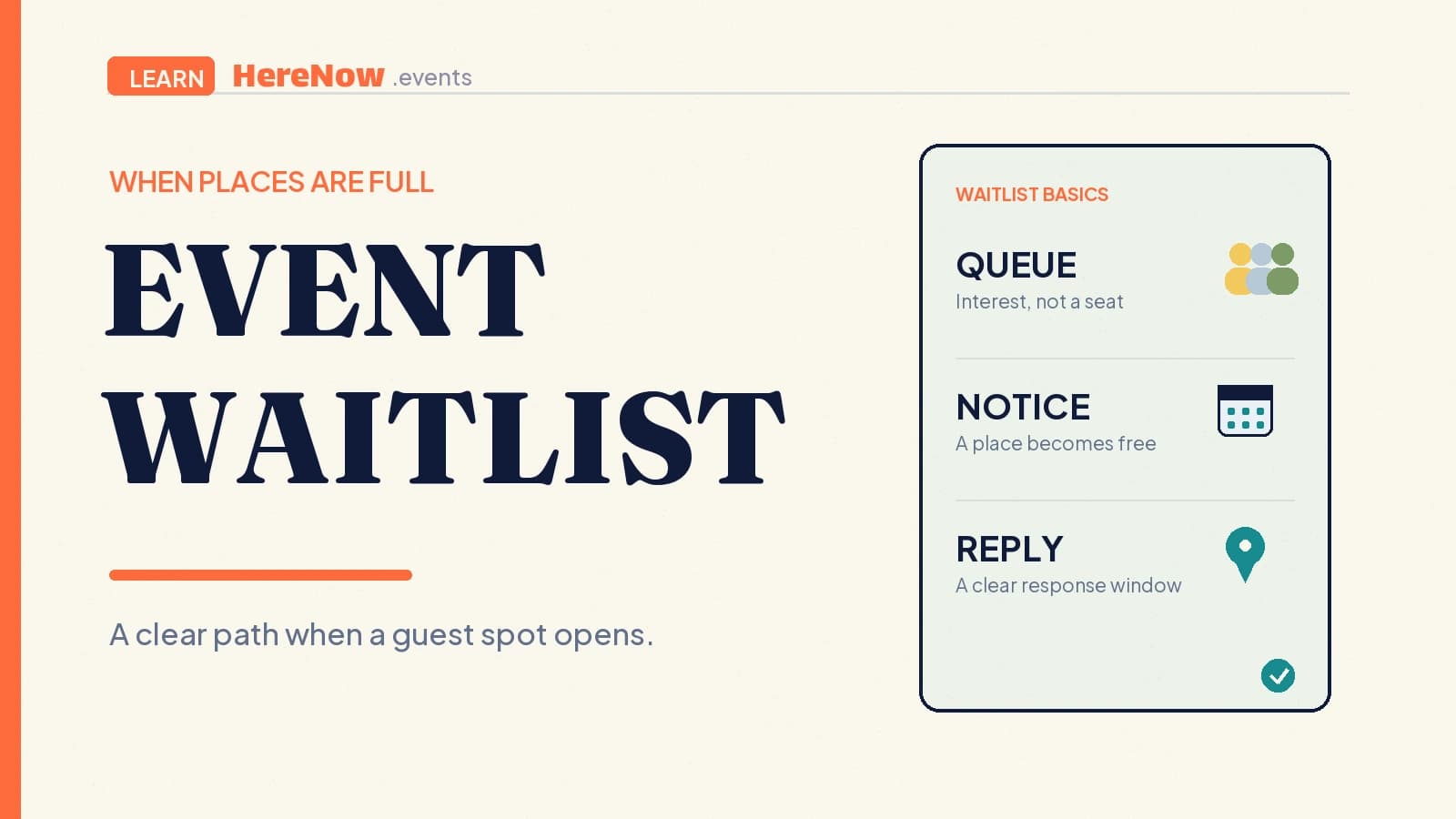
An event waitlist is a queue for people who want to attend after all currently available places have been taken. It records interest without promising entry. If a confirmed guest cancels or the host can add capacity, the host can offer the newly open place to someone on the list.
The short answer
- A waitlist is not a ticket or confirmation. It is a chance to be considered if space opens.
- It protects the event’s limit. The host can keep a small room, table, or workshop within the number it can support.
- It needs clear rules. Guests should know how places are offered, how long they have to reply, and when the list closes.
- It needs a real update. A guest should receive either an offer, a closing message, or a clear statement that no place became available.
For a guest, joining a waitlist means, “Please contact me if you can invite another person.” For a host, it keeps an event full without overselling it or leaving interested people in the dark.
What an event waitlist means
A waitlist starts when an event reaches a real attendance limit, such as a 10-seat pottery class, a fixed dinner table, or a guided walk. It gives interested guests an orderly place to wait rather than asking them to repeatedly check whether somebody cancelled.
The central distinction matters: waitlisted is a status of interest, while confirmed means the guest has a place. Yale’s registrar describes waitlisting as an opportunity when capacity becomes available, not a guarantee of enrollment. Its waitlisting guidance also illustrates a common pattern: when a place opens, the person first in the queue receives the offer.
A waitlist should not be a vague collection of emails for a future event or a promise that every interested person will be squeezed in. If there is no realistic path to an opening, say so plainly.
What guests should know before joining
Put the waitlist terms near the action a guest takes. State that joining does not reserve a place, then explain the order. First come, first served is easy to understand, but a host may use another published rule when accessibility needs or a balanced group genuinely require it. Decide the rule before names start moving.
Next, say how an offer will arrive and how long it remains open. University of Florida’s waitlist guidance explains that people are alerted when a place becomes available, have limited time to act, and are not guaranteed a seat. That is a helpful model for events: a notification should name the event, the available place, the response deadline, and the way to accept or decline.
Also tell guests when the list stops. A waitlist for a Saturday workshop might close the evening before so the host can buy materials. A guest who is still waiting should receive a short closing note rather than silence. This is respectful even when no opening appears.
How a host should set a waitlist
Start with a genuine capacity. Do not create a waitlist to make an event look scarce; use one because the room, materials, staffing, or format has a real limit. Then decide whether guests can see their position. Position numbers can reassure people, but may create false precision when a host must accommodate an access need or a particular session.
Choose one reliable contact channel and check it. When a place becomes free, send the same factual offer to the next eligible person, with a practical response window. UAB’s waitlist instructions show why this matters: a place is offered only after it opens, the notice gives a deadline, and an unclaimed place moves on. For a small event, the exact time can vary; what matters is that the deadline is clear and applied consistently.
Four rules make the queue feel fair
Write down four things before publishing the event: who can join the queue, how offers are ordered, how long a guest has to answer, and when the list ends. Keep a simple record of each offer and reply so you do not accidentally promise the same place twice. If you must deviate from the usual order, explain the reason in a way that protects guest privacy. A transparent rule will not remove every disappointment, but it makes the experience predictable and easier to trust.
Example: a small ceramics workshop
A maker is hosting an eight-person ceramics workshop. Eight guests are confirmed, and six more people want to join. The event page shows that the class is full and offers a waitlist. Before someone joins, it says: “A waitlist place is not a confirmed workshop place. If a space opens, we’ll email the next person in order. You’ll have until the stated deadline to accept. The waitlist closes at 6 p.m. the day before the workshop.”
On Thursday, a confirmed guest cancels. The host contacts the first person on the list, gives them a clear deadline, and updates the attendee count only after they accept. If they decline or do not reply, the host moves to the next person. On Friday evening, everyone still waiting receives a brief closing note. The event’s permalink remains the stable place to revisit the practical details.
What a waitlist is not
A waitlist is not an automatic upgrade, a payment authorization, or permission to arrive and hope for a chair. It does not turn an event’s capacity into a suggestion. Baylor’s summary of waitlist basics makes the distinction directly: a person in the queue is not registered, and an open place is offered before it is claimed. The same expectation helps event guests understand their status.
It is also not a substitute for communication. Do not ask guests to watch a page constantly, guess whether a cancellation happened, or wait indefinitely. If the event changes, keep the event visibility and guest messages aligned with the intended audience. When you are ready to set up the core event information, create an event in HereNow and give every guest a clear route to the right update.
FAQ
Does joining an event waitlist mean I am registered?
No. Joining a waitlist means you have asked to be considered if a confirmed place becomes available. You are registered only after the host offers you a place and you complete whatever acceptance step the event requires. Until then, avoid making travel plans or assuming that materials, a seat, or entry have been reserved for you.
Should event waitlists be first come, first served?
Often, yes, because it is simple to explain and administer. Another rule can be appropriate when it is announced upfront and connected to the event’s purpose, such as reserving access places. Choose the rule before people join and apply it consistently.
What should a host send when the waitlist closes?
Send a short, direct message to everyone who was not offered a place. Thank them for their interest, confirm that the event is now full, and avoid implying that they did something wrong. If you have a future session or another event that is genuinely relevant, you may mention it as an optional next step. The key outcome is certainty: guests should not be left wondering whether an invitation is still coming.