What is a micro-event?
A micro-event is a deliberately small gathering built around one clear shared activity or topic. Learn how the format works and how to make it easy for guests to join.
Micro-event, in plain English
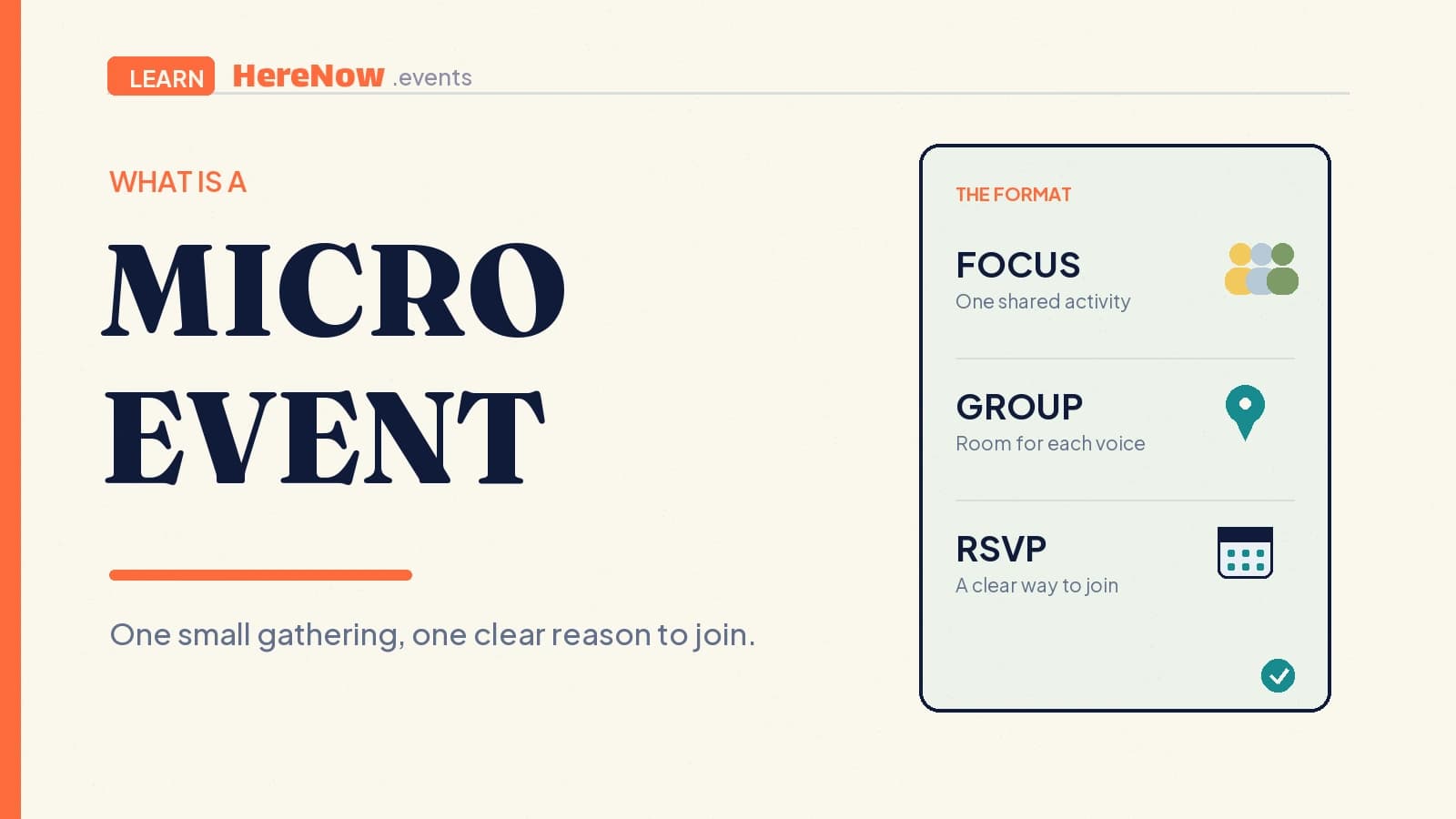
A micro-event is a deliberately small gathering built around one clear reason to get together. It might be a ten-person language exchange, a neighbourhood walking club, a craft session, or a focused conversation. “Micro-event” is a practical label rather than a formal event category, so there is no universal headcount. The important part is not being small for its own sake; it is making the topic, group, and guest experience manageable and specific.
Rather than trying to offer everything to everyone, a micro-event gives guests a simple invitation: join this small moment, at this time, for this shared activity. That clarity can make it easier for a first-time host to begin and for a guest to decide whether the gathering is for them.
Small does not mean unplanned
A smaller guest list changes the host’s job; it does not remove it. With fewer people, the details of welcome, participation, and timing become more visible. Guests are more likely to notice whether they know what to do on arrival, whether the conversation has a shape, and whether everyone has space to take part.
Group facilitation guidance from the University of Arkansas System Division of Agriculture frames the facilitator’s role as guiding a group through a process toward its goals. That is a useful model for a micro-event host. You do not need to control every exchange, but you do need to make the purpose and next step understandable.
Choose one promise for the gathering
The micro format works best when the invitation makes one promise guests can recognise. A loose idea like “meet interesting people” can be a starting point, but it becomes easier to join when it names the activity or topic. For example:
- Practise together: a beginner Spanish exchange where guests rotate through short, prompted conversations.
- Make or learn one thing: a sketching session focused on drawing leaves in a local park.
- Discuss one question: a small salon about how neighbours can share a community garden.
Each promise suggests a different structure, materials list, and sign-up question. University of Florida Extension distinguishes formats such as a workshop, panel, science café, skills demonstration, and meeting by the way people learn or participate. Its guide to education and facilitation methods is a helpful reminder that the right name should describe what guests will actually do, not just make an event sound appealing.
An illustrative language-exchange micro-event
Imagine a host inviting twelve learners to a 75-minute beginner French exchange at a café. The page says that guests will use simple conversation cards, switch partners twice, and spend the last 15 minutes sharing local recommendations. It also states that basic French is welcome but not required, that drinks are purchased individually, and that the host will meet everyone by the entrance.
The gathering is small, but it has a real guest journey: arrive, find the group, participate with a prompt, and leave knowing what happened. The host can send a low-friction RSVP confirmation with those same details. If two people need more speaking time or a late arrival changes the room dynamic, a clear format gives the host something to adapt rather than improvise from nothing.
Set the conditions for participation
A micro-event can feel welcoming when expectations are explicit. Before the event, decide how people will contribute, whether anyone needs to bring something, and what respectful participation looks like. Small-group facilitation guidance from Stanford’s National Student Support Accelerator recommends establishing group and discussion norms early, rather than leaving the group to infer them. Adapt that principle in plain language: “one person speaks at a time,” “ask before correcting someone,” or “you may pass on a prompt.”
Capacity should match the activity and space you can responsibly facilitate, not an arbitrary idea of what counts as micro. Put the limit, joining requirement, price if any, and accessibility information where people can see it. A thoughtful event capacity and a clear registration path help guests make an informed decision before they arrive.
Use the small format to learn and repeat
A micro-event is a useful way to test a hosting idea without pretending that the first version must be final. Afterward, note which prompt opened conversation, how long the activity actually took, and which question guests asked before joining. Keep the elements that made the event easy to understand; change only what the next session needs. That small review turns an isolated gathering into a repeatable host habit.
For a discussion-based format, a single focused question can also create a fairer starting point. The University of Nevada, Reno’s Nominal Group Technique guide describes how one question, ground rules, and structured sharing can help every member participate. You do not need to copy the full method, but it is a good prompt to plan who gets space to speak.
On HereNow, you can turn the idea into an editable event page, set the RSVP details, and refine the same structure for the next gathering. When the invitation is clear, create your small event and read the page once from a guest’s point of view before sharing it.
Frequently asked questions
How many people are in a micro-event?
There is no fixed, universal number. The label usually signals a gathering that is intentionally smaller than a broad public event and designed around closer participation. Choose the number from your activity, venue, materials, and ability to welcome people well. State the actual limit on the event page instead of relying on the word “micro.”
Is a micro-event the same as a meetup?
Sometimes a meetup can be a micro-event, but the terms describe different things. “Meetup” tells guests that people are gathering; “micro-event” emphasises a small, focused format. A meetup may be open-ended social time, while a micro-event may have a guided activity, a topic, or a short agenda. Use the title that creates the clearest expectation.
Can a micro-event be online?
Yes. The format can work online when the invitation explains how people will participate and what they need to prepare. For a small virtual discussion, share the time zone, platform, joining link process, and any prompts in advance. The same principle applies: make the experience focused enough that guests know why this smaller group is gathering.