What is a co-host?
A co-host shares meaningful responsibility for an event, with an agreed role in planning, welcoming guests, leading the experience, or following up afterward.
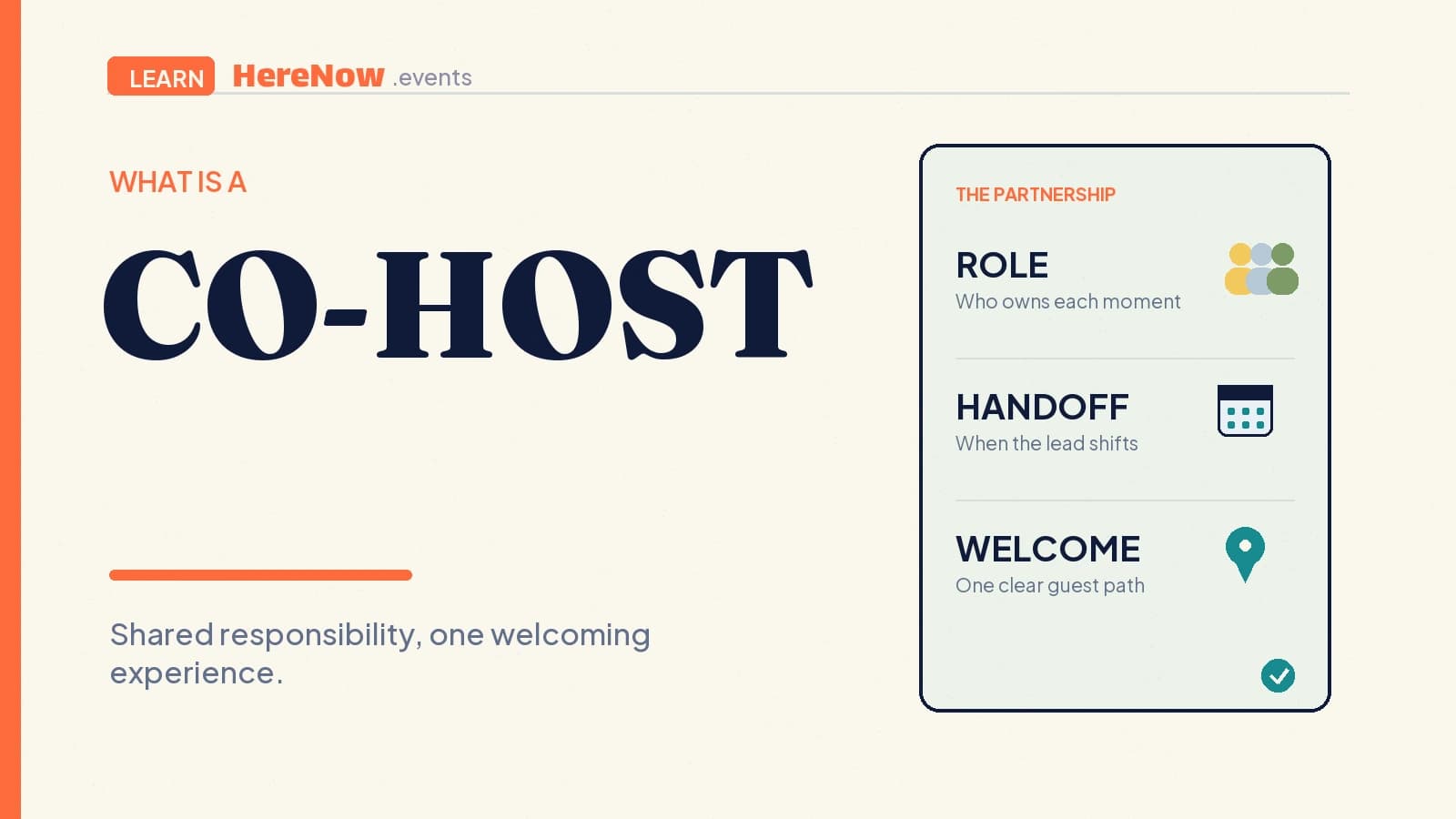
A co-host is a person who shares meaningful responsibility for an event with the primary host. They may help shape the idea, welcome guests, lead part of the agenda, manage the room, or follow up afterward. A co-host is not simply a speaker, a friend who attends, or an unnamed helper: their role is agreed in advance and visible in how the event is planned and run. The share of responsibility can be equal or deliberately uneven.
A co-host shares responsibility, not just visibility
The useful test is practical: if this person could not come, would the event plan need to change? If the answer is yes, they are probably acting as a co-host. They may bring a complementary skill, community connection, venue knowledge, language ability, or calm operational support. A guest lecturer may lead one section, while a co-host helps carry the overall experience before, during, and after the gathering.
Shared hosting does not mean that both people do every task together. The University of Minnesota describes co-teaching as sharing planning, organization, delivery, assessment, and the space itself. That broader definition of shared work is helpful for events too: co-hosts decide which responsibilities genuinely belong to both people and which have one clear owner.
Define the roles before guests see the invitation
Begin with the event’s purpose, then write a small ownership list. Who decides the format? Who writes the guest-facing details? Who handles materials, venue access, welcome, timing, questions, payment-related decisions if any, and follow-up? It is fine for one person to be primary host and another to lead a distinct part, but ambiguity is hard on both the team and the guests who need help.
Drexel University’s team-teaching guide organizes collaboration around preparation, design, facilitation, assessment, and reflection. Those five stages make a simple co-host checklist: agree on the idea, design the session, decide who leads each moment, notice what happened, and review it together. A short written agreement is kinder than assuming that enthusiasm will cover every gap.
Choose a co-hosting pattern that fits the event
There is no single correct split. Choose one pattern, name it, and revisit it after the event:
- Primary host and support co-host: one person owns the overall decision while the other leads a defined segment or guest experience.
- Split by domain: one person handles content and facilitation; the other handles venue, arrivals, materials, and timing.
- Taking turns: each co-host leads specific agenda items and supports during the other’s sections.
- Equal co-leads: both shape the program and share guest-facing leadership, while still assigning a final owner for each task.
For an interactive workshop, taking turns often works well: one host explains the exercise while the other notices who needs materials or a quieter entry point. In a local community event, a domain split may be clearer: one host holds the conversation, while the other welcomes newcomers and keeps the room moving.
Agree on handoffs and private communication
Most co-hosting friction appears at transitions: when a discussion runs long, a guest needs help, a room detail changes, or neither person is sure who should decide. Put the handoffs on the agenda. “Mina opens the welcome; Jo takes over the pair exercise; Mina closes and explains the next step” is more useful than “we will co-host.”
The Council of Europe’s facilitator manual recommends agreeing ground rules and how to handle disagreements before the session, giving credit in public, and sorting disagreements in private. Its co-facilitation guidance is a useful reminder that collaboration should not turn into public correction or competition. Decide on a simple signal for “please step in,” a place to make quick decisions, and which person speaks to guests if the plan changes.
Share the welcome, then debrief the work
Guests do not need every internal detail, but they should know who is hosting and whom to approach. Introduce both people at the start, say what each is there to help with, and make the handoff between them feel deliberate. If one co-host is new to leading, the other can remain visibly supportive without disappearing from the room.
University of Toronto guidance for co-facilitators advises connecting early, discussing the session plan, and developing guiding prompts together. The same guide also reserves time for debriefing. After a small event, ask three questions: What did guests respond to? Where did the handoff feel unclear? What should each person own next time? This turns one shared event into a more repeatable hosting habit.
Example: two hosts for a neighborhood supper club
Imagine “Friday Table: Seasonal Supper and Stories,” hosted by Ana and Ravi. Ana chooses the menu and leads a short cooking demonstration. Ravi knows the neighborhood well, welcomes guests at the door, manages dietary notes, and guides the table conversation after dinner. They co-write the event description, but Ana owns the final food plan and Ravi owns the arrival flow.
Before the evening, they agree that Ravi will signal Ana if guests are still arriving at the planned demo start. During dinner, Ana watches timing while Ravi makes sure quieter guests have a way into the conversation. Afterward, they compare notes on portions, seating, and the next theme. On HereNow, a host can start the shareable event page from that plain-language idea, then make the responsibilities behind it explicit between the people who will deliver it.
Frequently asked questions
Is a co-host the same as a collaborator?
Not always. A collaborator may contribute to one task—such as design, photography, music, or food—without sharing responsibility for the event as a whole. A co-host has an ongoing role in planning or delivery and is someone guests or the primary host can reasonably rely on during the experience.
Do co-hosts need equal responsibilities?
No. Equal respect matters more than identical task lists. One person may be the experienced facilitator while the other brings the community relationship or venue access. The important part is that the difference is intentional, discussed early, and clear enough that neither person silently carries work they did not agree to own.
What should co-hosts decide before publishing an event?
Agree on the purpose, public description, attendee experience, roles during the agenda, communication channel, budget or cost decisions when relevant, and how changes will be made. Also decide who will respond if a guest asks a question. Those basics create a dependable foundation without turning a small gathering into a heavy process.