What is a paid event ticket?
A paid event ticket is a clear purchase for defined access. Learn what it should explain about price, capacity, confirmation, and refunds.
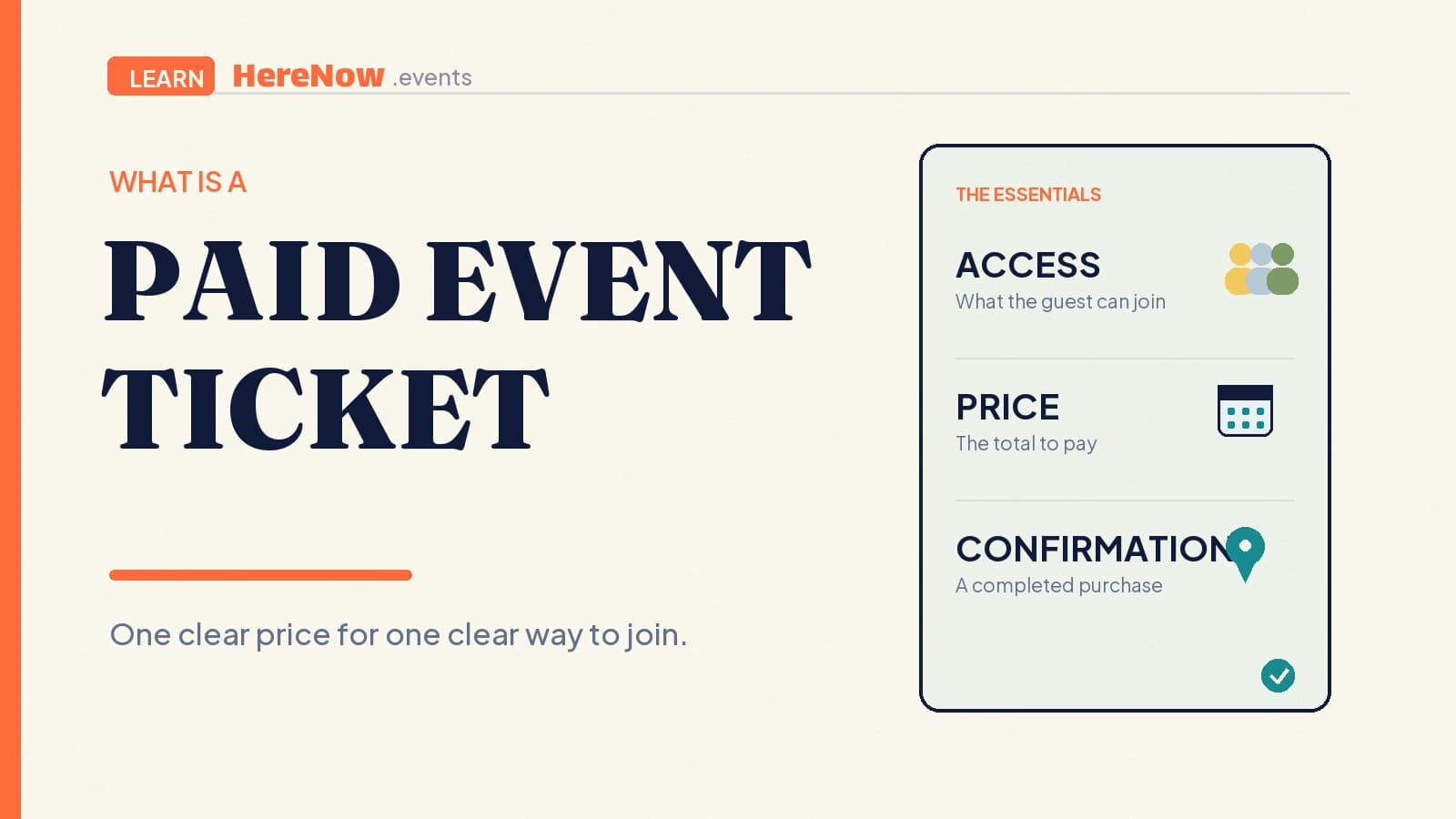
A paid event ticket is a defined purchase that gives a guest the right to join an event under stated terms. The guest pays a set amount, and confirmation connects the purchase to the event. For a small workshop or supper club, a good paid ticket makes one decision simple: what am I getting, what will I pay, and how do I know my place is reserved?
A paid ticket is an agreement to attend
A ticket is more than a price beside an RSVP button. It makes a clear agreement: the host offers defined admission and the guest pays to claim it. The access might be general entry, a class seat, a shared-table place, or a particular session.
In practical ticketing guidance, Yale describes a paid ticketed event as one where registrants pay a fee to purchase a ticket and complete their registration. Its setup also treats price, available quantity, purchase limits, sales window, and who may buy as separate choices. Those details are useful for any independent host because they turn a vague "paid event" into a specific guest offer. Yale's ticketed-event guidance is a helpful illustration of the settings that make an offer legible.
What the guest is really buying
At its simplest, a paid ticket buys access. The exact access should be written in everyday language. “One place at the 90-minute wheel-throwing workshop, clay and firing included” is more useful than “Workshop ticket.” If the ticket covers a tasting, materials, a class handout, or a members-only walk, name that too. If it does not cover something a guest may reasonably expect, say so before checkout.
The ticket also makes the host's capacity promise visible. A host might sell 12 seats because there are 12 wheels, or 20 meal tickets because there are 20 place settings. That is why it helps to settle event capacity before naming the price: the number of places shapes both the experience and the inventory a guest sees.
Finally, a paid ticket creates a record. A completed payment and a clear confirmation let the host prepare for the right number of people and give the guest something dependable to refer back to. Payment flows can require an extra authentication step or remain incomplete, so a host should not treat a card entry alone as a confirmed place. Stripe explains that a payment marked succeeded has completed, while incomplete or failed states need different handling. Stripe's payment-status guidance shows why confirmation matters.
The details to settle before checkout
Guests need the facts that change whether the ticket is right for them. Put these details on the event page, close to the ticket choice:
- Access: what one ticket includes, who it is for, and any meaningful requirement such as age, experience level, or member status.
- Timing: the event date and time, plus when ticket sales begin and end.
- Availability: the quantity on sale, any per-person limit, and what happens after it sells out.
- Money: the currency, the total the guest will pay, what is included, and the refund or cancellation terms.
Price clarity deserves special care. In the United States, the FTC's guidance for covered live-event ticket offers says sellers must disclose the total price up front, including mandatory charges they can calculate, and show it prominently. Taxes and truly optional additions can be handled differently, but the final amount still needs to be clear before payment. Rules vary by place and event type, so use this as a clarity standard and check the requirements that apply to your sale. The FTC's fee-rule FAQs explain the U.S. position.
An example: a neighbourhood ceramics class
Mina is hosting a Saturday ceramics class for 10 beginners. Her paid ticket is $42 and includes a two-hour lesson, clay, use of a wheel, and one firing. It does not include shipping finished work. Tickets go on sale for two weeks, with a limit of two per purchaser. If Mina cancels, guests receive a full refund; if a guest cannot attend, they can request a refund up to seven days beforehand.
That is a complete enough offer for a guest to decide. The event page can explain the class, while the ticket names the purchasable unit. After payment succeeds, the registration confirmation can restate the date, location, ticket quantity, and the next practical step. This is the same low-friction path that makes a clear event registration useful: guests know what they have done and what happens next.
Paid tickets are not donations or free RSVPs
A free RSVP records intent to attend without a payment requirement. A donation invites a contribution, which may or may not be connected to a place at the event. A paid ticket, by contrast, sets a purchase price for defined access. The three can sit beside one another—for example, a free community talk with optional donations, or a paid class with a sponsor-funded free ticket—but their guest promises should not blur together.
Payment tools make a similar distinction. Stripe describes fixed-price products as one model and customer-chosen amounts as another, with the latter suited to tips, donations, or pay-what-you-want offers. That difference is useful when naming your option: call it a ticket when payment reserves the stated access; call it a donation when contribution is the point. Stripe's pricing-model overview outlines both approaches.
Set up a paid ticket with a host mindset
Start with the guest decision rather than a revenue target. Decide the smallest ticket structure that explains the event honestly: one general-admission ticket may be enough for a first language exchange, while a workshop may need separate standard and materials-included choices. Keep the language consistent between the event description, ticket label, confirmation, and refund policy.
On HereNow, free registration is the default. When you are ready to sell seats, paid tickets require Pro and payout setup; review the ticket details, the event capacity, and the guest-facing terms before publishing. Then add tickets to your event only when the page gives a newcomer enough information to decide without sending a follow-up message.
Frequently asked questions
Is a paid ticket the same as a paid event?
Not quite. A paid event describes the event as a whole. A paid ticket is one purchasable admission option within it. One event may have a single paid ticket, several ticket types with different access, or a mix of paid and free options. The ticket is where the guest sees the precise price and terms.
When should a host use a paid ticket instead of a donation?
Use a paid ticket when payment reserves a defined place or includes a defined experience, such as a seat, lesson, meal, or materials. Use a donation when guests may contribute voluntarily and access does not depend on paying a set amount. If both are offered, state clearly which action reserves attendance.
Does buying a paid ticket always mean a refund is available?
No. A ticket purchase does not by itself determine the refund outcome. Before paying, guests should be able to see the host's refund and cancellation terms, including deadlines and how to contact the host. Hosts should keep those terms specific, communicate changes promptly, and follow the consumer rules that apply where they sell.