Best Eventbrite Alternatives for Small Workshop Hosts in 2026
Compare five Eventbrite alternatives by the workshop job they replace, then test audience, transaction, and attendee continuity before switching.

The best Eventbrite alternative for a small workshop is the one that replaces the specific job you rely on Eventbrite to do. That job may be attracting people beyond your existing audience, selling paid tickets, running check-in, keeping a recurring calendar, or simply turning an idea into a convincing page. Switching because another tool looks cheaper can fail if it leaves one of those jobs uncovered.
Replace the Eventbrite Job, Not Just the Platform
The alternatives center different audience and operating jobs. Ticket Tailor is the ticket-operations candidate for a host with an audience. Humanitix offers a fuller ticketing stack with a social-impact model. Luma is strongest when one workshop belongs to a recurring calendar. Partiful fits invitations that spread through messages. HereNow fits a host whose bottleneck is shaping a rough workshop idea into a public page.
- Name the audience source. This is the channel where likely guests first discover the workshop: your list, a partner, social sharing, search, or a platform marketplace.
- Keep Eventbrite when its discovery is working. Marketplace discovery means registrations from people browsing or receiving recommendations inside the platform.
- Pilot before moving a series. The replacement must pass audience, transaction, and continuity checks with one real workshop edition.
How We Compared Eventbrite Alternatives
Official public pages were checked on August 14, 2026. We compared the Eventbrite job replaced, likely audience source, free or paid-event model, recurring-event fit, access to usable guest data, and the main migration limitation. These are public-source findings, not an authenticated test of every paid feature or regional account.
Disclosure: HereNow publishes this comparison and is one of the products covered. There are no affiliate links and no universal winner. Current fees, plan limits, payment terms, exports, and regional availability should be verified in the live product. If you are choosing from scratch rather than replacing Eventbrite, compare the broader small-event builder landscape.
Eventbrite Alternatives at a Glance
Each option replaces a different Eventbrite job and has a distinct limitation. Use this table to keep one or two plausible candidates, then verify the live workflow.
| Alternative | Eventbrite job replaced | Audience assumption | Best workshop fit | Main limitation to test |
|---|---|---|---|---|
| Ticket Tailor | Ticket operations and data access | The host brings demand | Paid workshops needing a dedicated ticket layer | Live pricing, processor costs, and host-facing export format |
| Humanitix | Full ticketing, check-in, and reporting | Mostly host or partner promotion | Operationally detailed paid or free workshops | Rates and terms vary by market and organization |
| Luma | Calendar, guest communication, and repeat events | The host builds an ongoing audience | Workshop series and recurring communities | Paid-event economics and discovery are not equivalent to Eventbrite |
| Partiful | Social invitation, updates, and ticketed entry | Guests arrive through messages and relationships | Social, local, or creator-led workshops | Professional fit, exact fees, and guest-list transfer |
| HereNow | Idea-to-page creation and low-friction RSVP | The host, partners, search, or social bring demand | Small workshops that need a clear page quickly | No claimed Eventbrite-style discovery marketplace |
When Staying on Eventbrite Is Rational
Eventbrite combines marketplace discovery, ticketing, and attendee export. Its official discovery page describes marketplace listing, recommendations, and source reporting. Its organizer pricing page covers free-event publishing, paid-ticket charges, reminders, and check-in, while its attendee report guide documents CSV and Excel exports.
Stay when Eventbrite supplies registrations you cannot yet replace, guests already trust its checkout, or your team depends on a stable ticketing and door workflow. Discovery is not guaranteed, but source reporting gives you something concrete to inspect. If a meaningful share of seats comes from Eventbrite channels, first build a replacement audience route and test it. Lower fees on fewer registrations are not automatically a better outcome.
Choose the Alternative by Workshop Bottleneck
Ticket control, full ticketing, recurring community, social invitation, and idea-to-page creation are distinct jobs. Start with the job that should noticeably improve after the switch.
Ticket Tailor: Best for Ticketing Control With Your Own Audience
Ticket Tailor documents API access to ticketing events, orders, and tickets. Its official box-office API documentation makes it a credible candidate when ticket records and operational integrations matter.
Shortlist it when your mailing list, venue, partners, or website already create demand and the missing layer is dedicated ticketing. Do not assume that its current commercial terms or a particular export format fit your workshop from the API alone. Open a live account and test ticket setup, payment processing, refunds, check-in, and the file or integration your team will actually use.
Humanitix: Best for Full Ticketing With a Social-Impact Model
Humanitix documents no subscription fee, broad features, charity-directed profits, and granular CSV exports. Its official US pricing page distinguishes free events from paid-ticket charges and explains the social-impact model. The buyer and attendee reporting guide documents granular CSV data.
Choose it for a workshop that needs ticket types, attendee questions, door operations, and detailed reporting in one system. The mission is a genuine differentiator only if the operational fit is already sound. Verify the host’s country, currency, organization type, processor arrangement, and refund path because the applicable rates and terms can differ.
Luma: Best for a Recurring Workshop Calendar
Luma documents unlimited events and guests, communications, check-in, approvals, and CSV export. Its public pricing page presents a free plan and a paid plan with different paid-event economics. Its guest CSV guide lists registration, approval, check-in, payment, coupon, and custom-response fields.
Luma makes most sense when a workshop should become a calendar that guests follow across dates. That continuity can matter more than optimizing one checkout. It is not evidence of Eventbrite-equivalent marketplace discovery, so the host still needs a reliable path to the first audience. Verify the plan and country used for paid events.
Partiful: Best for Workshops Shared Through Messages
Partiful documents ticket tiers, text updates, check-in, Stripe-powered payments, and service-fee disclosure during event setup. The official ticketing page centers customizable pages, promo codes, sales tracking, guest updates, and check-in. Its ticket seller terms explain payment processing and where service fees are disclosed.
Partiful belongs on the shortlist when guests arrive through group chats, friends, or creator relationships and the invitation should feel social. Test whether that tone fits a professional workshop, then verify current fees and how the guest list transfers into your post-event workflow. Do not assume an export path from a marketing page.
HereNow: Best for Turning a Rough Workshop Idea Into a Public Page
HereNow documents idea-to-page creation, no-account RSVP, and attendee export. You can see how HereNow turns a rough idea into an event page, then edit the draft before publishing. A no-account RSVP means a guest can register without first creating a platform account; hosts can review the no-account RSVP flow. The documented host workflow also lets a host check the registration and CSV export workflow.
Shortlist HereNow when the bottleneck is expressing the workshop clearly and getting a shareable page live without a form-heavy setup. It is designed for hosts who can bring demand through partners, social channels, a list, or search. HereNow does not claim an Eventbrite-style discovery marketplace, so it is a poor replacement when marketplace demand is the essential job.
Run the Three-Gate Migration Gap Test
Audience, transaction, and continuity are independent migration gates. A migration gap is a missing replacement for an essential Eventbrite job. Stop the switch if any gate contains a gap without a named owner or workaround.
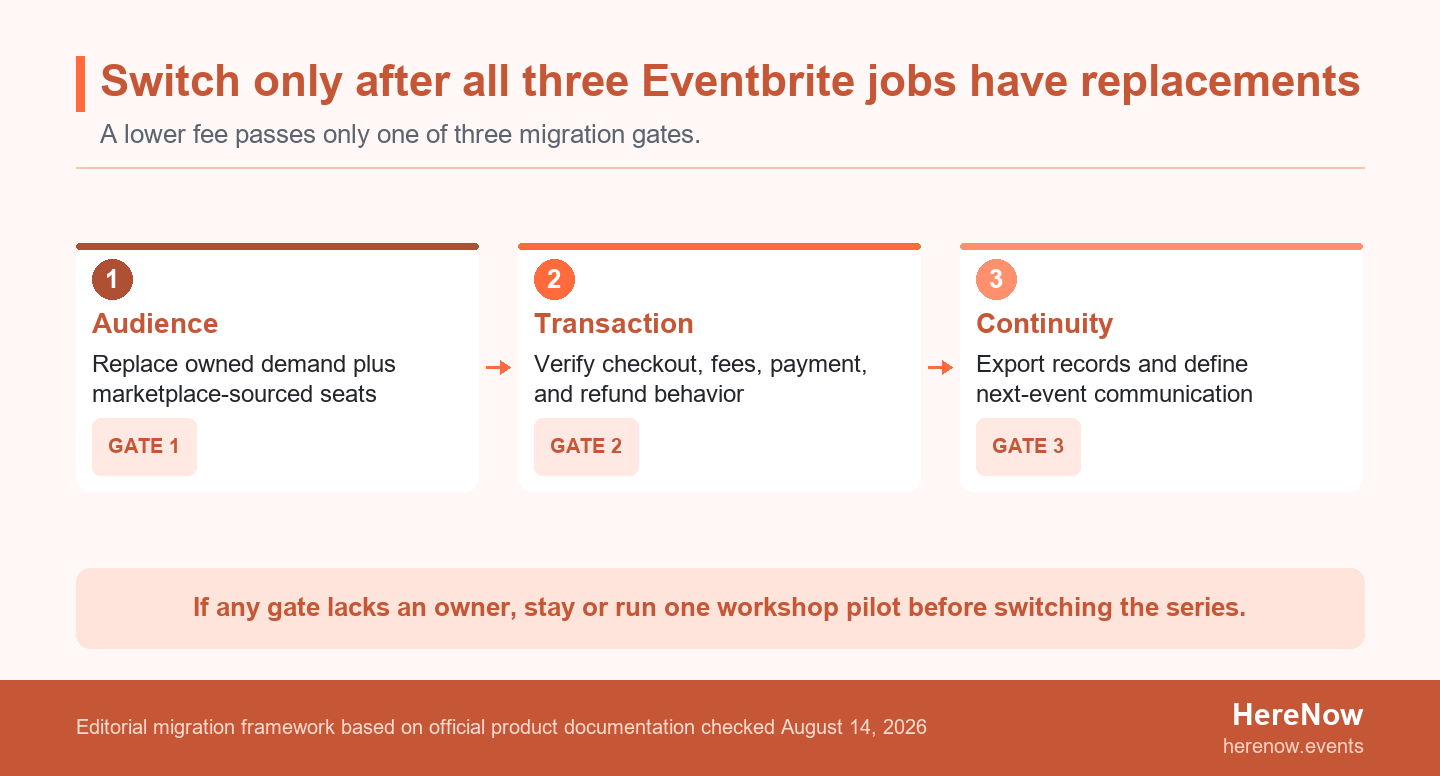
- Audience gate: Where will the seats come from after Eventbrite? Separate registrations generated by your list, partners, social posts, search, and Eventbrite discovery. If the replacement lacks marketplace reach, build a small-event promotion plan before launch.
- Transaction gate: Can a guest understand the offer, choose the right ticket, pay or RSVP, receive confirmation, and arrive with the right check-in record? Test the exact device, country, currency, refund rule, tax treatment, and payment provider.
- Continuity gate: Can the host use attendee records after the event and invite people appropriately to the next edition? Data portability means taking usable attendee records out of the platform. Export availability does not settle consent, import behavior, or future communication rights.
Passing two gates is not enough. A beautiful page with no audience, cheaper tickets with a broken refund flow, or a successful event with unusable guest records can each make the migration worse. This is a qualitative decision framework, not a prediction of conversion or profit.
A 20-Seat Ceramics Workshop: Why Fee Savings Can Mislead
Six marketplace-sourced seats must be replaced before fee savings are meaningful. Consider an illustrative scenario, not a customer case: a ceramics teacher fills 20 seats, with 14 registrations from an email list, studio partners, and social posts, while six appear in Eventbrite’s discovery-channel reporting.
A lower-cost ticket workflow may improve the economics of the 14 direct registrations. It does not prove that the same workshop will still fill. The host first needs a plausible route for the other six seats: stronger partner promotion, a waitlist from earlier dates, search traffic, referrals, or a smaller initial capacity. Without that route, comparing platform fees across 20 seats hides the actual risk.
The sensible pilot moves only one date and caps the downside. Publish comparable information, use the same price and capacity, track every registration source, and record support or refund problems. If the alternative fills the workshop while the guest and export workflows pass, the series can move. If direct demand stalls, the host can keep Eventbrite, split channels, or run another pilot rather than forcing a full migration.
Migrate One Workshop Edition Before Moving the Series
A controlled pilot should exercise the full guest and host loop. Use one representative workshop date, not the easiest free test and not the entire season.
- Rebuild the page with the same promise, date, venue, capacity, access information, price, materials, cancellation terms, and contact route.
- Complete a registration or purchase on mobile and desktop; then test confirmation, reminder, refund or cancellation, check-in, and host notifications.
- Export attendee records and confirm that names, contact details, ticket or RSVP state, answers, and check-in fields are usable. Check consent before contacting past guests or importing them elsewhere.
- Track the source of every seat and compare filled seats, support load, refunds, guest friction, and continuity—not only headline fees.
Before including HereNow in the pilot, verify current HereNow pricing and apply the same live check to every alternative. You can start with a workshop template. If all three gates have replacements, create one test event page and complete the loop before moving the series.
Frequently Asked Questions
Which Eventbrite alternative is best for paid workshops?
The best paid-workshop alternative for a specific host depends on whether you need ticket control, a full event stack, a recurring calendar, social invitation, or faster page creation. Ticket Tailor and Humanitix deserve attention for ticket-heavy operations; Luma for a continuing series; Partiful for message-led audiences; and HereNow for idea-to-page speed. Verify the applicable fees, processor, refunds, exports, and country before choosing.
Is there a free Eventbrite alternative for workshops?
Yes, several Eventbrite alternatives currently support free workshop registration, but their paid-ticket, communication, branding, and fair-use rules differ. A free event path should still pass the audience, transaction, and continuity gates. Test capacity, reminders, check-in, attendee questions, export, and what happens when the workshop later becomes paid. Confirm current terms on each official page because free-plan limits can change.
Should I leave Eventbrite if it brings attendees?
Probably not until you can identify and replace the registrations that Eventbrite discovery contributes to your workshop. Review source reporting across several comparable dates, not one unusual event. Build an owned or partner-led audience route, then test one edition on the alternative. If the new route cannot replace enough seats, staying, splitting channels, or running another pilot may be more rational than switching.
Can I move my Eventbrite attendee list elsewhere?
Eventbrite documents CSV and Excel attendee exports, but importing records and contacting past guests are separate platform and consent questions. Export the fields you legitimately need, inspect their quality, and confirm the destination can accept them. A technical file transfer does not automatically permit marketing to past attendees, preserve payment records, recreate refunds, or carry every custom answer into another platform.
How current is this Eventbrite alternatives comparison?
The official product, pricing, terms, developer, and help sources cited in this comparison were checked on August 14, 2026. Public pages can change after publication, and an account may show different terms by location, currency, plan, event type, or payment provider. Follow the cited official links and run a small live test before moving a paid workshop, guest list, or recurring series.