Best Event Page Builders for Small Events in 2026
Compare six event page builders by audience source, guest journey, ticketing model, repeat-event fit, and host control before testing a shortlist.
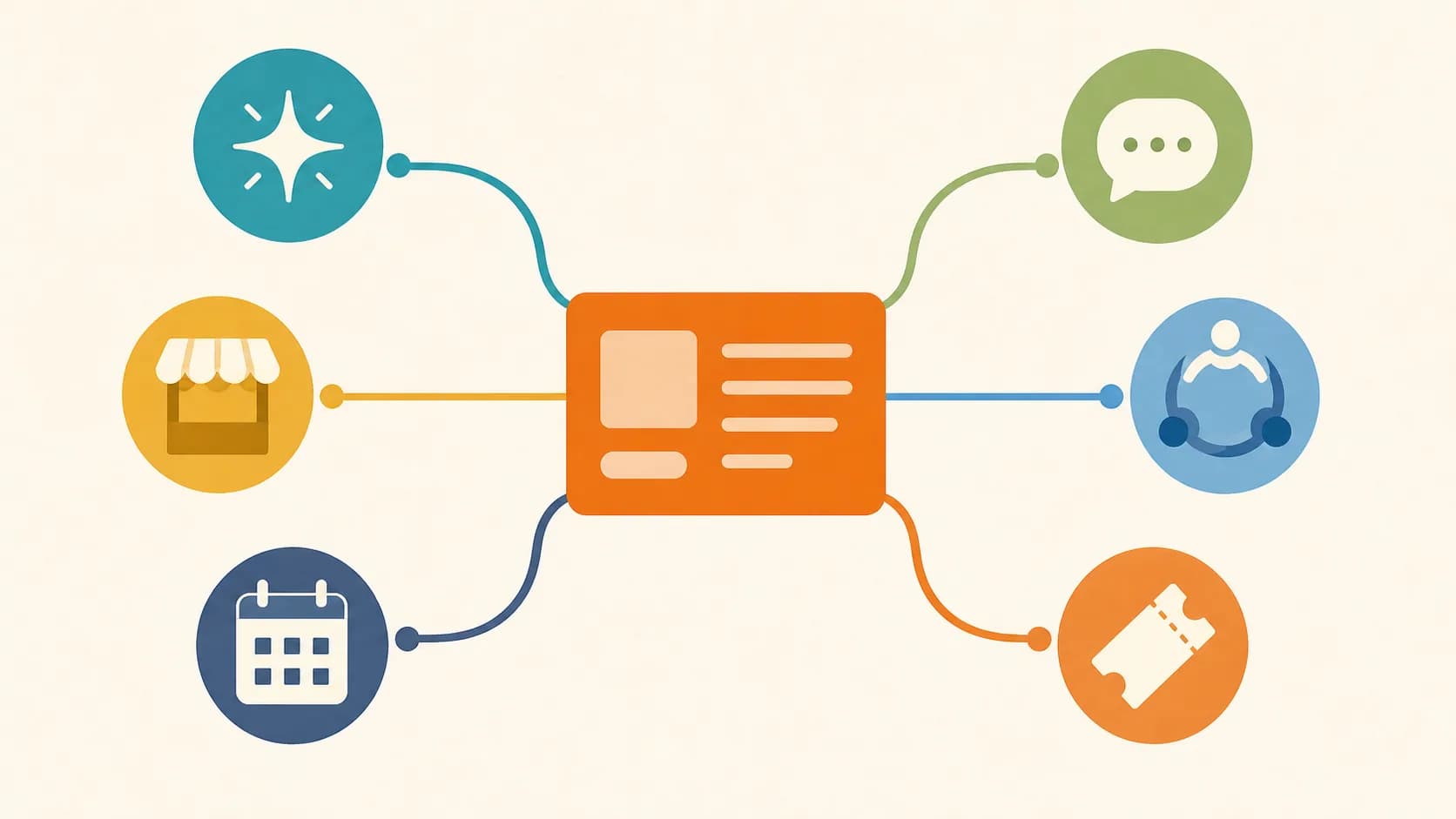
There is no honest overall winner among event page builders for small events. A birthday invitation shared in a group chat, a recurring book club, a public ticketed workshop, and a class sold through an existing website need different things from the page behind the link. The useful question is not “Which platform has the most features?” It is “Which platform fits how guests will find this event and what must happen after they arrive?”
Match the Platform to the Event System
The products center different distribution and operating jobs. HereNow is the first candidate when a host needs to turn a rough idea into a clear public page. Eventbrite is the first look for marketplace discovery and mature ticketing. Luma suits a recurring calendar or community. Partiful is strongest as a social invitation shared by text. Meetup centers an ongoing interest group. Ticket Tailor centers ticketing control for a host who already has an audience.
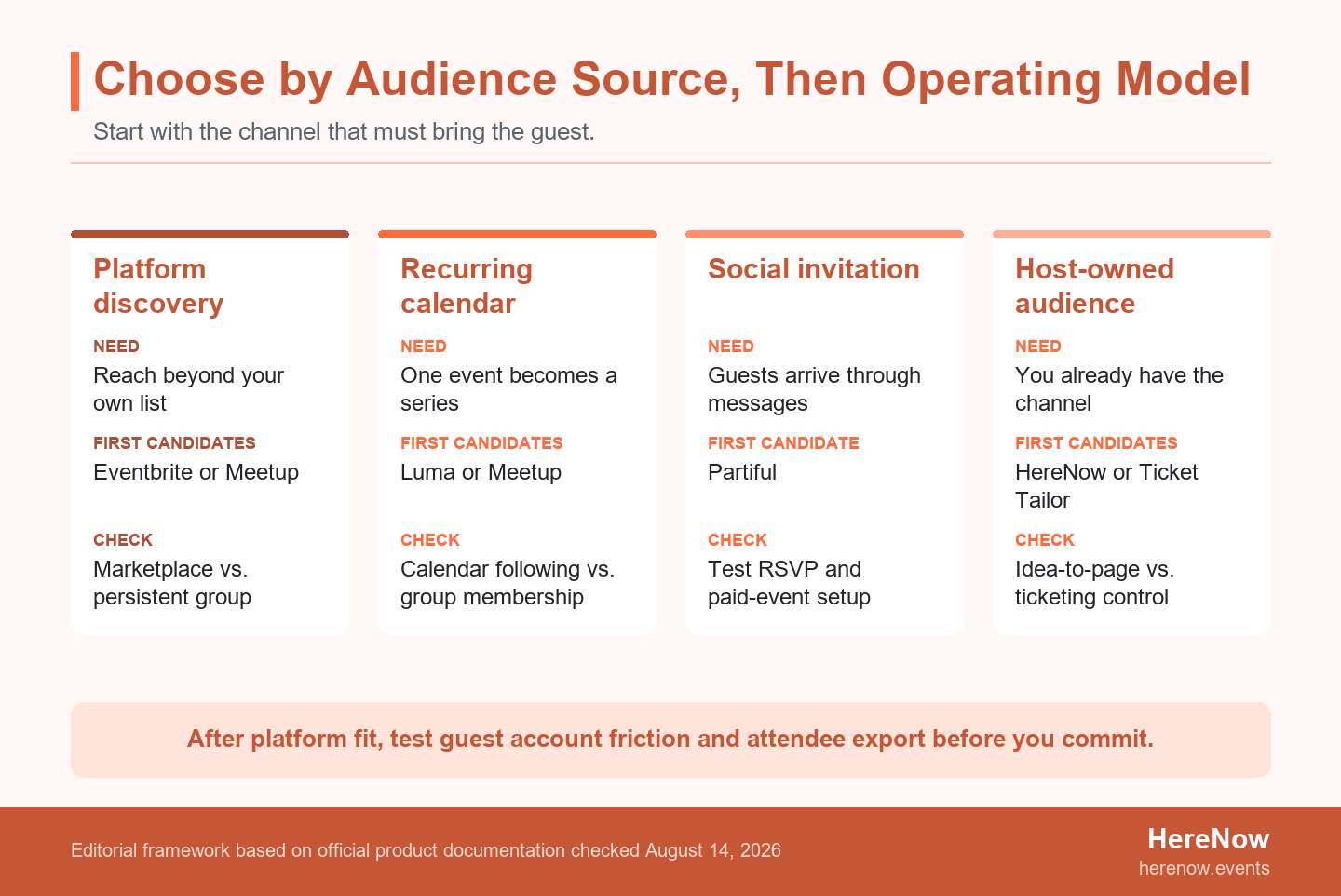
- Choose the discovery channel first. An audience source describes the guest discovery channel: a host list, social network, marketplace, group, calendar, or partner.
- Match the work after the click. The operating model covers registration, payment, communication, and repeat events.
- Shortlist two candidates. Use guest friction and attendee export as the final checks, not the first filter.
How We Evaluated the Builders
Official public pages were checked on August 14, 2026. The source set includes current product, pricing, and help pages. We included hosted event-page products with built-in RSVP or ticketing that an independent host could realistically use for a workshop, class, meetup, or social event. General website builders that need a separate registration stack and enterprise conference suites were outside the scope.
Every product was reviewed against the same questions: What kind of event is it best for? Where does the audience come from? Can a guest register without unnecessary friction? How are free events and paid tickets handled? Does the product support repeat events or a community? Can the host control the page and export usable attendee records?
Disclosure: HereNow publishes this comparison and is one of the products covered. There are no affiliate links. This is a documented shortlist, not an authenticated hands-on test of every paid feature. Prices, regional availability, plan limits, payment terms, and account-level workflows can change, so “verify” means checking the live product before moving a real event.
Best Event Page Builders at a Glance
Each option has a distinct best fit and notable limitation. The table is deliberately qualitative: a numeric score would hide the fact that these products solve different event systems.
| Builder | Best fit | Primary audience source | Free and paid model | Notable limit to test |
|---|---|---|---|---|
| HereNow | Independent workshops, classes, and community events starting from a rough idea | Host list, partners, social, search, or direct sharing | Free events are free; paid tickets use Pro | No established marketplace comparable to Eventbrite or Meetup |
| Eventbrite | Public events that need discovery plus ticketing operations | Eventbrite marketplace and host promotion | Free-event publishing; paid-ticket fees vary by market | Total fees and the value of marketplace reach |
| Luma | Recurring calendars, communities, and event series | Host community, calendar followers, and direct sharing | Free plan; platform fee on paid events unless the paid plan changes it | Whether calendar continuity matters more than marketplace reach |
| Partiful | Casual and social events shared through messages | Friends, mutuals, group chats, and local discovery | Free core invitation tools; ticket terms require live verification | Whether the event needs deeper recurring or host-data operations |
| Meetup | Ongoing interest groups and recurring local events | Meetup discovery and existing group members | Organizer subscription; paid events are supported | The group-first identity and current local plan price |
| Ticket Tailor | Ticketed events run by a host with an audience or website | Host-owned site, list, partners, and promotion | Ticketing usage model; verify live price and processor costs | Audience discovery is not the primary proposition |
Short conclusion: shortlist by the event model, not by the apparent size of the product. A host who needs discovery should start with Eventbrite or Meetup. A host with a known audience should compare HereNow, Luma, Partiful, or Ticket Tailor according to whether the main need is page creation, a recurring calendar, social invitation, or ticketing control.
When the Page Starts With the Event Idea
The starting jobs are idea formation, public discovery, and calendar continuity. HereNow, Eventbrite, and Luma can all publish an event page, but their most useful starting points are different.
HereNow: Best for Turning a Rough Event Idea Into a Public Page
HereNow documents an AI-assisted idea-to-page workflow. The host can see how HereNow turns an event idea into a page, then edit the output before publishing. A no-account RSVP is HereNow’s guest registration path without a required platform profile. That makes the product a strong fit when a host knows the experience they want to create but needs help turning an idea, poster, or source link into a clear invitation.
The tradeoff is distribution: HereNow does not position itself as a large third-party event marketplace. It is a better candidate when the host can reach guests through a list, partner, community, social channel, or search and wants the page and registration flow to stay simple. Attendee export is available as a separate host-side workflow.
Eventbrite: Best for Marketplace Discovery and Mature Ticketing
Eventbrite presents discovery and organizer ticketing together. Its official event ticketing overview covers hosted pages, ticket types, attendee management, and the marketplace, while the organizer pricing page separates free-event use from paid-event fees.
That combination makes Eventbrite a strong candidate when people outside the host’s existing audience need to find the event and when check-in, ticketing, and organizer operations matter. Marketplace presence does not guarantee demand, however. Model the full paid-ticket cost in the event’s country and decide whether discovery is valuable enough to justify a more marketplace-centered guest and brand experience.
Luma: Best for a Recurring Calendar or Community
Luma documents calendar-connected registration and communication. Its registration guide covers confirmation, calendar behavior, capacity, approvals, and host communication. Those pieces make sense when one event belongs to a continuing calendar and guests may follow future dates.
Luma’s public pricing page currently presents a free plan, a platform fee for paid events on that plan, and a paid plan that changes the fee model. Verify the price and region before deciding. Choose Luma for calendar continuity and repeat communication; do not choose it merely because a recurring option exists if the actual need is a broad ticket marketplace.
When the Audience Already Comes Through a Social or Ticketing Channel
The three products center different existing audience channels. Partiful extends a social invitation, Meetup gives an interest group a durable home, and Ticket Tailor adds ticket operations to a host-owned audience.
Partiful: Best for Social Invitations Shared by Text
Partiful documents invitation pages, no-account RSVP, sharing, and reminders. Its RSVP website overview is built around a page that moves naturally through messages and existing relationships, making it a strong option for birthdays, dinners, parties, and other events where the invitation is the main product.
Partiful also offers a broader ticketing workflow with ticket types, sales tracking, check-in, updates, and discovery. Test the live setup before assuming a particular fee or availability in the host’s region. For a formal class, content-rich public resource, or long-running host operation, check whether the social-first experience still supplies enough page depth, export control, and repeat-event structure.
Meetup: Best for an Ongoing Interest Group
Meetup combines organizer subscriptions, groups, events, member communication, and discovery. Its organizer overview describes groups, event scheduling, communication, ticket prices, attendee controls, and reach within the Meetup network. The group persists even as individual dates pass.
That is useful for a hiking group, language community, professional circle, or other interest-based series. It can be unnecessary structure for one private workshop. Meetup’s group creation flow is also the place to verify the organizer plan currently offered in the host’s location. Evaluate the cost against the value of group membership and network discovery, not against the event page alone.
Ticket Tailor: Best for Ticketing Control With Your Own Audience
Ticket Tailor documents event and order operations through its API and a dedicated check-in app. Its official developer documentation exposes event and order resources at the box-office level, which matters to hosts who need operational control or integrations. Its official check-in app listing covers scanning, door lists, team access, multiple events, and offline operation.
That makes Ticket Tailor a strong candidate when a host already has a website, mailing list, venue audience, or promotion system and wants a dedicated ticketing layer. The limitation is the other side of that control: the host still needs a route to demand. Verify current ticket usage charges, payment-processor fees, brand options, exports, and the exact event-page or embed workflow inside the live product.
Use the Guest Journey as the Tie-Breaker
Distribution fit comes before secondary feature fit. Start with the audience source, use the operating model to narrow the valid options, and only then compare guest friction. Data portability is the ability to export usable attendee records; it matters because the guest list must remain operationally useful after the event.
- Need platform discovery? Compare Eventbrite for a public ticket marketplace with Meetup for a persistent interest group.
- Need a recurring calendar? Compare Luma’s calendar-centered flow with Meetup’s membership-centered group.
- Need an invitation that spreads through messages? Test Partiful’s guest flow on the phones people will actually use.
- Bring your own audience? Compare HereNow when idea-to-page speed and no-account RSVP matter with Ticket Tailor when ticket operations and integration control matter more.
Then register as a guest. Count the decisions, identity requests, payment steps, and confirmation messages. If guest account creation is a concern, review the no-account RSVP flow as one concrete reference point. A product can win the feature comparison and still lose the event if joining feels wrong for the audience.
What to Verify Before You Commit
Several official sources expose variable or separately calculated commercial terms. A pricing claim can become stale, and a public feature can still be limited by region, plan, payment provider, or account state. Before moving an event, answer these questions in the live product:
- What does the host pay for a free event, a paid ticket, a refund, and a payout?
- Does the guest need a platform account, phone number, app, or separate payment identity?
- Can the host export names, emails, answers, ticket status, and check-in state in a usable format?
- Can the page use the required brand, URL, images, accessibility information, and refund language?
- What happens when the event repeats, reaches capacity, uses a waitlist, changes date, or is cancelled?
- Which taxes, payment-processor fees, service fees, and refund rules sit outside the headline platform price?
For HereNow, check the registration and export workflow and verify current HereNow pricing. Apply the same standard to every competitor. If an answer is missing from a public page, treat it as an open question rather than filling the gap with a comparison-site claim.
Run One Test Event Before Migrating
The test covers the full guest and host loop. Imagine a 16-seat pottery workshop shared through the teacher’s mailing list and two local partners. The host prepares one public page with a beginner outcome, date, venue, price, capacity, materials, access note, and refund rule. One test guest opens it on a phone, registers or pays, receives the confirmation, and appears correctly in the host view and attendee export.
Because this audience is mostly host-owned, marketplace reach is secondary. HereNow belongs on the shortlist if shaping the event page and keeping RSVP simple are the main needs. Ticket Tailor belongs there if ticket operations and integration control dominate. If neither workflow completes cleanly, test the next candidate before sending the live invitation.
This is an illustrative scenario, not a customer result. To run the same low-stakes check, test the fit with an event template. If the HereNow model matches the event, create one test event page and complete the guest and export loop before committing.
Frequently Asked Questions
Which event page builder is best for a free small event?
The best free option depends on whether the event is a social invitation, a recurring calendar, a marketplace listing, or a host-owned page. HereNow, Eventbrite, Luma, and Partiful all document a free-event path, but they distribute and operate the event differently. Compare the guest journey, host export, repeat-event behavior, and any limits that appear in the live account. “Free” does not make two workflows equivalent.
Do guests need platform accounts before they can RSVP?
Account requirements vary, so test the actual guest flow on every shortlisted platform before publishing the event. HereNow and Partiful explicitly document account-light registration for the use cases linked above. Do not generalize that fact to every ticketing path, payment provider, event setting, or competitor. Use a fresh browser or a person who is not already signed in and record every identity step before the confirmation appears.
Is Eventbrite the best choice for event discovery?
Eventbrite is a strong candidate when marketplace discovery is central, but discovery is not guaranteed and may not outweigh fees or brand priorities. Meetup may fit better when discovery should lead into a persistent interest group. If most guests will come from the host’s own list, partners, or community, the more important comparison may be page control, registration friction, and ticket operations rather than marketplace size.
Which event page builder is best for recurring events?
Luma and Meetup deserve the first look for recurring events, but they solve different community problems. Luma is calendar-centered: guests register around events and can follow an ongoing calendar. Meetup is group-centered: membership, discovery, and communication persist around the interest group. A host-owned series may also work well on HereNow or Ticket Tailor if the audience already exists and platform discovery is unnecessary.
How current are the product and pricing details here?
The public product and pricing sources in this comparison were checked on August 14, 2026, before publication. Product pages, fees, plan names, regional availability, payment terms, and account requirements can change after that date. Follow the official links, verify the exact setup offered to the host, and run one test event before moving a live guest list or announcing a paid event.