What is the curator economy?
The curator economy is a practical way to describe work built on judgment: choosing what matters, giving it context, and bringing people together around it.
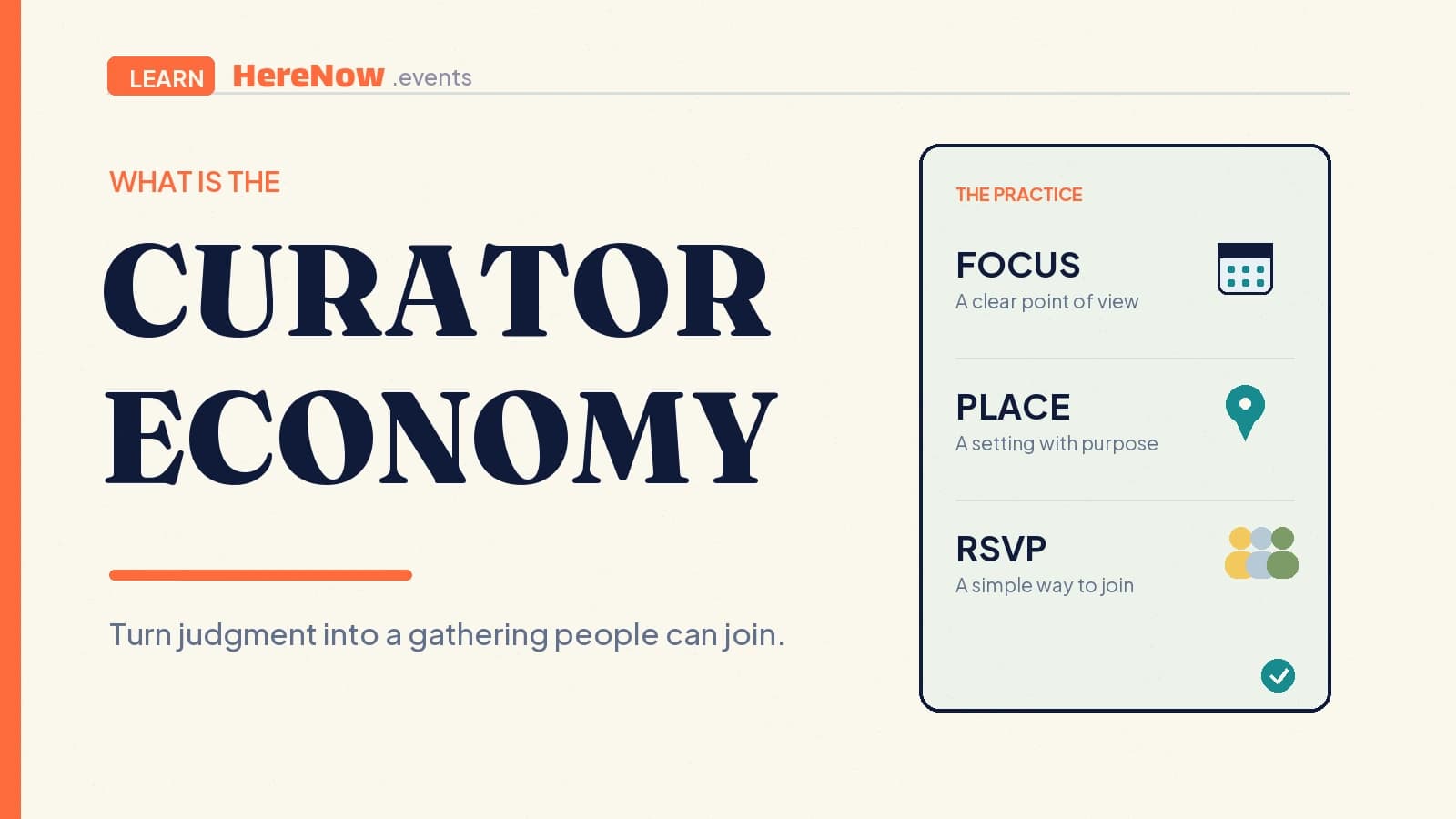
The curator economy is a practical way to describe work built on judgment: noticing what matters to a particular group, giving it context, and bringing people together around it. It is not a formal job category or a fixed market segment. For an independent host, it can mean turning a point of view—good ceramic teachers, overlooked local films, beginner-friendly running routes, or thoughtful dinner conversations—into gatherings that guests can understand and choose to join.
The short definition
In a curator economy, value does not come only from making something new. It also comes from making good choices on behalf of other people: what to include, what to leave out, how to frame it, and who should be in the room. That work can happen in a newsletter, a shop, a playlist, a learning program, or a recurring community event.
For event hosts, the idea is especially useful because an event is already a form of curation. A host chooses a theme, a setting, a pace, a guest mix, and a reason to gather. The result is not simply “an event about coffee” or “a walk on Saturday.” It is a clear invitation to a particular experience, for particular people, with a clear next step: RSVP.
Why the word “curator” matters
Curation can mean selecting and organizing material for publication or distribution, and it can also mean bringing people or groups together for a specific purpose. Museum practice makes the point even more clearly: the Smithsonian describes curators as caring for and interpreting collections, recommending acquisitions, and presenting those collections to public audiences. That combination of selection, interpretation, and presentation is a helpful model for a host.
A curator is not valuable merely because they have access to options. Guests can often find options on their own. The contribution is a trusted point of view: why this teacher, why this room, why this conversation now, and why these details belong together. Good curation reduces decision fatigue without pretending that one choice is right for everyone.
Curator economy versus creator economy
The two ideas overlap, but they start from different kinds of work. A creator usually makes original work: a video, a lesson, an illustration, a recipe, or a performance. A curator may create too, but their distinctive contribution is assembling a meaningful whole from people, ideas, places, and formats.
The creator economy is a broad and established commercial term. For example, the IAB’s 2025 creator-economy report describes creators as an increasingly important channel for brands. “Curator economy” is better treated as a useful lens inside that wider landscape, not as a claim that every host is a professional creator or that every gathering must be monetized.
That distinction gives new hosts permission to begin with taste and care rather than a content machine. A person who knows which independent bakers are great at teaching, or which local writers make newcomers feel welcome, may already have the raw material for a well-curated event.
What it looks like in a small event
Imagine Maya, who keeps a personal list of neighborhood designers and small studios. Instead of starting a generic “creative networking night,” she hosts a monthly open-studio evening for six people. Each session pairs one maker with one practical theme: bookbinding for travelers, mending for beginners, or choosing paper for personal letters. Maya does not need to be the most skilled maker in the room. Her work is choosing a focused topic, inviting the right teacher, setting expectations, and making the room comfortable for first-timers.
That is curator-economy work: a point of view translated into a repeatable social format. The same logic can shape a workshop, a community event, a supper club, or a neighborhood walk. What guests receive is not an endless list of possibilities; it is a thoughtfully bounded experience with a reason to show up.
The three choices that make curation visible
- Focus: Name the question or feeling the gathering is built around. “A friendly first run” is clearer than “fitness community.”
- Fit: Decide who the experience is for and what they need to know before joining, including experience level, cost, access needs, and tone.
- Flow: Give guests a simple path from interest to arrival: a clear event page, the essential details, and a low-friction RSVP.
These choices are modest, but together they create trust. They also make the next event easier to produce. When the focus and guest promise are clear, a host can keep the useful parts, change the theme, and improve the details without rebuilding from zero.
Build a repeatable curatorial loop
Start by choosing one audience you can genuinely serve. Then make one small promise you can keep. After the event, note what guests asked about, where they hesitated, and which part of the format made conversation easy. Use those observations to refine the next invitation. This is not about manufacturing scarcity or chasing a trend; it is about becoming more precise about the experience you are responsible for.
There is a community reason to take that responsibility seriously. The National Endowment for the Arts has examined how participation in arts events and activities relates to broader civic and community engagement. A host cannot promise those outcomes, but can design with the social side of gathering in mind: give newcomers a way in, make the purpose legible, and leave enough room for people to meet each other.
When you are ready to turn that judgment into an invitation, create an event page with the theme, time, place, and RSVP path in one shareable link. The page should help a guest make a confident decision, not ask them to decode the host’s intent.
FAQ
Do I need a large audience to be part of the curator economy?
No. Curation is about relevance and care, not reach. A six-person language exchange, a monthly reading table, or a small beginner workshop can be strongly curated when the host makes deliberate choices about the theme, people, and experience. Start with a group you understand, then build a format they can recognize and return to. Small groups often make those choices easier to notice and refine.
Is a curator economy event always paid?
No. A curated gathering may be free, donation-based, ticketed, or supported in another way. The important question is whether the format is clear and sustainable for the host. Payment can support the work involved, but it is not proof that an event is well curated, and a free event can still have a strong point of view. Be explicit about the arrangement before guests RSVP.
What should I curate first?
Begin with something you can explain in one sentence: a skill people want to try, a local scene you know well, or a conversation you wish existed. Then make the first version small enough to learn from. A clear promise and a welcoming RSVP path are more useful than an ambitious program with no obvious reason for guests to join.