What is a host-owned audience?
A host-owned audience is a permissioned direct relationship with people who choose to hear about future events—not a claim over attendee data or attention.
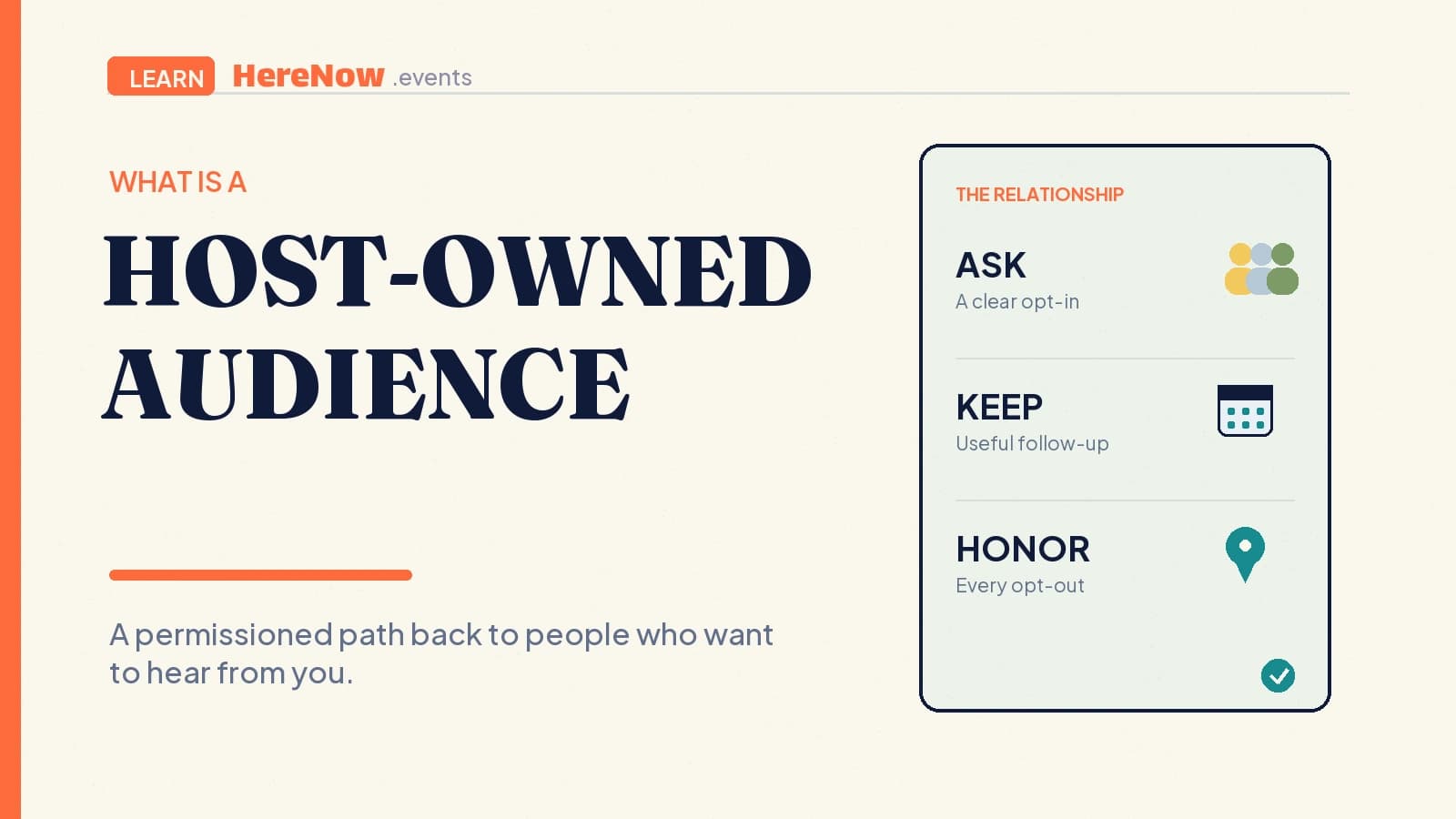
A host-owned audience is the group of people a host can reach directly, with the right context and permission. It is not a list of people a host can contact however they want. The relationship remains voluntary: people choose whether to hear about future gatherings, can change that choice, and still retain rights over their personal information.
It starts with a relationship, not a list
Independent hosts often hear that they should “own their audience.” The useful part of that advice is resilience. If a platform changes its algorithm, closes a group, or limits distribution, a host can still invite people who have asked to hear from them.
But the word owned can be misleading. A host does not own people, their attention, or their personal data. A better definition is a permissioned, host-controlled way to maintain a direct connection. It rests on three things: a clear reason someone chose to stay in touch, a channel they agreed to use, and a reliable way to respect a later no.
That distinction matters most after an event. A guest may expect a confirmation, a location change, or a recap because they registered. They may not expect a stream of unrelated invitations. Separating event operations from future-event updates keeps the relationship understandable from the first RSVP.
What belongs in a host-owned audience
A healthy host-owned audience is smaller and more specific than a raw reach number. It includes people who voluntarily subscribed to invitations from a named host or series. The valuable asset is not a spreadsheet; it is the ability to make a relevant invitation to people who recognize why it arrived.
- Direct reach: a contact channel beyond one platform’s feed.
- Shared context: a clear connection to the host, series, or kind of gathering.
- Current permission: a record of what a person agreed to receive and a simple way to stop.
- Useful memory: enough context to make the next invitation relevant, without collecting more than the host needs.
A public host profile helps create that shared context before anyone subscribes. It tells a potential guest who is inviting them, what they tend to host, and why a future message will feel familiar rather than random.
Why followers and registrations are not the same thing
A social following can be a strong discovery channel, but it is not automatically a host-owned audience. The platform controls distribution, account access, and the rules for contacting followers. A high follower count signals interest, yet does not give a host a dependable way to reach people when the next event opens.
Registrations are different again. They give a host the information needed to run one event: confirm a place, send a reminder, share a change, or manage arrival. That operational relationship should not silently become a marketing relationship. Read what attendee data ownership means for the companion question of who controls registration information and why guests retain rights over it.
In data-protection terms, control brings responsibilities. The European Data Protection Board explains that a controller determines the purposes and means of processing personal data while needing measures that protect people and enable their rights. Its controller-and-processor guidance is a useful reminder: managing a contact record is not a blank cheque to repurpose it.
Keep permission attached to the channel
When someone joins a host’s future-events list, make the choice legible. Name the host or series, say what updates they will receive, and avoid bundling it into the required RSVP step. The right option might be an unchecked invitation checkbox or a separate sign-up link after a guest registers. Store the choice with the contact method it applies to.
That approach is good relationship design and is also consistent with major privacy guidance. The UK Information Commissioner’s Office says electronic marketing to individuals generally needs specific consent or a qualifying existing-customer route, and requires a clear opt-out when that route is used. Its guidance also notes that consent for one channel does not automatically cover another. See the ICO’s electronic-mail marketing guidance for the details.
Rules vary by location and message type, so a host should use locally appropriate advice for their situation. The principle travels well: a guest should be able to understand what they are choosing and reverse that choice without friction. The ICO’s guidance on respecting people’s preferences emphasizes that a later opt-out or objection must be honoured. In the United States, the FTC likewise distinguishes transactional messages from commercial ones and requires a way to opt out of further marketing where commercial-email rules apply. Its CAN-SPAM compliance guide explains the distinction.
A small practice that compounds over time
Start with a simple rhythm rather than a complicated audience program:
- After each event, send the information guests need for that event.
- Offer a separate, plain-language way to hear about future gatherings.
- Keep notes on the series or interests a person chose, not guesses about them.
- Before each new invitation, check that it matches the context and channel they selected.
This creates a repeatable habit. A host does not need to rebuild interest from zero for every event, and guests do not need to hunt through feeds for the next date. In HereNow, hosts can use their host dashboard to manage event records and export attendee information for legitimate event operations, while keeping future contact separate and permission-aware.
Illustrative example: a monthly language exchange
Maya hosts a monthly beginner-friendly language exchange. Her RSVP form collects the details needed to confirm each session. After someone registers, she offers an optional choice: “Send me one monthly invite from Maya’s language exchange.” It names the sender, the cadence, and the purpose. People who choose it receive the next invitation; everyone else still receives essential messages about the session they joined. If someone unsubscribes, Maya stops future-invitation messages on that channel while preserving only what is necessary for the event record and applicable obligations.
Over six months, Maya’s direct audience may be more modest than her social reach. It is also more useful: each invitation arrives with a reason, a familiar host, and a low-friction RSVP path. That is what makes it host-owned in the practical sense—durable access to a relationship that guests have chosen.
Frequently asked questions
Is a social-media following a host-owned audience?
Not by itself. A following can help people discover a host, but the platform controls how and whether a post is shown. It becomes part of a more durable audience only when people choose a direct, well-explained way to hear from the host outside that feed.
Can I add every past attendee to my next-event email?
Treat the registration as permission to run the event they joined, not automatic permission for future marketing. Whether a message is allowed depends on its purpose, the relevant rules, and what people were told when their details were collected. A separate, explicit choice is clearer and more respectful.
Does exporting attendee data mean I own it?
No. Exporting can help a host operate an event and maintain their own records, but it does not remove attendees’ rights or make every use appropriate. Keep the purpose narrow, protect the information, and keep future invitations tied to a clear, current choice.