What is attendee data ownership?
Attendee data ownership explains who controls event registration information, how it should be used, and why guests retain rights over their own personal data.
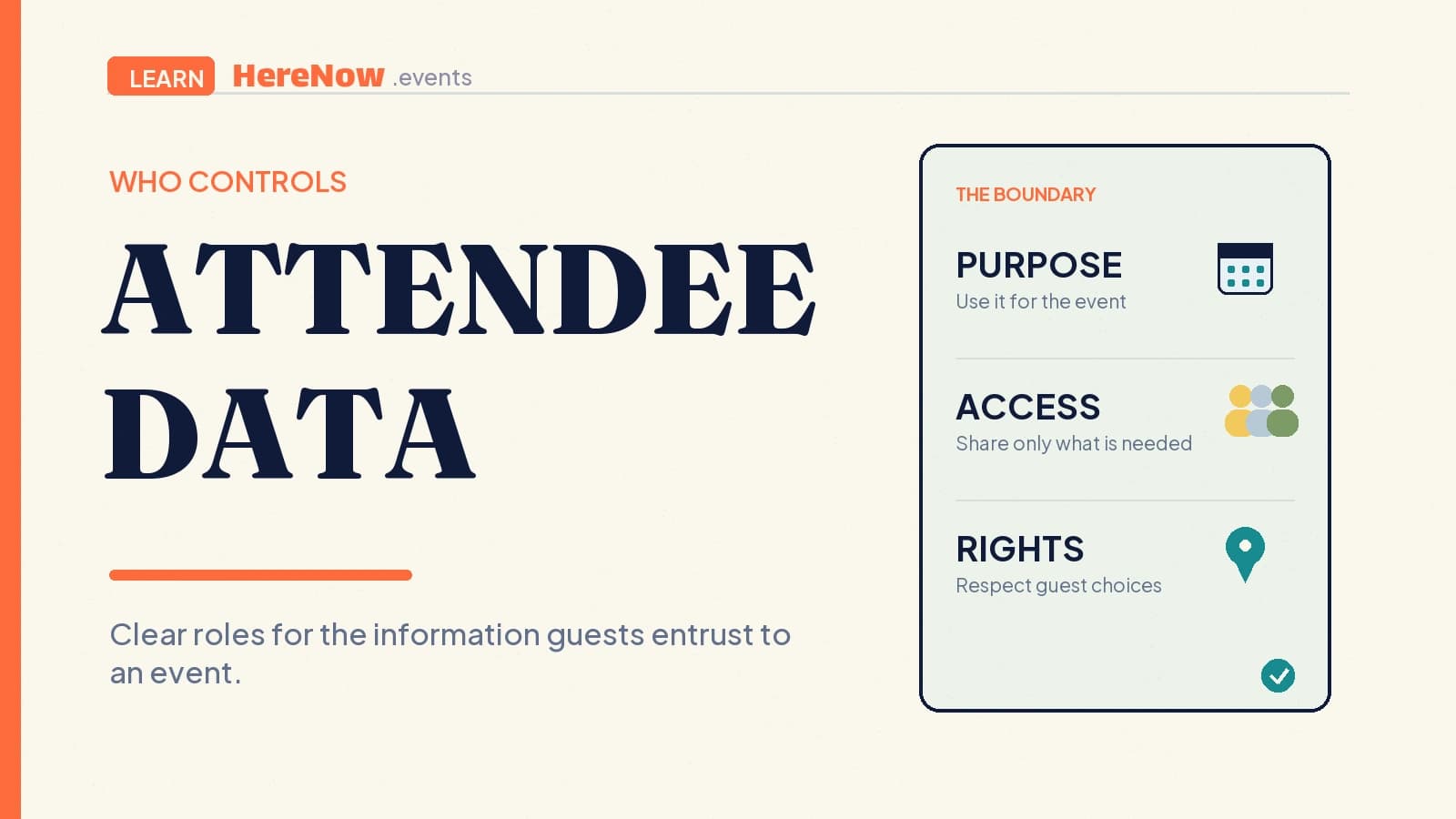
Attendee data ownership is the practical understanding of who controls information collected when someone registers and its permitted use. It does not mean a guest’s name or email becomes someone else’s property. In a well-designed event relationship, the host controls registration information for that event, the platform processes it to provide the service, and the attendee keeps rights over their own personal information. Exact roles depend on the event, contract, and law.
“Ownership” is shorthand for clear roles and limits
Hosts often use “my attendee data” to mean that a platform should not turn their guest list into its marketing asset or share it with unrelated organizers. That is a reasonable operational expectation, but data protection law uses more precise language. Ask: who decided why the information was collected, what was the guest told, who can access it, and what happens when a guest asks for a change or deletion?
The European Data Protection Board describes a controller as the party that determines the purposes and means of processing personal data, while a processor acts on the controller’s instructions. That controller–processor distinction helps a small host think clearly about an RSVP form. It is not a substitute for legal advice, and the legal arrangement can vary, especially when organizations or co-hosts share decisions.
Separate the attendee, host, and platform roles
A practical event data model has three parties with different interests. The attendee provides information and should know why it is needed. The host or organizing team named on the host profile uses it to run the event they invited the person to. The platform supplies the workflow: form, messages, storage, access, and export. None has a blank check to use a person’s information for unrelated purposes.
On HereNow, registration data collected through a curator’s event form is controlled by that curator, while HereNow processes it as the service provider for the event. The platform does not sell attendee lists, does not expose one curator’s list to another, and does not use RSVP emails for platform marketing unless the attendee separately creates an account or explicitly opts in. Guests can also request access, correction, export, or deletion of their personal information under the HereNow Privacy Policy.
Use registration data for the event relationship
For a workshop, language exchange, or walking club, the event relationship normally includes confirming a place, sending reminders, communicating a cancellation or location change, handling a waitlist, and sharing an approved recap or safety notice. It may also include a clearly explained follow-up from the same host when the guest knows what to expect and can choose their preferences.
It does not automatically include giving the list to a sponsor, adding it to a co-host’s unrelated business, or sending indefinite promotional campaigns. The UK ICO treats sharing contact details for direct marketing as a distinct activity and says people should be told when information will be shared for that purpose. Its direct-marketing guidance emphasizes a clear purpose, a valid basis, and a meaningful choice. Rules differ by jurisdiction, so obtain advice when the stakes or scale require it.
Collect less, explain more
Each field should have an event reason. A name and email may be enough for a casual book club. A pottery class may need allergy or accessibility information only when the host can genuinely use it to make the activity safer or more workable. If a question will not change the guest experience or event operations, leave it off. More fields create more responsibility, not a better event.
The ICO’s data-minimisation guidance puts this simply: information should be adequate and relevant for its purpose, but limited to what is necessary. Explain the purpose near the field in plain language. “Phone number for a same-day venue change” is clearer than “phone number required.” Do not use a registration form to gather details that might be useful someday.
Set access boundaries before the event starts
Data control is not just about export. Before registrations open, decide who can see the list, send event messages, handle a correction or deletion request, and what happens when a co-host leaves. Give volunteers the smallest access needed for their role. Someone checking guests in may only need a name list; they do not need every form answer or a spreadsheet download.
Service providers can be involved without becoming the intended audience for the data. The ICO’s own event privacy notice describes registration tools and other suppliers as processors handling information under its instructions. That event-specific example is a useful operational pattern: document what each provider does, share only what is needed, and keep the guest informed about the arrangement.
Example: a 16-seat beginner pottery class
A ceramics host collects a guest’s name, email, and an optional access note. They use the email for the confirmation, a 24-hour reminder, and notice if the studio needs to close because of weather. The co-host who welcomes people sees first names and the RSVP status; the instructor sees only access information that is relevant to preparing the room. The host does not send the list to the studio for its newsletter or upload it to a personal marketing tool.
After the class, the host sends a thank-you and a link to a new event registration page. A separate, clearly explained choice can invite interested guests to hear about future classes, but declining it does not affect the original registration. If a guest asks for a correction or deletion, the host follows the stated process and does not treat the request as a personal favor.
Make a small data promise you can keep
Before publishing, write down the answer to four questions: what will we collect, why do we need it, who can access it, and when will we stop using it? Put the guest-facing parts in the registration flow, keep the internal answer with the host team, and revisit it when the event becomes recurring or adds a collaborator. This small habit makes a host’s use of attendee information easier to explain and easier to honor.
Frequently asked questions
Does attendee data belong only to the host?
Not in the sense that a host can do anything with it. The host may control registration data for the event relationship, while the attendee retains rights over their personal information and the platform has its own service and security responsibilities. The exact legal responsibilities depend on the parties, their agreement, and the laws that apply.
Can a host invite attendees to the next event?
It can be appropriate to send event-related follow-up when guests have been told what to expect, but promotional messages and local legal rules need separate care. Explain the purpose clearly, respect any opt-in or opt-out choice, and do not assume that a registration for one event is permission for unlimited future marketing.
What should a host do if an attendee asks to delete their information?
Take the request seriously, confirm the person and the event it concerns, and follow the host’s stated privacy process. In some cases a platform may need to coordinate with the host or retain limited information for legal, security, or backup reasons. If you are unsure what applies, seek appropriate privacy advice rather than improvising.