How to Turn Photography Skills Into Paid Photo Walks
Package one visual skill into a guided photo walk, test the route and device fit, set an attention-based cap, and price one responsible paid pilot.
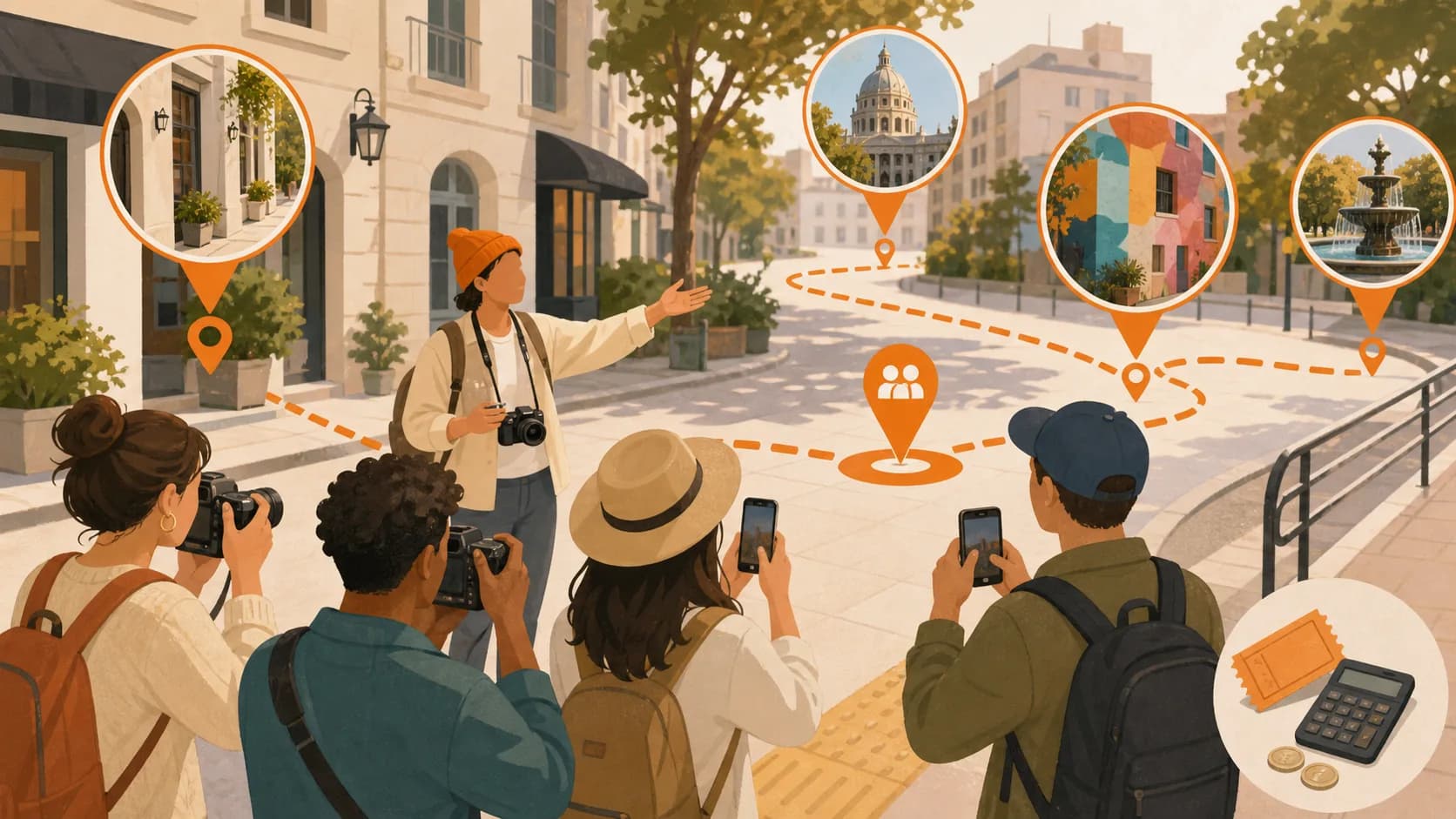
A paid photo walk is not paid access to attractive streets. It is a capacity-limited guided-attention product: guests pay for a host to direct what they notice, create practice conditions, keep a moving group together, and give the promised feedback. The route is available to everyone; the product is the structured way of seeing it.
That distinction changes the order of work. Choose a result and test the route before naming a ticket price. Then set the largest group you can still locate, regroup, and help. Only after that should you compare the attention cap with break-even seats. If the financial model needs nine guests but the experience works for eight, the offer is not ready. Raising capacity would sell more tickets by removing the value people are buying.
The method below turns one photography strength into a bounded offer, compares three walk formats, tests route and device fit, models an eight-seat pilot, and separates participant copyright from promotional image use. It does not promise demand, permission, safety, profit, or a professional photography outcome.
Six Conditions Before a Photo Walk Is Worth Charging For
A viable paid photo walk aligns a guest result, format, route, device fit, attention capacity, economics, and image-use boundaries. Test them in that order. Each condition limits the next one, so an unresolved route or vague promise cannot be repaired with a clever price.
- Offer: guests can name what they will practise, and the format works for the stated equipment and skill level.
- Route: permission, access, timing, shelter, facilities, and regroup points support the complete experience.
- Attention: the host can find every guest and deliver the promised guidance.
- Economics: break-even stays below the responsible registration cap.
- Image use: capture, participant sharing, and host promotion have separate, visible rules.
Turn Visual Judgment Into One Guest Promise
Start with one visual problem and one bounded guest result, not a broad promise to improve photography. “Notice and frame three kinds of reflected light on an evening route” can shape prompts, stops, timing, device guidance, and critique. “Take better photos” cannot. The narrower promise also reveals whether the event sells observation, portrait direction, camera control, editing, or local access. Those are different workloads.
A usable promise follows this shape: “For [specific guest], this walk helps you [observable result] by practising [one visual problem] at [three or four planned stops].” Keep it inside a skill you can demonstrate consistently. After choosing that skill, HereNow's broader guide to turn one repeatable skill into a paid workshop can help translate it into an event sequence.
Choose One Visual Problem the Whole Group Can See
A first walk works best when every guest can practice the same observation problem with a phone or camera. Google's photo-walk guide recommends a short photography introduction, includes smartphone users, and asks organizers to account for sunlight and weather. That supports an observation-led first offer: leading lines, layers, color contrast, reflection, or a short visual story can be shared across devices. A manual-exposure class cannot.
Write three prompt families and rehearse them at the actual time of day. Keep a prompt only if the scene reliably presents the visual problem and the host can explain it in under two minutes. A famous location with inconsistent light is weaker than an ordinary corner that repeatedly produces the practice condition.
Define the Result and the Work You Are Not Selling
State what guests will make or understand and whether critique, portraits, edits, files, admission, or refreshments are excluded. A bounded result might be “leave with a six-frame reflection sequence and a method for finding similar scenes.” If the ticket includes one brief review per guest, say so. If it does not include a personal portrait, retouching, equipment loan, museum entry, transport, or post-event image review, say that too. Visible exclusions prevent a two-hour walk from quietly becoming eight hours of unpaid production. They also give you a fair basis for declining requests that would reduce attention for the whole group.
Choose a Walk Format That Matches the Promise
Choose an observation walk, portrait-practice walk, or smartphone story walk according to subject rights, device demands, and feedback load. These are planning options rather than a complete industry taxonomy. For a first event, prefer the format with the fewest uncontrolled subjects and the clearest shared practice.
| Format | Guest result | Main delivery load | Use it when |
|---|---|---|---|
| Observation walk | A repeatable way to notice light, layers, color, or shape | Prompt clarity and regroup timing | Phones and cameras can solve the same visual problem |
| Portrait-practice walk | A small set of directed portraits | Subject permission, posing turns, and individual feedback | Models, releases, locations, and waiting time are controlled |
| Smartphone story walk | A short sequence built around place or theme | Narrative prompts and selection guidance | The result does not depend on specialist camera controls |
An observation walk is usually the simplest test because guests can work in parallel. Portrait practice creates queues and more image-use questions. A story walk needs stronger sequencing but can stay device-light. If portrait practice fits the promise, adapt the Golden-Hour Portrait Walk template only after confirming the models, stops, consent process, and critique limit.
Treat the Route as Part of the Product
The paid promise must fit the route's ownership, surfaces, pacing, rest points, toilets, shelter, crowding, and regroup locations. A route is a production system, not a list of scenic pins. Each stop must provide the planned visual condition, enough standing room, a clear regroup landmark, and a safe transition to the next stop. Run it at the advertised hour with the equipment you will carry.
Record walking time separately from teaching time. Mark the start, finish, toilets, step-free alternatives, seated rest, covered shelter, road crossings, low-signal areas, and a shortened route. Then plan the route and run of show with exact prompts, pace, regroup points, and day-of fallbacks.
Ask the Route Owner What Paid Group Use Changes
At one U.S. National Park Service site, still-photography permit triggers include models, sets or props, restricted access, and management needed to reduce resource or visitor conflicts. The Fort Davis National Historic Site guidance is a local example, not a global rule. Its practical lesson is to describe the actual paid group use to the route owner: group size, dates, equipment, models, props, reserved areas, access needs, and likely obstruction. Ask whether commercial group activity changes entry, insurance, staffing, or time restrictions. Get the answer in writing or choose a simpler route.
Publish the Access Facts and a Real Weather Stop Rule
A paid outdoor walk should publish verified access facts and assign stop, shelter, resumption, monitoring, and cancellation decisions before guests arrive. W3C event guidance asks organizers to provide accessible-route information and invite participants to state access requirements. The U.S. National Weather Service recommends an outdoor-event lightning plan with named stop, shelter, resumption, monitoring, and response decisions.
Publish facts rather than “accessible” or “weather permitting.” State distance, surfaces, gradients or steps, pace, standing periods, seating, toilets, shelter, and the contact path for access questions. Name who monitors conditions, the trigger to stop, where the group goes, when cancellation is announced, and how refunds or rescheduling work. Local rules and the real route still govern.
Make the Promise Device-Neutral or State the Prerequisite
List the minimum device requirement on the event page and design the opening demonstration around it. Ask guests to charge batteries, clear storage, and know how to open their camera. If the session requires manual settings or a particular lens, state that before purchase. Google's photo-walk guidance explicitly includes smartphone users; that inclusion works only when the teaching result is compatible with their equipment.
Set Capacity From Attention, Not Walking Space
The registration cap is the lowest limit among route, permission, access, regroup, weather, and promised feedback constraints. Compare the route-owner limit, the number that fits at the narrowest stop, the group you can count at crossings, the people who can hear a prompt, and the reviews you can deliver without rushing. The smallest number becomes the provisional cap. Use the test the limit in the event capacity planner, then verify it on foot.
Build an Attention Budget for Regroups and Feedback
Every regroup, question, device issue, and promised critique consumes time that the route cannot give back. An attention budget is the planning limit for how many guests the host can locate, regroup, and give the promised feedback to. For a 90-minute route, subtract the welcome, safety briefing, walking time, regrouping, and closing before dividing the remaining minutes among prompts and reviews.
Rehearse the busiest stop, not the easiest one. Time a two-minute prompt, a shooting window, the search for the last guest, one device question, and one review per person. If eight reviews need sixteen minutes and the stop safely allows ten, eight is already too many for that promise. The street may hold thirty people while the product can support six.
Reduce the Promise Before You Add More Guests
When attention is overloaded, reduce seats, critique depth, route length, or device complexity, or add a capable co-host. Start with the repair that preserves the result. A group review can replace eight private reviews if guests still receive the promised learning. One fewer stop can protect time for feedback. A co-host helps only when their route and teaching responsibilities are clear; an extra person without a role adds coordination rather than capacity. Rehearse again after the repair, because a shorter route or shared review changes the timing at every later regroup.
Price the Pilot Against the Attention Cap
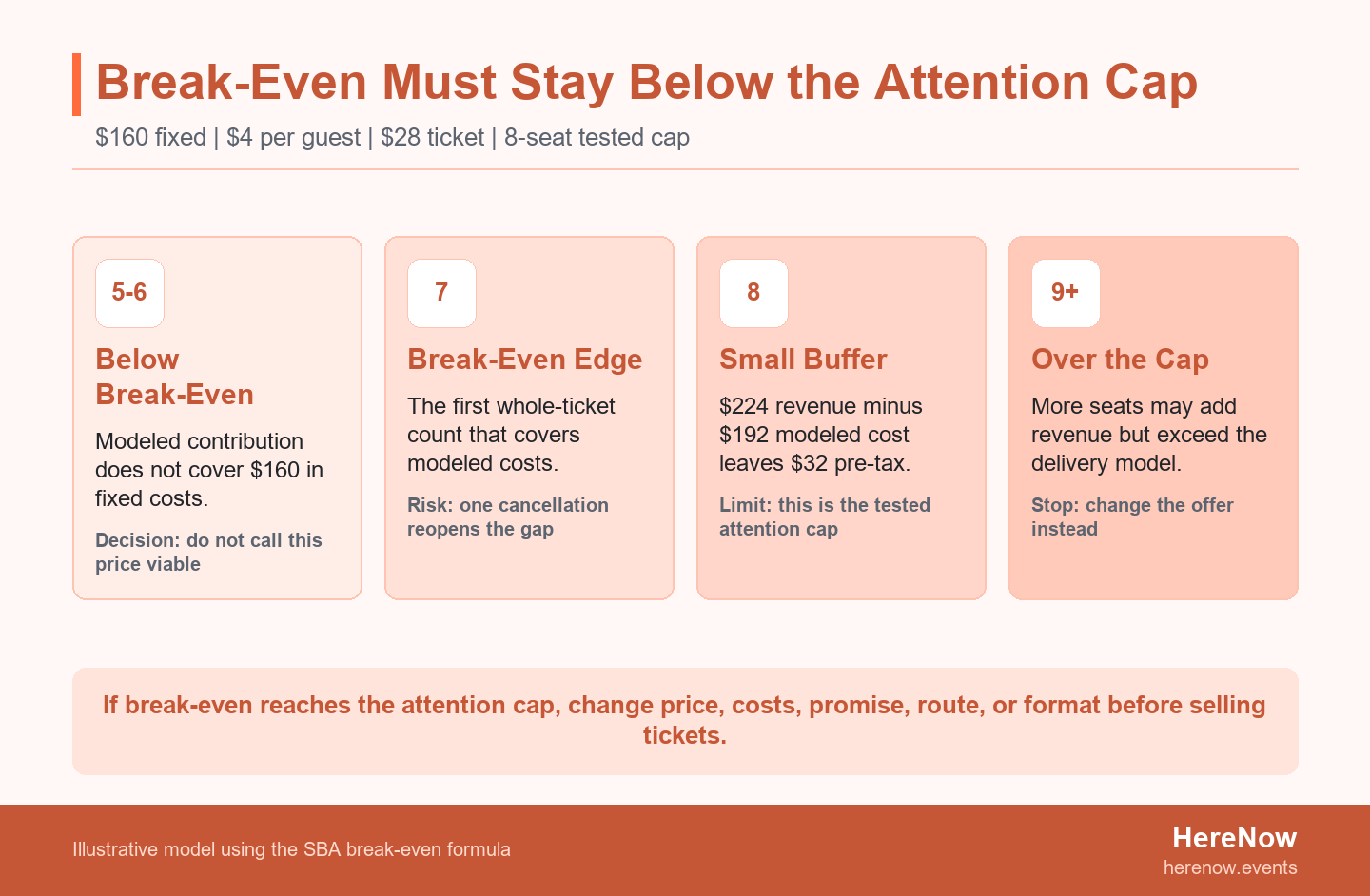
Break-even seats equal fixed costs divided by ticket price minus variable cost per guest, rounded up to the next whole sold ticket. The U.S. Small Business Administration presents this as an estimate. Break-even seats are the minimum whole number of sold tickets needed for modeled contribution to cover modeled fixed costs. Include host time, route checks, permits, insurance, platform and payment fees, materials, transport, marketing, refunds, and a realistic contingency.
| Illustrative input | Amount |
|---|---|
| Fixed costs | $160 |
| Variable cost per guest | $4 |
| Ticket price | $28 |
| Attention cap | 8 seats |
The calculation is $160 ÷ ($28 − $4) = 6.67, rounded up to seven sold seats. Six seats produce $168 of revenue against $184 of modeled cost. Seven cover the model. Eight produce $224 of revenue against $192 of cost, leaving a $32 pre-tax buffer. Use local numbers to replace the example in the workshop pricing calculator.
Under the illustrative assumptions, seven sold seats cover modeled costs while an eight-seat cap leaves only one seat of operating room. The $32 is not predicted profit: it excludes tax, cancellations, demand risk, and anything missing from the inputs. If break-even rises to nine while the attention cap stays at eight, change the price, route, format, costs, or included work. Do not solve the collision by selling a ninth seat.
Separate Copyright From Permission to Use People's Images
UK guidance lists original photography as automatically copyright-protected work, so paying for a walk should not be presented as transferring participant image ownership. The UK government's copyright overview says original photography is protected automatically. The exact ownership, exceptions, contracts, and enforcement rules vary by jurisdiction, but the ticket page should not casually claim the files guests create.
In the ICO's UK guidance context, recognizable photographs are usually personal data, and intended use should be explained upfront with an opt-out where possible. The Information Commissioner's Office guidance is written for UK schools and clubs, so it is not universal legal advice. Its useful operating distinction is separate rules for participants photographing public scenes, participants photographing one another, and the host capturing recognizable guests for promotion. Explain the intended use before the walk, provide a workable signal or zone for opting out, and verify the lawful basis and local rules that apply.
Write a Page That Makes the Paid Promise Auditable
The page should state result, audience, device fit, route demands, cap, inclusions, rights, weather fallback, refund terms, and host scope. Put the decision facts ahead of a long location story. A guest should be able to tell whether the walk fits their body, equipment, experience, expectations, and budget before registering.
- Name the guest result, the three or four practice stops, and the feedback included.
- State distance, surfaces, pace, standing time, toilets, rest, shelter, and access-contact details.
- List compatible devices, required controls or lenses, battery and storage needs, and any equipment supplied.
- Publish group cap, start and finish points, late-arrival rule, weather decision time, refund terms, and image-use choices.
- Describe the host's relevant experience without promising image quality, sales, publication, or professional advancement.
Before choosing the final ticket amount, review current HereNow pricing and ticket terms and put any fees into the model. HereNow supports the event page and ticket setup; it does not verify the route, permission, accessibility, or photo-use rules, and it cannot guarantee registrations.
Run One Paid Pilot to Test the Complete Offer
A first paid pilot should test one named uncertainty while delivering every promised inclusion and recording actual route, attention, and cost data. Choose the uncertainty before selling: Will mixed devices follow the same prompts? Does the route hold its timing at the advertised hour? Can eight guests receive the stated feedback? A paid ticket tests the complete value proposition, but one date does not prove recurring demand or future income.
Record registrations, attendance, device mix, late arrivals, every regroup delay, prompt timing, feedback delivered, access questions, weather decisions, actual expenses, refunds, and host hours. Ask which prompt changed how guests saw the route and which page detail was unclear. Then set up the first paid event only after the promise and terms match the tested operation.
Repeat Only When Route, Attention, and Economics Agree
Schedule another walk only when guest fit, route performance, host attention, rights, and actual contribution all remain workable. Repeat the same offer when intended guests arrived, prompts worked across the stated devices, the group stayed together, every inclusion was delivered, image-use choices were respected, and actual ticket contribution stayed below the attention cap. Revise when one repair is clear. Partner when permission, models, access, or co-host skill is missing. Stop when the promise depends on capacity the route cannot support.
Use This Publish-or-Change Gate
Publish only when the promise, route, device fit, attention cap, economics, and photo-use rules all agree. If one condition fails, repair that condition and rerun the downstream checks. When the result is specific, route permission is verified, access and weather facts are public, devices fit the teaching, break-even sits below capacity, and image use is clear, create your paid photo walk page. The goal is a small event whose value survives real delivery, not the largest group the street can physically hold.
Frequently Asked Questions
Can I run a paid photo walk for phone users?
Yes, if the promised result depends on observation, composition, light, timing, or storytelling rather than controls available only on one camera system. Use prompts that everyone can attempt, demonstrate the result on more than one device, and state any required app or setting before purchase. If the lesson depends on manual exposure, a specified focal length, off-camera flash, or RAW editing, list that prerequisite and do not market the same session as device-neutral.
Do I need to be a professional photographer?
A professional title is not the test; you need a bounded skill you can demonstrate, an honest promise, and the competence to guide the chosen group. Show relevant work and explain what the ticket includes without claiming outcomes you cannot control. Hosting also requires route planning, group communication, permission checks, weather decisions, and responsible image-use rules. If the offer depends on skills you do not have, narrow it or work with someone appropriately qualified.
Does a paid photo walk need a permit?
Sometimes. Requirements depend on the route owner, jurisdiction, group size, commercial use, equipment, models, props, reserved access, and disruption to ordinary public use. Contact the actual owner or authority with a precise description of the event and ask what permission, insurance, fees, or conditions apply. Do not assume that personal photography permission automatically covers a ticketed group. Keep written confirmation with the route plan and recheck it when the format changes.
Should my first photo walk be free or paid?
Use a free walk to test route and facilitation friction, or a paid pilot to test whether the complete promise is worth the stated ticket price. Name the uncertainty first. Free registration does not test willingness to pay and may produce different attendance behavior; paid registration adds refund and value expectations. In either case, measure real attendance, regroup time, delivered feedback, guest fit, and actual costs instead of judging the concept by sign-ups or compliments alone.