How to Host a Dinner Club
Learn how to host a dinner club with a clear menu boundary, service plan, seating rhythm, RSVP details, and a repeatable first-night format.

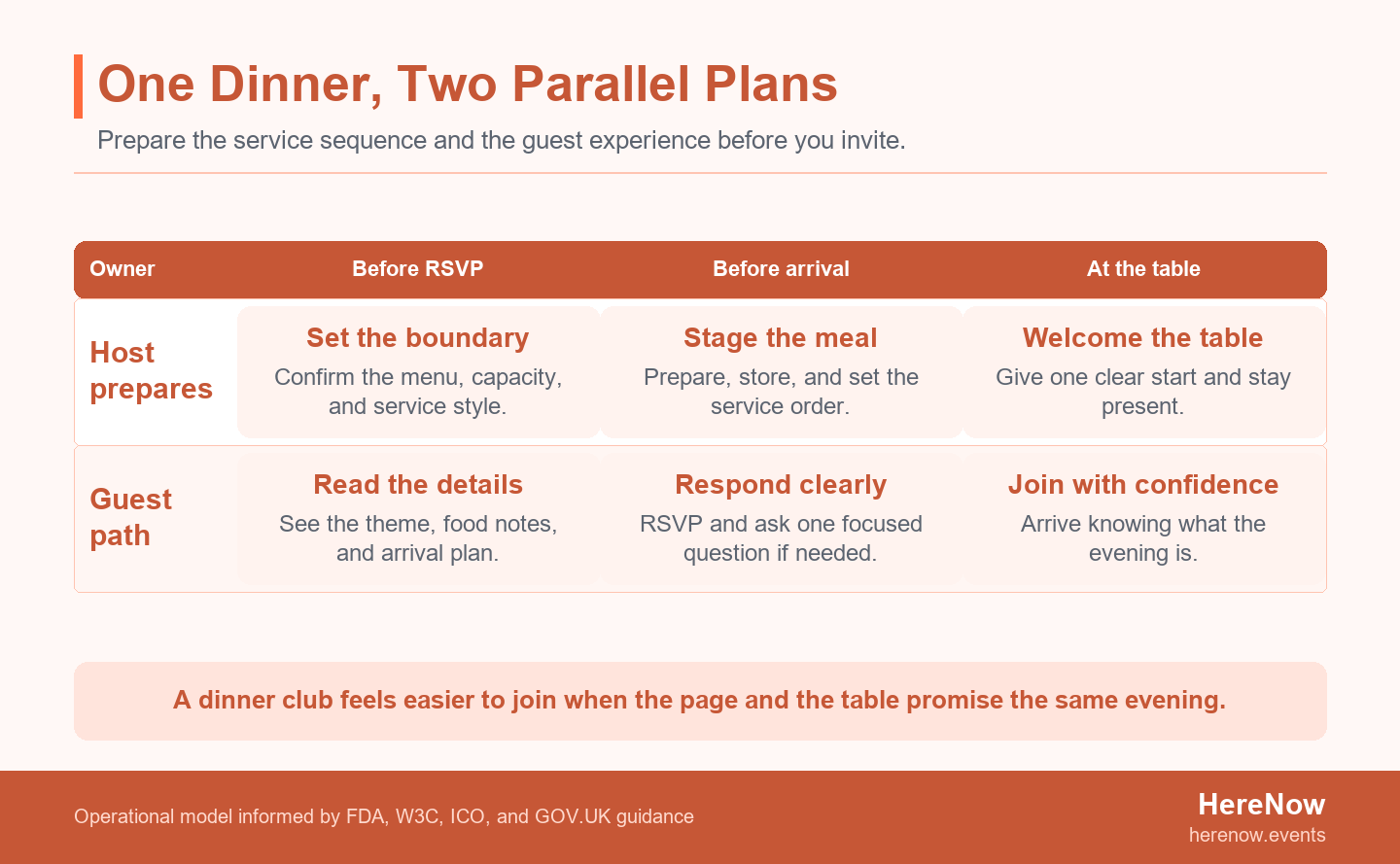
A dinner club does not become easy to host just because you choose a restaurant or write a menu. It becomes joinable when the dinner promise, menu boundary, service plan, seating rhythm, and RSVP details describe the same evening. Start with a format you can actually run: a clear reason to gather, a meal you can explain, a group size you can welcome, and one calm way for guests to flag a practical need. The goal is not to stage a perfect supper. It is to help people arrive knowing what they are joining and leave feeling included.
What Makes a Dinner Club Easy to Join?
- Choose one social purpose before choosing more courses, themes, or activities.
- Write down the menu, ingredients, service style, and dietary boundary before you publish.
- Set capacity from the table, serving pace, and host attention rather than the maximum number of chairs.
- Use the RSVP page to answer food, timing, access, and contact questions without collecting unnecessary personal details.
A first dinner club works best as one bounded shared meal with a clear welcome, a repeatable serving plan, and an honest guest-information path.
Choose a Dinner Promise You Can Deliver
Start with the social reason for the table, not a long list of attractions. Make that reason your dinner promise. Let the menu boundary name what you are serving, the service plan explain how it reaches the table, and the RSVP details tell guests what they need before arrival. A neighborhood supper can be about meeting nearby people, while a cookbook club can be about trying one cuisine together. When the purpose is precise, the invite can tell guests how the evening will feel without implying that they need a special social status or expert food knowledge.
Write one sentence that names who the evening is for, what guests will do together, and what makes the table distinct. For example: "A relaxed Sunday supper for people who want to meet neighbors over a shared vegetarian menu." That sentence helps you reject additions that make the experience harder to explain. When you are ready to turn the idea into public details, Browse event templates for a practical page starting point.
Start With One Social Shape
Make the invitation match that shape. A hosted meal should say what the host is providing. A contribution-based meal should say what people may bring and what is already covered. A restaurant gathering should say whether guests pay the venue directly, whether the reservation has a minimum, and how late arrivals should find the group. Specificity is friendly; it prevents a guest from arriving with an entirely different idea of the evening.
Plan the Menu as a Hosting Constraint
The FDA identifies nine major food allergens under U.S. law and notes that food allergic reactions can be life-threatening. That is a reason to replace a casual "let me know if you have allergies" line with a real process: keep the ingredient list, decide what substitutions you can support, and say when you cannot safely accommodate a request.
Write Down Ingredients and Alternatives Before RSVP
Your public page does not need to make medical promises. It should state the planned menu, the main ingredients a guest may reasonably need to know, the service style, and the best contact path for a focused question. Keep one current ingredient record, a written list of the planned ingredients and changes, for the host or cook, especially if you change a packaged item near the event date. That small discipline is more useful than a broad claim that the meal is safe for everyone.
The UK Food Standards Agency publishes allergen information and handling guidance for food businesses. A casual private supper and a recurring public food business may have different obligations, but the hosting lesson stays useful: do not guess, do not hide a change, and do not promise an alternative you have not planned.
Build a Service Plan Before You Invite
The FDA frames safe food handling around four steps: clean, separate, cook, and chill. A dinner club host does not need to turn the welcome into a lecture, but should settle the basics before guests arrive: where food is prepared, which dishes are ready to serve, how shared utensils are handled, and who can answer a kitchen question while the table is gathering.
The FDA describes its Food Code as a model for best practices to ensure safe handling of food in retail settings. Your home dinner club is not automatically a retail establishment, yet the underlying habit is valuable: decide the service sequence before the first guest rings the bell. Put serving tools where they will be used, stage water and drinks before the hot food needs attention, and give yourself a place to set an arriving dish without blocking the main work surface.
Keep Hot and Cold Food Out of the Guessing Game
The FDA says cold food should be kept at 40 degrees F or colder and that perishable food left at room temperature for more than two hours should be discarded unless it is kept hot or cold. Use that as a planning boundary, not an invitation to monitor the table anxiously. Avoid putting everything out at once, plan smaller replenishment dishes, and let one person own the moment when food moves from kitchen to table.
The FDA Food Safety in Your Kitchen resource covers food-safe shopping, storage, and meal preparation. That is a useful reminder to plan the hours before doors open as carefully as the meal itself. Decide what can be made ahead, what needs a last check, and what should wait until guests are seated. The more of the serving work you have settled early, the more present you can be once conversation begins.
Set Capacity From Conversation and Service
Capacity is not a popularity score for a dinner club. It is the number of people you can welcome, feed, hear, and send home with a clear final detail. Count seats, plates, serving tools, dietary variations, arrival flow, and the amount of time the host will spend away from the table. If a group needs two separate service waves or one person cannot join the shared conversation, the listed capacity may already be too high for the format.
Start with the smallest group that can create the feeling you promised. Six to ten people can often be enough for a first shared table, but there is no universal number. A restaurant table, a home kitchen, and a community venue create different limits. For the larger hosting system around that decision, See HereNow for independent hosts who are turning a good format into a repeatable practice.
Give Seating a Purpose
Seating is a host tool, not a social test. Seat people where they can hear one another, reach what they need, and meet at least one new person without being forced into a performance. If newcomers are arriving alone, greet them before the full group sits and give them one easy first connection. If friends are attending together, avoid treating that as a problem; simply create a table rhythm where familiar pairs and new guests can both participate.
Decide whether the conversation is open or lightly guided. An open table may need only a welcome question and a short toast. A themed table may need one prompt between courses. Do not schedule a question for every ten minutes. The host's job is to notice stalled energy, not to keep the evening sounding like a panel discussion.
Use an Agenda That Leaves Room for the Table
A dinner club needs a beginning, a shared middle, and a calm close. For a two-hour evening, reserve a short arrival window, a welcome before the first course, the main shared meal, and a closing cue that does not rush people out. The exact minutes are less important than protecting the point when everyone can eat and talk together. Do not place your only introduction after half the group has already begun a private conversation. Let the final ten minutes be optional rather than abrupt, so guests can finish a conversation, return a borrowed item, or ask one practical question without delaying everyone else. For adjacent hosting decisions, Explore host guides.
Use Prompts as Bridges, Not Assignments
A good prompt gives strangers something easy to answer and then gets out of the way. Ask about a local place someone loves, a meal they learned from another person, or one small thing they want to make time for this month. Give the question once, model a short answer, and let pairs or small clusters take it from there. Avoid prompts that ask for personal history, political agreement, or a performance of gratitude from people who just met.
The same restraint helps with announcements. Mention the menu boundary, the practical next step, and any time-sensitive information near the beginning. Save a future invitation until after guests have had the experience you promised. That sequence makes the evening feel hosted rather than harvested.
Make the RSVP Page Answer Food and Arrival Questions
The W3C recommends using headings to convey meaning and structure, meaningful link text, and clear instructions. Apply that to the invitation: use plain sections for the dinner theme, date and arrival window, venue directions, what the ticket or contribution covers, planned food information, and a direct contact path. A guest should not have to decode a charming paragraph to learn whether they can get there, what they will eat, or what happens if they arrive late.
Before you open RSVPs, compare the page with the actual kitchen or venue plan. Check that the address, arrival cue, food note, contribution language, and late-arrival instruction are all confirmed by the person who will be there on the night. HereNow lets a host make those decisions visible on a public event page and collect RSVPs without attendee accounts. That is useful for a social meal because a guest can confirm quickly while the host still gets a dependable count for seating and food. Keep all guest-facing messages aligned: the page, confirmation, and reminder should describe the same time, place, menu boundary, and contact route.
Keep the RSVP Form Focused
The UK Information Commissioner's Office says personal data should be adequate, relevant, and limited to what is necessary for the stated purpose. For a dinner club, that usually means a name, a contact route, and only the food or access information you genuinely need to respond to. Explain why you are asking, read the answer privately, and do not turn attendance into permission for unrelated marketing or photos.
Do not use the form to make guests do your menu planning. Offer a simple question that matches your actual options, such as whether a guest needs a listed vegetarian alternative or has an ingredient question. If you cannot support an accommodation, say so early and with care. Clear limits help someone make an informed decision before the day of the dinner.
Keep the First Dinner Club Inside a Real Operating Boundary
The GOV.UK says food businesses in England, Wales, and Northern Ireland must register at least 28 days before trading. That specific rule is not a global dinner-club rule, and a one-off private meal is not the same as a recurring paid food operation. The practical takeaway is to check the rules that apply where and how you are hosting before you sell food, advertise a regular service, or use a venue with its own requirements. When the first evening is over, record one observed point of friction before memory smooths it away. Use event feedback for the next dinner.
Know What You Can Actually Offer
Be explicit about the boundary of the evening: hosted meal, restaurant reservation, contribution-based potluck, or a paid dinner format. Confirm the venue arrangement, any food-service expectations, payment method, cancellation approach, and what happens if the guest count changes. This is not legal advice. It is a host habit that keeps a friendly invitation from becoming an unclear commercial promise.
Also decide which practical change belongs to the host and which belongs to a guest. The host can confirm the reservation, menu, timing, and stated alternatives. A guest can decide whether those details work for them and communicate a focused question before the day of the meal. This distinction keeps the response kind and useful when someone asks for something the format cannot support. It also prevents a last-minute workaround from becoming an unspoken promise for every future gathering.
That boundary also makes follow-up kinder. If the meal was a one-time neighborhood table, a thank-you may be enough. If it is the beginning of a series, keep the next invitation separate from the practical close. Send one message that completes the current experience before it asks guests to consider another one, then Get the post-event follow-up plan.
Illustrative Example: An 8-Seat Dinner Club Changes One Thing
A Small Change Between the First and Second Table
Illustrative example: A first-time host plans an 8-seat neighborhood dinner around a vegetarian main, one shared side, and a simple dessert. The event page gives an arrival window, a clear price or contribution explanation, and a short ingredient note.
The host uses a two-hour format in a small apartment dining area, with a six-person table and two nearby seats, so all 8 guests can hear the opening welcome.
The food is prepared ahead, water is set out before arrivals, and the host has one written menu and one private RSVP question for a listed dietary alternative.
Two guests arrive unsure whether the shared dishes include dairy.
The host notices that introductions take place while the main dish is still being finished.
Those are two different operating signals: the ingredient note was too general, and the arrival window did not leave enough hands-free hosting time.
The host keeps the eight-seat limit, moves the welcome ten minutes later, and adds a plain ingredient note for the next menu.
For the second dinner, the host prepares the main dish before arrivals, writes the dairy information on the page, and uses a one-question welcome prompt once everyone is seated.
At the next gathering, the host checks whether food questions arrive before RSVP rather than at the table and whether the full group hears the welcome.
The example does not claim an attendance, safety, or revenue result. It shows how one observed friction point can improve the next dinner's page and pace.
Turn the Dinner Plan Into a Clear Event Page
Publish only the dinner details you have confirmed: the theme, timing, venue, capacity, food boundary, contribution or ticket arrangement, and a focused way to ask a question. Read the page twice before you share it. First as a newcomer deciding whether this table is for them. Then as the host who has to make every promise true after guests arrive. If either reading exposes a vague detail, fix it before you invite another person.
A first table can grow into a repeatable club when the experience stays legible. Use the first night to notice one detail that needs clearer wording next time. Then Start your dinner club event page.
Frequently Asked Questions
How many people should a first dinner club have?
Start with the number you can seat, serve, and welcome without leaving people outside the shared conversation. A smaller first table gives you room to notice the real pace of cooking, arrivals, introductions, and cleanup. Choose capacity from the actual room and service plan rather than from the maximum number of people who might say yes. Increase only after you have seen the format work.
Should a dinner club be free or paid?
Choose the approach that matches what guests are receiving and what the host can explain clearly. A hosted free supper, a contribution-based potluck, a restaurant reservation, and a paid ticketed meal each create different expectations. Tell guests what is included, when payment happens, and what changes if someone cancels. Do not use a vague price line to postpone a decision you need to make before RSVP.
What food details belong on the dinner club page?
State the theme, planned menu direction, service style, what is included, and the main ingredient or dietary boundary a guest needs to know. Add an honest contact path for a focused question. Keep the details current if a packaged ingredient or venue arrangement changes. The goal is an informed RSVP, not a universal claim that every need can be accommodated.
How do you help strangers talk at a dinner club?
Welcome people before the entire group sits, offer one low-pressure prompt, and protect enough unstructured time for conversation to develop. Seat guests where they can hear one another and do not make sharing a performance. A host can gently bridge a quiet moment, but should not try to control every exchange. The best social design often feels simple because the setup has already removed the awkward parts.