How to Host a Language Exchange Night
Host a language exchange night with clear language goals, balanced pair rotations, inclusive prompts, a focused RSVP, and a format people want to revisit.
A language exchange night works when people know the language direction, what they can practise, how much help is welcome, and when they will get a turn. It is not a test of fluency or a room full of strangers asked to "just mingle." Name the bridge language and pair rotation before guests RSVP, then use conversation prompts that make the first sentence easier. The host's job is to create enough structure for a beginner to enter the room, enough freedom for confident speakers to connect, and one reason to return for the next exchange.
What Makes a Language Exchange Feel Easy to Join?
- Set one language direction and one practical social purpose before you invite anyone.
- Use short pair rounds with a visible prompt so every guest has a first sentence.
- Ask about target language and comfort level, not a long list of personal details.
- Describe the rotation, access details, and host contact path on the RSVP page.
Choose One Language Direction and One Social Promise
Do not begin with "all languages welcome" unless you can explain how those languages will meet in the room. A first exchange is easier to host when it has one clear direction: Spanish practice for English speakers, an English conversation hour for new arrivals, or a bilingual social night with named tables. The language direction is not a rule about who belongs. It is the shared expectation that helps a guest decide whether the night will give them a real chance to participate. Before you publish, keep the target language, bridge language, pair rotation, conversation prompts, and RSVP details in one visible summary.
The CEFR describes lower-level spoken interaction as relying on repetition, rephrasing, and simple familiar exchanges. Treat that as a hosting cue, not a label for guests. A beginner-friendly event should make repeats normal, give people time to find words, and use topics that do not require specialist vocabulary. A confident guest can still have a satisfying conversation when the format asks them to listen well rather than carry every table.
Name When a Bridge Language Is Welcome
A bridge language is the shared language guests may use briefly to clarify meaning before returning to the target language. Say whether it is welcome in your first invitation. Otherwise, a newcomer may fear being judged for using it while a fluent speaker may assume the whole evening should stay in the target language. The Council of Europe describes plurilingual competence as a changing repertoire used across social situations. Your event does not need to measure that repertoire. It can respect it by treating partial language knowledge, gestures, notes, and a brief translation as legitimate ways to stay in the conversation.
Write a promise that pairs the format with the feeling you want to create. For example: "Practise everyday French in relaxed pairs; English is available for a quick clarification, not required for a perfect answer." That promise gives guests a concrete choice. It also gives the host a boundary when a conversation drifts into one person correcting every sentence or one table switches permanently into the easier language.
Build Each Round So Everyone Gets a Turn
A language exchange needs a rhythm before it needs a large guest list. Use an opening welcome, two or three short pair rounds, a pause, and one shared close. That sequence gives late speakers a new entry point and keeps one lively pair from becoming the whole event. The British Council teaching guidance builds conversation from questions and responses into pair, group, and whole-group talk. Borrow the progression, not a classroom persona: begin small, then let the room widen only after guests have already spoken once.
For a 90-minute first night, plan a five-minute arrival buffer, a ten-minute host welcome, three 15-minute pair rounds, two five-minute movement breaks, and a ten-minute close. The times are illustrative, not a promise that every city or group needs the same schedule. Their purpose is to protect speaking time. When the host announces the next round, guests do not have to invent a polite exit from a stalled conversation; they simply move with everyone else.
Once the room plan is settled, see how HereNow turns an idea into an event page. Use the page to make the first round as visible online as it will be in the room.
Use Pairs Before You Use a Big Circle
A large opening circle makes a confident speaker visible, but it can make a hesitant guest silent for the same reason. Begin with pairs, then use a group moment only to share an optional observation. The British Council notes that pair and small-group work gives learners more speaking time. For a social host, that is a useful operating principle: make the highest-value activity the one that distributes attention instead of concentrating it around the loudest guest.
The Council of Europe's CEFR table includes turn-taking as an interaction element in spoken language use. A host does not need to assess anyone's skill. Use that distinction as a room-design cue: make it clear how a guest can enter a pair, leave a round, or begin again after a stalled conversation.
Use a simple pairing method that does not imply a hierarchy. Hand guests a colored dot on arrival, place conversation cards on small tables, or call a neutral rule such as "find someone you have not met tonight." Avoid announcing proficiency levels across the room. If guests volunteer a comfort range at RSVP, use it privately only to notice an obvious mismatch, not to create a public ranking system.
Give Every Pair a Prompt With More Than One Good Answer
A prompt is a bridge into a conversation, not a worksheet. Choose questions that invite a personal story and permit short answers: a place you would show a visitor, a food you miss, a small habit that saves time, or a local expression you enjoy. Keep a printed or projected version near each table, then let pairs leave it when the conversation has momentum. The British Council's Chat activity gives learners time to think and write notes before speaking. Offer the same dignity at your event: a guest may look at a prompt, make a note, or ask for a word without being put on display.
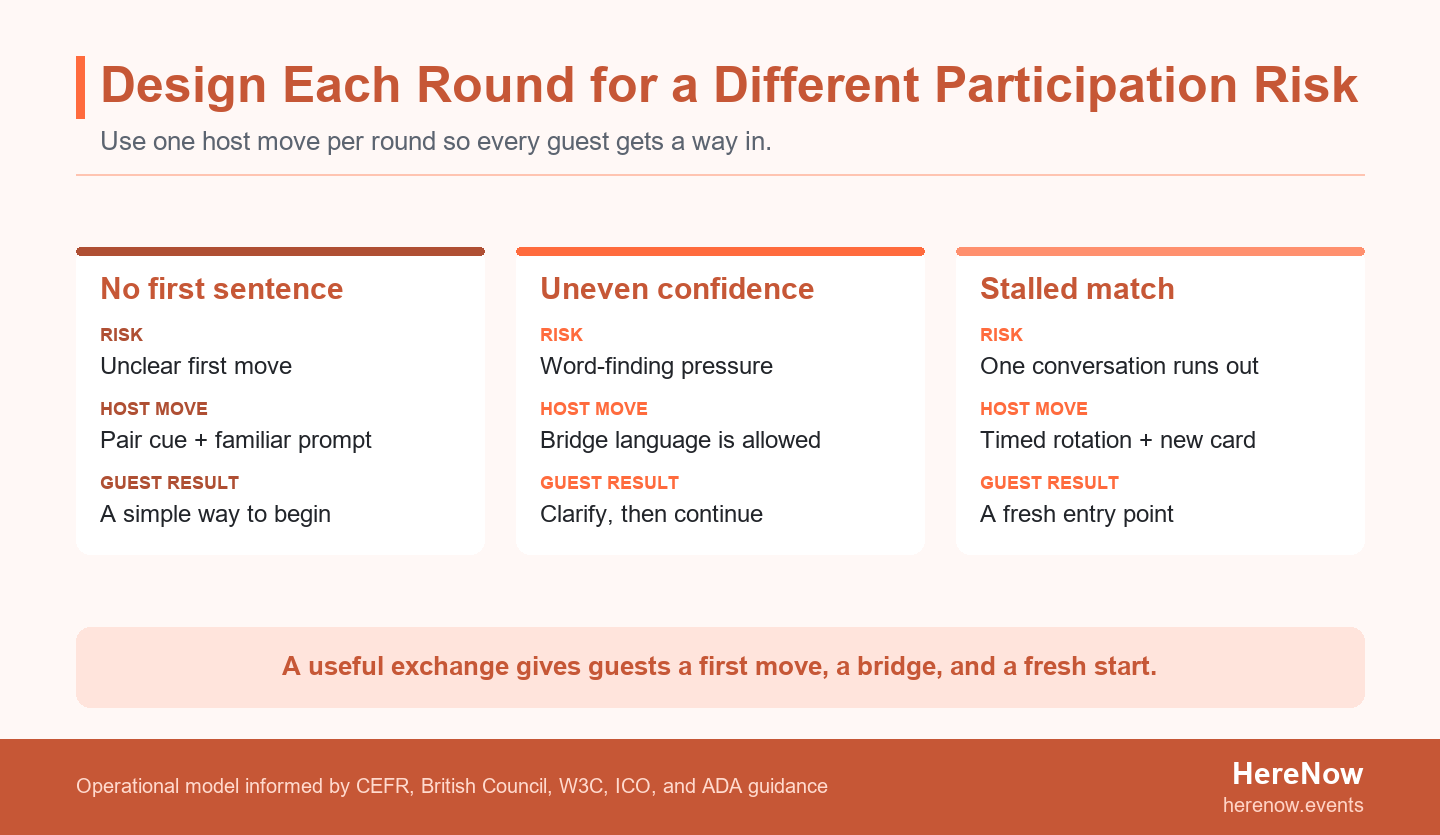
Plan a prompt ladder rather than one clever question. Round one can be familiar and concrete. Round two can ask for a preference or comparison. Round three can invite a story, recommendation, or local tip. The sequence gives a pair somewhere to go without forcing anyone into personal disclosure. It also makes the host's intervention light: if a table goes quiet, point to the next prompt instead of stepping in as a teacher.
Set Pairing Rules Before the Room Chooses for You
Pairing is a participation decision. If people self-sort from the first minute, friends and fluent speakers often find one another while a first-time guest waits for an opening. Use one low-pressure rule for each rotation: first round by target language, second round by a color card, third round with a new person. Make exceptions quietly for someone who asks to stay seated, needs an interpreter, or arrives with a support person.
Ask the host to watch for two signals: a guest who has had no partner, and a guest who is carrying a conversation without a break. Neither needs a public correction. A useful host can introduce a new pair with one sentence: "You both mentioned travel in your RSVP; would you like to try this prompt together?" Keep the question optional. Invitation creates an opening; assignment can make a social event feel like a test.
Use the same rule on the page. Say whether attendees will rotate, whether they can join as a pair, whether native or highly fluent speakers are welcome, and what the host will do if a language match is not immediately available. That specificity is more trustworthy than promising that everyone will find a perfect partner. It lets a guest decide with honest information before they make the trip.
Make the Event Page Explain the Exchange Before RSVP
The W3C recommends meaningful headings, link text, and clear instructions. Use that standard for the public page. Put the target language and bridge-language policy near the top; then state the format, duration, rotation plan, level expectation, address or venue entry cue, cost or contribution, and contact route. A guest should not have to decode whether the event is a lesson, a mixer, a language test, or an unstructured social hour.
Treat the first draft as a checklist of host decisions rather than final copy. Edit the page until it says exactly what a newcomer will do in the first 15 minutes, then preview the guest-facing details before you share the link.
Keep the RSVP Form Focused and Explain Why You Ask
The ICO says a stated purpose determines what personal information is needed. For a small exchange, a name, contact route, target language, and a self-described comfort range may be enough. Add an access or communication question only when you can use the answer to prepare. Explain the reason in plain words, read responses privately, and do not turn a language preference into permission for unrelated marketing.
HereNow can collect RSVPs without attendee accounts, which keeps the next step proportionate to a low-pressure community event. Keep the page, confirmation, and any reminder aligned: each should describe the same language direction, arrival time, rotation expectation, and contact path. If a detail changes, update the event page before sending a message that depends on it.
Plan for Communication Access Without Making Assumptions
Language practice and communication access are not the same thing. Do not assume that a spoken-only format works for every guest, or that one accommodation suits every person. The ADA guidance says effective communication depends on the nature, length, complexity, context, and a person's usual communication method. That is a useful boundary for any public host: describe the format honestly, invite an early access question, and respond only to arrangements you can actually provide or confirm with the venue.
Practical choices can help many guests without pretending to solve every access need. Use a quieter corner for pairs when the venue allows it, put prompts in readable text, face the group when giving instructions, and repeat the rotation cue once. Do not promise an interpreter, captioning, or venue feature unless it is confirmed. If a guest asks for support you cannot provide, say so early and respectfully, then offer the information they need to decide whether the format will work for them.
Illustrative Example: An 18-Seat Exchange Finds Its Rhythm
Keep the Format Stable and Fix the Unclear Handoff
Illustrative example: A first-time host plans an 18-seat English-and-Spanish exchange in a cafe community room. The first page says only "casual conversation," so early RSVPs include people seeking a lesson, native speakers expecting free-flowing networking, and beginners worried they will slow everyone down. The host keeps the 90-minute time and 18-seat capacity, but changes the operating sequence: a five-minute welcome, three 15-minute partner rounds, and one printed prompt card per table.
The cafe can offer one shared room, but no teaching equipment or separate beginner table. That constraint means the host must make the peer-practice boundary clear before RSVP instead of trying to solve it after guests arrive.
Before the first event, the host has three prompt cards and a published arrival time, but no visible pairing rule or bridge-language note.
At the first gathering, two guests wait through the opening because they do not know who to approach.
One fluent pair stays together for most of the session while a newcomer does not get a second conversation.
Neither issue is a demand problem. They are page-to-room handoff problems: the page does not name rotation, and the room does not give a newcomer a first move.
For the next edition, keep the 90-minute format and capacity, but publish a target-language field, a comfort-range question, and one sentence that English can be used for brief clarification.
At arrival, give each guest a color dot. Use target-language pairing for the first round, then a new color match and prompt card for later rounds.
Before publishing the next event, check that the page answers who the exchange is for, what happens in the first round, and how a guest can ask a practical question.
This illustrative example does not promise equal proficiency, perfect matching, or a language-learning result.
After the event, keep one observation and one change for the next edition. Review feedback before the next exchange.
Turn the Exchange Plan Into a Repeatable Event Page
Publish the details you have actually decided: language direction, bridge-language boundary, round length, venue entry cue, capacity, cost or contribution, access contact, and RSVP questions. The guest-facing promise still needs to match the room you can run.
- Choose the target language and the bridge-language boundary.
- Write three prompts that grow from familiar to reflective.
- Set the rotation cue and one quiet re-entry route.
- Publish the page after you have checked it as a first-time guest.
Do one last handoff check in a browser rather than in the editor. Read only the title and first two sections, then ask whether a new guest can identify the target language, the bridge-language boundary, the arrival point, and the first pairing cue. Next, compare the RSVP fields with the confirmation message. If either asks for information the page has not offered, simplify the question or add the missing detail. Finally, hold the first prompt and rotation rule in the same form you will use in the room. A page can sound welcoming while still leaving guests to infer their first move; this check makes the invitation and the room tell the same story.
Ask a trusted reader who does not attend language events to use the page without speaking to you. They should be able to say what will happen first, what a brief clarification looks like, how pair changes happen, and how to decline an invitation or leave after the hosted close. If their answer depends on reading two sections together, move the missing detail closer to the title or RSVP field. This is not a marketing test. It is a rehearsal for the private questions that otherwise arrive at the venue door. The aim is not to predict every concern; it is to remove the avoidable uncertainty that makes a thoughtful guest decide not to come.
Check the reminder too. The subject line, arrival note, and map cue should repeat the same first-round promise in shorter language. Guests should not learn a new rule from a reminder that was absent from the page. When they can compare the page, confirmation, and room sign without finding a difference, the event is ready to share.
Create the first version, then improve it with one observation after the event. When the promise, pair rhythm, and RSVP details agree, start your language exchange page.
Frequently Asked Questions
Do I need native speakers at a language exchange night?
No. A useful exchange needs people who share a clear target-language purpose and a format that gives each guest a turn. Invite fluent speakers when they value mutual conversation, not as unpaid teachers. Explain that the event is peer practice, then use prompts and rotations so one person is not expected to correct or lead every interaction. A guest who is still learning can contribute questions, stories, and useful listening; a fluent guest can practise being a generous partner. Describe those roles as possibilities, not requirements, and let every person decide whether the format suits them.
How long should a first language exchange night be?
Ninety minutes is a practical first boundary for many small groups because it allows an arrival buffer, several short conversations, and a clear close without asking guests to commit to an open-ended night. The right duration depends on travel, venue, and group energy. Publish the end time and leave guests an easy way to depart after the hosted portion. For a first edition, protect the hosted ending rather than stretching the schedule to fit one more round. Guests who want to continue can choose that informally, while the host can close the planned format with a clear next step.
Should I group guests by language level?
Use self-described comfort and target-language information as a quiet hosting aid, not a public ranking system. Pairing people with a wide difference can work when the prompt is simple and both know the bridge-language rule. Rotate after a short round so one mismatch does not define the whole evening. Grouping can help when guests have chosen clearly different goals, such as complete beginners and advanced professional practice, but it should be an optional route rather than a label announced at the door. The host's practical aim is a workable first conversation, not a perfect assessment of anyone's ability.
What should guests bring to a language exchange?
Usually, nothing beyond the information the host has actually requested. If prompts, name stickers, or a shared vocabulary note will be useful, provide them rather than assuming every guest owns the same materials. The event page should say whether food, a ticket, a notebook, or any venue contribution is involved. Keep the preparation list deliberately short: a phone for contact updates, a charged transit card where relevant, and an open-minded willingness to try a short conversation are usually enough. Avoid treating personal study materials as a test of readiness unless the event is explicitly a class.