How to Organize a Networking Event
Plan a networking event people can enter with confidence: set a connection goal, shape the guest mix, guide introductions, and make follow-up easy.
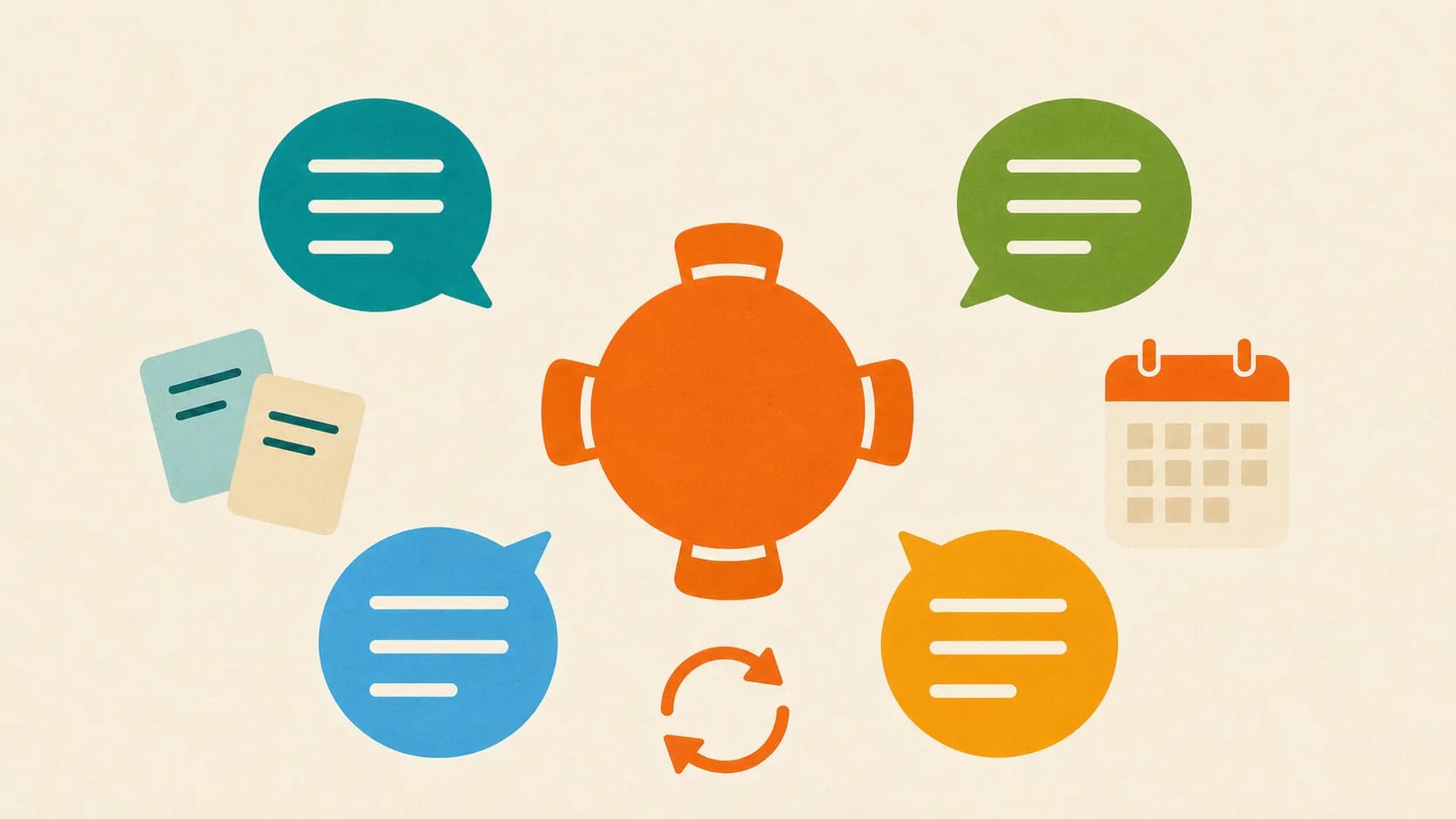
A networking event is not made useful by filling a room and leaving people to work it out. Guests need a reason to attend, a low-risk way to begin, one shared exchange, and a next step that does not feel like a forced pitch. Build those handoffs deliberately and free conversation becomes a reward for participating, rather than a test guests must pass at the door.
What Makes a Networking Event Worth Attending?
- Design for one useful exchange, such as finding a collaborator, comparing a local challenge, or sharing a practical lead.
- Give solo guests an optional first move at arrival instead of making them scan the room alone.
- Run a short structured round before open conversation, then let people choose where to take the exchange.
- Make the event page explain the room, the RSVP, and the follow-up with the same level of clarity.
Start With the Connection You Want People to Leave With
Begin with an outcome that is small enough to shape the room. "Meet interesting people" is a wish, not an operating instruction. "Meet two people who can compare how they find local clients" gives the invitation, prompts, and host introductions a job. A connection goal is the specific useful exchange your event is designed to make possible. It can be peer learning, local referrals, creative collaboration, or a shared problem that guests can explore together.
That choice matters because networking events are more than a venue and a guest list. A University of Edinburgh study of entrepreneurial communities examined how event structures and relational conditions shape knowledge transactions and social capital across 148 meetup groups and 33 interviews. That research does not predict what will happen at one local gathering, but it is a useful boundary: the host should design the conditions for exchange instead of assuming a social label will do it.
Name the Exchange, Not Just the Industry
Put the exchange in the first two lines of the invitation. For example: "A small working session for independent designers and neighborhood business owners who want to compare how they turn a first inquiry into a repeat client." That sentence quietly answers four questions: who belongs, why they might talk, what they can offer, and why arriving without a friend is still worthwhile. Avoid promise language such as "guaranteed leads" or "the best people in town." The point is to give guests a credible reason to contribute, not to imply that the host can manufacture a deal or a friendship.
Build a Guest List With Useful Edges
The strongest first networking rooms are rarely made of one perfectly matched type of person. A room of close friends may feel comfortable but offer little discovery. A room of strangers with nothing in common can feel like a queue of introductions. Look for a shared context plus adjacent experience: makers and shop owners, freelance writers and small agencies, early-stage founders and people who run community spaces. Each guest should be able to recognize the topic while also meeting someone who sees it from a nearby angle.
Harvard Business Review's host guidance similarly recommends thinking carefully about who is invited, using common ground to give people something to discuss, and paying attention to group dynamics rather than treating attendance as a headcount contest. Read its advice on holding your own networking event as a prompt to decide the mix before capacity. If you cannot describe why two different invitation lanes would be useful to one another, the event may still be too broad.
Aim for Adjacent Experience, Not a Room of Clones
Create three or four invitation lanes, not a public ranking system. A local creative-business night might invite independent designers, photographers, small retail owners, and people who run pop-ups. Their work overlaps enough for a first question, but each group has a different constraint to share. Do not make the lanes visible as labels guests have to defend. They are a private planning aid for the host. On the page, describe the shared problem and welcome people who have a relevant perspective. In the room, introduce people through the reason they may enjoy speaking, not through status, revenue, or a title.
Give Guests a Low-Pressure Way Into the Room
The first five minutes decide whether an event feels like a gathering or an audition. A guest arriving alone should not need to guess which group is open, whether the host is busy, or how much personal information they are expected to share. Give them one visible, optional next move: a welcome host who asks what brought them in, a prompt card near check-in, a small sign showing the first activity, or a color dot that points to a conversation area. The move should be easy to decline, but easy to take.
Early planning also makes the entry more usable for more people. Rutgers recommends addressing access through registration information, an access coordinator, venue review, clear directions, and an inclusive check-in flow in its guide to accessible and inclusive events. That does not mean a small host can promise every arrangement. It means known information, paths, noise considerations, and a way to ask for help should be considered before doors open rather than improvised in front of a guest.
Make Check-In a Connection Moment
Treat check-in as a gentle handoff, not only a name badge table. One host can say, "Welcome. Are you here to meet collaborators, compare local growth ideas, or just learn how others work?" Then offer a choice: add a colored dot to a badge, pick a question card, or wait for the first round. Do not require a guest to announce a need, career stage, or personal identity. The host is offering a first move, not collecting a confession. If there is a quiet corner, a seated area, or a different check-in route, explain it plainly on the page and at the entrance.
Use Structured Rounds Before Open Conversation
Free mingling is easier after guests have already spoken once. Start with one short, guided exchange: pairs for six minutes, a change of partner, then an open block. The goal is not to turn the event into a workshop. It is to give every person a first conversation that is not dependent on confidence, social position, or arriving with a colleague. Once people have crossed that first threshold, they can decide whom to continue with.
There is a useful distinction between being friendly and facilitating. In one study of an inter-organizational advocacy network, the frequency of facilitation functions was associated with trust and work coordination. The study's context is not a 90-minute local mixer, so it cannot prove a result for your event. Still, its finding supports treating network facilitation as a real host role: someone notices the edge of the room, makes a reasoned introduction, and signals the next shared action.
A host introduction is a short, permission-aware connection between two guests based on a stated reason. Try, "Would you both like to compare how you handle first client conversations?" That gives each person a reason to say yes or no, and it makes the host's judgment visible without taking control of the whole conversation. If you use HereNow to publish the gathering, carry that same question from the event page into the first structured round.
Set the Question, the Clock, and the Handoff
A useful first round has three parts. First, ask a question that has more than one good answer, such as "What are you trying to make easier for your customers this month?" Second, name a time boundary so no guest has to judge when it is acceptable to leave. Third, give a handoff: invite pairs to find another person with a different answer, point them toward a topic table, or ask the host for an introduction. Avoid questions that demand a polished elevator pitch. The best opening prompt lets a quieter guest answer from real work, curiosity, or a current obstacle.
Make Your Event Page Part of the Facilitation
The page is the first part of the room. It should tell a guest whether the event is a panel, a small working group, a guided exchange, or an open social hour. State who it is for, what will happen in the first ten minutes, how long the structured part lasts, and what guests can do if they arrive alone. When the public description and the actual room agree, guests can choose the event with fewer surprises.
A practical example comes from HBR's guidance for a structured virtual networking gathering: it suggests sharing short attendee context and guidelines for what to expect before the call. The article even frames a 60 to 90 minute format around introductions and structured conversation. Your in-person event may need a different duration, but the transferable lesson is simple: tell people how the room begins before they decide whether to come.
Once the format is settled, you can turn the connection plan into a public event page rather than translating it into generic promotional copy. Keep the description specific enough that a guest can recognize the invitation as being for them, but do not imply that the page can guarantee an introduction or commercial outcome.
Tell People How the Room Will Work
Your RSVP should collect only information that has a clear use in the format. The UK's Information Commissioner's Office explains that personal data should be adequate, relevant, and limited to what is necessary for the stated purpose in its guidance on data minimisation. For a small networking event, "What are you hoping to explore?" can be optional if the host will use it only to offer a relevant introduction. Explain that use next to the field. Do not ask for a full biography, sales figures, or contact-sharing permission just because the details might be convenient later.
A simple page sequence is: connection goal, who belongs, the first activity, timing, venue and access details, then RSVP. If you want the response step to stay low-friction, HereNow's guidance shows how to collect RSVPs without attendee accounts. The important operating choice is still yours: every optional answer should have a purpose you can state in one plain sentence.
Run an Inclusive Room, Not a Loud One
Networking can unintentionally reward the fastest speaker, the person closest to the door, or the guest who already knows the host. An inclusive room gives people more than one way to understand the plan and take part. That can mean quiet seating away from speakers, clear directions, name tags with readable contrast, a microphone when the room requires it, written prompts, or a host who repeats the next step. The right choices depend on the venue and guests. The principle is to reduce unnecessary friction without assuming what any individual needs.
The W3C event accessibility checklist recommends simple language and time for participants to process information. Use that in the opening announcement: say what is happening, point to the next action, then pause. Avoid an instruction like "everyone find a person you do not know and network" shouted over music. Tell guests where to go, what the prompt is, and how to opt into help from a host.
Treat Access Details as Participation Design
Publish information you know and a route for asking what you do not. New York City's guidance defines accessibility as being able to perceive, understand, navigate, and interact with both information and the environment. On a networking page, that can mean naming step-free entry if confirmed, seating options, restroom location, expected noise, transit notes, and an accommodation contact. Confirm arrangements before promising them. Check local requirements when they apply, especially if the event is open to the public or uses a venue with its own access rules.
When details are uncertain, say so plainly and give guests a direct contact route. That protects trust better than a broad access claim without practical information.
Worked Example: A 36-Person Freelance Network With Four Entry Routes
Keep the Invite, Change the First Five Minutes
Illustrative example: this is a planning model, not a customer case or a promise about a real event's results.
A local independent host wants freelancers, small-business owners, and people who run pop-ups to meet without making the night feel like a pitch contest.
The host plans a 100-minute illustrative gathering for 36 confirmed guests after work, with two volunteer hosts and a peer-introduction promise.
The page says "peer introductions" but initially gives no arrival task, no host zone, and no explanation of the first round. The two volunteers expect to welcome guests, but their only plan is to greet everyone at the door.
Early arrivals form two familiar clusters near the door. Several solo guests check the room, collect a drink, and remain at the edge until the first announcement.
The issue is not a shortage of good people or topics. The room has four kinds of guests but only one undefined way to enter. Adding more free-mingling time would make the least confident guest carry even more of the social work.
The host keeps the audience and duration, but creates four entry routes: a welcome table with one optional question, a prompt card for pairs, a marked host-introduction zone, and a six-minute first round.
One volunteer owns the welcome zone; the other circulates after the opening. The page now states the first five minutes, and the optional RSVP question asks what guests are building or hoping to explore so the hosts can offer a relevant opening connection.
Before the next edition, the host checks that the page names the first activity and that the team can say who owns each of the four entry routes. The next-edition question is not "Did everyone network?" It is "Did solo arrivals use an entry route before the open block?"
The example does not promise a job, sale, partnership, attendance result, or universal access outcome. It only shows how a host can correct a visible entry problem before changing capacity or audience.
After the event, review feedback before your next networking night by asking one open question about the first ten minutes rather than sending a generic satisfaction survey.
Use This 20-Minute Host Check Before You Publish
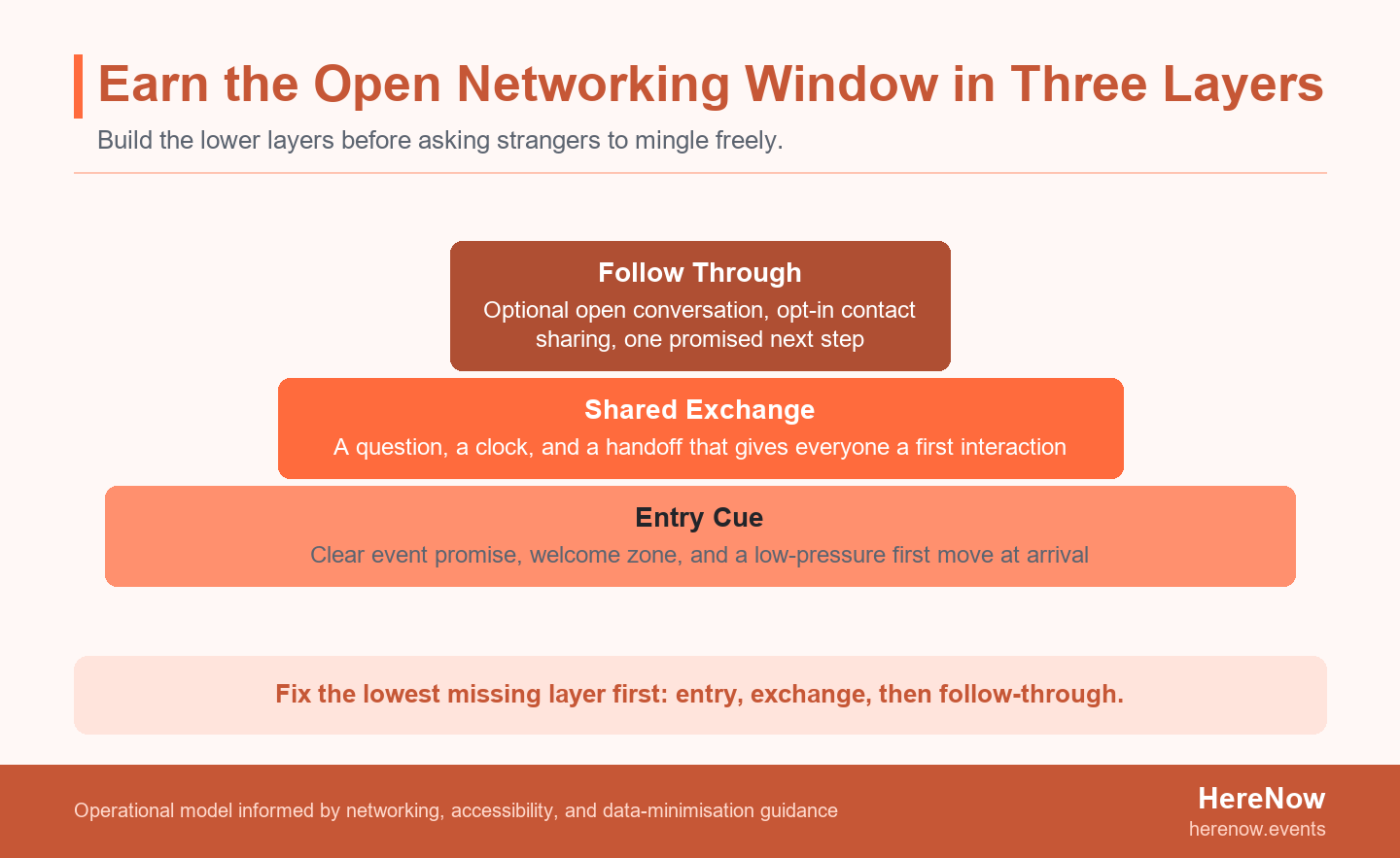
Before sharing the page, check four handoffs. First, can a guest repeat the connection goal in their own words? Second, does the page name what happens in the first ten minutes? Third, does each optional RSVP question have a stated use? Fourth, can the host team explain how guests will choose an open conversation or follow-up without pressure? If one answer is missing, fix that lowest layer before adding more agenda items.
- Promise: name the exchange and the people it is for.
- Entry: assign an optional first move and the person who owns it.
- Exchange: write one question, one clock, and one handoff.
- Follow-through: state what will happen after the event and what remains opt-in.
When those answers agree, start your networking event page.
Frequently Asked Questions
How many people should a first networking event have?
Choose a number you can greet, observe, and support with the time and hosts you have. A first event does not need a crowd. A smaller room lets you notice whether the invitation, arrival cue, and first round are actually working. If you cannot name who will welcome a solo guest or guide the next move, reduce capacity or add help before you add more seats.
Should I charge for a networking event?
Charge when the format, venue, and host effort give guests a clear reason to value the commitment, not because a price tag will create connection. A free RSVP can be appropriate for a first community test; a paid ticket can be appropriate when costs or a carefully facilitated format justify it. In either case, state what the guest is committing to and what the event is designed to provide.
What should I put on a networking event invitation?
Say who the room is for, the exchange it is designed to make possible, what happens first, the event timing, and any practical access details you have confirmed. Add one sentence for solo guests, such as "You do not need to know anyone before you arrive; a host will explain the first activity." Keep optional RSVP questions focused and explain how a response will be used.
How do I follow up after a networking event?
Send one concise thank-you that delivers the next step you promised, such as a future date, shared resource, or optional feedback question. Do not publish a guest directory or move people into a group space unless they were told and had a real choice. A useful follow-up protects trust first; it gives people a reason to continue the connection without treating attendance as permission to market to them.