How to Start a Book Club
Start a book club with a clear promise, an easy first gathering, an accessible reading plan, and a discussion format guests can join.

Start a book club by deciding what kind of room you are inviting people into before you choose the first book. A clear purpose, a realistic reading commitment, a simple first gathering, and a few good prompts will do more for a new club than an ambitious reading list. Your first event does not need to prove that every guest is a devoted reader. It needs to make the right people feel that they can arrive, contribute in their own way, and understand what happens next.
That is a useful distinction for an independent host. Some people want a social neighborhood ritual; others want a guided conversation about one shared book; others are looking for a low-pressure place to read and meet new people. Those formats can all work, but they set different expectations about preparation, discussion, capacity, and the public event page. Start with the commitment guests can honestly make, then build the first meeting around it.
What Makes a First Book Club Worth Returning To?
- Choose the club promise before you pick a title, so guests know whether they are joining a social ritual, a shared discussion, or an open-reading gathering.
- Make the first meeting easy to join with a visible start time, a realistic reading expectation, and a clear way to participate without performing expertise.
- Use a short question ladder to start the conversation, then let the group take the discussion somewhere real.
- Publish the book, access plan, format, capacity, and next decision on the event page before anyone RSVPs.
Choose a Club Promise Before Choosing a Book
A book club is more than a list of titles. It is a recurring agreement about why people gather around reading. The American Library Association's guide to book discussion groups begins with planning questions about goals, group size, meeting frequency, available copies, and discussion prompts. For an independent host, those are not administrative details. They are the shape of the offer. For a first book club, that means naming the book access guests have before the first meeting and the kind of discussion they will share. To see the adjacent operating questions that appear as a club grows, Explore host guides.
A useful club promise is a one-sentence description of the experience and commitment a guest is joining. For example: "A monthly neighborhood reading circle for people who want one shared novel and a relaxed, guided conversation." Or: "A drop-in reading night where people bring their current book, read quietly together, and help choose one shared title for next month." The first sentence tells guests whether they need to finish a book, whether the conversation will be facilitated, and whether this is likely to feel social, reflective, or structured.
Do not try to satisfy every possible reader in the first event. A group that promises literary analysis, snacks, author research, silent reading, and casual networking at once gives nobody a reliable reason to attend. Pick the job that matters most. You can add a second format later after the group has enough shared context to ask for it.
Write a One-Sentence Invitation That Excludes the Wrong Expectations
A strong invitation does not merely attract people; it helps the wrong expectations self-select out. Name the book relationship first. Are guests expected to read one title, a chapter range, or anything they are already reading? Then name the room relationship. Will people sit in a circle and discuss prepared prompts, spend part of the time reading quietly, or meet over a short themed activity? Finally, name the social boundary. "New readers welcome" means something different from "come ready to compare passages."
Use concrete language rather than a vague promise of "good conversation." A guest can decide much more easily from "We will discuss the first half of the novel with three optional prompts" than from "an evening for book lovers." If you want a page starting point while you define the format, Browse event templates for the structural parts of an invitation. The wording should still describe this club's real commitment, not a generic literary mood.
Make the First Gathering Easy to Join
The first meeting should lower uncertainty before it asks for insight. ALA's book-club facilitation tips recommend setting expectations and using active facilitation that clarifies, summarizes, shifts focus, and leaves room for silence. That does not turn the host into a teacher. It gives guests a calm route into a conversation with people they may not know yet.
For a 75- to 90-minute first gathering, begin with ten minutes for arrivals and a low-stakes check-in. Give the group a shared point of departure: a passage, a question about their reading experience, or a short explanation of the club promise. Leave the largest block for discussion, and end with a visible next step: choose the next date, ask for one book suggestion, or confirm the next shared title. ALA's programming guide offers examples that combine a welcome, reviewed norms, an icebreaker, discussion, and a handoff to the next reading.
Keep the host's preparation proportional. You need a beginning, a middle, and an ending, not a script for every minute. If the discussion is lively, do not interrupt it just to reach every prompt. If the room is quiet, do not fill every pause yourself. Your job is to protect the purpose of the gathering and make a next contribution feel possible.
Start With a Capacity You Can Facilitate
Capacity is a discussion design decision, not a popularity score. In a small circle, you can notice who has not spoken, invite a second perspective, or split into pairs without losing the thread. In a larger room, you may need table prompts, a co-host, or a more explicit way to gather questions. Start with the number of people you can welcome into one conversation while also handling arrivals, venue details, and the first-time nerves in the room.
For a first event, it is reasonable to publish a modest capacity and adapt later. Do not make a universal claim that a particular number is correct for every club. The right number depends on the venue, the discussion style, whether guests know one another, and whether someone else is helping you host. What matters is that the page tells guests whether they are joining an intimate circle, a table-based conversation, or a larger community gathering.
Choose a First Book That Can Actually Reach the Room
The first book should be easy enough to obtain and prepare for that it tests the club promise rather than the guests' devotion to an arbitrary deadline. Check the real access path before you announce it: local library holds, digital lending options, purchase cost, used copies, audiobook availability, and the calendar gap before the meeting. The American Library Association's reading and discussion guide describes useful supporting material such as context, questions, activities, and related resources. You do not need all of that for a small club, but it is a helpful reminder that the book itself is only one part of the shared starting point.
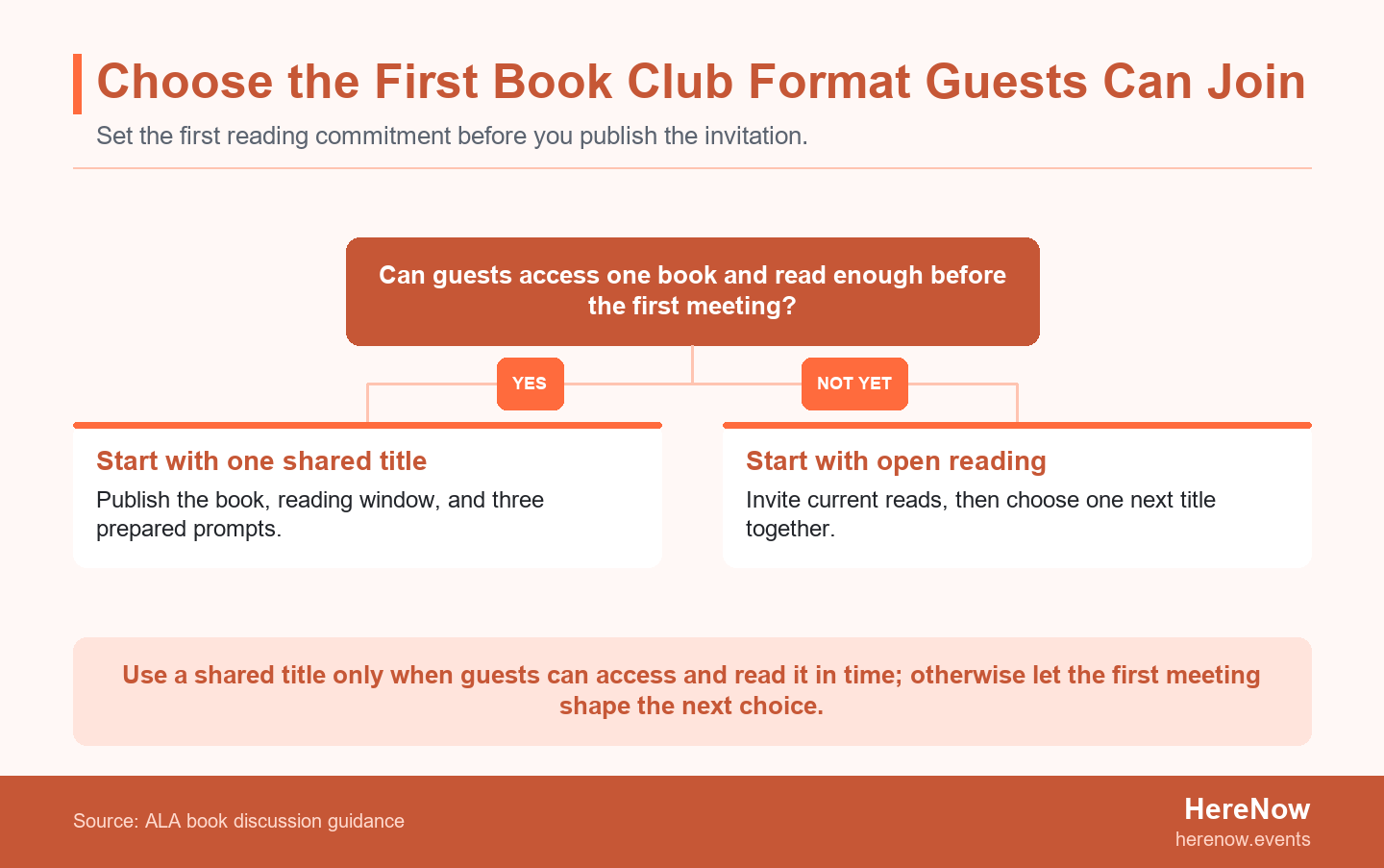
Choose a book that gives people something to hold onto in conversation. That might be a clear theme, a memorable setting, a compact premise, or several perspectives that invite more than one response. Avoid choosing only for prestige or personal attachment. A difficult or long book can be perfect for an established group that has already agreed on that challenge. It is a riskier first promise when guests still do not know whether the club will feel welcoming.
There are two valid first formats. If people can access one shared title and have enough time to read a useful portion, publish a shared-title discussion. If access or timing is uncertain, host an open-reading launch: invite people to bring what they are currently reading, let the group meet around their reading lives, and choose the first shared title together. The second route is not a lesser club. It is an honest response to what guests can commit to before they know the group. Hosts who want to turn that local ritual into a repeatable public format can See HereNow for curators.
Set a Reading Pace Around the Calendar, Not Your Ideal Reader
A reading pace is simply how much guests are asked to read before meeting. Set it from the calendar backward. The ALA's planning guidance lists meeting frequency and available copies as setup questions. Count the days between announcing the event and the gathering, then ask what a new member can realistically borrow, buy, download, or begin in that time. A long novel may still be workable when you announce it well in advance, but a first meeting does not need to make everyone finish a full book to have a real discussion.
Be specific on the page: "Read chapters 1-8 if you can," "Bring a book you are already reading," or "The discussion will welcome people who have only started." This is more generous than silently assuming completion. It also helps a guest decide whether to RSVP now, wait for a later date, or join the social part without pretending to have read more than they have.
Once the reading pace is clear, make the response path equally straightforward. HereNow explains how to collect RSVPs without attendee accounts, so a new reader can decide to join without taking on another account task.
Facilitate a Conversation, Not a Literature Exam
The host's role is to make interpretation easier to share, not to find the correct answer. Cornell's guidance on facilitating discussions recommends asking one question at a time, allowing thinking time, and organizing prompts into warm-up, exploration, and wrap-up stages. Those practices translate well to a book club because they give both quick speakers and reflective readers somewhere to enter.
A Library of Congress book-club notice welcomes people to discuss, listen to the conversation, or simply join fellow readers. That is a useful example of naming more than one low-pressure way into the room.
Start with an experience question: "What stayed with you after reading?" Move to a text question: "Which scene changed how you understood the main character?" Then offer a connection question: "What tension in the book feels unresolved, and why?" Close with one forward-looking question: "What should we carry into the next conversation?" This sequence makes room for personal reaction without requiring anyone to reveal more than they want to.
Do not force every prompt. If two guests are responding to each other, your best move may be to listen, name the thread, and invite one more angle. If the group gets stuck, return to the shared text rather than increasing the complexity of the question. A prepared prompt is a handrail, not a destination.
Prepare a Question Ladder, Then Leave Space
Bring three to five prompts that become gradually more specific. The first should be easy to answer without notes. The second can ask people to point to a moment, character, or idea in the reading. The third can ask them to compare interpretations or name a tension. The University of Michigan's guide to using discussion questions helps match a prompt to the response you want to invite. Keep one recovery question for silence, such as "What feels hardest to talk about in this book?" The host is prepared, but no guest needs to sound prepared.
University of Michigan guidance on discussion frameworks recommends clear, open-ended but bounded questions, options beyond whole-group talk, and a synthesis near the end. For a book club, use private notes, paired talk, or a passing option when it lets more people take part.
Agree on Enough Norms to Let Different Readers Belong
A first book club needs a few agreements, especially when people bring different reading histories, language backgrounds, or comfort levels with disagreement. Cornell's resource on community agreements emphasizes making expectations visible and giving participants room to shape them. For a small host, three simple norms are usually enough: listen without interrupting, criticize ideas rather than people, and make room for others or pass when you do not want to speak.
Say these agreements out loud at the first gathering and explain why they exist. A club about a difficult book may need a reminder that personal stories stay in the room unless everyone agrees otherwise. A group with many new people may need a clear signal that no one is required to speak in every round. The rules should make the room more open, not more formal.
When disagreement arrives, return to the question and the shared text. You can summarize two views, ask what each person noticed, or let the group name a question that remains unresolved. Do not rush to settle a disagreement just because it is uncomfortable. Do step in if one person starts treating another guest as a stand-in for a whole group, or if the discussion stops being safe enough for people to participate.
Before guests leave, decide how you will close the loop: a brief thank-you, the next title, and any resource you promised to send.
Once those details are clear, Get the post-event follow-up plan.
Example: A Nine-Person Neighborhood Book Club Builds the Second Meeting
Illustrative example: A host invites nine neighbors to a Sunday afternoon book club around a short novel available from the local library and as an ebook. The page says guests can read the first half, bring one passage or question if they want, and still attend if they only started. The first fifteen minutes are for tea and introductions. The next forty-five are guided by four prompts, then the last fifteen are used to choose the next date and collect book suggestions.
The room reveals two useful observations. Most people enjoyed the shared-title format, but two guests only obtained the book the day before and felt reluctant to speak. The host does not conclude that the book was wrong or that reading should become optional forever. For the second meeting, they publish the selected title three weeks earlier, add an optional passage card to the welcome note, and keep the same small capacity. That is one bounded adjustment: better access before the event.
The host also records what should remain stable: a short introduction, voluntary speaking, and a visible final decision about the next date. This is how a club becomes a repeatable format rather than a series of unrelated social plans. The host now has a clear reason to repeat the format without pretending that one first meeting has settled every future choice.
Put the Real Club Details on the Event Page
The public page should answer the decision a potential reader is making before they RSVP. State the club promise in the first lines. Name the first title or explain that it is an open-reading launch. Say how much reading is expected, how long the meeting lasts, where it happens, how the discussion will work, and whether new readers can attend without finishing. These are trust details, not clutter.
Also make book access concrete. Link to a library listing only when it is reliable for your guests, or simply explain what formats you expect to be available. If guests need to bring something, say so. If the group will choose the next book at the event, say that too. When people can see the real commitment, they can choose with confidence rather than discovering a hidden expectation after they arrive.
Keep the RSVP count in its proper role: it is a planning signal, not proof that every guest has finished the reading. The host still needs to check details, access, and the real room setup before publishing.
Create the First Book Club Event in HereNow
When the club promise, reading commitment, and first-meeting shape are clear, turn them into a public invitation. Include the title or open-reading format, the date, location, capacity, preparation note, and the one thing guests should expect from the discussion. HereNow gives an independent host a place to create that event page and share an RSVP path without requiring guests to create a HereNow account. Create your first book club event.
Frequently Asked Questions
How many people should be in a new book club?
Begin with the number of readers you can genuinely welcome into one conversation while handling the room and the first-time uncertainty. A small capacity is often easier to facilitate, but there is no universal ideal. Publish the shape of the gathering clearly, then adjust after you learn whether people need a more intimate circle, table prompts, or a co-host.
What should a book club do at its first meeting?
Use the first meeting to make the purpose, reading expectation, and next choice visible. Welcome people, explain the format, offer a low-stakes opening prompt, make space for discussion, and close with a next date or book-selection decision. Do not try to establish every tradition at once. A reliable rhythm is more valuable than a crowded agenda.
Do all book club members need to finish the book?
No, but the event page should say what kind of participation is welcome. A shared-title discussion may ask guests to read a chapter range, while an open-reading launch may welcome people with any current book. Make the boundary visible before RSVP so a guest can decide honestly rather than arriving embarrassed or feeling excluded.
How often should a book club meet?
Choose a rhythm that leaves real time to find and read the book, travel to the gathering, and handle ordinary life. A regular cadence can help, but it should fit the group rather than become a test of commitment. After two meetings, ask what made the schedule easier or harder to keep, then change one practical detail if the pattern calls for it.