How to Host a Beginner-Friendly Small Group Yoga Class
Plan a beginner-friendly small group yoga class with a 60-minute run of show, room and equipment checks, focused registration, consent, and day-of fallback rules.

The hardest part of hosting a beginner yoga class is not choosing more poses; it is protecting orientation and closing time while keeping the page, room, and instructor promise aligned. A beginner-friendly class gives a first-time guest enough information to decide whether to join, enough time to understand the room, and visible permission to choose, rest, or stop. The host owns the invitation and operations. The instructor owns the practice within the instruction they are prepared to provide.
Start with one bounded, in-person format rather than a universal promise: a named teacher, a stated pace, a confirmed venue, a modest capacity, a timed beginning, middle, and ending, plus an agreed day-of response. That response is not a guarantee that every condition can be fixed; sometimes the correct decision is to pause.
The Decisions to Lock Before You Publish
- A beginner-friendly class is ready to publish only when its promise, room, timing, registration, consent, and fallback decisions agree.
- Protect the orientation and close; if ordinary delays occur, simplify the repeatable middle of the class first.
- Set capacity from the smallest real limit: usable space, teacher attention, equipment, entry flow, audibility, or venue rules.
- Keep a registration question only when its answer changes preparation, communication, or delivery.
- Verify local, venue, teacher, and insurance requirements instead of treating any global guide as legal or professional approval.
Define Beginner Fit Before You Build the Sequence
Yoga can combine physical postures, breathing techniques, and meditation or relaxation, and classes can range from gentle to physically demanding. The U.S. National Center for Complementary and Integrative Health describes that range in its overview of yoga effectiveness and safety. That variation is why “beginner” cannot stand alone. Name the style or approach, pace, duration, setting, prior experience expected, and what choices the instructor plans to offer.
A useful promise might be: “A 60-minute, small-group foundations class for adults who are new to yoga, with slow verbal guidance, optional props, and no prior yoga experience required.” Avoid promising treatment, pain relief, injury prevention, emotional transformation, or suitability for everyone. If the offer itself is still uncertain—single class or series, observation capacity, pilot price, or break-even—HereNow's offer guide can help you test the small-group yoga offer first. Return to the operating decisions below after choosing that format.
Match the Promise to the Teacher's Real Scope
The instructor should teach only the style and methods they are prepared and qualified to lead. Here, scope means the instruction this teacher is prepared and qualified to provide. Yoga Alliance's Scope of Practice ties member instruction to education, training, experience, and qualified methodology. Use that as a professional boundary, not as a universal rule that one credential is legally required everywhere. Name the actual instructor and approach, then verify local law, venue policy, insurance conditions, and any credential expectations that apply to this event. Record who approved the final public wording before the page goes live.
Prepare the Room, Equipment, and Emergency Handoff
The room preflight should follow the whole guest route from the building entrance to the mat, props, restroom, exit, and post-class departure. Walk it at the same time of day as the event if possible. Confirm the correct entrance, lighting, stairs or lift information, temperature controls, restroom route, water access, storage for shoes and bags, usable floor area, sight lines, sound, and exits. Then set out only the equipment the teacher has included in the plan. Say whether mats, blocks, straps, chairs, or blankets are supplied and whether guests may bring their own.
A room can hold ten mats and still fail the class. A locked side entrance, props stored behind settled guests, a noisy air system, or belongings blocking the exit can create confusion before instruction begins. Run a short dry rehearsal with the host and teacher: enter, place equipment, stand where the teacher will demonstrate, speak at normal volume, move to the exit, and restore the room.
Use a Short Welcome That Gives Permission to Choose
The welcome should explain the room, the class duration, how options work, and how a guest can rest or stop without being singled out. In about one minute, identify the teacher, point out belongings and exits, state the planned finish time, explain how questions work, and say that resting or stopping is always available. If props will be used, show where they are before people settle. Do not tell guests to push through pain, compare themselves with a neighbor, or assume that a quieter option fits every individual. Rehearse the welcome once so it stays calm when arrivals overlap.
Agree the Emergency Handoff Before Guests Arrive
A practical emergency handoff names how to report a problem, where people should move, who accounts for the group, and who contacts emergency support. Those elements appear in the U.S. Occupational Safety and Health Administration's workplace emergency action planning guidance. Treat them as a planning checklist, not as a claim that workplace rules govern every yoga event. Confirm the venue's process, local emergency number, address wording, first-aid resources, and who makes the pause, evacuation, or call decision. Keep the RSVP list accessible to the host without exposing it publicly.
Use a 60-Minute Arc With a Protected Close
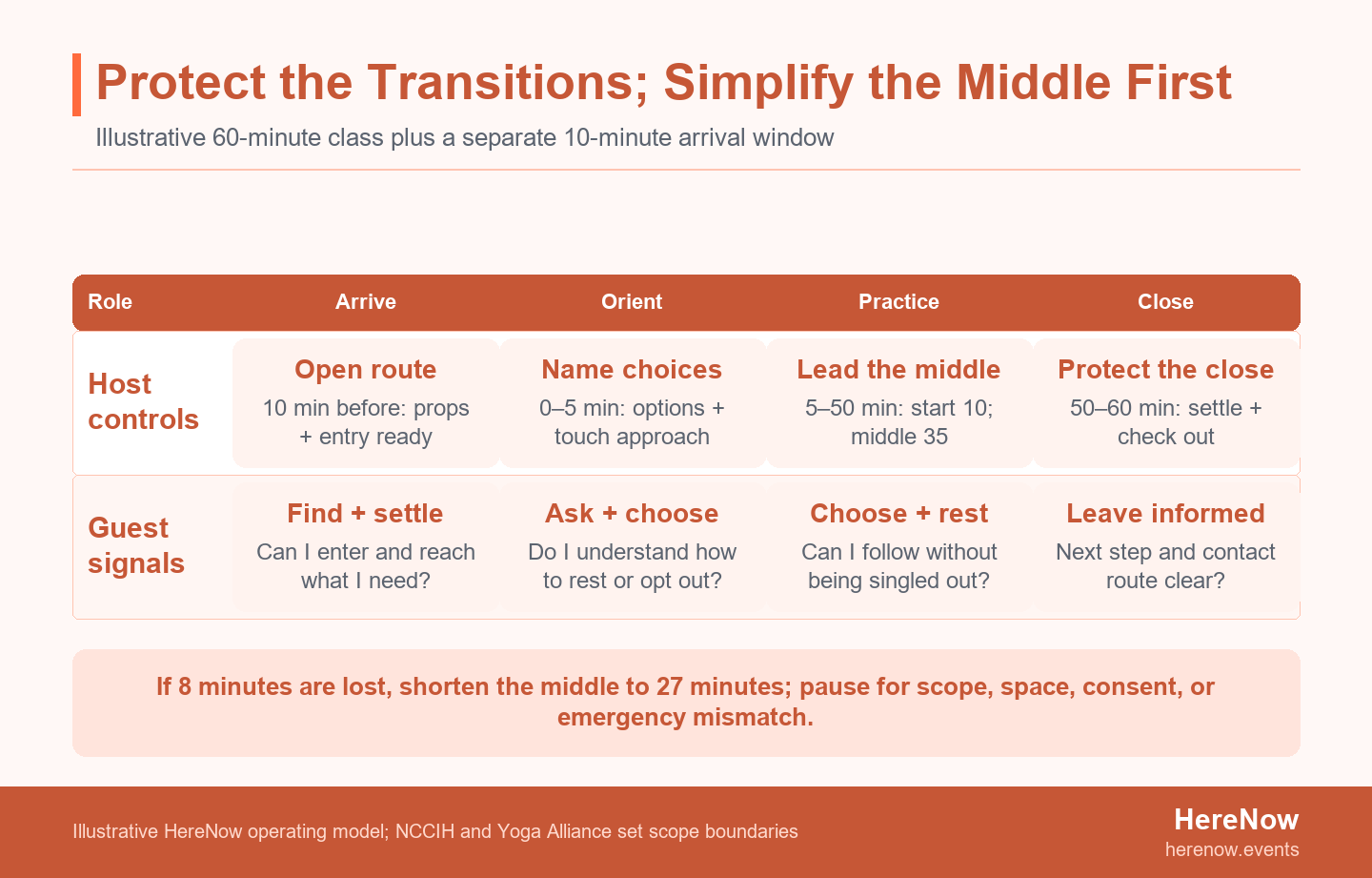
In a 60-minute beginner class, protect 15 minutes for orientation and closing, then make the middle practice block the first place to simplify when time slips. The class arc is the timed beginning, middle, and ending of the session. The fallback plan is the agreed change when time, space, or another condition no longer matches the original plan. In the example below, a separate 10-minute arrival window happens before the advertised start. Inside the class, five minutes are protected for orientation and ten for the close. The teacher still controls the actual practice content.
| Class time | Host and teacher focus | What a beginner should understand | If time slips |
|---|---|---|---|
| 0–5 minutes | Welcome, room orientation, choices, touch approach | Where things are and how to rest, ask, or stop | Protect this block |
| 5–15 minutes | Gradual start chosen by the instructor | The pace and instruction style | Keep the progression intact |
| 15–35 minutes | Foundational practice with demonstrated choices | How to follow without copying the largest version | Shorten repetition, not explanation |
| 35–50 minutes | Repeat, integrate, or simplify | Rest remains a normal choice | This is the first compressible block |
| 50–60 minutes | Quieter close, check-out, next practical step | The class has ended and departure is unhurried | Protect this block |
Based on this timing model, the final 35 minutes before the close form the repeatable middle. If an eight-minute access delay occurs and the venue end time cannot move, that middle can fall from 35 to 27 minutes while the five-minute orientation and ten-minute close remain intact. This is an illustrative operating calculation, not a universal yoga sequence. Rehearse the arc with the instructor, then adapt the Sunset Yoga Flow template to the confirmed duration and level; its default all-levels copy and capacity are starting material, not approval for this class.
Change the Middle Before You Cut Orientation or Closing
NCCIH advises beginners to start slowly, learn the basics, and choose a class appropriate for their level. Its Yoga for Health guide supports a restrained promise: the public level and the live class should match. When time is short, remove a repetition, shorten a transition, or omit an optional extension that the teacher has already identified. Do not accelerate instructions, hide the change, or erase the close. If the remaining plan no longer fits the teacher's scope, room, or consent conditions, pause rather than improvise. Mark removable elements on the instructor's run sheet before guests arrive.
Set a Small-Group Capacity From Space and Attention
Capacity is the smallest limit created by usable space, the instructor's attention, equipment, entry flow, audibility, and venue rules. Ask the instructor what group size they can lead for this exact level and format. Then test that number against the room, not a generic class-size benchmark. If the teacher is comfortable with twelve but the room only supports eight clear places with usable prop access and exits, the capacity is eight. If the room fits twelve but the instructor wants a first pilot of six, the capacity is six.
Keep the first limit modest when the space or guest questions are still unknown. Capacity can rise after the host and teacher observe a real class; it should not rise because a template suggests 24 places or because more RSVPs would look successful. Observation capacity and offer economics belong in the earlier product decision. For execution, use the lowest operating limit the teacher and room can support.
Walk Every Guest Path, Not Just the Mat Grid
One RSVP consumes a complete guest path, not only the rectangle occupied by a yoga mat. Place the proposed number of mats or chairs, then walk the entrance, belongings area, prop route, restroom route, teacher demonstration line, and exit. Check whether a late guest can enter without stepping through the practice area and whether someone can reach a chair or leave quietly. If adding the last place blocks any of those paths or makes instructions hard to hear, remove it before registration opens. Repeat the walk after furniture and personal belongings are in place.
Publish Access and Equipment Details Before RSVP
Publish the access facts you have verified and provide a direct route for practical questions instead of promising that the venue suits everyone. Give the exact entrance, floor, stairs or lift information, restroom facts, parking or transit notes, outdoor surface or weather plan, arrival window, equipment supplied, items guests should bring, and a way to contact the host. If a detail is unknown, say that it is unconfirmed and find out before claiming it.
Inaccessible web features can limit access to services, including event registration. ADA.gov's web accessibility guidance uses event registration as an example, while the W3C Web Accessibility Initiative recommends informative headings and link text that describes its destination. Put essential class facts in real text, not only on a poster image. Use short sections, descriptive links, and a visible contact route.
Ask Only the Registration Questions You Will Use
Keep a registration field only when its answer changes preparation, communication, or delivery for this class. That field test adapts the UK Information Commissioner's Office data-minimisation principle, which limits personal data to what is adequate, relevant, and necessary for the purpose. It is a sound design rule even when another jurisdiction applies; hosts must still follow the privacy rules that govern their event.
For a simple first class, collect a name, email for event updates, and only the operational choices you will act on. Examples include whether a guest needs a provided mat, whether they want to share a practical access question, or which ticket they selected. Avoid asking for diagnoses, detailed medical history, body measurements, pain scores, or a broad “tell us everything” field. Do not use a registration form to decide what exercise is appropriate for an individual. Explain why an optional question is asked, who receives the answer, and how the guest can contact the host privately. HereNow shows how to collect RSVPs without attendee accounts after the field list is settled.
Set Consent and Day-of Decision Rules
If touch may be used, the event page and opening should make consent explicit and declining simple. Yoga Alliance includes consent-based touch in its Ethical Commitment. Opt-in touch means physical contact occurs only after a guest has a clear choice to agree or decline. Confirm the teacher's approach before publishing. Do not rely on silence, a one-time blanket consent, or the assumption that a prior answer remains true throughout the class.
Write three day-of decisions in plain language. Continue when the named teacher, usable room, equipment, access route, consent approach, and emergency handoff still match the page. Simplify when a bounded problem—such as a short delay or unavailable optional prop—can be handled inside the agreed fallback without changing the class identity. Pause when the instructor is unavailable, the room or exit is unusable, essential equipment is missing, consent conditions cannot be honored, or an incident requires attention. The host and teacher should agree who calls each decision before guests arrive.
HereNow can hold the public details and RSVP list, but the host still owns the accuracy of the listing and the live handoff with the teacher and venue. Hosts building recurring community formats can see how HereNow supports independent hosts once the operating boundaries are clear.
Illustrative Day-of Example: A Ten-Seat Class Loses Eight Minutes
An illustrative ten-seat class loses eight minutes before the welcome, so the teacher shortens the middle practice while preserving orientation and closing. The host had advertised a 60-minute indoor foundations class, opened a separate 10-minute arrival window, confirmed blocks and mats, and agreed that the room booking must end on time.
Use the Fallback Plan Without Rushing the Close
This is an illustrative example, not a reported HereNow customer result. An independent host partners with a yoga teacher for a first 60-minute, beginner-friendly class with 10 seats. The page names the teacher, level, entrance, supplied equipment, consent approach, and contact route. Nine guests RSVP.
On the day, building access is delayed and the welcome starts eight minutes late. One guest also asks where the blocks are stored because that information appeared too low on the page. The host confirms that the room, teacher, exits, and equipment are still usable; the problem is time compression plus information order.
The delay threatens the timed plan, while the equipment question reveals a page-order problem rather than a teaching problem. The teacher and host keep the five-minute orientation and ten-minute close, shorten the repeatable middle by eight minutes, and agree to move the equipment details higher before the next class. The planned 35-minute middle becomes 27 minutes: one optional repetition is removed, instructions keep their normal pace, and the venue still closes on time. If the room or consent conditions had failed instead, this timing change would not have been enough; the class would pause.
Before the second event, the host moves the entrance and provided-equipment details into the opening page copy and confirms earlier building access. After the class, change the public information that caused uncertainty and verify whether the same question returns next time. This illustrative example does not assess anyone's health, body, flexibility, or progress. To ask whether guests found the entrance and props without extra explanation, start a focused post-class follow-up.
Publish a Page That Matches the Room
HereNow can turn the confirmed class scope, venue, schedule, equipment, and registration plan into a public event page with account-light RSVPs. Before opening registration, ask six release questions: Is the teacher named and the scope accurate? Has the guest route been walked? Are equipment and capacity confirmed? Does the run of show protect orientation and closing? Will every registration field be used? Do the consent, emergency, and fallback owners agree? Hold the page if any answer is no.
Keep the invitation factual and update it if the room, instructor, equipment, or access plan changes. When all six answers are yes, start creating your beginner-friendly yoga class.
Related guides: write an event page that earns informed signups, then use the first room's evidence to turn one class into a repeatable series.
Frequently Asked Questions
Do I need a certification to host a yoga class?
Work with an instructor whose preparation matches the style and level being advertised, then verify the law, venue policy, insurance terms, and professional expectations that apply where the event occurs. Hosting logistics and teaching yoga are different responsibilities. No single global credential rule applies everywhere, and a platform listing does not verify that someone is qualified to teach a particular class.
How long should a first beginner yoga class be?
A 45- to 60-minute class is a workable planning range for a first small group, not a universal yoga standard. The instructor's method, the group, the setting, and the promised format should determine the duration. Whatever length you choose, publish it accurately and protect time for orientation and a calm close. Do not make a class “beginner-friendly” by rushing more content into a shorter slot.
What should I ask on a yoga class registration form?
Ask for a name, an email for event communication, and only the operational choices you will use, such as a provided-mat request or an optional practical access question. Explain the purpose of each extra field. Avoid collecting detailed medical history or asking a host to decide which practice is suitable for someone. Give guests a private contact route for questions the form should not hold.
Should a yoga host mention physical adjustments on the event page?
The event page should clearly explain the instructor's physical-adjustment approach before each guest decides whether to RSVP for the class. If physical contact may be offered, explain how guests can agree or decline and repeat that choice at the start of class. If the class does not use touch, say so plainly. A response collected earlier should not be treated as permission that cannot change during the session.