What is a supper club?
A clear definition of supper clubs, how they differ from dinner parties, and how to host one with useful guest information.
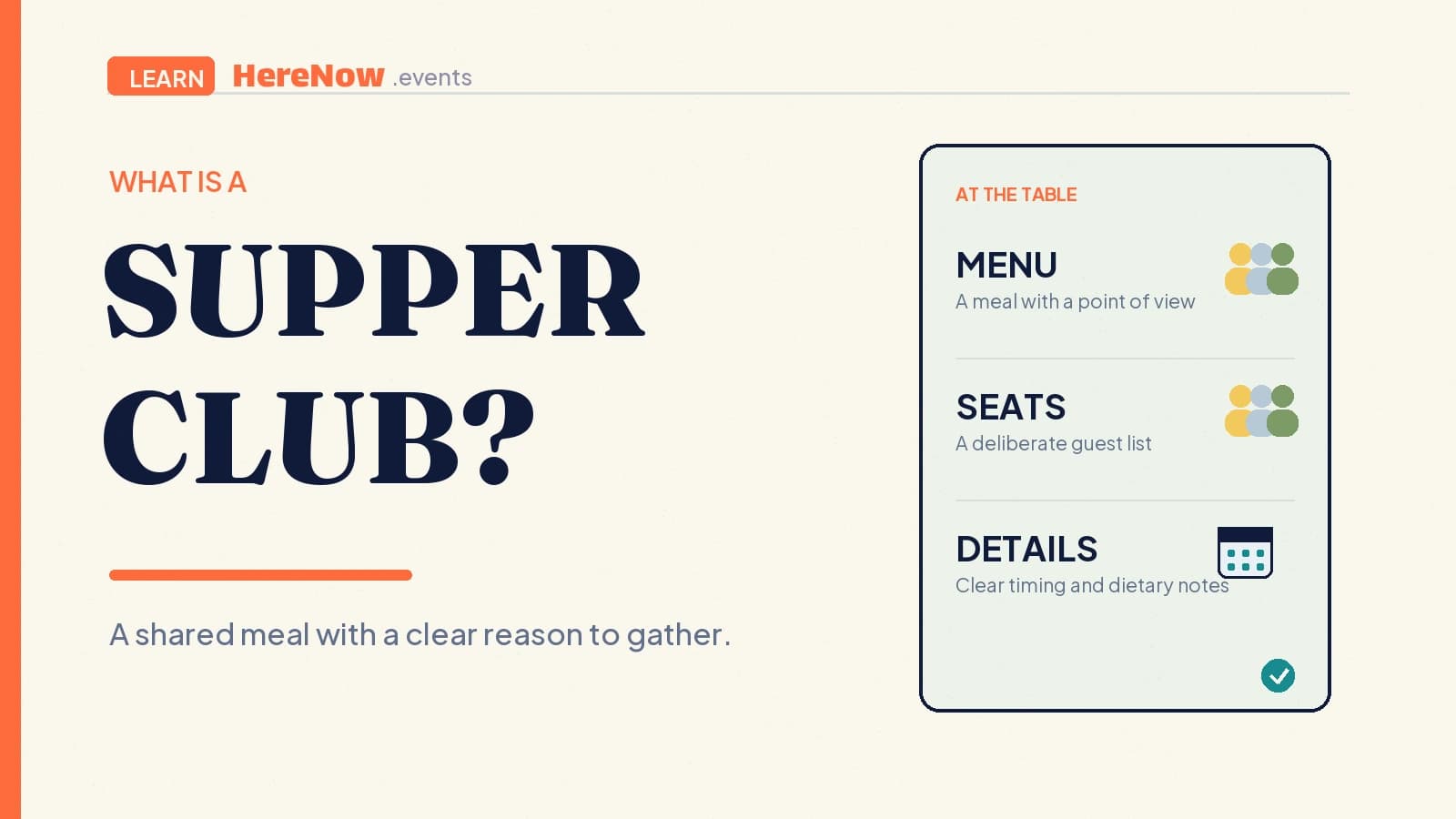
A supper club is a small, hosted dining event built around a shared meal and a deliberate social experience. It can take place in a home, studio, restaurant private room, or temporary venue. Unlike an ordinary dinner reservation, guests join a particular host’s menu, theme, guest mix, and rhythm for one evening. The meal matters, but the real format is a curated gathering where people have time to talk, eat, and participate.
A shared meal with a point of view
“Supper club” has more than one history. In the United States, it can describe a traditional destination restaurant. Today, independent hosts also use the term for an intentionally small dinner with a theme: regional cooking, a cookbook chapter, a harvest ingredient, a cultural story, or simply a table for neighbours who have not met yet.
The useful definition for a host is practical: a supper club gives guests a clear reason to gather around one table. The host sets the invitation, meal style, duration, capacity, and tone. It may be a one-off occasion or a recurring series. Research commissioned by the UK Food Standards Agency found supper-club hosts operating as hobby projects, arts projects, charities, and small professional ventures—another reminder that the format is defined by the hosted experience, not by a single business model.
How a supper club differs from a dinner party or restaurant booking
The boundaries are flexible, but the guest decision is different. A dinner party is often an informal invitation among existing friends. A restaurant booking puts the restaurant’s regular service at the centre. A supper club asks people to opt into a particular hosted occasion, often with limited seats and a defined programme.
- Dinner party: primarily personal and informal; the guest list and menu may stay private.
- Restaurant booking: guests choose from an established venue’s normal service and menu.
- Supper club: the host curates a specific meal and social setting, then gives guests enough information to decide whether to join.
That does not make a supper club formal or exclusive. A host might serve a family-style vegetarian meal at a shared table, invite strangers and friends together, and include a short introduction to the cook or cuisine. What makes it a supper club is the intentional container around the meal.
Choose a format guests can understand before they RSVP
Clarity is more valuable than elaborate copy. State whether the meal is seated or standing, shared platters or individual courses, hosted at a private home or a public venue, and conversational or programme-led. Give a real start and end time; “arrive from 7” is not the same as a meal beginning at 7:30.
Capacity shapes the experience. Eight guests around one table supports one conversation; twenty guests may need two tables, place cards, and a different way to welcome people. Decide whether guests know one another, whether they can bring someone, and whether the evening is alcohol-free. These details belong on an event page because they let a guest make an informed, low-friction RSVP decision.
For example, Mina hosts a monthly “Coastal Pantry” supper club for ten. Her page says that dinner is family-style, begins at 7:30 p.m., includes a short story about each ingredient, and ends by 10 p.m. It also says that the menu is pescatarian and that seating is communal. A potential guest can quickly tell whether the format suits them—before asking Mina a chain of follow-up questions.
Make the meal information operational
Food is both the attraction and the main responsibility. Ask for dietary requirements at registration, but do not promise that a dish is safe for a particular person unless you can confirm the ingredients and preparation conditions. The FDA identifies nine major food allergens under US law, including milk, eggs, fish, shellfish, tree nuts, peanuts, wheat, soy, and sesame. Laws and priority allergens differ by place, so a menu should name ingredients plainly and guests should be able to ask questions early.
Where food is sold, served to the public, or prepared repeatedly, check the rules that apply to the venue and jurisdiction before announcing the event. Food Standards Australia New Zealand, for instance, says home-based food businesses must meet relevant food-safety requirements and notify the local regulator; its guidance specifically includes catering for events. UK government guidance likewise shows why clear allergen information matters in food service. These are not universal rules for every private meal, but they illustrate why a host should verify local requirements rather than rely on the label “supper club.”
Build a repeatable hosting rhythm
A good first supper club is small enough to learn from. Begin with one menu concept, one seating plan, and one reliable arrival window. Keep a simple host checklist: confirm the venue, count seats, collect dietary notes, send the final menu or caveats, set a cancellation point, and prepare a welcome. After the meal, note what created ease or friction: seating, serving pace, quantity, music, and the time guests began leaving.
That review turns one dinner into a format you can repeat. An editable event page also means you can keep the useful parts—your capacity, dietary question, arrival note, and closing time—while changing the next menu. On HereNow, start with a dinner template, make the details your own, and give guests one clear route to register.
When is a supper club the right format?
Choose a supper club when the meal is the shared activity and you want conversation to be part of the design. It works well for cooks testing a theme, cultural exchanges, neighbourhood tables, and small community gatherings. It is less suitable when the main goal is a lecture, fast networking, or a large open house; a community event may be a broader fit in those cases.
It can be public, invitation-only, or unlisted. If you are still testing the format with a small circle, consider how event visibility changes who can discover the page and who receives the link. Match the visibility setting to the promise you make about the table.
Frequently asked questions
How many people should a first supper club have?
Start with the number you can feed, welcome, and communicate with confidently. Six to ten people is often easier to manage than a larger table because one host can still notice dietary notes, make introductions, and guide the evening. The right number also depends on the venue, service style, and help available.
Does a supper club have to charge for tickets?
No. A supper club can be free, shared-cost, donation-based, or ticketed. Be explicit about what any payment covers, when it is due, and what happens if a guest cancels. Charging or selling food may change the rules that apply, so check local requirements before you publish the invitation.
Can a supper club be hosted in a restaurant?
Yes. A private room, a chef’s table, or a restaurant collaboration can still be a supper club if the host is curating a particular menu and social experience. Confirm the venue’s service, dietary, capacity, and cancellation arrangements first, then state those decisions clearly on the event page.