What is a run club?
A practical definition of a run club, the guest information that matters, and a repeatable way to host a safe, social group run.
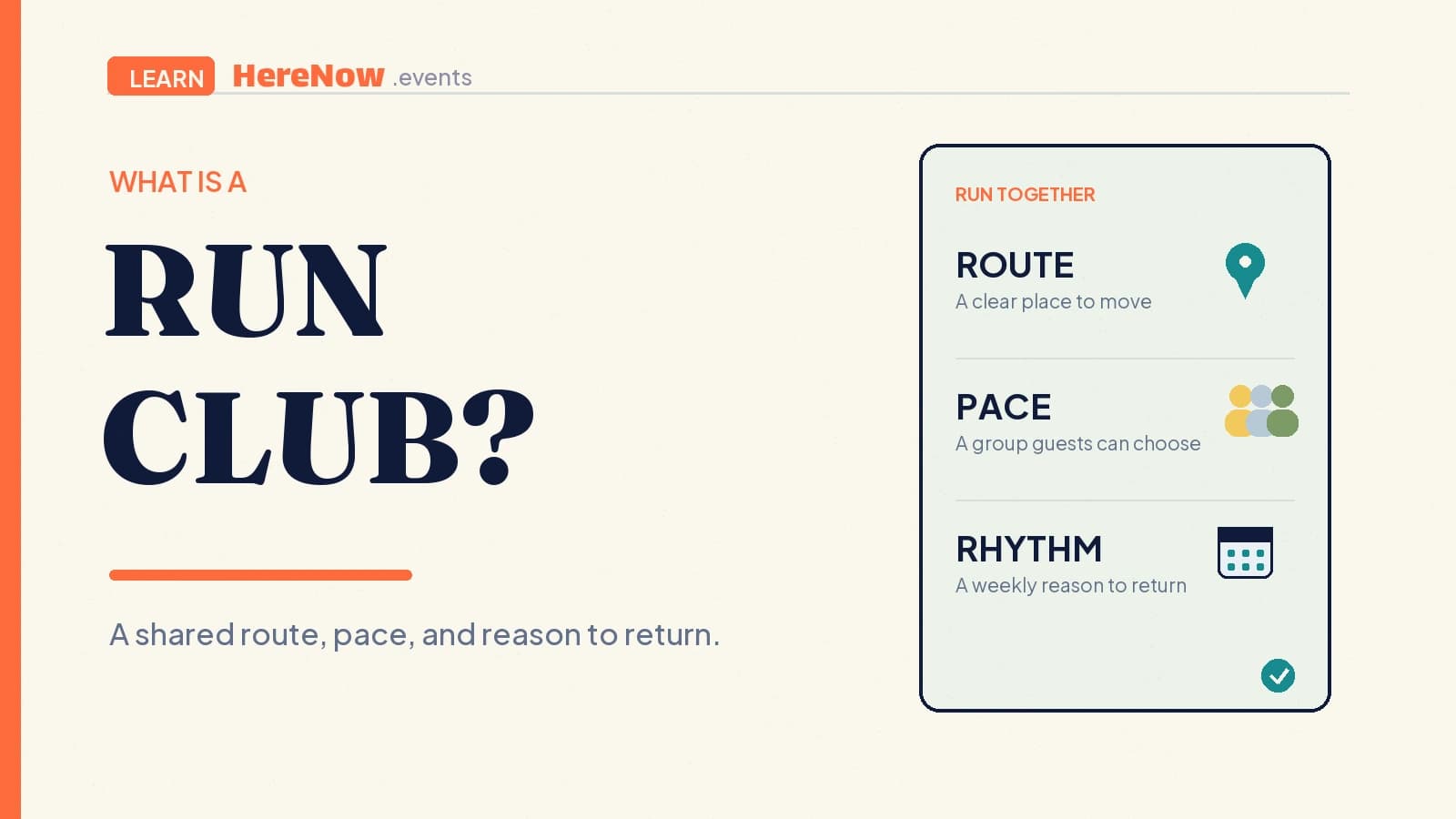
A run club is a recurring group run built around a shared meeting point, route, pace expectation, and social rhythm. People join to run or walk with others, not to enter a race. Some clubs are training-focused; others are mostly a relaxed loop followed by coffee. The useful common thread is that guests know where to meet, how far and fast the group will go, and what support to expect before they decide to RSVP.
A club is a repeatable group run
A run club may be a formal membership organisation, a neighbourhood crew, a store-led weekly run, or two friends hosting the same loop each Saturday. It can welcome first-time runners, experienced runners, or a defined pace group. England Athletics’ RunTogether programme describes group running through four operational qualities: fun, friendly, inclusive, and safe. That is a useful framing for a host because the route is only part of the experience.
Regularity is what turns a run into a club. A host does not need a huge calendar or a race permit to begin a small recurring social run. They do need a stable promise: for example, “Wednesday 7 p.m., 5 km conversational loop, then tea nearby.” Guests can decide whether the time, distance, pace, terrain, and social tone fit their week.
How a run club differs from a race or training plan
A race is a timed or competitive event with a fixed course and event-specific operations. A training plan is a structured progression toward an athletic goal. A run club can include both ambitious and beginner-friendly people, but its basic offer is shared movement and a reliable community moment.
- Social run club: a recurring run or walk where conversation and a familiar routine matter as much as performance.
- Training group: sessions designed around coaching, workouts, or a particular race goal.
- Road race: a discrete competitive event that normally needs more formal route, timing, and safety operations.
These categories can overlap. A Tuesday club might offer a gentle 3 km option and a faster 6 km option; a marathon group might still gather for coffee. The key is to name the actual format instead of calling every group run “all levels” without explaining what that means.
Give runners the information that changes their decision
A clear event page should answer the questions a new runner would otherwise need to send by message: exact meeting point, start time, route link or turn-by-turn summary, distance, terrain, expected pace, and the finish point. Also say whether the group regroups, uses pace leaders, waits at crossings, or has a back-of-pack volunteer.
Do not use “all paces welcome” as a substitute for useful detail. RunTogether categorises sessions by pace, distance, and experience; its runner guidance also encourages guests to ask a leader about a suitable group. A host can adopt the same clarity without copying a formal programme: publish a pace range, a run/walk option, and a simple note about hills or trail surfaces.
For example, Ayo’s Sunday run club starts at the east gate of the park at 8:00 a.m. The page offers a 3 km walk-run and a 6 km easy run, both at conversational effort, with a volunteer closing each group. It links to the loop, notes that paths can be muddy after rain, and ends at a café. A newcomer can choose a group before arriving rather than worrying about being stranded on an unfamiliar route.
Plan the route and the welcome together
Route planning is guest experience planning. Check access, crossings, surfaces, lighting, water, and the likely weather before you publish. The Road Runners Club of America’s safe group-run guidance recommends mapping routes, stating distance and pace groups, checking whether local permissions are needed, and assigning someone to stay at the back. Treat those as prompts to adapt to your local context, not as universal legal advice.
Have a quick pre-run briefing when the route, weather, or group makeup requires it. Share changes before setting off, introduce first-timers, and make it clear who is leading each pace. parkrun’s volunteer guidance illustrates the value of a day-of course check and a person responsible for welcoming newcomers and communicating course-specific information. Even a small club benefits when someone owns those small jobs.
Make inclusion visible in the format
Inclusion is not a claim in the title; it is the decisions behind the session. Offer a shorter option, publish whether walking is welcome, describe the terrain honestly, and state any age, accessibility, dog, or stroller expectations in advance. If the group is hosted after dark, write the lighting and visibility expectations plainly. If the group is invitation-only, use a public event page only when the invitation is genuinely open.
For larger groups, recurring public sessions, or routes that use shared trails and roads, check local rules, insurance needs, and venue permissions. Qualified programmes can have specific training, safeguarding, and licensing requirements; for example, England Athletics requires RunTogether group leaders to complete an approved course and safeguarding checks. A casual host should not imply that their run has the same safeguards unless it does.
Turn one run into a habit
Use the same core event structure every week: meet, brief, split by pace, move, regroup, and close. After each run, record the route condition, actual duration, who led, and any information guests asked for. That small review makes the next listing easier to update and reduces surprises for regulars.
On HereNow, the Run & Coffee Social Club template gives you an editable starting point for route notes, pace groups, safety reminders, and a post-run coffee stop. Keep the event page current, let guests register with the details they need, and adapt the recurring format as the group learns what works.
Frequently asked questions
Do I need to be a fast runner to join a run club?
No. The right club is one whose published pace, distance, and experience level suit you. Look for a walk-run option, conversational pace, or explicit beginner session if you are new. If a listing is vague, ask the host before registering rather than assuming that “all levels” means the same thing everywhere.
How often should a new run club meet?
Weekly is a practical rhythm because guests can remember it and hosts can learn from a consistent format. Start with one recurring time and route before adding extra sessions. Reliability matters more than frequency: a smaller group that knows when and where to meet is easier to sustain than an ambitious but irregular calendar.
What should a run-club host do if the route is unsafe on the day?
Change, shorten, postpone, or cancel the session and tell registered guests as early as possible. Do not rely on the original route if weather, construction, crowding, or a new hazard changes the conditions. A quick route check and a clear host decision are more useful than trying to preserve the planned distance.