What is a language exchange?
A language exchange is a conversation-based gathering where people practise languages with one another. Learn how the format works and how to host it clearly.
Language exchange, in plain English
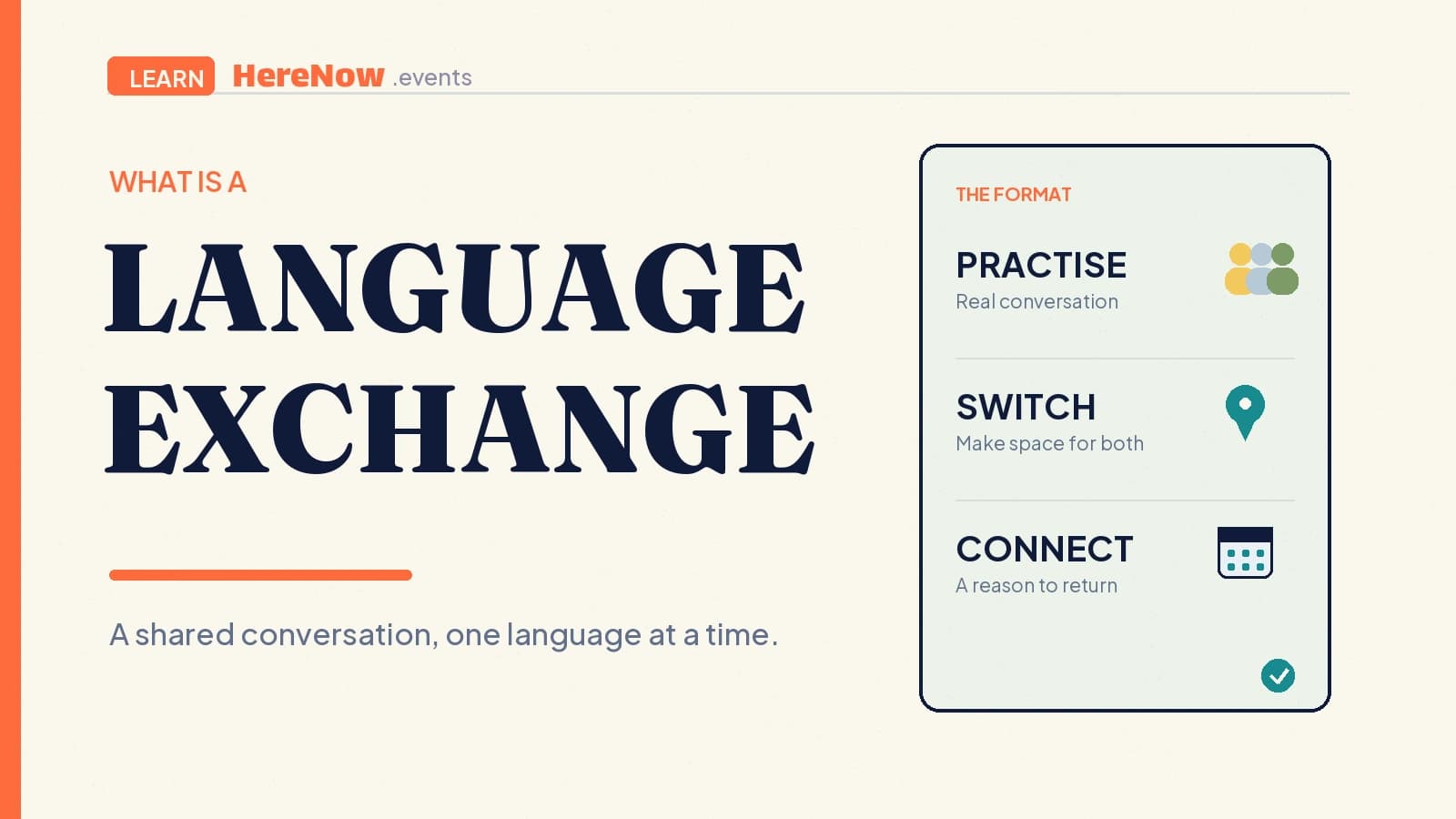
A language exchange is a conversation-based gathering where people practise languages with one another. It can pair two people who want to learn each other’s language, or bring a small group together around guided prompts. Unlike a formal class, the focus is usually real conversation, listening, and mutual support. People may correct each other when invited, but the purpose is practice—not grading, testing, or replacing a language teacher.
The exchange can happen in a café, library, community room, on a walk, or online. What matters is that guests know which language or languages they will use, the level the event welcomes, and how the host will make participation feel possible for someone who is still finding their words.
How a language exchange works
A simple format gives both languages and both speakers room. Some exchanges use one half of the session for one language and the other half for the second; others use small groups with a facilitator, topic cards, or partner rotations. The University of Houston’s Conversation Partners guidance describes a common one-hour arrangement with 30 minutes in each language, while noting that partners can adapt it to their preferences.
That flexibility is useful, but the host still needs to set a clear expectation. Is this a German-English exchange? A multilingual beginner conversation circle? A weekly English practice hour? Naming the format accurately helps guests decide whether their language level and goals fit the room.
Make the first conversation less intimidating
Many guests will worry about making mistakes, arriving alone, or not knowing what to say. A host can lower that uncertainty by sharing a light structure:
- Topic prompts: food, neighbourhoods, music, travel, work, or a simple “what happened this week?” question.
- Time cues: say when partners or languages change so no one has to negotiate the whole session alone.
- Correction preference: make correction optional and invite people to say what kind of help they want.
University of Washington conversation practice sessions use small groups and facilitator-guided activities, while explicitly valuing different varieties of English and treating mistakes as part of learning. Its language-practice description is a useful model for a welcoming tone: invite practice without asking guests to perform perfection.
An illustrative bilingual café exchange
Imagine a host running a 75-minute Spanish–English language exchange in a local café. The event page says that the first ten minutes are for arrivals and a name-tag prompt, followed by 25 minutes in Spanish, a short break, and 25 minutes in English. Guests can use conversation cards or bring a topic they care about. The host explains that fluent speakers are welcome but should leave space for learners, and that correction is offered only when requested.
That information gives a newcomer a genuine decision: they can see the pace, language balance, location, and social expectation before registering. The host does not promise fluency or a perfect match. They offer a real time and place to practise with other people who understand why pauses and mistakes belong in the exchange.
Explain the guest experience before RSVP
Use an event page to list the languages, level guidance, time, place or online access, format, cost if any, and what guests should bring. State whether the group is drop-in, partner-based, or capacity-limited. A clear registration path can ask about the languages a person speaks and wants to practise, but it should not make people prove a level they do not need to prove.
Harvard’s Language Exchange connects people looking to exchange practice and supplies conversation itineraries to help them begin. For a host, that points to a repeatable habit: keep a short library of prompts and test one new activity at a time, instead of rebuilding the session from nothing.
Help the exchange become a regular habit
After every session, note which prompt got people talking, whether the language split felt fair, and what first-time guests asked. Small changes—clearer name tags, quieter seating, a different rotation, or more time for beginners—can make the next event easier to host. Do not assume one arrangement works for every language pair or group.
On HereNow, you can shape the language details into an editable event page, make the joining route visible, and reuse the structure for the next practice session. When you are ready to invite the group, use a language-exchange template and read the page as a nervous first-time guest would.
Frequently asked questions
Do I need to be fluent to join a language exchange?
No, unless the event says it is intended for a particular level. Many exchanges are designed for learners who want low-pressure speaking practice. Read the language and level guidance before joining, then choose a session whose format lets you participate honestly. A good host will state whether beginners, mixed levels, or fluent speakers are welcome.
Is a language exchange the same as a language class?
No. A class generally has a teacher, curriculum, and planned instruction. A language exchange is peer-led or lightly facilitated conversation practice. It can complement study, but it should not promise formal instruction, assessment, or qualifications. The page should make clear whether the host is facilitating conversation, teaching a lesson, or offering both.
Should people correct each other’s mistakes?
Only if they want that kind of feedback. Some guests prefer a quick correction, while others want to keep the conversation moving and ask questions later. A host can normalise both preferences by suggesting that partners ask first. That small agreement keeps language practice mutual rather than turning one person into an uninvited teacher.