What is a salon event?
A salon event is a small, hosted gathering built around a shared conversation. Learn how to frame the topic, invite guests, and guide discussion clearly.
Salon event, in plain English
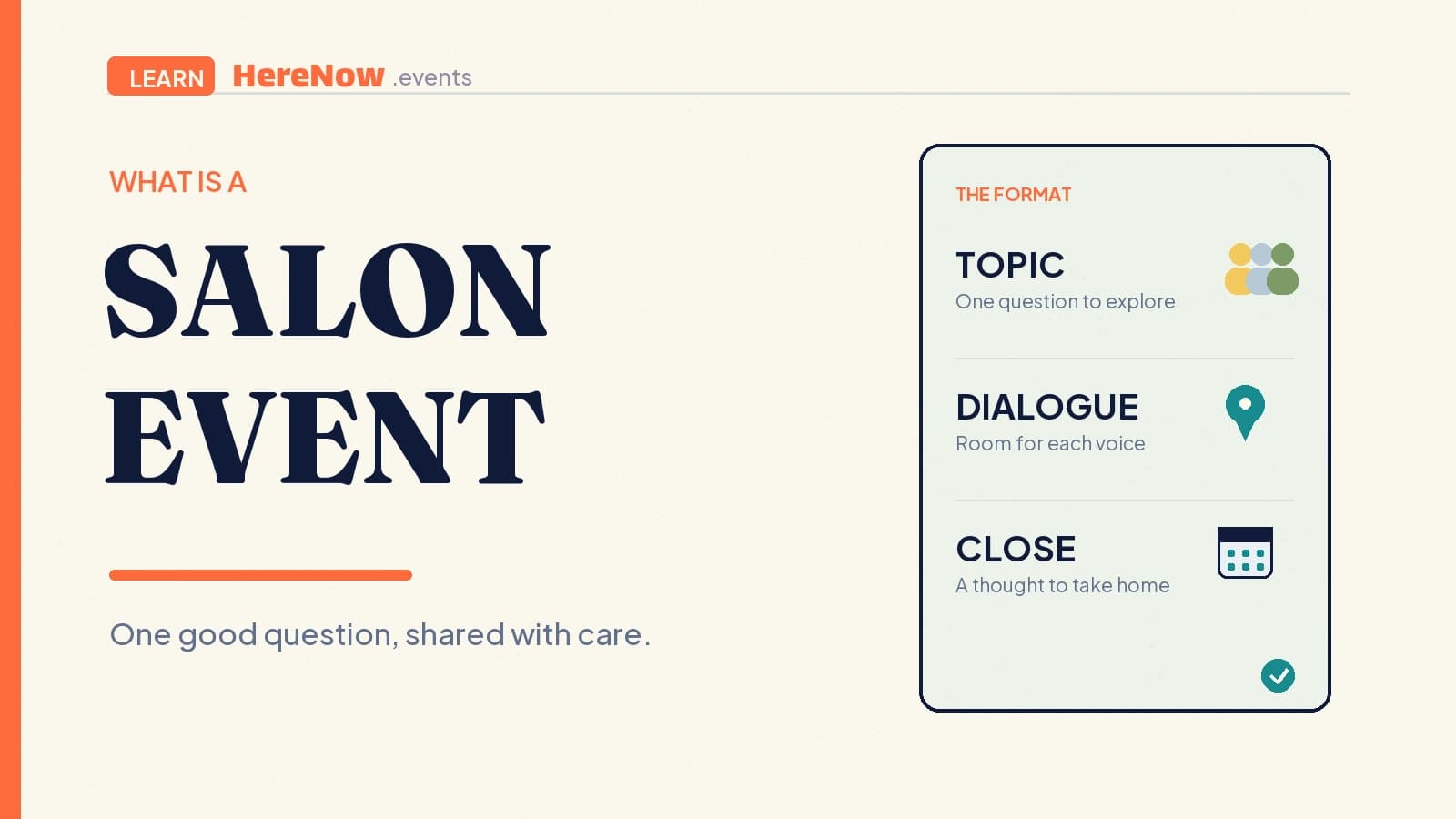
A salon event is a small, hosted gathering built around a shared conversation. Guests come to explore one question, idea, work, or theme with one another, often in a relaxed setting such as a living room, studio, bookshop, or community space. A host may offer a short introduction, reading, or provocation, but the central experience is dialogue—not a long presentation or an unstructured social party.
Modern salons borrow the spirit of the historic salon: people with different perspectives meet to exchange ideas. The format does not require an expert audience or a formal lecture. It needs a clear topic, a considerate host, and an invitation that tells people what kind of participation the conversation asks of them.
What makes a salon different from a panel or meetup?
A panel usually gives a few speakers the main role, with discussion following. A meetup may be primarily social and open-ended. A salon gives the room a common subject and expects guests to shape the conversation. The host protects the conditions for listening, questioning, and connecting different viewpoints; they do not need to have the final answer.
UC San Diego’s discussion-facilitation guidance describes a facilitator as creating the process and conditions for a group to discuss, plan, decide, learn, or grow. It also recommends structure rather than a free-for-all when participation matters. That is a useful distinction: a salon can feel informal while still being carefully hosted.
Frame one question people can enter
Choose a question with room for more than one honest answer. “What makes a neighbourhood feel like home?” works better than “Why our neighbourhood plan is correct.” “What do we keep when we make work with AI?” can open a different kind of salon, especially when guests know whether they should bring an example, read something beforehand, or simply arrive curious.
- Opening frame: a short context, reading, object, image, or first question.
- Conversation agreement: how people take turns, disagree, and treat personal stories.
- Closing shape: a reflection, a final round of questions, or a simple invitation to continue the idea later.
Harvard’s Civil Discourse Handbook highlights participatory facilitation and clearly defined norms as support for constructive dialogue. A salon host can state a few plain expectations at the beginning: speak from experience, make space for others, and question ideas without dismissing people.
An illustrative neighbourhood salon
Imagine a host inviting fourteen neighbours to a 90-minute salon called “What should a quiet street feel like after dark?” They bring one map of the area and open with three observations gathered during an evening walk. For the first ten minutes, guests pair up to name one place that feels welcoming and one that does not. Then the whole group compares themes, with the host noting recurring ideas on a visible sheet of paper.
The page says this is a conversation, not a public hearing or promise of a policy change. It gives the address, arrival time, step-free access information, and the discussion question. That clarity lets someone decide whether they want to contribute. It also gives the host a way to keep the evening from becoming a sequence of unrelated personal stories.
Host the conversation, not every opinion
A salon host does not need to dominate. Prepare two or three follow-up questions, notice who has not had room to speak, and summarise what the group is actually saying. The Art of Salons facilitation guide encourages hosts to prepare questions and draw themes from comments so the group moves into dialogue rather than a string of separate stories. If the discussion becomes tense, return to the agreed purpose and invite people to respond to the point they heard.
Norms are especially valuable when the topic might be personal, contested, or unfamiliar. Stanford’s small-group guidance recommends establishing norms early and designing them around respectful, inclusive participation. A host can also offer a quiet way to pass on a question, rather than treating every contribution as compulsory.
Make the invitation easy to accept
Use an event page to state the topic, host, time, location or online access, participation style, and any preparation. Tell guests whether food is part of the evening, whether there is a capacity limit, and whether they should RSVP. A clear registration path is not bureaucracy; it gives the host enough information to prepare a workable room and gives guests a reliable confirmation.
Keep a simple note after each salon: which opening question created dialogue, where the energy shifted, and what guests asked for next time. On HereNow, you can adapt an editable event template to that next conversation and keep the guest details in one place. When the theme is ready to share, use a salon template and review the invitation as a first-time guest.
Frequently asked questions
How many people should be at a salon event?
There is no fixed number, but the group should be small enough that guests can recognise the shared conversation and the host can make room for different voices. Decide from the space, topic, and facilitation approach. State the actual capacity instead of assuming that the word “salon” tells guests how intimate the event will be.
Does a salon need a speaker?
No. A host can open with a question, short reading, object, or shared experience rather than a featured speaker. A speaker can be useful when they provide relevant context, but the event should still explain how guests will participate. If the audience is only listening, a talk or interview may be the clearer name.
Can a salon discuss difficult topics?
Yes, when the host is prepared to frame the purpose, set respectful expectations, and respond calmly if tension arises. Do not promise total agreement or assume every guest will want to share personal experiences. Make participation voluntary where possible, provide clear context in the invitation, and choose a format you can facilitate responsibly.