What is an early bird ticket?
An early bird ticket is a lower-priced, limited early release. Learn how its deadline or quantity limit should work and how to explain it clearly to guests.
Early bird ticket, in plain English
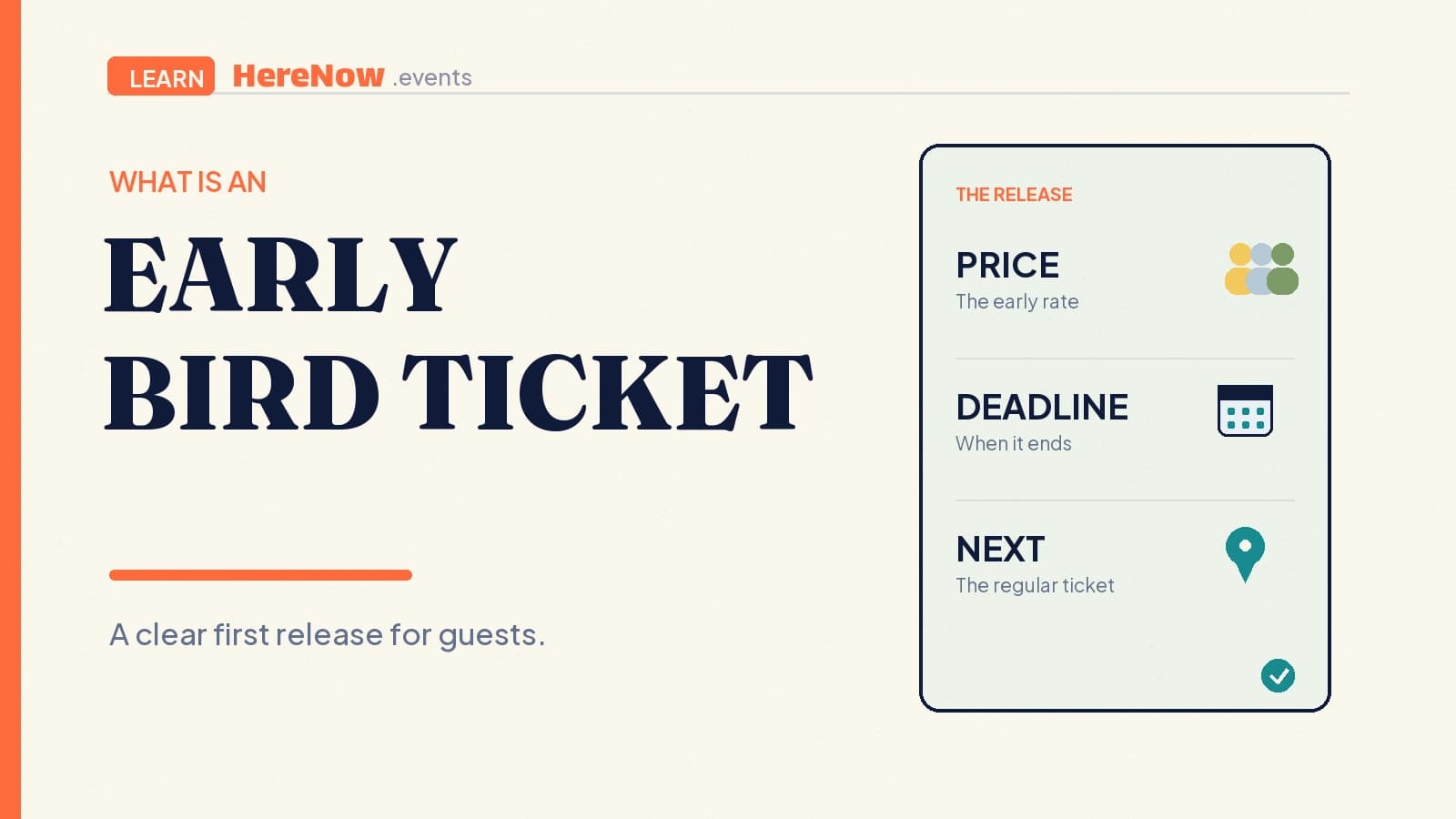
An early bird ticket is a ticket offered at a lower price during the first part of an event’s sales period. It rewards guests who decide earlier than the regular release. Most often, it gives the same entry as the standard ticket; the difference is the price and the fact that it ends at a stated time or after a limited number has been claimed.
For a small host, an early bird ticket is simply a clear first invitation. It can suit a class, supper club, walking group, or language exchange when the date, place, and core experience are ready to share. It is not a promise that the event will sell out, and it should never make guests guess what will happen to the price next.
What makes a ticket early bird?
The defining feature is a real early-purchase condition. A reduced price might end on a named date and time, when a stated quantity is reached, or at whichever happens first. Leiden University describes an early-bird discount as a lower price for people who buy before a specified date, with a regular ticket starting just after that period ends. Its ticket-sales guidance is useful because it treats the early and regular options as a sequence, not two unexplained prices shown together.
Early bird does not have to mean “first people through the door.” It means the host has set a verifiable release condition. If guests can buy the cheaper ticket indefinitely, it is simply the normal price. If the price changes on a date, name the time zone. If it is limited by quantity, decide what guests will see once that allocation is gone.
Keep the offer honest and easy to read
Use a title that explains the choice: “Early Bird — through 8 September” is better than “Tier One.” Put the price, what the ticket includes, and the end condition next to each other. When the early and standard tickets provide the same workshop, say so. When one has extra materials, reserved seating, or a different eligibility rule, describe that difference instead of relying on the word “early.”
Price presentation is part of this clarity. For covered live-event ticket offers in the United States, the FTC’s fee guidance requires the total price to be disclosed upfront when it can be calculated and the final amount to be prominent before payment. Australia’s consumer regulator similarly explains that presented prices should show the total in a single figure and include compulsory charges. Read the ACCC’s ticket-pricing guidance for that context. Requirements vary by location, so check the rules that apply to your event; the practical baseline is that no guest should discover an unavoidable cost late in checkout.
An illustrative language-exchange release
A host has planned a twelve-person, beginner-friendly Spanish language exchange in a café. They publish an editable event page with the date, the conversation format, and the café address. The first four places are “Early Bird — $6, through 14 August, 18:00 local time.” The next eight are “Standard — $8.” Both include the same ninety-minute exchange and a printed conversation prompt.
The host has made one easy guest decision: commit before the deadline for the earlier price, or select standard admission afterwards. They have not invented a vague “VIP” label, hidden the price change, or implied that four places are available if they are not. The small release also helps the host practice a repeatable routine: define the condition, check the live page, and make sure the next available choice is understandable before sharing the link.
Plan the handoff to the regular ticket
Write the release path before sales begin. Start with the standard ticket: its price, quantity, and sale end. Then set the early bird’s lower price and its precise end. Review the two options together so there is no confusing gap or unnecessary overlap. Yale’s event guidance shows why the details matter: ticket choices can have their own price, available quantity, per-person purchase limit, sales start and end, and access rules. See the ticket-option checklist for a practical view of those separate controls.
For a small gathering, keep the setup proportionate. One early bird and one standard ticket is often enough. Make both descriptions consistent with the event’s capacity, and make the purchase limit fit how guests normally book. Clear registration choices reduce the follow-up questions that slow a simple event registration path.
Set an early bird ticket on HereNow
HereNow’s ticket editor lets you give a ticket its own name, description, price, quantity, maximum per order, sales start and end, status, and sort order. Use those fields to turn the release path into the guest-facing details you have already decided. Keep the early bird active only for its intended window, and ensure the standard ticket has a clear status and availability plan.
Before you share the event, read it once from the guest’s point of view: Can they see the early price, its deadline or limit, what happens next, and the final amount they should expect? When the answer is yes, add tickets to your HereNow event and publish the invitation with confidence in the information, not artificial pressure.
Frequently asked questions
Does an early bird ticket include less than a regular ticket?
Usually, no. An early bird ticket often gives the same entry as the regular ticket at a lower price because the guest booked earlier. It can include something different, but that must be stated clearly. If the access differs, name the inclusion rather than assuming guests will infer it from the price.
Should an early bird ticket end by date or by quantity?
Either can work when the condition is real and visible. A date gives every guest the same deadline; a quantity suits a small fixed allocation. You may use whichever comes first, but say so plainly. Avoid changing the rule after launch unless you communicate the change accurately to everyone considering the event.
Can an early bird ticket be free?
It can, but the wording should still explain the condition. A free first release for community members can be useful when paired with a paid guest ticket, for example. If it is simply a free event for everyone, call it a free RSVP instead of an early bird ticket so the guest expectation remains simple.