What is a third place event?
A practical definition of third place events and a clear way to host repeatable, low-pressure community gatherings.
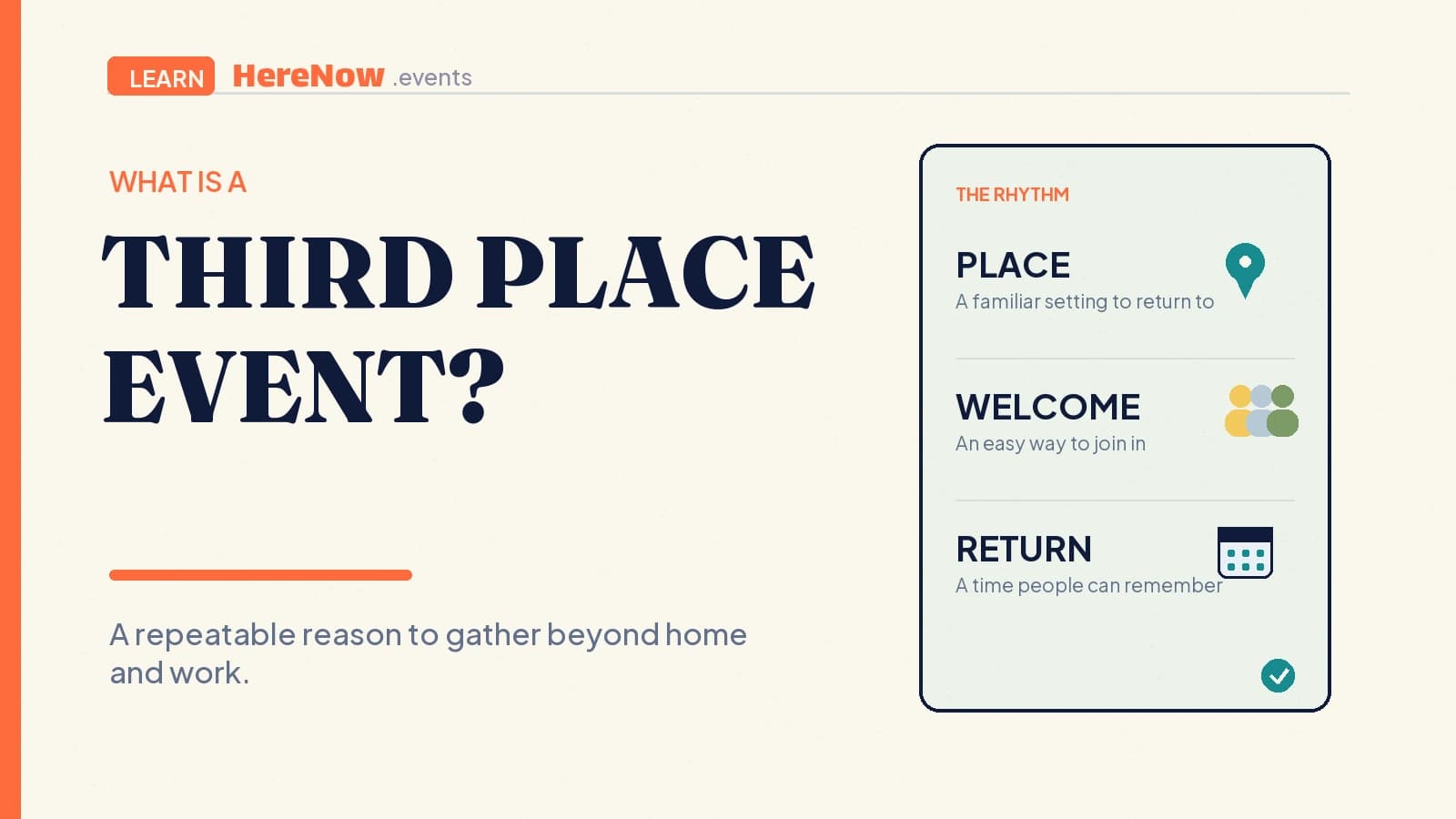
A third place event is a small, welcoming gathering designed to help people spend time together somewhere beyond home and work. The “third place” idea comes from sociologist Ray Oldenburg’s description of neutral, informal settings where people can linger, talk, and return. An event does not become a third place by name alone; it can help activate one when it is easy to join, socially low-pressure, and repeated often enough for familiarity to grow.
From a place to a hosted moment
A third place is usually a setting such as a library, café, park, community room, garden, barbershop, shared studio, or street corner. Queens College describes it as a neutral public place apart from home and work where people gather around interests, knowledge, cultural exchange, and community connection. The location matters, but the social behaviour matters more: people need to be able to arrive, interact, and stay without having to perform a job or a formal role.
A third place event gives that setting a gentle reason to come alive. It might be a weekly neighbourhood coffee hour, a library repair table, a Sunday walking group that ends at the same plaza, or a drop-in board-game night in a local café. The event supplies a time, a welcome, and a little structure; the place supplies a chance for conversation and return visits.
What makes an event feel like a third place?
It is not a question of stylish furniture or a clever theme. Oldenburg’s work grouped many kinds of familiar local settings under the term “third place,” from cafés and pubs to libraries, parks, and street corners. The common qualities are neutral ground, accessibility, informality, regulars, conversation, and a home-away-from-home feeling.
For a host, translate those ideas into decisions rather than slogans:
- Easy to enter: guests know where to arrive, what happens first, and whether they can come alone.
- Low-pressure: no elaborate expertise, application, or purchase is required just to take part.
- Conversation-friendly: the activity leaves room for people to meet rather than demanding constant attention.
- Repeatable: a familiar time and location give people a reason to return and make newcomers easier to welcome.
Not every community event needs all four qualities. A one-off festival can be valuable without being a third place. The difference is that a third-place event is built for ordinary, recurring connection—not a single peak moment.
Choose the right amount of structure
Too little information can make a newcomer anxious; too much programme can make the gathering feel like a class. Give guests a clear event page with the start and end time, exact location, accessibility note, cost or purchase expectation, and a simple description of what people will do. Then keep the activity light enough for conversation to happen around it.
A reading table can begin with a five-minute introduction and then allow people to browse and talk. A neighbourhood walk can use one short route and a tea stop rather than a full itinerary. A crafting night can provide one shared prompt and an optional supply list. The aim is not to engineer friendships; it is to make joining feel understandable and leaving—or returning—feel easy.
University of Missouri Extension makes a useful distinction: the defining feature of a third place is not the building but the interaction inside it. Its guidance also highlights predictable rhythms and regulars as the way a location becomes a place. That makes a small recurring event a practical tool for an independent host.
A simple example: the Tuesday table
Priya asks a local independent bookshop if she can host a Tuesday table from 6:30 to 7:30 p.m. twice a month. There is no guest speaker and no purchase requirement. Each session has one optional conversation card about a local issue, a bowl of name stickers, and three tables that welcome people to sit with someone new. The shop confirms the accessible entrance and quiet corner; Priya caps the page at twenty guests only if the room needs a headcount.
Her event page says plainly: “Come alone or bring a neighbour. Arrive anytime in the first twenty minutes. We will have prompts, but there is no required discussion.” That simple invitation removes the usual uncertainty around a social gathering. If the table returns on the same rhythm, guests can recognise faces, become regulars, and help welcome the next person.
Work with a place, not just in it
Before publishing, agree with the venue on the basics: who opens and closes, where people gather, how much space is available, whether purchasing is expected, restroom access, noise limits, and what happens if the group is larger than expected. A host should not imply that a café, park, library, or shop is open to a public gathering without the owner or manager’s agreement.
Access is part of the design. The Urban Institute notes that seating, shelter, and other physical features can either enable social interaction or exclude people. State steps, toilets, lighting, language, cost, and any sensory considerations as honestly as you can. If the gathering is intended for a known group while the venue is public, use the right event visibility setting and share the link deliberately.
Let the rhythm do the work
A third-place event is strongest when it can remain modest. Keep a short host checklist: confirm the space, refresh the arrival note, bring one simple conversation starter, greet first-timers, and record what needs changing. After each gathering, note whether the time, layout, capacity, and welcome made it easier or harder for people to linger.
On HereNow, you can create a community event from one idea, turn it into an editable public page, and make the next date easier to publish. The point is not to promise belonging on demand. It is to keep making a clear, welcoming occasion where belonging has room to develop.
Frequently asked questions
Does a third place event have to be free?
No. Free or low-cost access can lower barriers, but the crucial question is whether the cost and purchase expectation are clear and reasonable for the gathering. A café event can still work when guests are welcome to buy something, provided that the host and venue are honest about the expectation and no one is surprised.
Can a one-time event be a third place event?
It can introduce the idea, but a single gathering usually cannot create the familiarity associated with a third place. Treat a one-off event as a test of the location and format. If people respond well, repeat it on a simple rhythm so guests know when they can return and who they may see.
How can hosts make a third place event welcoming to newcomers?
Say explicitly that people may come alone, explain what happens on arrival, and give a host or regular the job of greeting new guests. Use an activity that permits conversation without forcing introductions. Clear access information and a low-pressure exit are just as important as a warm welcome at the door.