How to Turn Yoga Knowledge Into Small-Group Events
Shape one credible yoga offer, set capacity by observation load, compare safe seats with break-even, and test a responsible small-group pilot.

Knowing yoga and packaging a yoga event are different skills. A host needs more than a sequence of poses: the public promise must fit the teacher's competence, the room must support the plan, and the group must remain small enough to observe and assist responsibly. The first product is therefore not “a yoga class for everyone.” It is a deliberately bounded experience for a specific participant.
Set that boundary before choosing a ticket price. The real limit is often observation capacity: how many people the teacher can actively see, cue, and support through the planned session. If the safe delivery cap cannot cover the event's modeled costs, the answer is to change the format, costs, venue, or audience—not to squeeze more mats into the room.
The path from one credible promise to a publish-or-change decision covers three small-group formats, an eight-seat pilot model, consent and venue controls, the page details that help guests assess fit, and the evidence needed before turning one class into a series. The framework is not certification, medical advice, legal advice, or an income guarantee.
Five Conditions Before Yoga Knowledge Becomes an Event
A viable first yoga event aligns competence, participant promise, observation capacity, economics, and trust details. Check them in that order: the host is trained and permitted to deliver the session; the promise names one suitable participant and one reasonable result; the group is small enough to see and support; safe capacity can cover modeled costs; and the public page states the experience level, consent approach, access details, and what to bring. A failure is useful information. It tells you exactly what to narrow, verify, or redesign before tickets go live.
- Competence: the session stays inside verified training and permitted work.
- Promise: one suitable guest can understand one reasonable result.
- Capacity: the teacher can continuously see, cue, and support the group.
- Economics: modeled costs fit inside the safe delivery cap.
- Trust: the public terms make fit, choice, access, and expectations clear.
Make the Knowledge Teachable Before You Make It Sellable
Start with one participant, one result, and one boundary. “Desk workers new to yoga will learn a short wind-down sequence they can practise at home” is more usable than “transform your body and mind.” It suggests the pace, vocabulary, equipment, exclusions, and likely questions. The boundary is equally important: say what the session does not provide, especially where a request would require clinical assessment, therapeutic claims, or skills outside the host's training. Once this yoga-specific boundary is clear, HereNow's broader guide to turn a repeatable skill into a paid workshop can help shape the offer.
Choose One Participant and One After-Class Result
A useful first event promise says who the class is for and what the participant can reasonably understand or practice by the end. Write the sentence as: “For [participant], this session helps you [practical result] through [bounded experience].” A credible example is: “For adults who are curious about yoga but unsure where to start, this 60-minute session introduces breathing, five foundational shapes, and a short sequence with optional variations.” The result is observable without promising pain relief, treatment, weight change, or a personal breakthrough. Test the sentence against the run-of-show: if the class cannot create enough time to explain, demonstrate, observe, and let participants practise the result, narrow the result rather than adding more content.
Draw the Teaching Boundary Around That Promise
Teach and advise only within your training, competence, credentials, and permitted scope. Yoga Alliance's scope guidance applies that principle to its members and also requires informed consent for touch. Scope of practice means the limits of what a teacher is trained, competent, and permitted to teach or advise. Personal practice alone does not establish that boundary. Before selling instruction, verify the training, credential, venue, insurance, and local requirements that apply to you. Then mark each part of the promise as keep, narrow, partner on, or decline. If a proposed workshop depends on prenatal, post-injury, therapeutic, or other specialized instruction you cannot responsibly provide, change the audience or work with an appropriately qualified professional.
Choose a Small-Group Format That Matches the Promise
Choose the lowest-complexity format that can actually deliver the promised result. A single-session pilot tests a self-contained experience with the least commitment. A short series supports real progression, but it adds attendance rules, between-session practice, a higher total price, and more delivery risk. A themed workshop gives time for explanation and discussion around one subject, but it can become overloaded if the theme is too broad.
| Format | Use it when | First-event risk |
|---|---|---|
| Single-session pilot | The result can be experienced safely in one class | Trying to cover too much |
| Short series | The result genuinely depends on practice and progression | Committing before demand and delivery are proven |
| Themed workshop | One topic needs demonstration, practice, and discussion | Making claims beyond the host's scope |
For a first release, default to one session unless the result would be misleading without progression. If the chosen offer is specifically for newcomers, use the detailed guide to plan a beginner-friendly yoga class after the product decision is made.
Set Capacity From Observation, Not Mat Count
Capacity is the lowest limit among venue, equipment, observation, modification, and competence. Compare five numbers: legal or venue occupancy, usable mat-and-prop spaces, people you can see continuously, variations you can prepare and explain, and participants the qualified teaching team can responsibly support. The smallest number is the provisional cap. An event capacity planner can organize the room inputs, but it cannot decide the teaching limit for you.
Build an Observation Budget for the Class
Group instructors are expected to monitor safety and technique, check understanding, introduce exercise gradually, and offer suitable alternatives. These responsibilities appear in the CIMSPA Core Group Exercise Instructor professional standard; it does not prescribe a universal yoga class size. An observation budget is a planning limit for how many participants the host can actively see, cue, and support. Test it in the actual room: can you see every mat from likely teaching positions, notice confusion while demonstrating, answer one person's question without losing the group, and deliver an easier or lower-intensity alternative without rushing? Dim lighting, columns, noise, complex transitions, unfamiliar participants, and multiple prop setups all spend that budget.
Reduce Scope Before You Reduce the Safety Margin
Reduce seats or complexity, add qualified support, or change the audience before accepting more participants. Start with the cheapest safe repair: remove a complex transition, use fewer props, simplify the theme, improve sightlines, or restrict the session to the experience level it was designed for. If support is necessary, define what that person is qualified and authorized to do; a friendly volunteer does not become a yoga teacher or emergency professional by standing in the room. Retest the complete run-of-show after every change. Capacity should survive the busiest moment of the session, not only the quiet opening.
Price the Pilot Against the Safe Capacity
Break-even seats equal fixed costs divided by ticket price minus variable cost per guest. This follows the planning formula explained by the U.S. Small Business Administration. Break-even seats are the minimum whole number of sold seats needed for modeled revenue to cover modeled costs. Use real venue, labor, processing, equipment, insurance, marketing, and contingency assumptions; do not copy another teacher's ticket price and hope it fits.
| Illustrative input | Amount |
|---|---|
| Fixed costs | $325 |
| Variable cost per guest | $3 |
| Ticket price | $52 |
| Safe delivery cap | 8 seats |
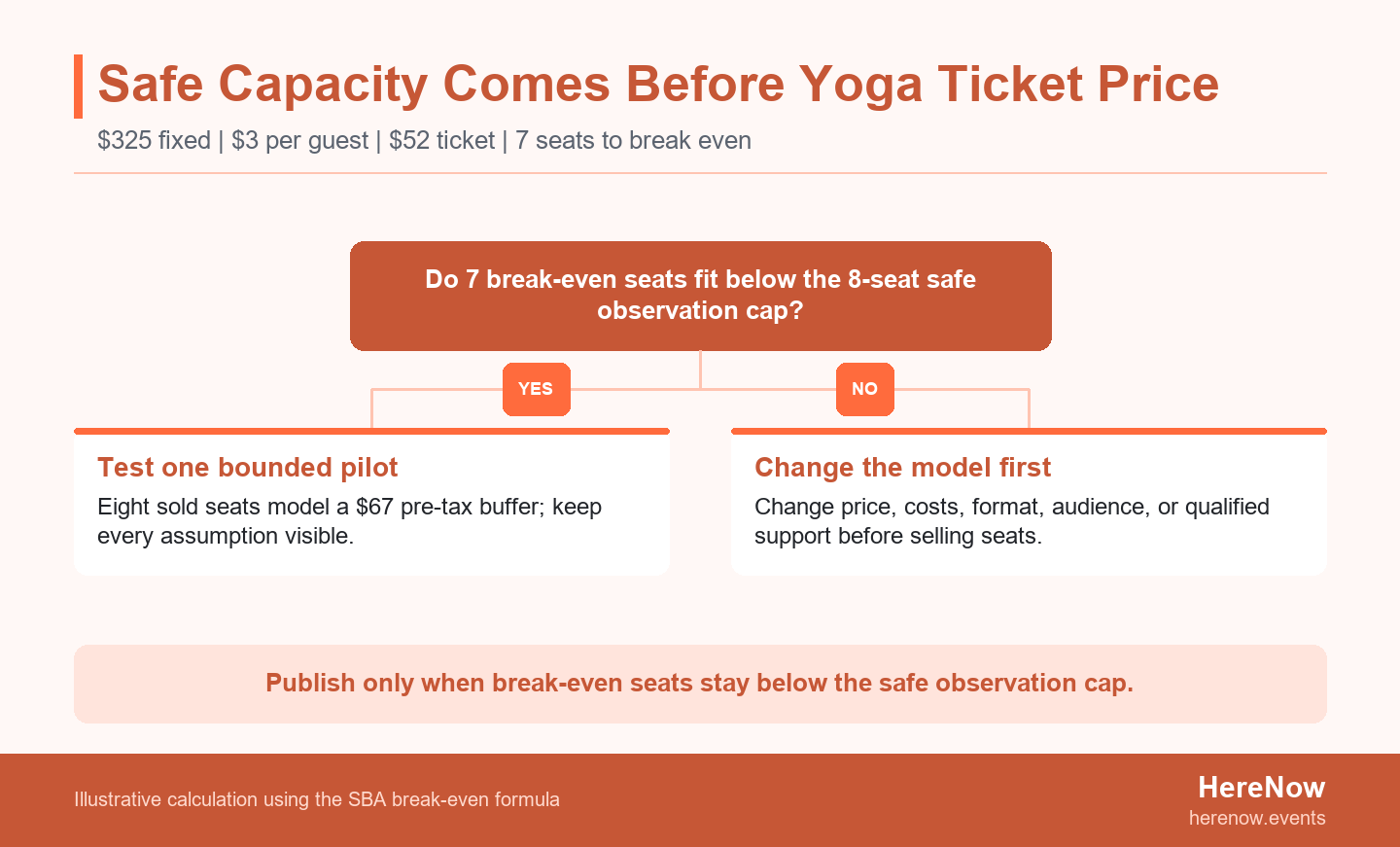
The calculation is $325 ÷ ($52 − $3) = 6.63, rounded up to seven sold seats. At eight seats, revenue is $416 and modeled total cost is $349. Use the workshop pricing calculator to replace these assumptions with your own.
Seven sold seats cover the modeled costs; eight seats leave a $67 pre-tax buffer. That is not a projected income figure: it excludes taxes, cancellations, unmodeled labor, and demand risk. The decision comes from comparing two thresholds. If safe capacity is eight and break-even is seven, the pilot has one seat of room for uncertainty. If safe capacity is six, the current model cannot break even safely. Change the venue cost, format, price, or offer; do not raise capacity past the delivery limit.
Build Safety, Choice, and Consent Into the Offer
Qualified instruction, beginner-appropriate practice, and individual modifications are part of a responsible yoga safety boundary. The U.S. National Center for Complementary and Integrative Health notes that yoga is generally considered safe for healthy people when performed properly under qualified instruction, while injuries can occur and some people or practices need additional caution. “Beginner-friendly” is therefore a design commitment, not a universal guarantee of suitability. Decide what information you need before class, what choices you can responsibly offer, and when to ask someone to seek appropriate professional guidance.
Use Choice-Based Teaching and Specific Consent
Physical adjustments require explicit informed consent, and event copy should not exaggerate credentials or yoga outcomes. Yoga Alliance's Code of Conduct addresses consent-based touch, active inclusion, accessible locations, harm prevention, and honest communications for its members, while its scope guidance separately connects touch with explicit informed consent. A simple first-event policy is no hands-on adjustment unless a clear, specific consent process is designed and the teacher is trained to use it. Consent to attend is not consent to touch, photograph, or record. Use verbal cues and demonstrations, normalize opting out, and describe choices as valid ways to participate—not as public labels for the person taking them. Keep marketing factual about training and the experience rather than implying a cure or guaranteed outcome.
Verify the Room, Emergency Plan, and Local Requirements
Environment evaluation, safety communication, privacy, insurance, and emergency readiness are professional group-exercise responsibilities. The ACSM group exercise instructor exam outline covers professional, insurance, and emergency duties, while the CIMSPA professional standard covers environment checks and safety communication. Neither can specify your local policy. Assign an owner to check access, floor condition, temperature, ventilation, exits, toilets, privacy, first-aid resources, emergency contacts, incident reporting, and venue rules. Verify what insurance and credentials are required and whether the venue expects its own emergency procedure. Walk the room using the actual layout and equipment. Any control with no named owner is still an unresolved risk, not an item to discover when guests arrive.
Write an Event Page That Filters for Fit
The event page should help a guest assess fit before registering. Lead with who the session is for and the practical after-class result. Then state the experience level, pace, session length, key movements or theme, options available, accessibility information, consent and recording policy, what to bring, what is provided, venue access, cancellation terms, and a contact path for questions or access needs. Name exclusions without diagnosing people: explain the boundaries of the session and invite someone who is unsure about suitability to seek appropriate professional advice.
Do not hide the most important fit details inside a long inspirational story. A guest should be able to scan the page and answer: Is this designed for me? What will happen? What choices do I have? Who is teaching, and what are their relevant qualifications? What will it cost? HereNow can turn the bounded yoga offer into a public page with the essential details in one place, and the registration flow can collect RSVPs without attendee accounts. The page supports trust, but the host remains responsible for accurate claims, screening decisions, and local compliance.
Run One Pilot to Test the Uncertain Part
A first pilot should test welcome, participant fit, and prepared modifications as well as attendance. The American College of Sports Medicine's guidance on group-exercise intimidation explains how unfamiliar settings, low confidence, or uncertainty about the format can make joining harder, and recommends greeting newcomers, learning their needs, and preparing modifications before class.
Choose the pilot according to the uncertainty. A free RSVP can test whether people understand the promise and will show up; a paid ticket tests the fuller proposition but introduces price and refund expectations. Decide whether to choose free RSVPs or paid tickets by separating those goals. Before inviting anyone, write down the evidence: registrations, show-up rate, fit questions, moments when sightlines failed, how often an unplanned alternative was needed, whether the timing held, and actual costs. Ask participants what felt clear, uncertain, or unsupported. A compliment is welcome, but it is not a capacity audit.
Repeat Only After Delivery Evidence Agrees
Repeat only when participant fit, delivery load, safety controls, and economics remain workable. Review the pilot in four columns: promise fit, observation load, safety and consent controls, and actual money. Repeat the same offer only if the intended participants arrived, the teacher could see and support the group, the controls worked in the real room, and the economics did not require exceeding safe capacity. Revise if one fix is clear; partner with another qualified professional if competence or support is missing; stop if the promise cannot be delivered responsibly. One successful class does not prove recurring demand. Keep the next run equally bounded, compare evidence over time, and let the event page and participant questions show what needs clarification. You can also read the HereNow story behind this focus on independent hosts and useful real-world events.
Use This Publish-or-Change Check
Publish only when competence, promise, capacity, economics, venue controls, and page details agree. If the teacher boundary fails, narrow the offer or find qualified support. If the observation cap falls below break-even, change the model. If the room or emergency ownership is unclear, resolve it or move venues. If a guest cannot assess fit from the page, rewrite before promotion. When all six conditions pass, create your small-group yoga event page and treat the first date as a measured pilot. The goal is not to prove that yoga knowledge can earn money at any cost; it is to find a small offer you can deliver honestly, responsibly, and well enough to deserve a second run.
Frequently Asked Questions
Do I need a yoga teacher certification to host a small-group event?
Knowing yoga as a participant is not enough by itself to teach a safe paid class; get appropriate training and verify local, venue, and insurance requirements. The exact credential or legal requirement varies by location, venue, audience, and the kind of instruction offered. Start by checking the recognized professional standards and rules relevant to you, then confirm them with the venue and insurer. If your experience does not cover the promised session, narrow it, partner with an appropriately qualified teacher, or do not offer instruction.
How many people should be in a first small-group yoga class?
Use the smallest number you can continuously observe, cue, and offer alternatives to, even when the room can legally hold more people. Test the real layout, transitions, lighting, props, participant experience level, and teaching support. The lowest limit becomes the cap. There is no single number that makes every yoga event safe; an eight-person cap in one simple, visible room may be too high for a more complex session or a room with poor sightlines.
Should the first yoga event be free or paid?
Use a free event to test participation friction or a paid pilot to test the complete offer, but label the experiment and success measure before inviting anyone. Free registrations can overstate demand because they do not test willingness to pay and may produce more no-shows. A paid pilot adds refund, payment, and price expectations. In either case, collect actual attendance, delivery-load, participant-fit, and cost evidence instead of judging the idea only by registration count.
Is one class or a short yoga series better for a first event?
Start with one class unless the promised result depends on practice between sessions and you can explain the progression, attendance policy, and full-series price clearly. A single session exposes the offer, room, teaching load, and guest questions with less commitment. Choose a short series only when progression is part of the honest promise and you have the competence, curriculum, capacity, and operational plan to support it across every date.