How to Turn Coffee Knowledge Into a Tasting Event
Turn coffee knowledge into a guided tasting with one observable result, a tested table cap, complete costs, and clear caffeine and ingredient notes.
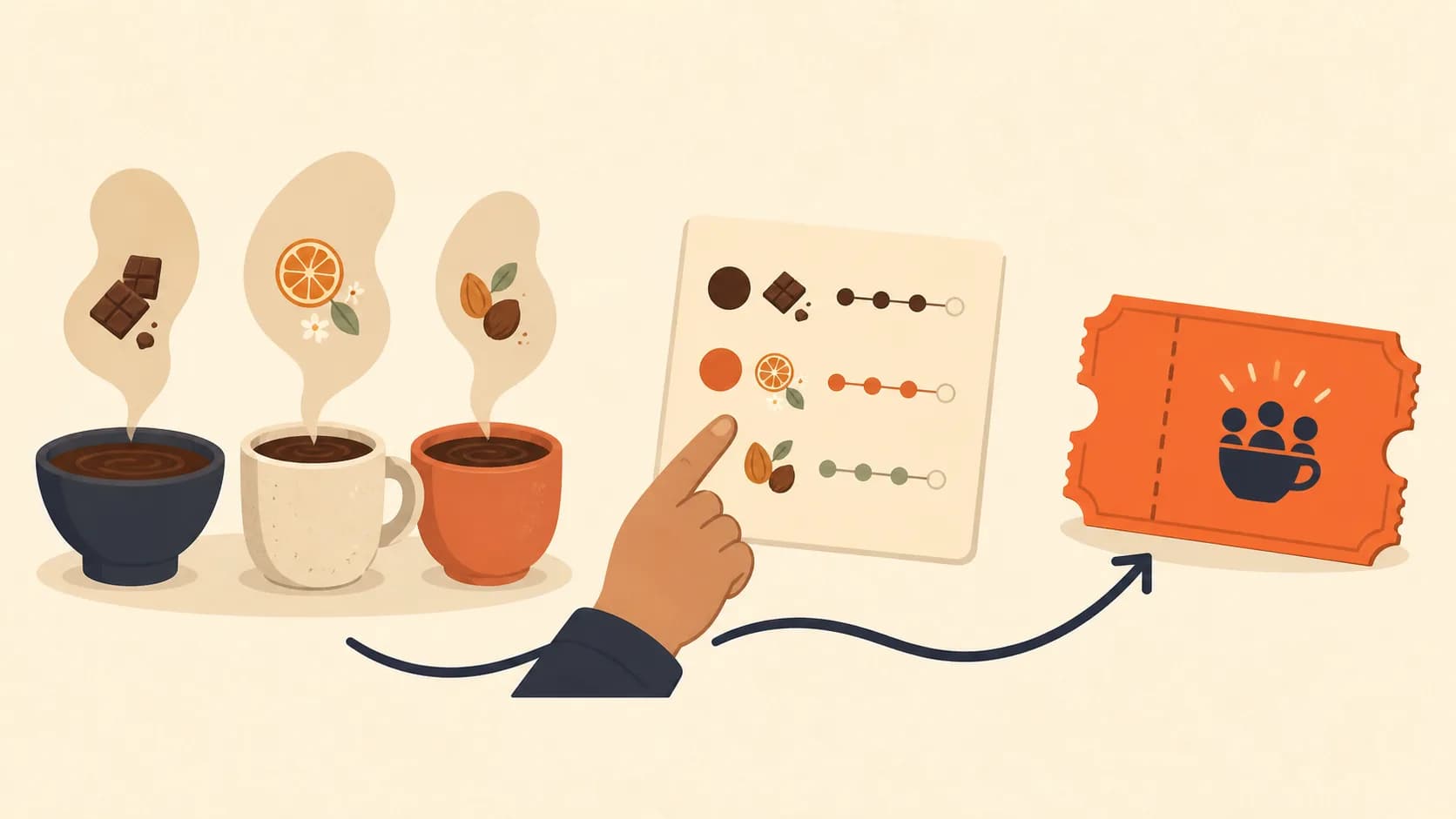
Coffee knowledge becomes a chargeable event when it produces a guided result that casual café conversation does not: guests compare the same coffees under controlled conditions, learn a usable tasting language, and leave able to notice one distinction for themselves. The beans are an input. The product is the host’s selection, setup, explanation, pacing, and feedback.
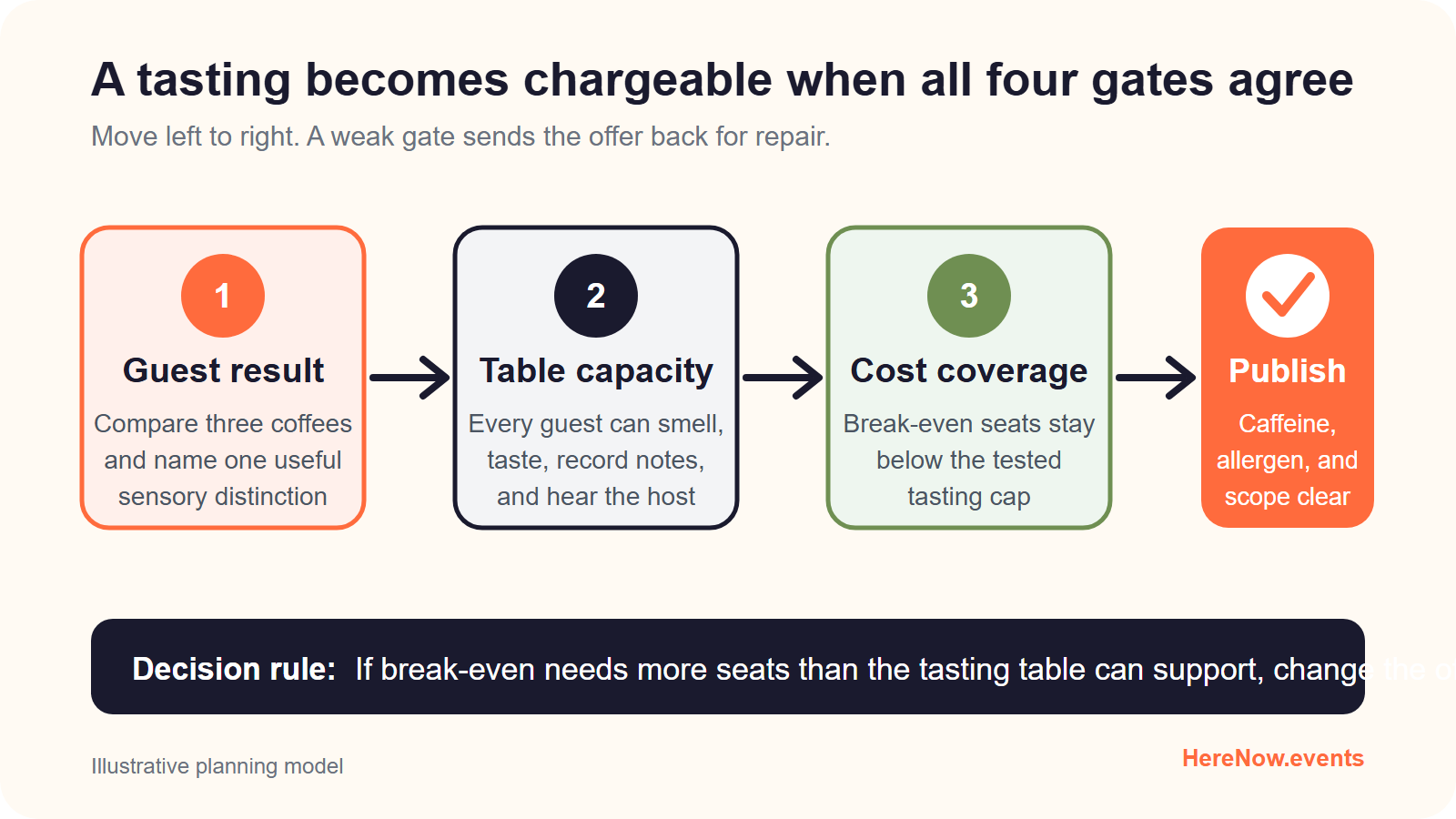
Start with a three-coffee result, not a promise to make beginners into professional cuppers. Test the table before pricing it. Every guest needs reliable access to aroma, tasting vessels, water, notes, and the host’s guidance. Then compare that table limit with break-even seats. If the numbers require more people than the tasting can support, change the offer rather than crowd the table.
Five Conditions Before a Coffee Tasting Is Worth Charging For
A responsible first offer aligns five conditions: a specific guest result, a tasting format suited to the audience, repeatable preparation, a table-sized capacity, and economics that work below that cap. Caffeine and dietary information must also be visible before purchase.
- Result: guests can describe what they will compare and what they should be able to do afterward.
- Format: a beginner tasting, structured cupping, or brewing comparison matches the host’s real competence.
- Table: every seat receives equivalent samples, clean tools, note-taking space, water, and audible guidance.
- Economics: break-even seats remain below the tested table capacity.
- Trust: caffeine, ingredients, allergens, accessibility, refunds, and host scope are stated plainly.
Turn Coffee Knowledge Into One Observable Guest Result
“Learn about coffee” is too broad to design or price. A stronger promise is: “Compare three coffees and leave with a simple method for distinguishing acidity, sweetness, and aftertaste.” That result controls the number of samples, the vocabulary, the pace, and the amount of individual attention. It also sets a fair boundary: the ticket does not include professional certification, green-coffee grading, roasting training, or an objective verdict about which coffee is best.
Use a Shared Vocabulary Without Turning the Event Into an Exam
The Specialty Coffee Association’s Coffee Value Assessment separates physical, descriptive, affective, and extrinsic assessment instead of reducing coffee to one score. A beginner event can borrow that distinction without claiming to deliver a formal assessment. Ask first what guests perceive, then whether they personally enjoy it, and only afterward add origin or processing information. This keeps description separate from preference and prevents the most confident voice at the table from defining everyone else’s experience.
The World Coffee Research Sensory Lexicon identifies 110 aroma, flavor, and texture attributes with reference standards. That depth is useful evidence that sensory language can be structured, but a first public tasting should use a much smaller vocabulary. Choose perhaps six accessible contrasts—citrus versus stone fruit, cocoa versus toasted grain, light versus heavy body—and make uncertainty acceptable. The guest result is better observation, not matching an expert answer key.
Sell the Facilitation You Can Reliably Deliver
A coffee enthusiast may be able to host a welcoming comparative tasting without presenting themselves as a Q Grader, roaster, green buyer, or sensory scientist. State the relevant experience you do have: regular home brewing, roastery work, café service, formal sensory training, or repeated tasting practice. Do not borrow a professional title you have not earned. If the promise depends on calibrated scoring, defect diagnosis, roast evaluation, or producer purchasing decisions, partner with an appropriately qualified professional or narrow the event.
The practical dividing line is whether you can repeat the setup, explain the comparison, manage the table, answer beginner questions within scope, and say when you do not know. HereNow’s coffee cupping execution guide covers equipment, dose planning, table flow, sanitation, and the 90-minute run of show after the commercial offer is clear.
Choose a Format That Matches the Audience and the Promise
Three formats cover most first pilots. They should not be marketed as interchangeable because they create different preparation loads and expectations.
| Format | Guest result | Main operating load | Best first use |
|---|---|---|---|
| Guided tasting flight | Compare aroma, flavor, body, and preference | Consistent brewing and clear prompts | Curious beginners in a café or community room |
| Structured cupping | Experience a repeatable professional-style sequence | Grinding, water, timing, crust breaking, spoons, and sanitation | Guests who specifically want the cupping process |
| Brewing comparison | See how one variable changes the cup | Parallel equipment, recipes, and service timing | Home brewers with a defined equipment baseline |
A guided flight is usually the easiest paid pilot because guests can focus on the sensory distinction while the host controls preparation. Structured cupping can be compelling, but it creates more vessel, spoon, water, grinder, sanitation, and explanation work. A brewing comparison is valuable only when the variable is genuinely controlled. Changing coffee, grind, water, ratio, and brewer at once produces theatre rather than a useful lesson.
Design the Tasting Table Before Setting Capacity
A room may legally hold forty people while one host can run a fair tasting for ten. Capacity is the lowest limit among equal sample service, aroma access, spoon or cup sanitation, water delivery, waste handling, note-taking space, host audibility, and feedback. Map the complete movement of grounds, water, vessels, spoons, samples, guests, and used equipment. Then rehearse with the real table.
For each seat, verify that the guest can reach or receive the same coffees in the same sequence without queuing through another person’s space. Time grinding, brewing, cooling, explanation, tasting, rinsing, questions, and reset. If the host must prepare the next flight while guiding the current one, split the work or simplify the format. A co-host only adds capacity when their preparation, service, sanitation, and teaching roles are explicit.
The SCA’s guidance on the Coffee Taster’s Flavor Wheel begins with mindful tasting and moves from broad descriptors toward specific ones. Build the table around that cognitive sequence. Give guests time to smell and taste before showing detailed origin notes or another person’s descriptors, which can bias what they report.
Price the Experience Below the Table Limit
Model fixed costs, per-guest costs, host time, fees, and a contingency before choosing a ticket price. Fixed costs may include venue, equipment transport, preparation time, event delivery, cleanup, insurance, and a co-host. Variable costs may include coffee, water, tasting cups, filters, printed sheets, palate cleansers, and a small take-home sample.
The U.S. Small Business Administration expresses break-even units as fixed costs divided by price minus variable cost per unit. Treat it as an estimate, not a profit guarantee.
| Illustrative input | Amount |
|---|---|
| Fixed costs, including host time | $180 |
| Variable cost per guest | $9 |
| Ticket price | $39 |
| Tested table capacity | 8 guests |
The calculation is $180 ÷ ($39 − $9) = 6 sold seats. Six tickets produce $234 of revenue against $234 of modeled cost. Eight tickets produce $312 of revenue against $252 of modeled cost, leaving a $60 pre-tax buffer. The buffer is not predicted profit; it can disappear through refunds, breakage, extra prep, tax, or a missed cost. Replace every assumption in the workshop pricing calculator.
A current public workshop can provide a market reference without becoming your price. Pacific Coffee Research listed a two-hour introduction to cupping at $50 with cupping forms and flavor-wheel instruction. That single offer reflects its place, host, date, audience, inclusions, and currency. Use comparable events to understand guest expectations, then price your own cost structure and promise.
Publish Caffeine, Ingredient, and Participation Boundaries
Coffee tasting is a food-and-beverage event. Ask the venue what food-service, sanitation, insurance, and licensing conditions apply to a ticketed event. Confirm whether outside beans, water heating, milk, flavor references, baked goods, or retail samples change the rules. Requirements vary by jurisdiction and venue, so no global checklist can replace that verification.
The U.S. Food and Drug Administration says that for most adults, 400 milligrams of caffeine per day is not generally associated with negative effects, while sensitivity varies and some conditions or medications change the advice. A tasting page should not estimate an exact caffeine dose unless the coffee, recipe, serving volume, and evidence support it. Instead, state the number of coffees, approximate tasting volume, whether decaf or water-only participation is possible, and that guests may taste lightly or decline any sample.
List milk, plant drinks, sweeteners, palate cleansers, food pairings, and any known major allergens. Do not describe a shared table as allergen-free when cross-contact is possible. Provide clean water, a clear discard option, seating or breaks where possible, and a way to request access information before booking. Keep the sensory atmosphere welcoming: slurping may be demonstrated as a technique, but it should not be mandatory.
Write an Event Page That Makes the Value Visible
The page should answer the purchase decision before telling a long origin story. State who the tasting is for, the three-coffee result, format, duration, capacity, venue, caffeine note, ingredients, what is included, and the host’s relevant scope. Show whether the event is educational, social, professional, or a mixture. Explain whether guests receive beans, forms, brewing recommendations, or follow-up notes.
- Name the coffees or selection principle without promising exact stock that may change.
- Describe the sequence: welcome, sensory prompt, tasting, comparison, and close.
- State experience level, language, seating, standing, scent considerations, and access contact.
- Publish ticket inclusions, cancellation terms, caffeine and ingredient information, and any age rule.
- Describe credentials accurately and avoid certification, health, or income claims.
Use the Neighborhood Coffee Cupping Club template to shape the agenda and registration fields after the real table has been tested. Check current platform and paid-ticket terms on HereNow pricing and include fees in the model.
Run One Paid Pilot and Measure the Complete Offer
A paid pilot should test one named uncertainty while delivering everything promised. The uncertainty might be whether beginners can use the chosen vocabulary, whether eight guests can taste without queuing, or whether the host can prepare three coffees and still facilitate. Record registrations, attendance, sample waste, preparation time, table delays, questions, actual costs, refunds, guest understanding, and host energy.
Repeat the same offer only when guests received equivalent samples, the learning result was visible, the table stayed clean and calm, actual contribution worked below capacity, and the host could answer within scope. Revise when one repair is clear. Partner when professional sensory instruction or venue operations exceed your competence. Stop when the price requires a crowd that removes comparison access or guidance.
Review the Pilot With Evidence, Not Compliments
Positive comments are encouraging, but they do not show which part of the offer worked. Compare the published promise with observable behavior: Could guests identify the intended contrast without being led to the answer? Did every person receive the same coffee at a useful temperature? How long did setup, grinding, brewing, serving, clearing, and follow-up actually take? Recalculate the contribution with real waste and labor rather than the estimate. Then change one variable for the next date—such as the number of coffees, the preparation method, the cap, or the duration—so the second event produces evidence you can interpret. Keep the title and core result stable while testing that repair.
Also separate a service failure from a teaching failure. If cups arrived cold or late, repair preparation and flow before rewriting the lesson. If service was consistent but guests could not explain the comparison, simplify the sensory prompt or reduce the flight. This distinction prevents an operational problem from being disguised as a content change.
Use This Publish-or-Repair Check
Publish when the result is specific, the format matches the host, the preparation is repeatable, every seat works at the table, break-even stays below capacity, and caffeine and ingredient details are visible. If those conditions agree, create your coffee tasting event page. If one fails, repair it before selling tickets; presentation cannot compensate for an experience the table cannot deliver.
Frequently Asked Questions
Do I need to be a certified coffee professional?
No, not for every beginner tasting, but the promise must stay inside your demonstrated competence. An enthusiast can facilitate a comparative experience and explain a bounded method without claiming professional calibration, grading authority, or certification. State your relevant experience honestly. If guests are paying for formal sensory training, commercial quality evaluation, roast diagnosis, or a credential-linked outcome, work with an appropriately qualified educator or narrow the offer.
How many coffees should a beginner tasting include?
Three coffees are often enough to create contrast without overwhelming a first-time guest, but the correct number depends on the format, serving size, caffeine plan, preparation capacity, and session length. More samples do not automatically create more value. Use the fewest coffees needed to make the promised distinction visible, then leave enough time for smelling, cooling, tasting, notes, comparison, water, and questions.
Can a coffee tasting include milk or food pairings?
Yes, when they support the stated result and the venue permits them. Milk, plant drinks, sweeteners, baked goods, and flavor references add ingredients, allergens, cross-contact questions, service time, and cost. List them before purchase, keep the black-coffee comparison separate when that matters, and avoid an allergen-free claim unless the complete environment and process justify it.
Should the first coffee tasting be free or paid?
Use a free gathering to test interest or table mechanics, and a paid pilot to test the complete promise, price, and guest expectations. Name the uncertainty first. Free attendance does not prove willingness to pay, while a paid ticket adds trust, refund, and inclusion expectations. In either case, measure actual attendance, preparation load, service delays, learning result, waste, and total host time.