How to Make a Small Event Feel Professional
A guest-first guide to creating a professional small-event experience with a clear promise, calm arrival, visible rhythm, and intentional close.
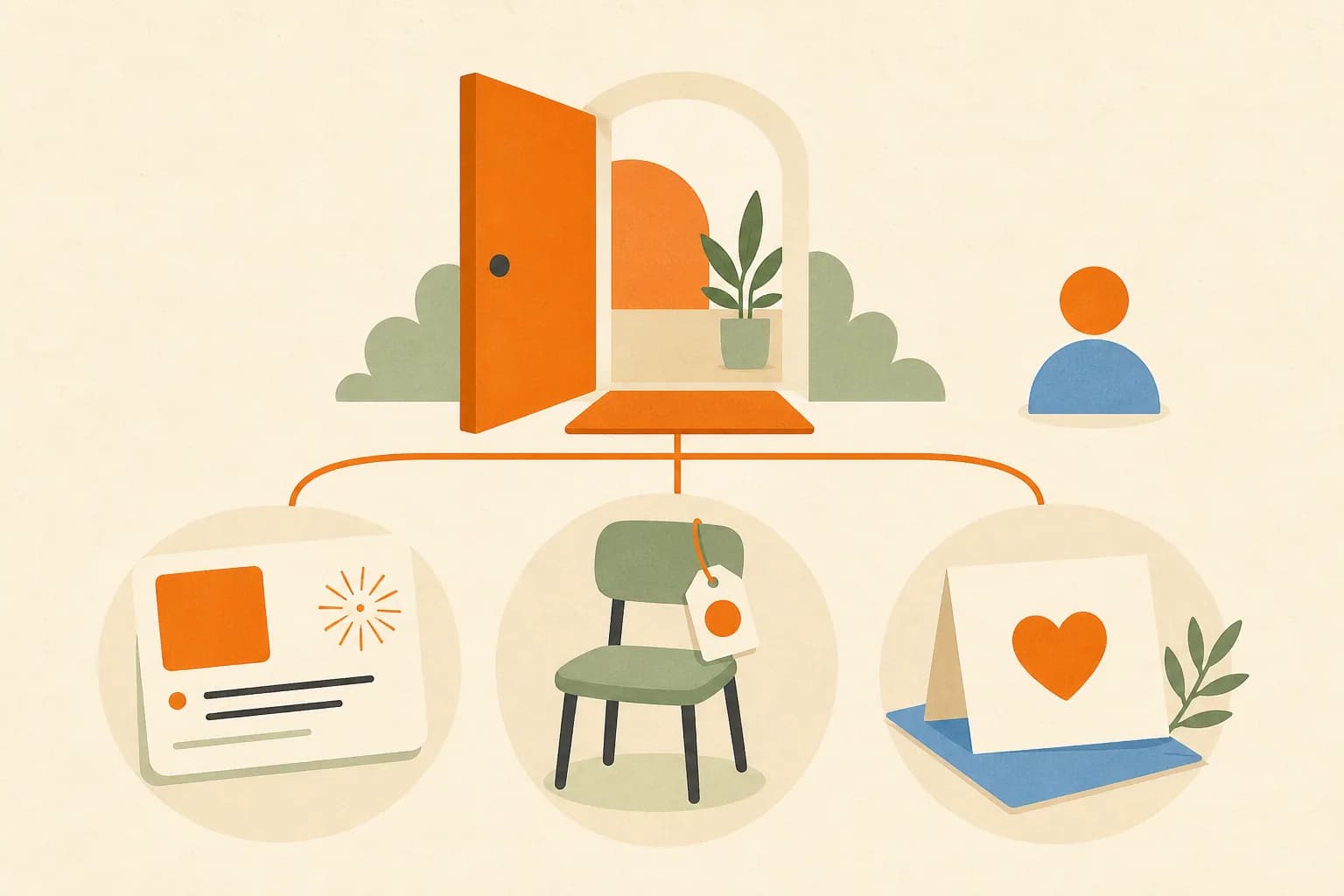
A small event feels professional when guests can tell what they are joining, arrive without awkward detective work, and trust that someone is holding the room. That does not require a stage, a large budget, or a production crew. It requires a few deliberate signals: a precise promise, practical information, a calm welcome, a visible rhythm, and a close that respects the time people gave you.
Workshops, dinners, classes, walks, clubs, salons, and meetups can all feel intentional when the guest path is clearer than the production around it.
Key Takeaways
- Professional is a clarity standard, not a decoration budget.
- Guests notice the promise, the threshold, the handoffs, and the ending more than extra production.
- Write the public page as an operating document, not only as promotion.
- Give every helper one shared answer for timing, arrivals, and changes.
- Finish the current event before asking guests to take another action.
Professional Is a Guest Experience, Not a Production Budget
A professional event is clear, reliable, and well-held for guests. Guests do not grade it by whether it resembles a large venue. They notice whether the invitation matches the room, whether the next step is obvious, and whether small changes are handled with care. A University of Gothenburg study on event quality, perceived value, and satisfaction examines those relationships in an event context. It does not prove that any particular workshop will make guests return, but it supports a useful host principle: the quality of an experience is broader than spectacle.
For a small host, professionalism is coherence. The tone on the page should match the room. The start time should mean something. The host should know what happens if someone arrives late. A guest should never have to wonder whether they are in the right place or whether they are bothering someone by asking a basic question. Those details make a modest gathering feel held.
That distinction also protects your budget. Spend first on the parts that help a guest participate: enough seating, readable directions, a working check-in path, the materials your format truly needs, and time to welcome people. The HereNow Host Guides can help you plan the surrounding page, RSVP, and format decisions. Do not buy visual polish to cover an unclear promise.
Start With One Promise You Can Deliver Calmly
A professional event begins with a promise narrow enough to keep. “An evening of community” is a mood, not an outcome. “A two-hour beginner pottery session where each guest makes one small cup” tells people what they will do, who the event fits, and what success looks like. The University of Nebraska Omaha’s event planning checklist starts with the event purpose, why attendees are invited, and what they should take away. Those questions are just as useful for twelve guests as for a campus program.
Make the promise operational by answering four things before you promote: the person this is for, the change or activity they can expect, the actual time boundary, and the level of participation required. You can then say no to additions that make the event harder to run. A long speaker list, extra networking hour, or elaborate menu is not automatically more professional if it makes the original promise less clear.
A Small Language Exchange Can Feel More Considered Than a Bigger Mixer
Imagine a 16-person language exchange in a neighborhood cafe. The vague version says, “Meet new people and practice languages.” The professional version says, “A guided 90-minute English and Spanish exchange for conversational beginners. We start with paired prompts at 6:30, rotate once at 7:05, and close with a shared resource list at 7:45.” It tells guests that coming alone is normal, what level is welcome, when the structured part starts, and what happens after arrival. The host only needs name cards, two prompt sheets, a visible start time, and a way to guide the rotation. Nothing about that setup is expensive. It is simply specific enough for guests and helpers to act on.
Use the same test for any format: could a first-time guest describe the outcome to a friend after reading one paragraph? If not, tighten the promise before you choose decor, promotion channels, or an ambitious agenda. The same focus on ordinary, real-world gatherings sits at the heart of HereNow's host mission. Read the HereNow story.
Make the Public Page Do the Quiet Work
Your public event page should answer the questions guests are often reluctant to ask: Can I come alone? Where is the actual entrance? When do doors open? What do I bring? Is this a class, a conversation, or an unstructured social hour? City of Edinburgh guidance for event organizers includes attendee engagement, arrival and departure information, and expectation-setting in its communications planning. That guidance serves larger public events, but the small-host lesson is direct: say what happens at the threshold.
Write the details in the order a guest needs them. Lead with the outcome and audience. Follow with the date, start and finish time, venue or joining link, cost, and RSVP decision. Then add the practical notes that alter a person’s choice: stairs, weather, food, supplies, accessibility details, parking, camera use, or a late-arrival plan. You are not making the page longer for its own sake. You are reducing private messages and pre-event uncertainty.
Review It From the Sidewalk, Not From Your Desk
Before publishing, pretend you have never visited the venue and do not know the host. Can you find the door, recognize the room, and know what to do at 6:22 if the event starts at 6:30? Can you tell whether you may join alone? Can you decide whether the format suits your energy and access needs? A page is professional when it gives real answers, not when it uses formal language.
Preview the page on a phone, where many guests will first see it. Look for the first action a reader can take and for information that is buried below a decorative image or generic introduction. The HereNow preview and publish guide is useful for that final guest-eye check. Update the public page when a practical detail changes instead of assuming every RSVP will see a separate message.
Design for More Than the Most Confident Guest
A professional welcome gives people a way to participate without first proving that they belong. The W3C’s event accessibility checklist asks organizers to plan for different access needs, use clear information, and invite participants to share requirements. You do not need to promise facilities you cannot provide. You do need to describe what you know and make it possible for someone to ask early.
Put usable details on the page: stairs or step-free access, seating, light and sound conditions, expected movement, restroom availability, whether the session has breaks, and how guests can contact you before the event. Choose participation options that do not force public speaking as the only way in. A written prompt, a pair activity, a quieter corner, or a brief orientation can be the difference between “I was invited” and “I could actually join.”
Make Arrival Feel Like the Event Has Already Begun
Professionalism is most visible at the first point of friction. The UK Health and Safety Executive separates arrival and entry, on-site circulation, and departure when describing event crowd controls. A small class is not a crowd-management operation, but the three-part arrival-to-departure lens is a practical reminder: guests need a clear route into the event, a clear place to settle, and a clear way to leave.
Walk the guest route before doors open. Stand at the street, parking area, elevator, or first doorway. Check whether the event name is visible, whether a guest can tell which door to use, and whether they know where to put a coat or bag. If people will queue, say what the queue is for. If the activity starts after a short welcome, write that down. A calm arrival does not require a receptionist; it requires one visible answer at each small decision point.
Give Every Helper a Short Brief They Can Use
One assistant, venue manager, or friend can make a small event feel much more reliable when they know the same version of the plan. Dover District Council’s event communication guidance emphasizes unambiguous language, clear labels, and knowing who is responsible for specific tasks. Translate that into a simple five-line helper brief: who welcomes, where late arrivals go, when the main activity starts, how a change is announced, and who decides when something unexpected happens.
Keep the brief in verbs. “Welcome guests, point them to the table, and tell them we begin at 7:05” is useful. “Make it feel warm” is not a handoff. Give helpers the public page URL and ask them to flag any mismatch they spot. For hosts building this kind of repeatable practice, HereNow for independent event hosts connects the guest-facing page, RSVP, and hosting workflow around the same promise.
Use a Simple Rhythm Instead of Filling Every Minute
A tight, understandable agenda feels more professional than a packed one. Let guests know when the event has begun, what the main activity is, when a transition is coming, and what the close will look like. You can say this aloud, place it on a small sign, or write it on the page. The point is not perfect timing. It is that people know whether the room is waiting, starting, taking a break, or moving on.
Bradford Council’s event-planning guidance describes information as key at an event and recommends sufficient signage designed with users in mind. The guidance addresses public events, but the communication principle travels well: use a small number of clear, visible cues rather than making guests hunt for instructions. A welcome card, a start-time note, and a materials label can do more than a wall of decorative copy.
Protect One Main Moment
Choose the part of the event that must work for the guest to feel the promise was kept. In a workshop, it may be the time they actually make or practice something. In a dinner, it may be the first table conversation. In a community walk, it may be the guided first stop. Protect that moment from late setup, long introductions, private host conversations, and extra activities that steal attention.
Build the rest of the agenda around it: welcome, orient, do the main thing, and close. HereNow’s event templates can give you a familiar starting structure, but adjust the timing to the actual room and the outcome you promised. The best agenda is not the fullest one. It is the one that lets the important part land without guests wondering whether they missed it.
Close With Care, Then Learn One Useful Thing
A professional ending tells people what was completed and what, if anything, happens next. The HSE notes that a simple checklist may be enough for small-scale events and recommends a debrief after an event to listen to problems and successes. Its context is event safety rather than guest hospitality, but the small-event checklist and debrief principle is a good operating habit: finish intentionally, then improve one real point.
Thank guests, deliver any resource you promised, and make the departure path clear. If you want feedback, ask one question that has a decision waiting behind it: “Was the arrival information enough to find us without messaging?” or “Would you rather have ten more minutes to practice?” Avoid turning the first thank-you into a hard sell for the next event. Guests should feel the present event was complete before they are asked to choose another one.
Use the Professional Signals Map Before You Spend More
When a small event feels underpowered, hosts often reach for more: more decor, more speakers, more activities, more promotional language. Review the basic signals first. If the promise is unclear, extra production makes the confusion more expensive. If arrival is awkward, a beautiful room cannot erase the first five minutes. If the close feels abrupt, a generous gift bag may not repair it.
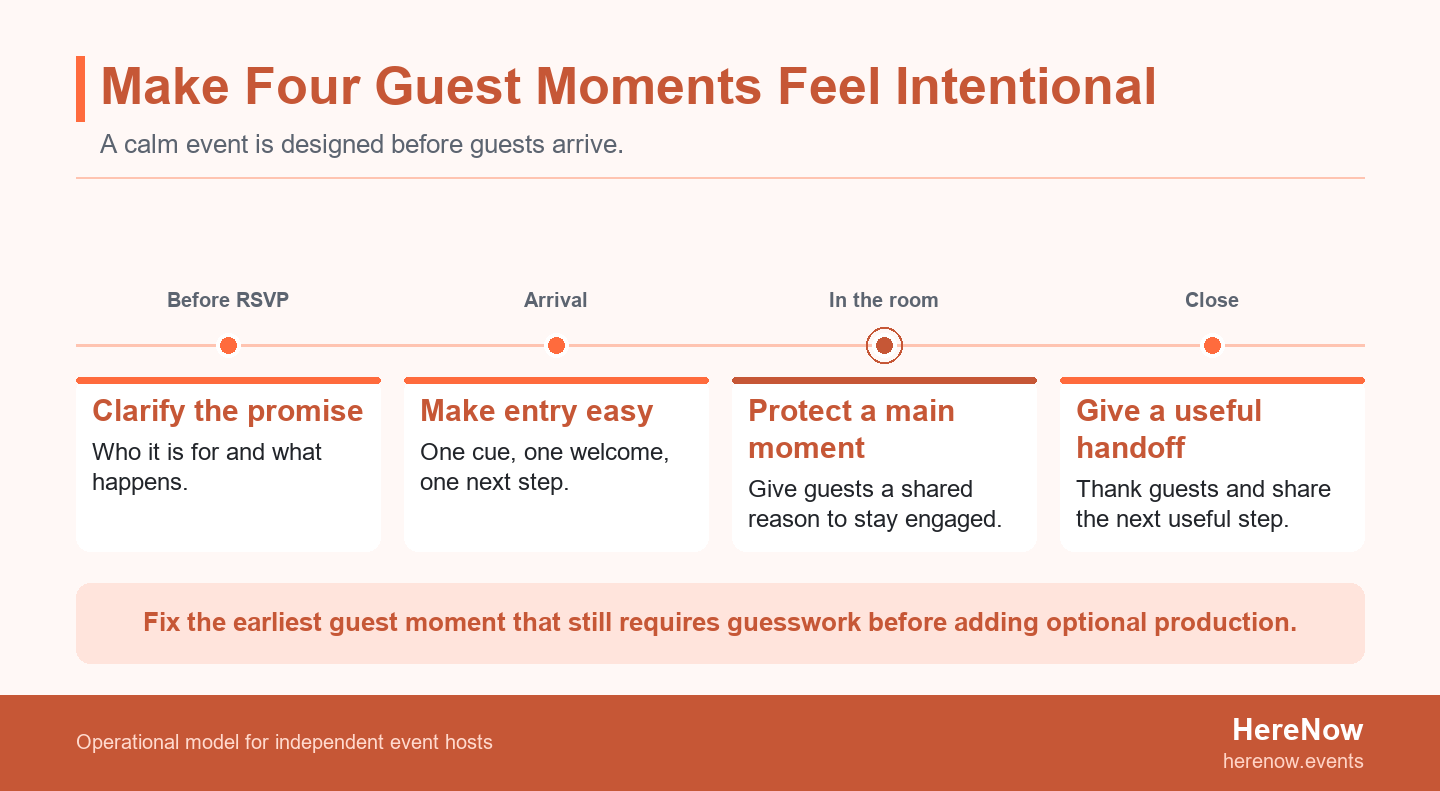
| Guest moment | Professional signal | Low-cost host move |
|---|---|---|
| Before RSVP | A specific outcome and honest fit | Write one sentence for who the event is for and what they will do. |
| At arrival | A clear next step | Use one entrance cue and one welcome instruction. |
| During the room | A visible rhythm and participation route | Name the main moment and offer a low-pressure way in. |
| At the close | A completed experience | Send what you promised and ask one useful question. |
Use this map to make one improvement per event. You will build a stronger hosting system by repeating small reliable choices than by designing a different production from scratch each time.
Turn the Plan Into a Guest-Ready Event Page
HereNow helps independent hosts turn a rough idea into an editable public event page and RSVP flow without asking guests to create an account. Use the page as the source of truth for the promise, arrival details, timing, and any update that affects the guest experience. A clear page does not make an event professional by itself; it gives your real-world care somewhere consistent to live before people arrive.
If you are planning the next gathering now, keep the Professional Signals Map beside you. Put the outcome, arrival plan, main moment, and close into the page before you promote it. That gives guests a more coherent first impression and gives you a calmer event to run. start your event page.
Frequently Asked Questions
What makes a small event feel professional to guests?
A small event feels professional when the promise is clear, arrival is easy, the room has a visible rhythm, and the ending feels complete. Guests do not need luxury production to feel cared for. They need accurate information, a confident welcome, and a host who has made the next practical step easy to understand. Start with those signals before adding optional extras.
Do I need a large budget to make an event feel professional?
You do not need a large budget because guests first notice accurate information, an easy arrival, suitable materials, and a host who is ready. A larger budget can help with some formats, but it cannot replace an honest promise, readable directions, enough seating, appropriate materials, and a plan for arrivals. Then use simple operational touches such as a clear start time, labeled materials, a helper brief, and a deliberate close to make the experience feel reliable.
How far in advance should I send event details?
Share essential information on the public page before someone RSVPs, then repeat only what is useful close to the event. A guest should not have to wait for a reminder to learn the venue, start time, what to bring, or whether they can attend alone. Send any changed information promptly and keep the source of truth easy to find on a phone.
What should I do if I am hosting alone?
When you host alone, choose a format you can hold without splitting your attention across too many tasks, handoffs, and guest questions. Simplify the agenda, make the arrival instruction visible, and ask one trusted person or venue contact to cover a specific handoff if needed. A solo host can run a professional event by narrowing the promise and making the guest path predictable, not by trying to do every role at once.