How to Create an Event Agenda
A practical agenda framework that turns an event idea into timed blocks, transitions, support moments, and a guest-ready flow.
An event agenda is both a guest promise and a host operating plan. The public agenda tells people what kind of experience they are joining before they register. The private run sheet tells the host how to move the room from arrival to a useful close. A good agenda starts with the outcome, protects the main activity, builds in transition time, and gives guests enough detail to feel oriented without exposing every backstage task.
Key Takeaways
- Start with the event outcome, then work backward into agenda blocks.
- Separate the guest-facing agenda from the host's private run sheet.
- Use a beginning, middle, and close even for casual gatherings.
- Add buffer for arrival, transitions, questions, breaks, access needs, and cleanup.
- Match agenda detail to event risk, price, guest uncertainty, and participation level.
- Publish enough agenda detail to reduce hesitation on the event page.
Start With the Outcome, Not the Clock
Many hosts start an agenda by filling time: 6:00 welcome, 6:10 introduction, 6:20 activity, 7:30 questions. That can work later, but it is not the best first move. First decide what guests should have made, learned, decided, practiced, discussed, or felt by the end. The outcome gives every agenda block a reason to exist.
The outcome decides what gets time
If guests should leave with a finished object, the agenda must protect making time. If guests should make a decision, the agenda must include enough framing, comparison, and decision space. If guests should meet people, the agenda must include low-pressure ways to talk, not only a lecture. Stanford Teaching Commons notes that learning activities matter because students need to actively participate and engage in different ways. For small events, that means the agenda should make the guest action visible. Time should go to what guests came to do, not to everything the host knows.
The agenda should make the promise testable
A public event promise like "learn the basics of pottery" is hard to evaluate. A promise like "make and decorate one small pinch pot" is easier to turn into agenda blocks: arrival, clay basics, demo, hands-on making, decorating, questions, drying and pickup instructions, close. If an agenda block does not move guests toward the stated outcome, it may belong in a future event, a follow-up email, or the private host notes. This is how the agenda prevents scope creep. The test is whether a guest can see how each block earns its place.
Separate the Public Agenda From the Private Run Sheet
The public agenda is for guest confidence. It should be short, readable, and tied to the experience. The private run sheet is for operations. It can include setup tasks, supply checks, private reminders, safety notes, backup plans, cleanup, and exact timing. Mixing them creates a page that feels cluttered while still leaving the host underprepared.
The public agenda answers "what will happen?"
The public version belongs on the event page. It should tell guests the flow in plain terms: welcome, short demo, hands-on making, questions, share-out, close. This is especially important when the event involves unfamiliar people, payment, materials, movement, food, or a beginner learning curve. OPM plain language guidance recommends using headings, white space, and tables to make complex information easier to understand. The same principle applies to agenda presentation: guests should be able to scan the schedule and understand the shape of the experience. A clear agenda is page copy, not only scheduling.
The run sheet answers "what must the host remember?"
The run sheet can be much more detailed. It may include when to unlock the venue, where to place supplies, who checks the registration list, when to test audio, when to label food, what to do if a guest arrives late, and how cleanup will work. The host does not need to memorize these tasks. A run sheet turns the event into a sequence of decisions made before the room gets noisy. The more moving parts the event has, the more useful the private run sheet becomes.
| Public agenda | Private run sheet |
|---|---|
| Arrival and welcome | Open doors, check RSVP list, set music, place signs, greet early arrivals |
| Short demo | Prepare demo station, keep backup materials nearby, mention safety note |
| Hands-on activity | Walk the room every 10 minutes, help beginners first, monitor supply levels |
| Share-out and close | Take final questions, mention follow-up, collect materials, record observations |
Use Five Core Blocks for Most Small Events
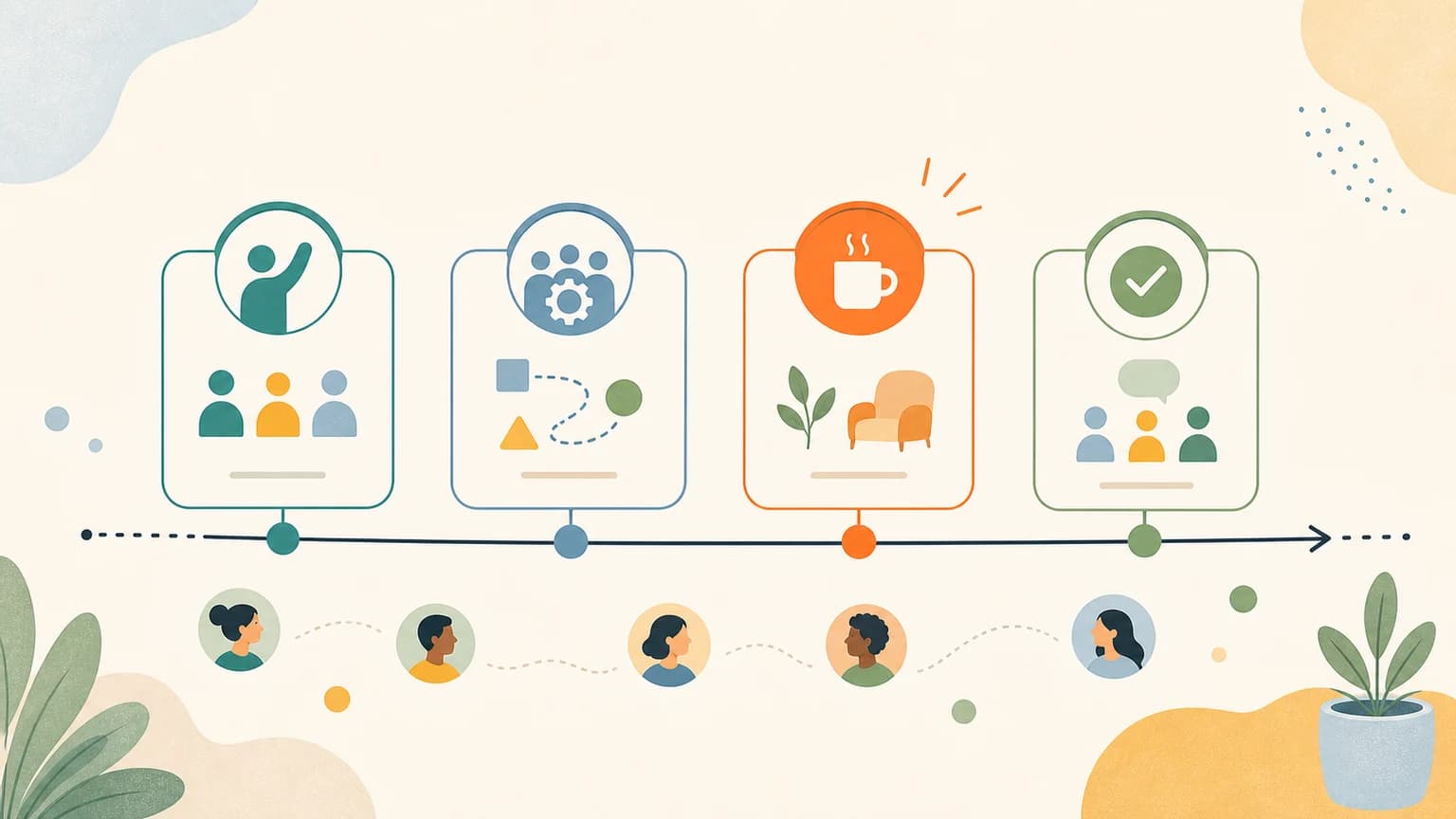
Most workshops, classes, dinners, salons, walks, tastings, and community meetups can be built from five core blocks: arrival, orientation, core experience, reflection, and close. The names can change. The jobs should not.
Arrival and orientation create psychological safety
Arrival is the first few minutes when guests decide whether they understand the room. Give them something simple to do: check in, choose a seat, pick up materials, write a name tag, get tea, or answer a low-pressure prompt. Orientation comes next. Explain what will happen, how participation works, what guests should do if they need help, and how the event will end. This is not filler. It reduces social uncertainty, especially for first-time guests, paid participants, and people entering a room where they do not know anyone. A calm start makes participation easier later.
The core experience should get the best time and energy
The core block is the reason people came: making, learning, practicing, discussing, tasting, walking, networking, or deciding. Protect it from long introductions. If the event is a workshop, guests should start doing the main activity early enough to recover from mistakes. If the event is a discussion, the room needs enough time to move beyond first answers. If the event is a tasting or dinner, pacing matters because guests experience value through sequence. Do not let announcements consume the time that should belong to the promise. The main activity deserves the cleanest energy of the session.
Reflection and close make the event feel complete
Small events often feel more valuable when guests have a moment to name what happened. Reflection can be a share-out, Q&A, gallery walk, closing circle, written note, or one-sentence takeaway. The close should explain what happens next: pickup instructions, a link, a follow-up email, the next session, or a simple thank-you. Without a deliberate close, a good event can fade out awkwardly. The final five minutes are part of the experience, not leftover time. They turn activity into memory, appreciation, and next action. Hosts should plan the close before event day, because tired rooms rarely create good endings by accident.
Match Agenda Detail to Risk, Price, and Guest Uncertainty
Different events need different agenda depth. A casual free meetup may need a light public agenda. A paid beginner workshop needs more detail because guests are judging value, comfort, and readiness before they buy. A professional salon needs clarity about discussion format and preparation. A food, movement, outdoor, or accessibility-sensitive event needs details that help people decide whether the room works for them.
Paid or unfamiliar events need more agenda proof
When a guest pays, travels, brings materials, or joins people they do not know, the agenda carries trust. It shows what the ticket or commitment includes. It also lowers the chance of mismatched expectations. A paid candle workshop might publish a six-part agenda with demo, scent selection, pouring, decorating, questions, and care instructions. A free neighborhood coffee meetup might publish three blocks: arrival, introductions, group conversation. Both are valid because the agenda depth follows the decision risk. More uncertainty calls for more visible structure and clearer expectations. Less risky, familiar events can stay lighter without feeling underplanned.
Safety and accessibility details change the agenda
Accessibility and safety are not separate from timing. Harvard's guidance on planning accessible meetings and events recommends building accessibility in from the front end, and Cornell's accessible event checklist gives concrete examples such as parking, ramps, elevators, accessible bathrooms, and barrier-free pathways. If the venue takes time to navigate, arrival needs more buffer. If the activity involves tools, heat, stairs, food, scent, movement, or a walk route, the agenda needs orientation and safety notes before the core activity begins. Do not hide those details until after registration. Guests need that context before they decide.
Build Timing With Buffers, Not Wishful Thinking
Most first agendas fail because they assume perfect transitions. Guests arrive late, questions take longer than expected, materials need resetting, people need breaks, and hosts need time to move between roles. Buffer is not wasted time. It is how the event protects the promise when real people behave like real people.
Use a simple buffer rule
For a 90-minute to two-hour small event, reserve 10 to 15 percent of the total time for transitions and recovery. In a two-hour workshop, that means 12 to 18 minutes spread across arrival, questions, setup changes, and close. If the event involves food, movement, children, accessibility needs, complex materials, or a venue with tricky access, add more. This is an illustrative planning rule, not a universal law. The point is to make the agenda honest enough that the main activity does not collapse when one block runs five minutes over.
Design for the energy curve
Agenda timing is also about energy. Arrival should be easy. Orientation should be clear but short. The main activity should begin before attention drops. If the event is longer than two hours, include a break or a low-intensity shift. Reflection should happen before everyone is packing bags. The close should be decisive. A good agenda has rhythm: welcome, focus, activity, release, closure. If every block asks for high attention, guests get tired. If every block is loose, the event feels under-hosted. Use the energy curve to decide where to simplify.
Example: Two-Hour Beginner Workshop Agenda
Here is a guest-facing agenda for a two-hour beginner workshop. Notice that it gives enough structure to reduce uncertainty without revealing every private host task.
| Time | Guest-facing agenda | Host purpose |
|---|---|---|
| 0:00-0:10 | Arrival and welcome | Settle the room and reduce awkwardness |
| 0:10-0:20 | What we are making and how the session works | Orient guests and set expectations |
| 0:20-0:35 | Short demo | Show the process before people start |
| 0:35-1:25 | Hands-on workshop time | Deliver the main value of the event |
| 1:25-1:45 | Finishing touches and questions | Help guests complete the outcome |
| 1:45-2:00 | Share-out and close | Make the experience feel complete |
The private run sheet for the same event would add setup time, supply checks, cleanup, backup materials, accessibility notes, and reminders for the host. If the event page needs to collect RSVPs, make sure the registration flow asks for any information needed to prepare the room. The W3C Web Accessibility Initiative's forms tutorial recommends clear instructions and only necessary information, which is a useful standard for event registration questions.
Add the Agenda to the Event Page
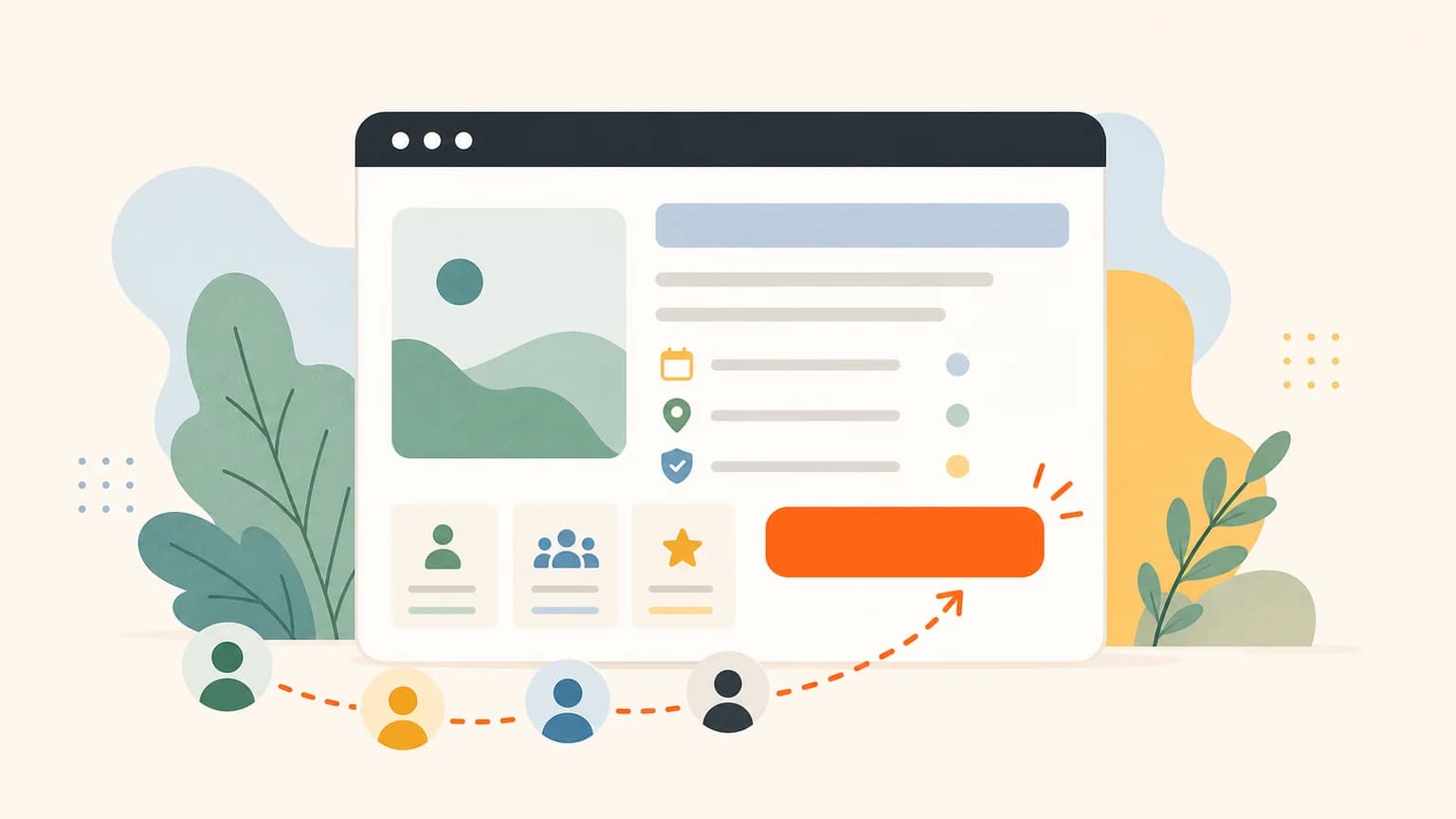
The agenda should appear after the main promise and before the registration decision, or near the section where guests are evaluating value. It should be short enough to scan and detailed enough to answer "what will happen?" If the event is paid, the agenda may also support perceived value. If the event is free, it can still increase commitment by making the gathering feel real.
Agenda details support event metadata and guest trust
Google's Event structured data documentation focuses on machine-readable event details such as name, date, location, image, description, offers, and organizer. Your published agenda is not a replacement for structured data, but it supports the same goal: make the event clear and consistent. The public page should not say "two-hour workshop" in one place and show a 75-minute agenda somewhere else. Guests, share previews, confirmations, and event metadata should all point to the same experience. Consistency is part of trust and guest confidence. It also reduces the operational cost of answering avoidable questions.
Scannable agenda copy helps guests decide quickly
Nielsen Norman Group's web-reading research is a useful reminder that guests scan for meaning before they read every word. Use short labels and concrete actions: "short demo," "hands-on making time," "guided discussion," "tea tasting," "share-out," "close." Avoid agenda labels that sound impressive but reveal little, such as "activation," "immersion," or "integration," unless your audience already understands them. The public agenda should make the event feel easier to join, not more mysterious. If a label needs explanation, choose a simpler label that carries its own meaning. Good agenda copy should answer faster than it decorates.
Create Your Agenda With HereNow
HereNow can help turn a rough idea into an editable event page with a proposed agenda, description, RSVP flow, and shareable link. You can create an event, review the draft flow, and adjust the public agenda before publishing. If you are still shaping the overall format, start with how to host your first workshop or browse event templates for familiar structures. When the page is ready, preview it as a guest and confirm the agenda matches the promise.
FAQ
What is an event agenda?
An event agenda is the planned sequence of the guest experience. It usually includes arrival, orientation, the main activity or discussion, transitions, breaks when needed, and a clear close. A host may also keep a private run sheet with setup tasks, material notes, safety checks, and cleanup details that do not belong on the public page.
How detailed should an event agenda be?
The public agenda should be detailed enough to reduce uncertainty and support the signup decision. A casual meetup may need three broad blocks. A paid workshop, beginner class, or professional roundtable may need more detail because guests are evaluating value, preparation, and participation expectations. The private run sheet can be much more detailed than the public version.
Should I publish exact times for every agenda item?
Use exact times when they help guests understand the experience, especially for workshops, classes, paid events, and events with strict arrival or pickup needs. For casual gatherings, broader blocks may be better. The key is consistency: if you publish exact times, make sure the event can realistically follow them without rushing the main activity.
How much buffer time should I add?
For a 90-minute to two-hour event, reserve about 10 to 15 percent of the total time for arrival, transitions, questions, breaks, and close. Add more buffer when the event involves food, movement, children, complex materials, accessibility needs, or a venue that may slow arrival. Buffer protects the guest promise when real life interrupts the ideal schedule.
Can I change the agenda after publishing?
Yes, if the change does not surprise or disadvantage guests. Small wording improvements are normal. Changes that affect time, location, materials, price, preparation, access, or what guests expected to receive should be communicated clearly. If people registered based on a specific agenda promise, treat that promise as part of the event commitment.