How to Turn Language Skills Into Small Group Events
Choose an honest exchange, guided-practice, or class model, then set the result, level, speaking-time cap, facilitator scope, and pilot price.
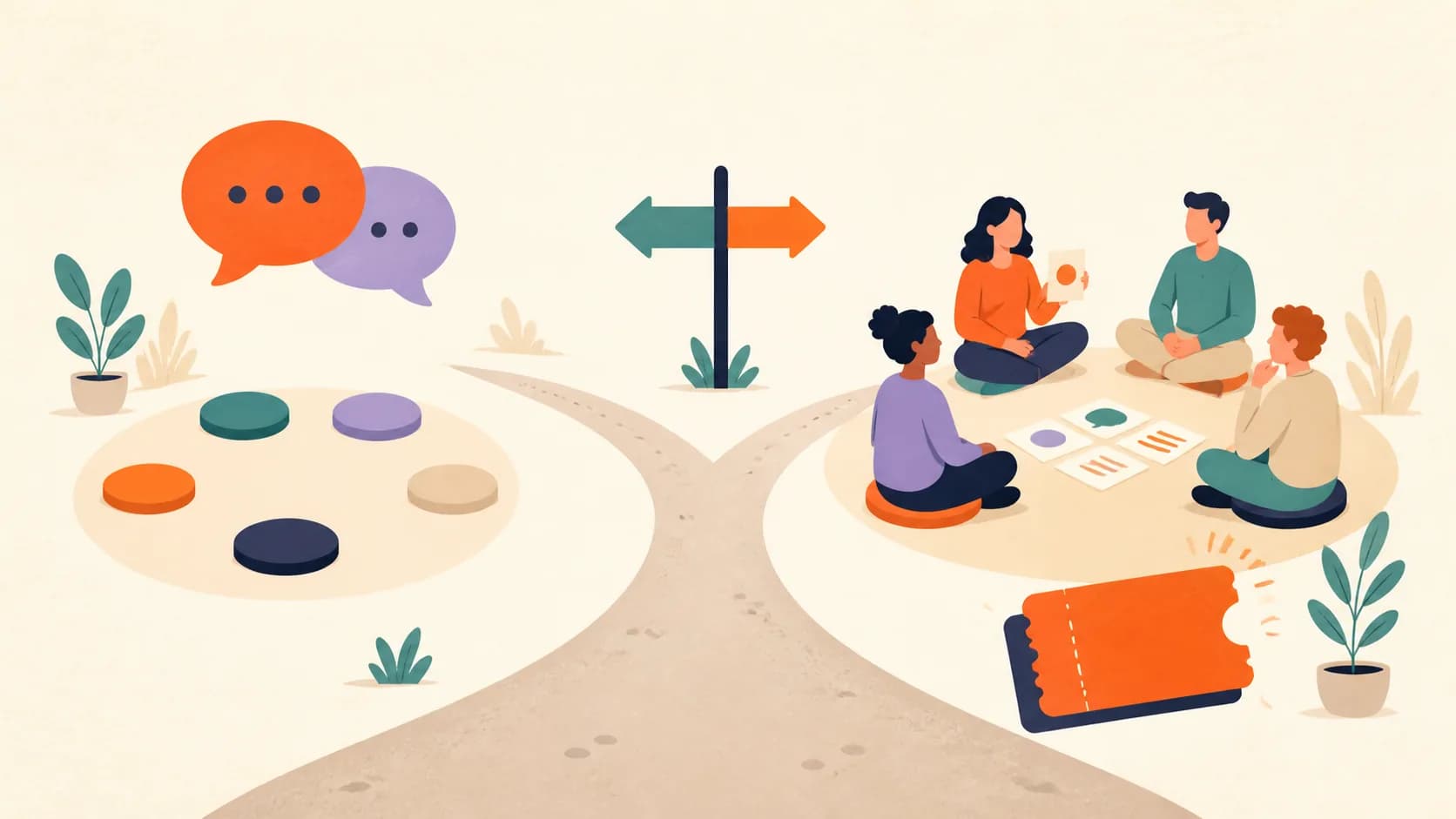
Conversation alone is not automatically a paid language product. A chargeable small-group event adds structure that changes what participants can do: level-matched prompts, protected speaking turns, purposeful correction, preparation, and a bounded practice result. The clearest first decision is therefore not the ticket price. It is whether you are hosting a mutual exchange, facilitating guided practice, or teaching a class.
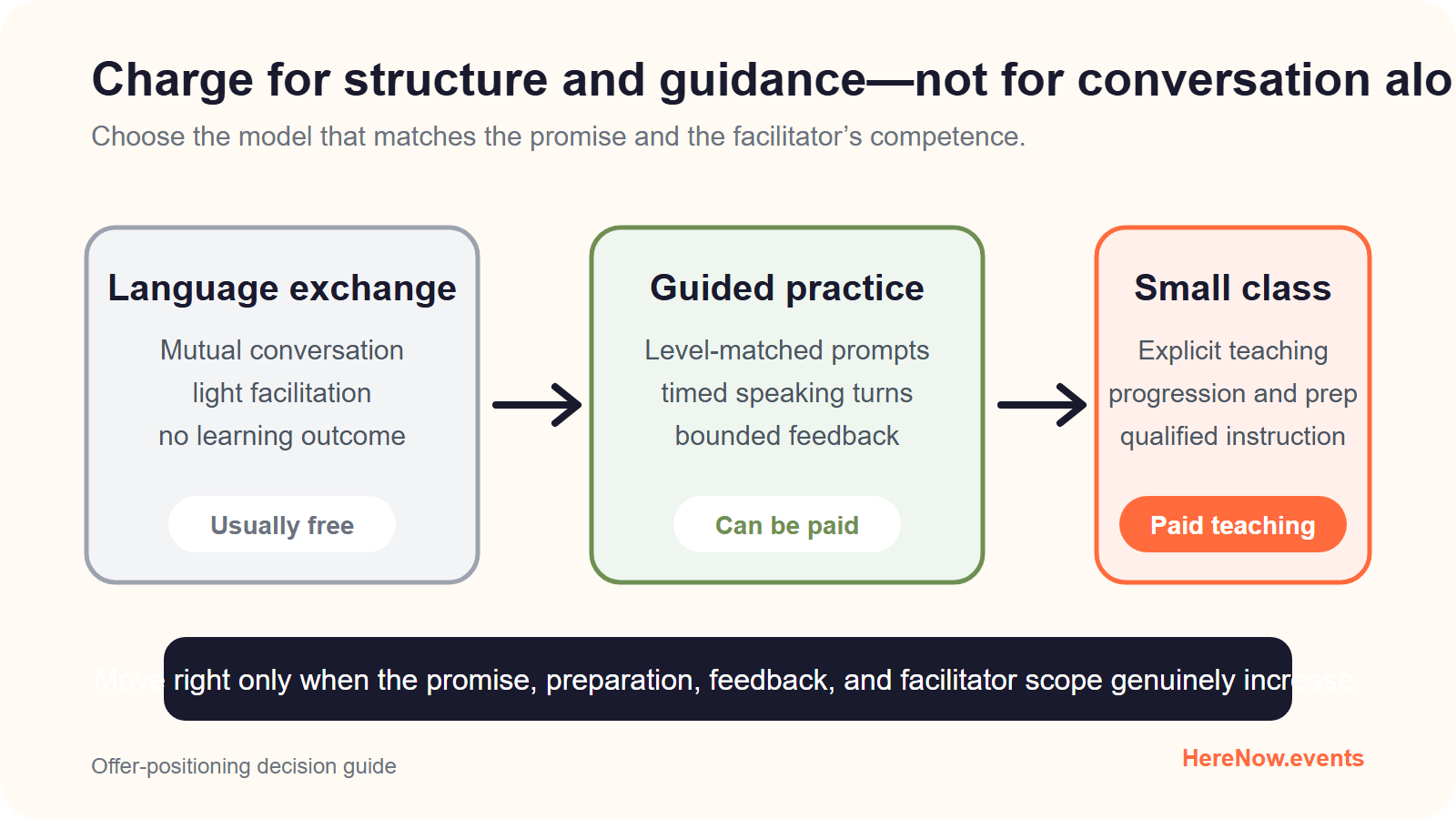
Keep a social exchange free unless the paid value is visible and honest. Charge for guided practice when you can design and facilitate a repeatable speaking experience without promising formal instruction. Offer a class only when your competence, curriculum, feedback, and local requirements support that teaching promise. Then set capacity from speaking time and feedback load before modeling price.
Five Decisions Before a Language Event Should Be Paid
A responsible offer aligns five decisions: event model, participant level, observable result, facilitator scope, and economics below an attention-based cap.
- Model: exchange, guided practice, or class is named accurately.
- Level: participants share enough ability and support to complete the same tasks.
- Result: the paid promise describes practice or learning that can be observed.
- Attention: every participant receives the promised speaking time and feedback.
- Economics: break-even seats remain below that participation cap.
Choose the Honest Model: Exchange, Guided Practice, or Class
The model determines what participants can reasonably expect and what the facilitator must prepare. A language exchange creates mutual practice between participants. Guided practice adds designed prompts, grouping, timed turns, and a limited feedback rule. A class adds explicit instruction, progression, preparation, assessment choices, and a stronger duty to teach within competence.
| Model | Core promise | Facilitator role | Typical payment logic |
|---|---|---|---|
| Language exchange | Meet people and practise mutually | Welcome, match, prompt, and manage inclusion | Usually free or venue-cost sharing |
| Guided practice group | Complete a structured speaking task with bounded feedback | Design tasks, protect turns, observe, and summarize | Can justify a ticket when the added structure is clear |
| Small class | Build a defined skill through instruction and progression | Teach, prepare, correct, adapt, and track the stated result | Paid teaching service |
Do not rename a casual meetup as a class to charge more. Equally, do not give away a fully prepared lesson while calling it an exchange. The ticket page should let a participant tell who supplies the learning plan, who speaks, how feedback works, and what is not included. HereNow’s language exchange guide covers the balanced social format; this page focuses on the decision to add paid structure.
Define One Communicative Result
“Improve your Spanish” is too broad for a single event. A useful promise names a situation and an observable action: “Practise asking follow-up questions during a ten-minute travel conversation,” or “Leave with a three-part structure for introducing your work at a professional meetup.” The result should fit the group’s starting level and the facilitator’s ability to model and respond.
The Council of Europe’s CEFR Companion Volume includes reception, production, interaction, and mediation. That breadth is a reminder that “language ability” is not one scale to promise casually. Choose one mode for the event. A conversation practice session may emphasize interaction; a host-translation workshop may emphasize mediation; a storytelling class may emphasize production.
Build the Result Around a Task, Not a Topic
“Food” is a topic. “Order a meal, ask one follow-up question, and clarify an ingredient” is a task. Tasks create a beginning, an information need, and an observable finish. They also reveal the vocabulary, support cards, demonstration, grouping, and feedback the session needs. Design one core task with a simpler version and a stretch version so different participants can stay in the same room without pretending they have identical proficiency.
ACTFL’s official Proficiency Guidelines organize real-world, spontaneous language use by skill and level. For a small event, that task-based view helps prevent scope drift. If the ticket promises conversation, protect back-and-forth interaction. Do not spend most of the session on a lecture or individual presentation simply because it is easier to manage.
Use a Level Description Guests Can Recognize
A label such as “intermediate” can mean very different things across schools, tests, and self-assessments. Add a functional description: “You can describe familiar experiences in connected sentences and ask for clarification, but you do not need workplace fluency.” Give two sample tasks and state the language used for instructions. If beginners are welcome, explain what scaffolding exists rather than using “all levels” as a marketing shortcut.
The ACTFL Performance Descriptors describe interpersonal communication as active negotiation of meaning with adjustments and clarification. That supports a practical admission rule: group people who can attempt the same interaction, not merely people who selected the same label.
Design Speaking Time and Feedback Before Capacity
A sixty-minute event with twelve people does not contain twelve hours of practice. Subtract arrival, instructions, demonstrations, transitions, regrouping, and close. Then decide whether participants speak in pairs, trios, or one whole group. The cap should preserve the promised minutes and feedback for every participant, including someone who needs more processing time.
For lower-level fluency activities, the British Council’s TeachingEnglish guidance recommends preparation, visual support, short bursts, clear class management, and demonstration rather than relying only on verbal instructions. Those practices also improve paid-event design: prompts should be visible, instructions rehearsed, and speaking cycles short enough that a weak pairing can be repaired.
Calculate a Speaking-Time Budget
Suppose a 90-minute guided practice event reserves 15 minutes for welcome and demonstration, 15 for transitions and regrouping, and 10 for closing. Fifty minutes remain. In pairs, two 12-minute rounds plus two 8-minute rounds create 40 minutes of participant practice and leave 10 minutes for targeted feedback. If a ninth guest produces an unmatched trio and removes a full turn, the physical room may still fit while the product no longer does.
Feedback must also be bounded. Choose one method: one correction target per round, a group pattern summary, written feedback on one short output, or brief individual notes. “Personal feedback” without a limit can consume the whole event. If private coaching is not included, say so. If feedback is peer-led, provide a safe prompt and explain that peers are not grading one another.
Protect Participation Without Forcing Disclosure
State whether reading, hearing, speaking, writing, camera use, or movement is required. Provide prompts in advance when that supports processing, and create a way to pass or observe without public explanation. W3C’s guidance on accessible presentations and meetings recommends sharing accessible materials, using clear language, describing relevant visuals, and giving participants ways to communicate access needs. Apply those principles to prompt cards, slides, captions, room acoustics, seating, and online tools.
Separate Fluency, Teaching, Translation, and Therapy Claims
Speak precisely about what you offer. A conversation facilitator can structure turns and help participants practise without diagnosing a language disorder, certifying proficiency, preparing every exam, or offering professional translation. A fluent speaker is not automatically a trained teacher. A trained teacher may still need different competence for children, exam preparation, pronunciation therapy, or workplace compliance.
Describe credentials, lived experience, teaching background, and language level accurately. Verify any local requirements that apply to paid teaching, work with minors, venue use, safeguarding, insurance, taxes, or data collection. If the event includes sensitive topics, set discussion boundaries and a conduct process. Do not promise fluency, test scores, employment, immigration, or medical outcomes that one small group cannot control.
Price the Preparation and Attention, Not the Language Itself
Fixed costs may include venue or video tools, insurance, curriculum design, prompt creation, outreach, setup, teaching, follow-up, and host administration. Variable costs may include printed materials, refreshments, platform and payment fees, workbooks, or per-participant tool access. Include unpaid preparation and follow-up time; otherwise a seemingly profitable session can pay less than the host intended.
Use break-even seats = fixed costs ÷ (ticket price − variable cost per participant), rounded up. The SBA break-even formula is an estimate, not a prediction of demand or profit.
| Illustrative input | Amount |
|---|---|
| Fixed costs, including preparation and teaching time | $168 |
| Variable cost per participant | $3 |
| Ticket price | $27 |
| Tested participation cap | 8 people |
The calculation is $168 ÷ ($27 − $3) = 7 sold seats. Seven tickets produce $189 against $189 of modeled cost. Eight produce $216 against $192, leaving a $24 pre-tax buffer. That is not guaranteed profit; cancellations, tax, extra preparation, refunds, and uncounted tools can remove it. Replace the assumptions in the workshop pricing calculator.
If seven break-even seats feel too close to an eight-person participation cap, change the price, reduce fixed work, sell a short series, secure a venue partner, or simplify the promised feedback. Do not add people until speaking time becomes symbolic. A guided group must still offer materially more structure than a free exchange.
Write a Page That Prevents Level and Model Mismatch
The event page should name the model, target language, instruction language, functional level, core task, speaking format, feedback included, capacity, preparation, and conduct expectations. Give a sample prompt so participants can judge fit. State whether the event is social, educational, or both, and whether native or near-native proficiency is necessary.
- Describe what participants will practise and what they are not promised.
- Give a functional level description with two example tasks.
- State pair, trio, or whole-group structure and the approximate speaking rhythm.
- List required materials, camera or microphone expectations, access information, and code of conduct.
- Publish ticket inclusions, cancellation terms, late-arrival rule, and how the host handles an obvious level mismatch.
Use the Language Exchange Night template for a mutual social model. For a paid guided-practice event, adapt the page so the task, level, feedback, and host responsibility are explicit. Review current HereNow paid-ticket terms and include fees in the model.
Run One Pilot and Measure Participation Quality
Choose one uncertainty: Can self-described B1 participants complete the same task? Does pair rotation protect speaking time? Can one host deliver the promised feedback to eight people? Record registrations, attendance, level mismatches, speaking minutes, unused prompts, transition time, corrections delivered, access requests, actual labor, refunds, and which task participants could complete by the end.
Repeat when the model was understood, participants could attempt the same interaction, speaking time matched the promise, feedback stayed within scope, and actual contribution worked below capacity. Revise when one change is clear. Split by level when one group cannot share a task. Partner with a qualified teacher when the promise requires instruction beyond facilitation. Keep the event free when the real value remains mutual conversation rather than designed service.
Review Participation, Not Just Satisfaction
A friendly room can still fail the stated practice result. After the pilot, compare each participant’s available speaking minutes with the advertised format, note who repeatedly waited or opted out, and identify whether prompts produced the target interaction. Separate a level mismatch from a facilitation problem: easier prompts will not repair missing turn structure, while stricter timing will not make one task suitable for widely different levels. Recalculate the host’s preparation and feedback time, then test one change at the next event—for example a narrower level description, fewer guests, triads instead of pairs, or one defined feedback pattern. Keep the model and outcome stable long enough to learn whether that repair genuinely improves participation.
Use This Free-or-Paid Decision Gate
Keep the event free when the main value is people meeting and talking. Charge when a clearly described task, level match, prepared materials, protected turns, bounded feedback, and competent facilitation create a different product—and when break-even stays below the participation cap. If those conditions agree, create your small-group language event page. If they do not, simplify the promise or return to the exchange model.
Frequently Asked Questions
Can a language exchange event charge a ticket?
It can charge for real added value such as a venue, materials, structured facilitation, or included service, but the page should not imply formal teaching when the event remains mutual conversation. Explain exactly what payment covers. If participants supply most of the practice and the host only opens the room, a free event or transparent cost-sharing model may be more credible than a class-style ticket.
Do I need to be a qualified language teacher?
Not to host every social exchange or bounded practice group, but paid instruction should stay inside your competence and any local requirements. Fluency alone does not prove teaching skill. State your background honestly and avoid promises involving certification, exams, therapy, immigration, or employment unless you are qualified and the service truly supports them. When the result depends on curriculum design or specialist feedback you cannot provide, partner or narrow the offer.
How many people fit a small language practice group?
Use the largest number that preserves the promised speaking time, level fit, regrouping, feedback, and inclusion—not the room’s seating count. Build a minute budget, decide whether people work in pairs or trios, and test an odd attendance number. If one extra participant removes a speaking turn or makes feedback impossible, the cap has already been reached. Add another facilitator only with a clear grouping and feedback role.
Should the first session be a one-off or a series?
Start with one event when testing the model, level description, task, or price. Use a short series when the promised result requires progression between sessions and you can state attendance, missed-session, materials, feedback, and refund rules clearly. A series improves continuity but raises the commitment and preparation burden. Do not sell several dates before one pilot shows that the group can share a level and that the format protects participation.