How to Turn Cooking Skills Into a Small Paid Class
Bound one dish or technique, verify the kitchen and local requirements, set capacity from the lowest operating limit, and price a responsible pilot.
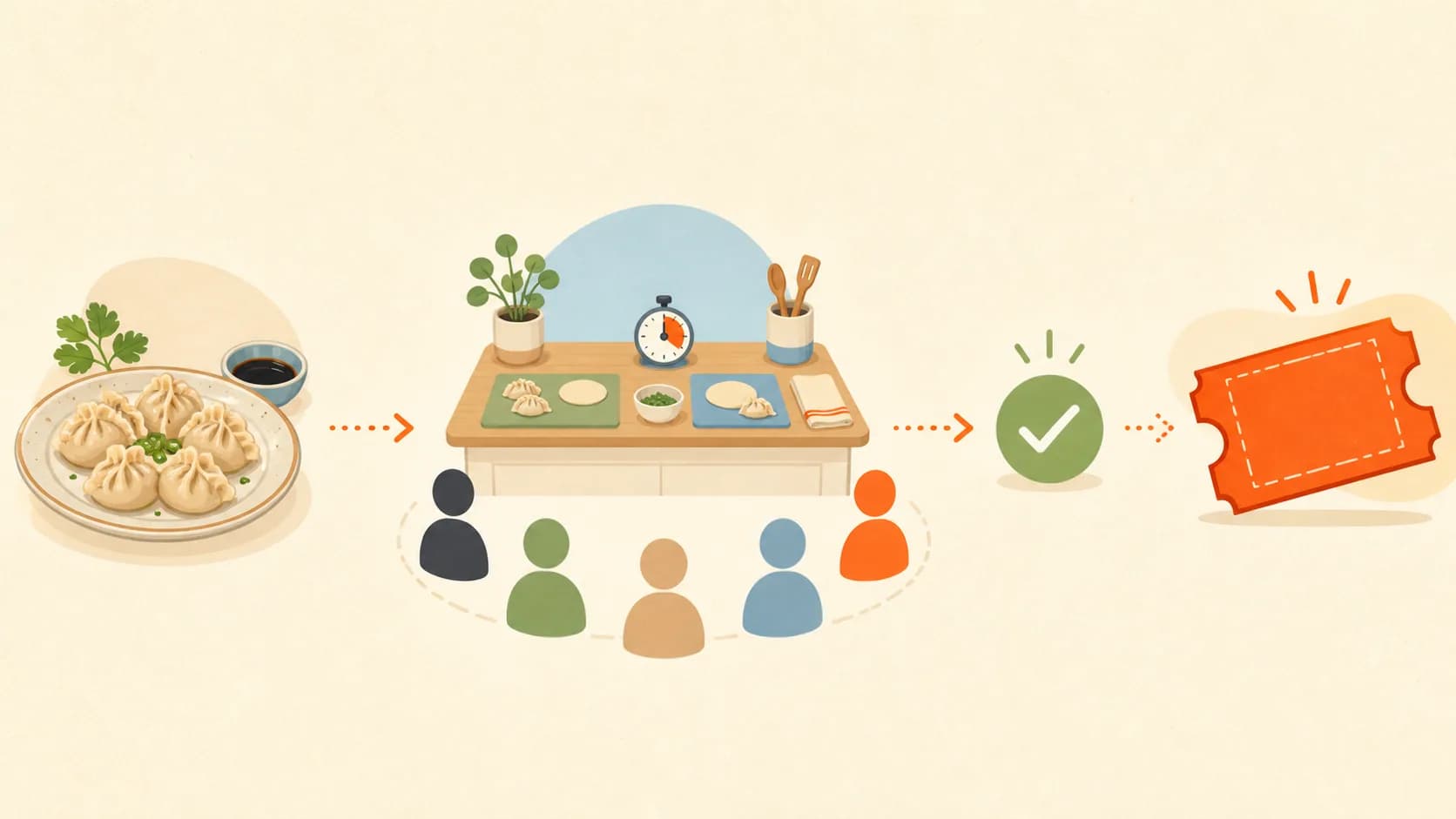
A paid cooking class is not a dinner with commentary. It is a controlled teaching service in which guests can safely practise one technique, see a result, and understand what they are responsible for at each step. The dish attracts interest; the product is the host’s preparation, demonstration, observation, correction, food controls, and pacing.
Begin with one result that the actual kitchen can support. Then identify the lowest operating limit among workstations, equipment, heat, food controls, host attention, and venue rules. Price only after that capacity is known. If break-even requires eight guests but the host can safely observe six, the class is not ready at that price or format.
Six Gates Before a Cooking Skill Becomes a Paid Class
A viable first class aligns six conditions: a bounded dish or technique, an appropriate kitchen, verified local requirements, a clean workflow, observable capacity, and economics that work below the cap.
- Result: each guest can name the technique and the finished outcome.
- Kitchen: stations, equipment, ventilation, power, water, refrigeration, and cleaning support the plan.
- Rules: the venue and relevant local authority confirm what a ticketed class requires.
- Food controls: ingredients, allergens, cross-contact, temperatures, storage, and waste have owners.
- Capacity: the host can see and correct every high-risk step.
- Economics: break-even seats stay below that capacity.
Choose One Result, Not an Entire Cuisine
“Learn Italian cooking” cannot fit a first two-hour class. “Make fresh ricotta gnocchi and learn how dough moisture changes the texture” can. A narrow result controls ingredients, mise en place, tools, station layout, demonstration length, practice time, and the moment when the host must observe each guest. It also makes the ticket legible: guests know what they will make, eat, and take home.
Pick a Technique With a Visible Correction Point
A strong first class gives the host one or two moments where feedback changes the result: dough texture before shaping, knife grip before repetition, wrapper sealing before cooking, or sauce consistency before serving. Avoid a format in which every guest runs several heat processes at once. The more simultaneous hazards and timing dependencies the dish contains, the more the class depends on assistants, pre-portioned ingredients, or demonstration rather than hands-on work.
Write the promise in this form: “For [specific beginner], this class helps you [complete one dish or technique] by practising [two observable decisions].” Then define exclusions. The ticket may not include professional culinary certification, a full meal, alcohol, nutrition advice, personalized dietary accommodation, or permission to sell the finished food. Boundaries protect the guest and stop a small class from becoming catering, private consulting, and restaurant service at one price.
Choose Demonstration, Shared Production, or Individual Stations
A demonstration-led tasting lets the host control heat and sharp tools while guests observe, taste, and practise a limited step. Shared production gives pairs one station and works when the result tolerates small differences in pace. Individual stations create more practice but multiply equipment, ingredients, cleaning, supervision, and failure points. Choose the least complex format that still delivers the promised learning.
If the idea is social and cultural rather than technique-heavy, a hosted table may be more honest than calling it a class. HereNow’s Cultural Cooking Table template supports a shared meal format; the Dumpling Making Party template fits a repeatable hands-on result. Do not use “class” only to justify a higher ticket.
Verify the Kitchen and Local Rules Before Promotion
A visually attractive home kitchen or rental studio is not automatically approved for a paid public class. Ask the venue what commercial teaching, food preparation, outside ingredients, alcohol, children, open flame, sharp tools, insurance, cleaning, waste, and food removal are allowed. Then ask the relevant local authority what permits, food-handler training, inspection, or facility conditions apply to this exact activity.
The U.S. Small Business Administration notes that licenses and permits vary by business activity, location, and government rules, and that restaurants are commonly regulated at state or local level. That is a planning boundary, not a universal U.S. cooking-class rule. Outside the United States, the same principle holds: identify the competent local body instead of copying another host’s checklist.
The FDA Food Code is a model used by jurisdictions for retail and food-service rules; the 2022 edition is the latest full edition listed by FDA. Your local code may adopt, modify, or replace it. Use it to understand the seriousness of time, temperature, hygiene, and management controls, then verify the rule that actually governs the venue.
Design the Food Workflow Before the Agenda
Map ingredients from receipt through storage, preparation, cooking, service, leftovers, and disposal. Assign a clean location and an owner to every step. A guest agenda is only credible when the food workflow underneath it works. If raw and ready-to-eat foods cross the same crowded path, or guests cannot wash hands without leaving hot equipment unattended, the class needs a new layout or a simpler dish.
The USDA Food Safety and Inspection Service summarizes four basic controls as clean, separate, cook, and chill. Translate each into visible class operations:
- Clean: handwashing, sanitized contact surfaces, clean utensils, and a reset plan are available when needed.
- Separate: raw ingredients, ready-to-eat food, allergen-specific tools, and finished dishes have distinct locations.
- Cook: the host knows the applicable safe endpoint and how it will be checked.
- Chill: perishable ingredients and leftovers do not wait on a teaching table without a time-and-temperature plan.
Treat Dietary Questions as Operations, Not Marketing Labels
The FDA lists nine major food allergens in the United States: milk, egg, fish, crustacean shellfish, tree nuts, wheat, peanuts, soybeans, and sesame. Its food allergy guidance also defines cross-contact as the inadvertent introduction of an allergen. The legal list and requirements vary by jurisdiction, but the operating lesson is broader: collect dietary information early, retain ingredient labels, identify shared equipment, and never promise an allergen-free environment unless the complete process supports that claim.
Offer only substitutions that have been tested in the same recipe and workflow. A last-minute ingredient swap can change texture, cooking time, allergens, station tools, and the teaching sequence. When an accommodation cannot be provided safely, say so before purchase and offer a clear cancellation path rather than improvising during the class.
Set Capacity From the Lowest Operating Limit
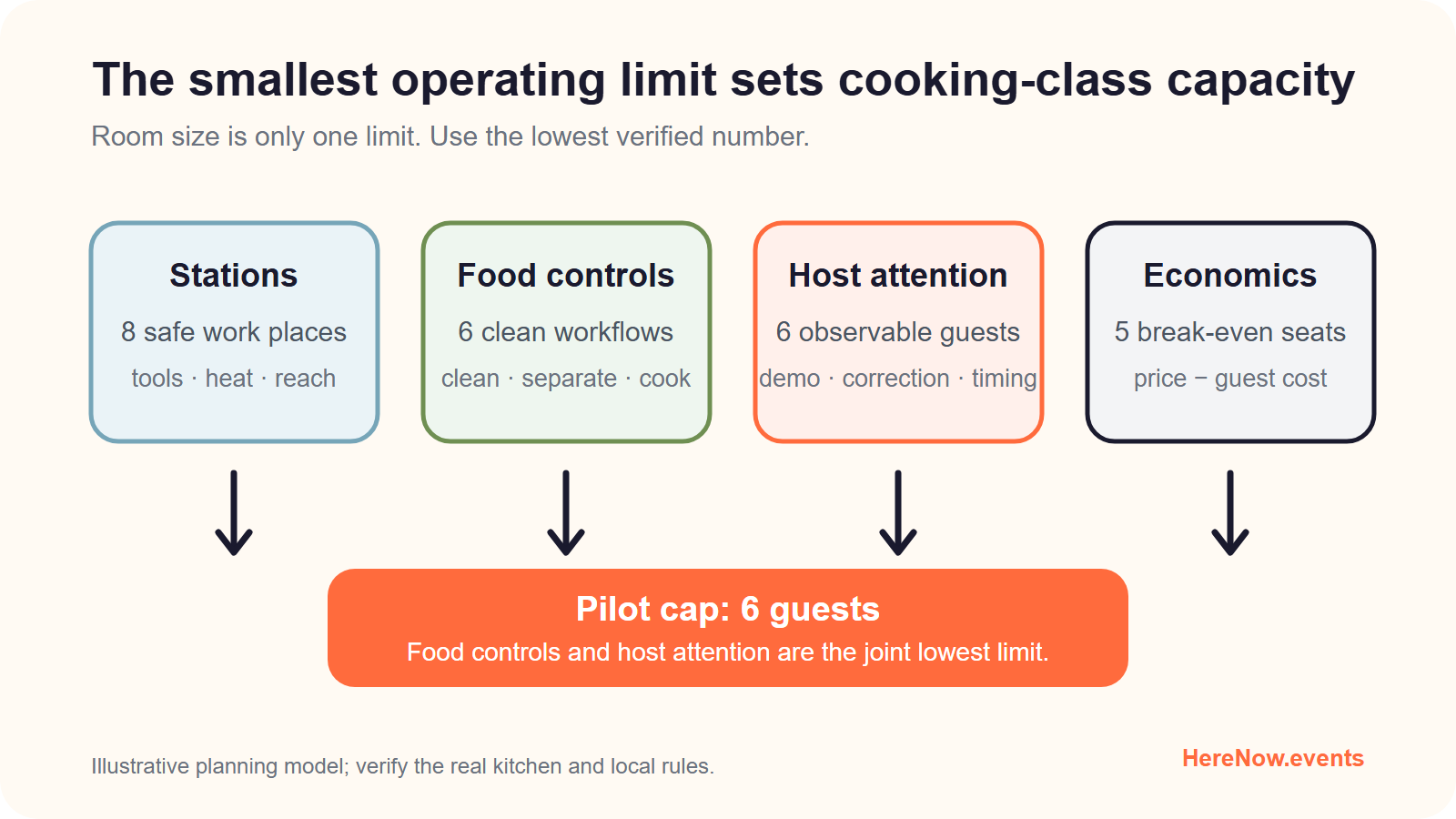
Calculate separate limits for stations, equipment, heat, refrigeration, cleaning, host observation, accessibility, and venue rules. The smallest verified number becomes the provisional cap. A kitchen with eight stools may have six safe cutting positions, four burners, one sink, and one host who can observe six beginners. The answer is not eight.
Rehearse the busiest ten minutes. Time the demonstration, ingredient handoff, guest work, correction, cooking transition, plating, and cleanup. Count how many people can see the critical step and how long unsafe or unsuccessful work could continue before the host notices. Use the event capacity planner to compare limits, then test the result in the real kitchen.
An assistant increases capacity only when they can perform the assigned food-control and teaching tasks. “Extra hands” is not a role. Specify who receives ingredients, watches handwashing, monitors heat, answers routine questions, manages dietary exceptions, and stops the process if something is wrong.
Price the Class From Complete Labor and Guest Costs
Count work that happens before and after guests arrive. Fixed costs may include kitchen rental, insurance, permits, transport, recipe testing, shopping, pre-preparation, setup, teaching, cleanup, and follow-up. Variable costs may include ingredients, consumables, packaging, recipe sheets, payment fees, and expected waste per guest.
Use break-even seats = fixed costs ÷ (ticket price − variable cost per guest), rounded up. The SBA’s break-even guidance describes the calculation as an estimate and suggests accounting for miscellaneous expenses that cannot be predicted.
| Illustrative input | Amount |
|---|---|
| Fixed costs, including host time | $310 |
| Ingredients and consumables per guest | $18 |
| Ticket price | $82 |
| Tested service capacity | 6 guests |
The model gives $310 ÷ ($82 − $18) = 4.84, rounded to five sold seats. Five tickets produce $410 against $400 of modeled cost. Six produce $492 against $418, leaving a $74 pre-tax buffer. That buffer is not guaranteed profit and does not include tax, refunds, spoiled ingredients, extra labor, or missing costs. Enter the real numbers in the workshop pricing calculator.
If the price feels high, do not hide labor or increase the group beyond safe service capacity. Reduce the ingredient cost, simplify the dish, shorten the rental, move one step to demonstration, obtain a venue partnership, or redesign the inclusion. A first class should be a bounded pilot, not a permanent price promise.
Make the Event Page Part of the Food-Control Plan
The page should help unsuitable guests opt out before the class. State the dish, techniques, hands-on level, ingredients, known allergens, cross-contact limitations, age or guardian rules, standing time, heat and tool exposure, clothing and footwear guidance, accessibility, take-home policy, and what the ticket includes. Give guests a route to ask dietary or access questions before purchase.
Keep the registration form focused and understandable. The W3C Web Accessibility Initiative recommends giving clear overall and field-level instructions, including which information is required and the expected format. Ask only for details that affect participation or preparation, label optional dietary and access fields honestly, and explain who will use the response.
- Show the finished result and explain which parts guests make themselves.
- List the venue, duration, station format, capacity, and whether guests work alone or in pairs.
- State whether ingredients, equipment, recipe notes, the meal, leftovers, or containers are included.
- Publish dietary boundaries, cancellation terms, late-arrival rules, and any reason a guest may observe rather than participate.
- Describe host experience accurately without promising nutrition, health, employment, or business outcomes.
Before selling, review current HereNow paid-ticket terms and include platform fees in the cost model. HereNow can provide the event page, registration, and ticket workflow; it does not approve the kitchen, host competence, permits, food controls, or allergen claims.
Run One Pilot and Audit the Real Service Load
Choose one uncertainty to test: Can six beginners complete the shaping step without queues? Does the oven schedule protect the promised finish time? Can the host monitor handwashing, cross-contact, and heat while teaching? Deliver the complete promise, then record registrations, attendance, station delays, ingredient waste, substitutions, temperatures where relevant, corrections, actual labor, cleanup time, refunds, and guest understanding.
Repeat only when the kitchen, food workflow, guest result, host attention, and actual contribution all remain workable. Revise when one repair is clear. Add an assistant when a defined role removes a real bottleneck. Partner with a licensed venue or food professional when the local requirements or production risks exceed the original plan. Stop when the business model depends on hiding labor or exceeding safe observation capacity.
Review the Pilot as a Service System
Do not judge the class only by the finished dish or the loudest compliments. Reconstruct the full service: when ingredients left safe storage, where guests waited, which instruction had to be repeated, when the host lost sight of a station, how much usable food became waste, and how long cleaning continued after guests left. Compare those observations with the event-page promise and the price calculation. For the next date, change one constraint at a time—perhaps pre-portioning an ingredient, simplifying one knife step, reducing capacity, or assigning an assistant to a named control point. A repeatable class is one in which the safest workflow also delivers the promised result without invisible unpaid labor.
Use This Kitchen-to-Ticket Gate
Publish only when the dish is bounded, the venue permits the activity, local requirements are verified, food controls are practical, every guest can be observed, and break-even stays below capacity. When those conditions agree, create your small cooking class page. If one fails, change the dish, kitchen, service format, cost structure, or ticket promise before inviting payment.
Frequently Asked Questions
Can I teach a paid cooking class from home?
Possibly, but a home kitchen that works for private cooking may not be approved for a ticketed public class. Requirements vary by location, food activity, venue, group size, and whether food is consumed or taken away. Ask the relevant local authority and insurer about the exact format. Also verify parking, access, sanitation, handwashing, refrigeration, waste, fire safety, neighbors, and the venue’s occupancy and commercial-use rules before promotion.
Do cooking-class guests need to disclose allergies?
Ask about allergies and dietary needs during registration, but do not treat disclosure as transferring responsibility to the guest. Keep ingredient labels, explain cross-contact limits, use tested substitutions only, and state when an accommodation cannot be made safely. Avoid an allergen-free claim unless the entire ingredient, storage, equipment, surface, and service process supports it. Provide a contact path before purchase so a guest can decide with accurate information.
How many guests should a first cooking class have?
Use the lowest limit among safe stations, equipment, food controls, host observation, accessibility, venue rules, and economics. For many first hands-on formats that number will be smaller than the room capacity. Rehearse the busiest step with the real tools and timing. If the host cannot see and correct every critical action before it affects safety or the result, reduce seats, simplify the technique, or add a qualified assistant with a defined role.
Should I include ingredients in the ticket price?
Usually yes when consistent ingredients are necessary for the learning result and food controls. Host-provided ingredients simplify quality, quantity, allergens, timing, and station setup, but they also increase variable cost and waste risk. If guests bring ingredients, specify exact quantities, preparation, storage, substitutions, and transport. Whichever model you choose, show what the ticket includes and place every ingredient and consumable cost in the break-even calculation.