Photo details
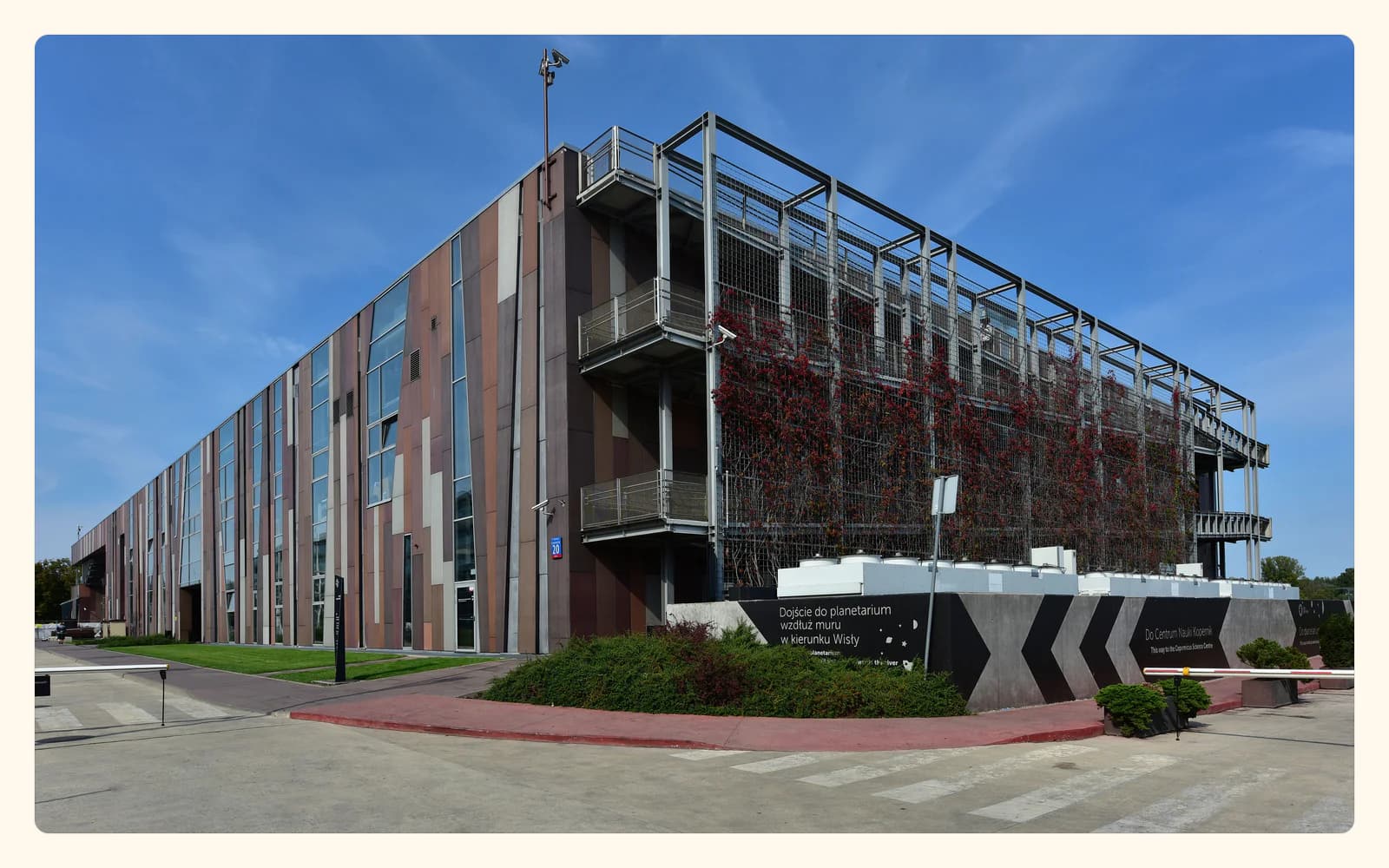
The Copernicus Science Centre in Warsaw in 2018. The fossil-preparation lab documented in the embedded videos operates inside the centre.
Photo: Adrian Grycuk / Wikimedia Commons · CC BY-SA 3.0 PL
Image adapted for this page.
In Warsaw, 2,000 Volunteers Took Turns Revealing a Prehistoric Giant
At the Copernicus Science Centre, ordinary visitors trained for short shifts on a 240-million-year-old fossil, turning meticulous scientific work into a shared public story.
What actually happened
- Original event
- Science Speaks for Itself: Touch Prehistory
- Date & time zone
- Since November 2025 · Europe/Warsaw
- By
- Copernicus Science Centre + Ministry of Science and Higher Education
- Format
- Supervised citizen-science fossil preparation
- Entry
- Volunteer shifts · entry terms not publicly stated
What happened
Inside a glass-walled laboratory at Warsaw's Copernicus Science Centre, a 1.3-tonne block of rock holds the remains of a Mastodonsaurus, a large amphibian that lived about 240 million years ago. Since November 2025, the centre has invited people without specialist backgrounds to help reveal it, one carefully supervised shift at a time.
AP reported in July 2026 that more than 2,000 volunteers had joined. After training and protective equipment, participants worked for roughly two hours with small chisels, brushes, and a pneumatic tool, separating fossil from rock millimetre by millimetre. Scientists and trained staff stayed close; visitors outside the lab could watch through the glass.
The two videos preserve details that numbers cannot. Gazeta Wyborcza's report enters the preparation space and shows the fossil, tools, glass wall, and people at work. A Copernicus Science Centre video returns to the same bench as part of its citizen-science programme, showing how public contribution sits inside an expert-led project rather than beside it.
See the event in motion
What draws people in
The invitation offers rare proximity to consequential work. A guest is not only hearing about a discovery or looking at a finished object; for a bounded period, their hands become part of the long process by which the object can be understood. The task is small enough to learn, while the thing it serves is enormous in age, scale, and meaning.
Progress also remains visible across shifts. No individual needs to finish the fossil. One person exposes an edge, another clears a narrow channel, and later volunteers continue from that exact point. The unfinished state is not a flaw in the event—it is evidence that many contributions belong to the same story.
The glass wall creates a second way to participate. Some people work at the bench; others watch the concentration, tools, and gradual change. This makes the process itself public, including its patience and uncertainty, instead of revealing only a polished result at the end.
If you host something similar
One real object, a series of expert-defined micro-tasks, a visible progress record, and a handoff between shifts give the relay its shape. A durable donated object, robust community fixture, expendable teaching collection, or accurate replica is a more suitable starting point than anything rare, culturally sensitive, privately owned, or difficult to reverse.
A knowledgeable project lead decides which steps are genuinely appropriate for guests, demonstrates one task at a time, and keeps tools, dust, noise, posture, ventilation, and protective equipment within the venue's established practice. Observation, photography, note-taking, parts sorting, and progress mapping provide meaningful roles when hands-on work is not comfortable or suitable.
The Warsaw project also studies how participation affects trust in science. In another setting, any research survey, interview, recording, or publication remains a separate, optional invitation rather than a condition of joining the event. For younger guests, the venue sets an age route that fits the task, supervision, tools, and local requirements.
One Object, Many Hands
Complete one careful piece of a real restoration, see exactly how it changes the object, and leave a clear handoff for the next guest.
One expert-led restoration is divided into short reversible tasks whose results remain visible, documented, and ready for the next participant.
Host a supervised restoration relay for 8–24 guests, where each person completes one safe reversible micro-task on a durable community object or replica, records the change, and hands the work to the next shift.
Host checklist
- A qualified project lead chooses a durable donated object, expendable teaching piece, community fixture, or replica whose guest tasks are safe, lawful, culturally appropriate, and genuinely reversible.
- A short task card defines the tool, stopping point, demonstration, protective equipment, ventilation, dust or noise limits, and the moment when a guest should ask for help.
- Seated stations, lighter tools, shorter shifts, observation, documentation, parts sorting, and progress mapping offer distinct ways to contribute.
- Photography, interviews, research surveys, and public attribution stay separate from event participation.
- A younger-guest route reflects the task, tools, supervision, insurance, venue policy, and local requirements instead of using one rule for every station.
- Every shift ends with a condition check and named handoff so the next guest understands what changed, what remains uncertain, and what should not be touched.
The idea will be ready in the event creator.
Questions hosts ask
Does the object need to be old or valuable?
No. A durable community fixture, donated object, teaching piece, large model, archive box, or replica can carry the same relay. Suitability comes from the project lead, the task design, and the story of shared progress—not the object's price.
Can guests join without using tools?
Yes. Observation, photography, condition notes, parts sorting, progress mapping, labeling, and shift handoff can all make the collective work visible. The strongest alternative roles contribute to the same object rather than sitting beside the event.
How does the event feel complete if the restoration continues?
Close each shift with a checked condition note, one visible before-and-after comparison, and a handoff to the next group. Guests leave knowing exactly what changed because they were there, even while the larger project remains open.
What would you make from this?
Share a local twist, a different format, or a gathering this story set in motion.