Photo details
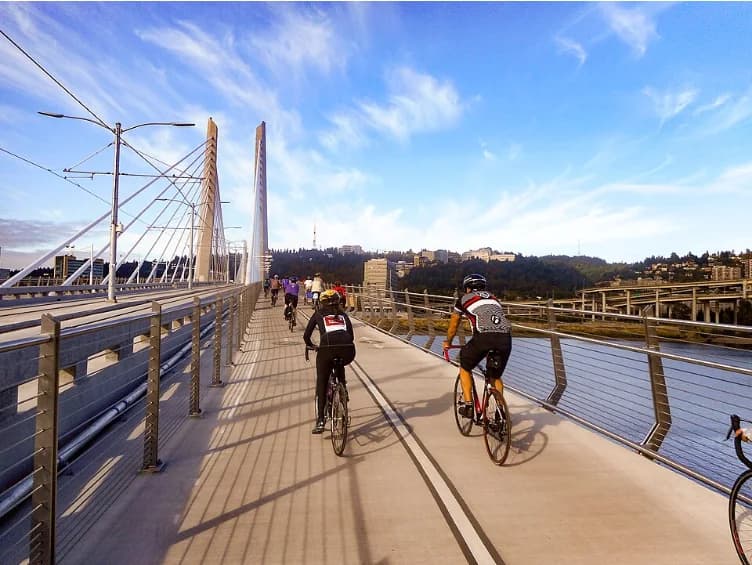
Cyclists use Portland's Tilikum Crossing during the 2015 Providence Bridge Pedal. It provides Portland cycling context and does not depict MADE Bike Show.
Photo: Tedder / Wikimedia Commons · CC BY-SA 4.0
Image adapted for this page.
Portland Put Its Makers on a Route, Not Just a Show Floor
At Portland's 2025 MADE Bike Show, visitors moved between a crowded exhibition, group rides, and local workshop tours. An independent version starts with the ticket promise: three clear encounters that move a guest from seeing the work to speaking with its maker.
What actually happened
- Original event
- MADE Bike Show 2025
- Date & time zone
- August 22–24, 2025 · America/Los_Angeles
- By
- MADE Bike Show
- Format
- Ticketed three-day handmade bicycle show with exhibitions, group rides, and workshop tours
- Entry
- Paid single- and multi-day admission; pass prices varied by edition
What happened
The 2025 MADE Bike Show filled Portland's Zidell Yards from August 22 to 24 with handmade bicycles and the people who build them. BikePortland listed the three-day show at the South Waterfront venue, while Cycling Weekly later reported nearly 200 exhibitors and more than 6,500 attendees.
The programme did not stop at display stands. Cycling Weekly described city rides and tours of local framebuilders' workshops alongside the show floor. That is a practical distinction: the event gave visitors more than a row of products to inspect; it gave them several ways to meet the work and its maker.
What makes the programme legible is the route between discovery and conversation. This article does not reproduce MADE's name, bicycle designs, brands, exhibitor list, ride routes, workshop access, ticket copy, or visual identity.
See the event in motion
Why this event works
A paid ticket becomes easier to understand when it changes how a guest spends time. In the source event, people could browse the show, join a ride, or visit a workshop. An independent version promises a sequence of maker demonstrations and conversation slots rather than an undefined premium tier.
For makers, a short timed encounter gives a prospective customer a way to ask useful questions: what is made to order, what can be tried, what a repair or alteration involves, or how a commission begins. It does not guarantee a sale. The value is a more deliberate introduction than a fast pass through a crowded room.
The commercial details must be explicit. A host should decide whether ticket revenue pays for the programme, whether makers pay a stall fee, how any referral or commission arrangement works, and which payments are made directly to the maker. None of those terms should be left for guests or makers to infer at the door.
If you host something similar
Make the passport original. Do not use MADE, its bicycle focus, exhibitor names, workshop routes, ride formats, ticket wording, or visual system. An Open Bench Passport can centre ceramics, furniture, fashion, printmaking, repair, audio gear, or another local craft without borrowing the source event's identity.
Start in one accessible venue. A maker can demonstrate a process at a safe, confirmed table or bench without inviting strangers into an unprepared studio. If a future edition includes off-site visits, obtain each maker's consent, assess access and travel, set a capacity, and publish a weather, late-arrival, and cancellation plan.
Write the trading terms before selling tickets. Confirm maker fees, any commission or referral rule, merchant-of-record responsibilities, deposits, refunds, product handling, public-liability cover, photography consent, and accessible routes. Consumer, tax, safety, and venue requirements vary by place, so get the appropriate local advice before taking payment.
The Open Bench Passport
Use one ticket to meet a small line-up of makers through three timed demonstrations or conversation slots, then buy directly, start a commission, or simply leave with a clearer sense of the work.
Each guest chooses three timed maker encounters from a simple passport card, so the ticket buys a deliberate route through the room rather than priority access to an unstructured market.
Host an Open Bench Passport for 30–60 guests: a paid maker showcase with six to ten original makers, three bookable 15-minute demonstration or conversation slots per guest, direct maker sales, and clear vendor, refund, accessibility, and product-safety terms.
Host checklist
- Set ticket price only after confirming venue hire, staffing, access support, insurance, maker fees, payment responsibility, refund terms, and a realistic no-show plan; describe exactly what the pass includes.
- Agree each maker's permitted demonstration, product-handling boundary, sales channel, commission or referral terms, photo consent, set-up needs, and cancellation terms in writing before public promotion.
- Use one accessible public venue for the first edition. Do not promise studio visits, rides, tools, fittings, or hands-on participation until safety, transport, capacity, and consent have been independently confirmed.
- Publish the booking window, slot length, late-arrival policy, queue plan, accessible entry route, quiet waiting option, and how guests can participate without purchasing a product.
- Use an original event name, identity, programme, maker line-up, copy, and visual system; do not imply any connection to MADE Bike Show, its exhibitors, routes, or bicycle designs.
The idea will be ready in the event creator.
Questions hosts ask
What makes the passport worth paying for?
Make the promise exact: three short booked maker encounters, a visible schedule, and time to follow up during an open browse period. A ticket should not imply that a product, commission, discount, or private studio access is included unless it really is.
How should makers be paid?
Choose and document one model before promotion: a fixed maker fee, a host-paid appearance fee, a disclosed referral arrangement, or direct sales with no host share. Keep product prices, deposits, taxes, refunds, and delivery responsibilities visible and avoid assuming ticket revenue will cover a maker's work.
Do I need off-site studio visits?
No. A first edition can deliver the core idea in one accessible venue with safe, scheduled demonstrations. Add studio visits only when each maker consents and transport, privacy, capacity, accessibility, safety, weather, and late-arrival arrangements are confirmed.
What would you make from this?
Share a local twist, a different format, or a gathering this story set in motion.