Photo details
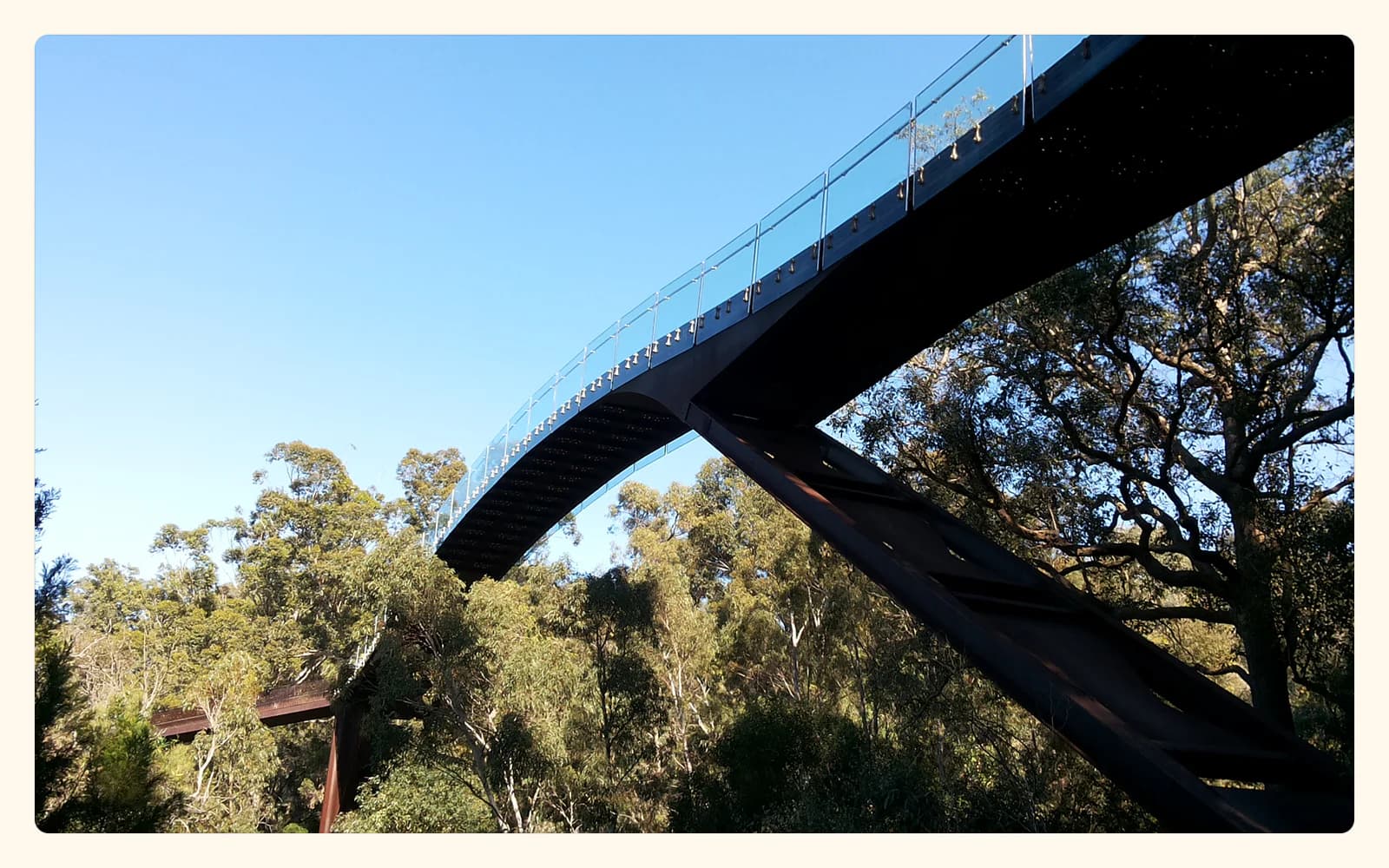
The glass bridge on the Lotterywest Federation Walkway in Kings Park in 2018. The first Perth episode was filmed on the park's treetop bridge.
Photo: ZidaneHartono / Wikimedia Commons · CC BY-SA 4.0
Image adapted for this page.
In Perth, an Old Red Phone Gave Every Story a Horizon
During Perth Festival, one person at a time lifted a handset, spoke across the distance, and became the still centre of a moving city portrait.
What actually happened
- Original event
- A View From A Bridge
- Date & time zone
- February 6–March 1, 2026 · Australia/Perth
- By
- Perth Festival + Joe Bloom / A View From A Bridge
- Format
- Filmed bridge conversations and online festival series
- Entry
- Participants arranged in advance · episodes released online
What happened
For its 2026 season, Perth Festival commissioned British artist Joe Bloom to make a Western Australian chapter of A View From A Bridge. The films were recorded around Perth in January, then released online from February 6 to March 1 as the work's first presentation outside the United Kingdom.
The scene was spare but exact. One person stood on a bridge holding an old red telephone receiver. The handset was connected to a mobile phone, allowing Bloom to speak with the participant while filming from a distance. Some conversations were arranged in advance, and participants wore a lapel microphone. In the finished films, Bloom's questions disappear and the camera slowly pulls away, leaving one voice suspended inside a widening view.
The first Perth episode placed Noongar Elder Dr Richard Walley OAM on the treetop walkway in Kings Park. Perth Festival reported in March that six episodes were then live, with two more to come, and that the Perth films had already been watched more than two million times across platforms. The embedded original upload shows the first episode's actual handset, speaker, bridge, and gradual visual reveal.
See the event in motion
What draws people in
The telephone gives the guest a role before a word is spoken. Lifting the receiver marks a beginning; the person at the other end is present but not visually competing for attention. For a few minutes, one speaker can occupy the centre without having to perform to a room.
The view does more than decorate the conversation. As the frame widens, paths, trees, water, buildings, and passing life place the voice inside a particular city. A private-scale exchange becomes a public portrait without needing a live audience around the speaker.
The release pattern also changes what a festival can be. Guests did not all arrive at one time. Separate encounters accumulated into a shared series, allowing the event to feel rooted in Perth while reaching people far beyond it.
If you host something similar
One guest, one meaningful view, one attentive listener, and one participant-approved outcome create the complete shape. An original name, listening object, prompt set, visual language, and output keep it distinct from A View From A Bridge.
A bridge is not essential. An accessible garden edge, window, terrace, courtyard, museum lookout, or indoor view offers the same perspective with fewer concerns around height, weather, through-traffic, noise, and public access. Seating, a sheltered alternative, and a clear waiting area make staggered slots easier to join.
Personal stories often arrive with more depth than a host expects. A gentle prompt ladder, an easy pass, a visible stop signal, and separate choices for participation, recording, editing, credit, and publication keep the invitation understandable. No recording remains the default. When a story touches a living community or local history, the speaker defines what they are comfortable representing, how the context is named, and whether anything leaves the event.
Horizon Listening Room
Take three uninterrupted minutes at a meaningful view, be heard by one attentive listener, and choose whether the resulting view card stays private, goes home, or joins an anonymous display.
One guest faces a view while one listener remains nearby but out of the spotlight; a single participant-approved line, colour, or image becomes a guest-controlled view card.
Host a Horizon Listening Room for 8–16 guests, where each person chooses a gentle prompt at an accessible viewpoint, speaks for three uninterrupted minutes to one attentive listener, and decides whether a view card stays private, goes home, or joins an anonymous display.
Host checklist
- The prompt ladder begins with the view itself before offering memory, change, or hope; a pass or early stop remains available without explanation.
- An accessible viewpoint with seating, shelter, a quiet waiting area, and an alternative indoor view is a more comfortable fit than a busy or elevated bridge.
- Participation, note-taking, recording, editing, naming, and public display remain separate choices; the guest approves the exact card or media before it leaves the event.
- An original event name, listening object, visual language, prompts, and output help the new format stand on its own rather than reproducing Joe Bloom's artwork.
- The listener's role is to hold attention without interpreting, advising, diagnosing, or promising a personal outcome.
- Guests speaking about a living community or local history retain control of the scope, context, credit, and audience for their own contribution.
The idea will be ready in the event creator.
Questions hosts ask
Does the event need to happen on a bridge?
No. Choose a view that helps a guest feel both grounded and spacious. A garden edge, museum window, courtyard, terrace, or indoor overlook offers that feeling with easier access, seating, shelter, and sound control.
Do guests have to be recorded?
No. The listening event can end with no record at all. A private handwritten card, a sealed take-home envelope, or an anonymous display card can preserve the sense of completion without creating audio or video.
How can the event invite depth without pressuring disclosure?
Begin with prompts about the visible place, an ordinary detail, or something the guest notices today. Offer reflective prompts only as an option, keep passing and stopping easy, and let every guest decide what—if anything—may be written, named, recorded, or shared.
What would you make from this?
Share a local twist, a different format, or a gathering this story set in motion.