Photo details
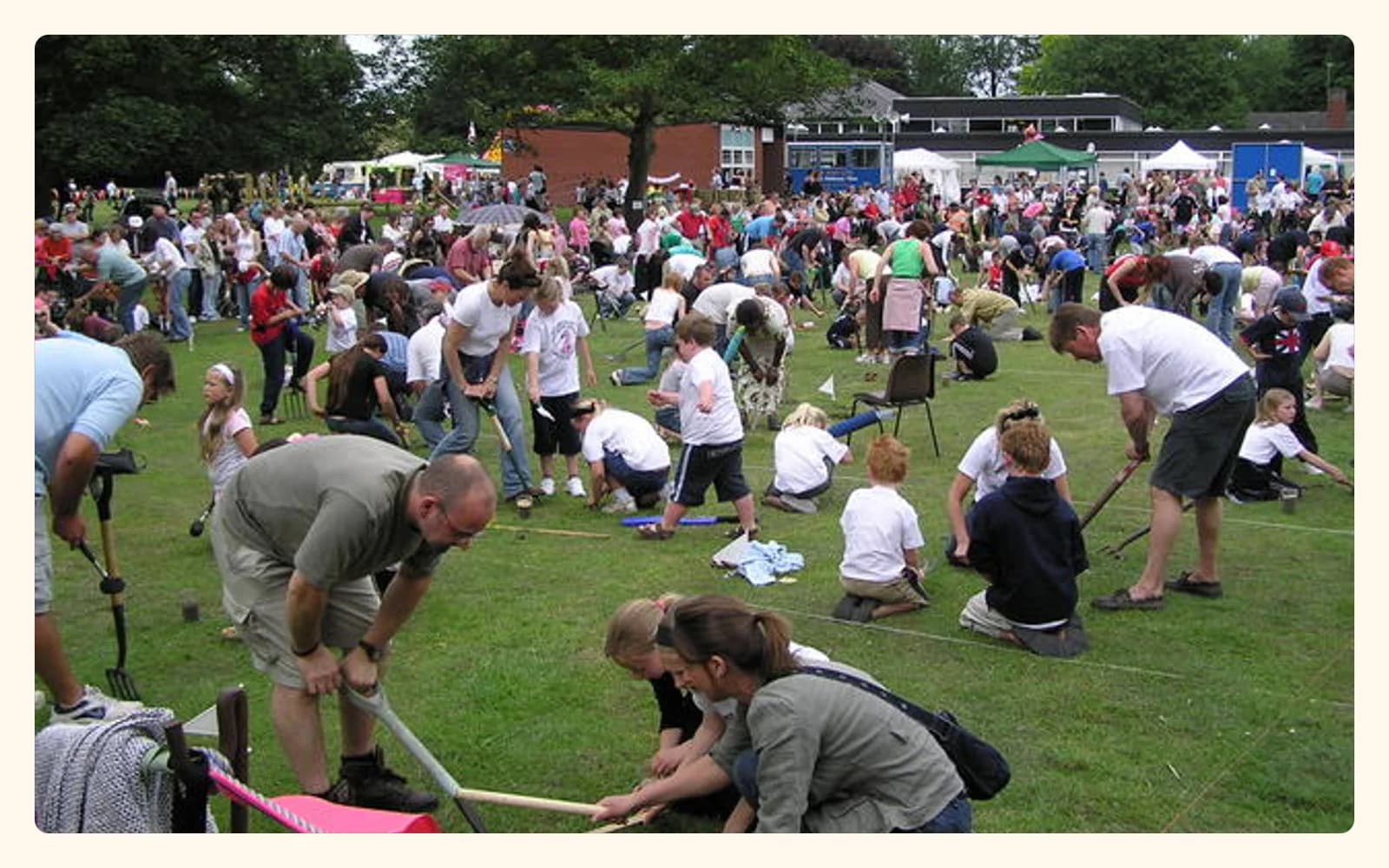
Participants work across marked plots at the separate Willaston worm-charming championship in 2006. The exact 2026 Blackawton event appears in the embedded Euronews footage.
Photo: Graham Shaw / Wikimedia Commons · CC BY-SA 2.0
Image adapted for this page.
In Blackawton, Teams Tried to Charm Worms Out of the Ground
A Devon field became a laboratory of odd noises, careful vibrations, and three-person teamwork as competitors tried to persuade earthworms to surface—without digging.
What actually happened
- Original event
- Blackawton International Festival of Wormcharming 2026
- Date & time zone
- May 3, 2026 · Europe/London
- By
- Blackawton International Festival of Wormcharming
- Format
- Three-person worm-charming field competition
- Entry
- Teams registered · spectator entry not publicly stated
What happened
On 3 May 2026, Blackawton in Devon held the 40th International Festival of Wormcharming. Teams registered around Worm HQ near The George Inn, joined a procession, and followed the organizers to a field whose location was kept as part of the day’s reveal.
Each three-person team had a Charmerer, a Pickerer, and a Counterer. Inside a marked plot, they received a five-minute warm-up and 15 judged minutes to coax worms to the surface. The official rules favoured sound and vibration rather than digging, forks, or potions.
Euronews footage shows the strange methods becoming the spectacle: participants tap, stomp, scrape, and improvise while officials and spectators move between plots. Surfaced worms are counted and returned, so the result depends on invention, attention, and what the ground does in response.
See the event in motion
What draws people in
The ground keeps the outcome uncertain. A loud or theatrical method may draw a crowd, but it does not guarantee a worm. That gives every team a reason to test, listen, adjust, and watch its tiny square of earth more closely.
The three named roles make the event easy to join without asking everyone to perform in the same way. One person generates the method, another watches and handles any surfaced worms, and a third protects the count. The team’s rhythm becomes as interesting as the score.
One marked plot, one short window, several approved methods, and the ground deciding the outcome form the whole challenge. That precise boundary makes the event responsive to nature rather than a performance with a predetermined winner.
If you host something similar
A friendly field owner, suitable ground, and a local check on wildlife and event rules are useful starting points. A shared welfare agreement—sound and vibration only, no digging or chemicals, gentle counting, and immediate return—can give teams a clear creative boundary.
Shaded worm containers, hand-washing supplies, a weather plan, and a viewing route that does not compress the plots complete the field setup. Guests who prefer not to handle worms still have charmer, counter, timekeeper, method-documenter, steward, or parallel sound-and-soil observation roles.
The Worm-Charming Field Challenge
Invent a strange sound-and-vibration method with two teammates, watch one small patch of ground intently, and discover whether the earth responds.
Teams divide into Charmer, Spotter, and Counter roles, then invent non-invasive sound or vibration methods inside identical marked plots while the natural response remains unpredictable.
Host a supervised worm-charming field challenge for 18–45 guests in teams of three, using sound and vibration only on marked plots, with a landowner-approved field, gentle counting, and immediate return of every worm.
Host checklist
- A landowner-approved lawn or field with suitable, uncompacted soil gives the event a clear and legitimate home.
- Local wildlife guidance and a simple welfare plan can shape how worms are observed, held briefly, counted, and returned.
- Sound and vibration methods can be agreed in advance, leaving plenty of invention inside a no-dig, no-chemical boundary.
- The arrival plan includes hand-washing, shade, drinking water, accessible viewing, weather cover, and meaningful non-handling roles.
The idea will be ready in the event creator.
Questions hosts ask
Do teams need specialist equipment?
Usually not. The creative interest comes from simple approved sounds and surface vibrations. A small object table works once every item has been checked for the ground.
What if no worms appear?
That uncertainty belongs to the format. Celebrate the most inventive method, clearest teamwork, best field notes, or strongest costume as well as the highest count.
Can someone join without handling worms?
Yes. Charmer, counter, timekeeper, method documenter, steward, and commentator roles can all be designed without direct handling.
What would you make from this?
Share a local twist, a different format, or a gathering this story set in motion.