Photo details
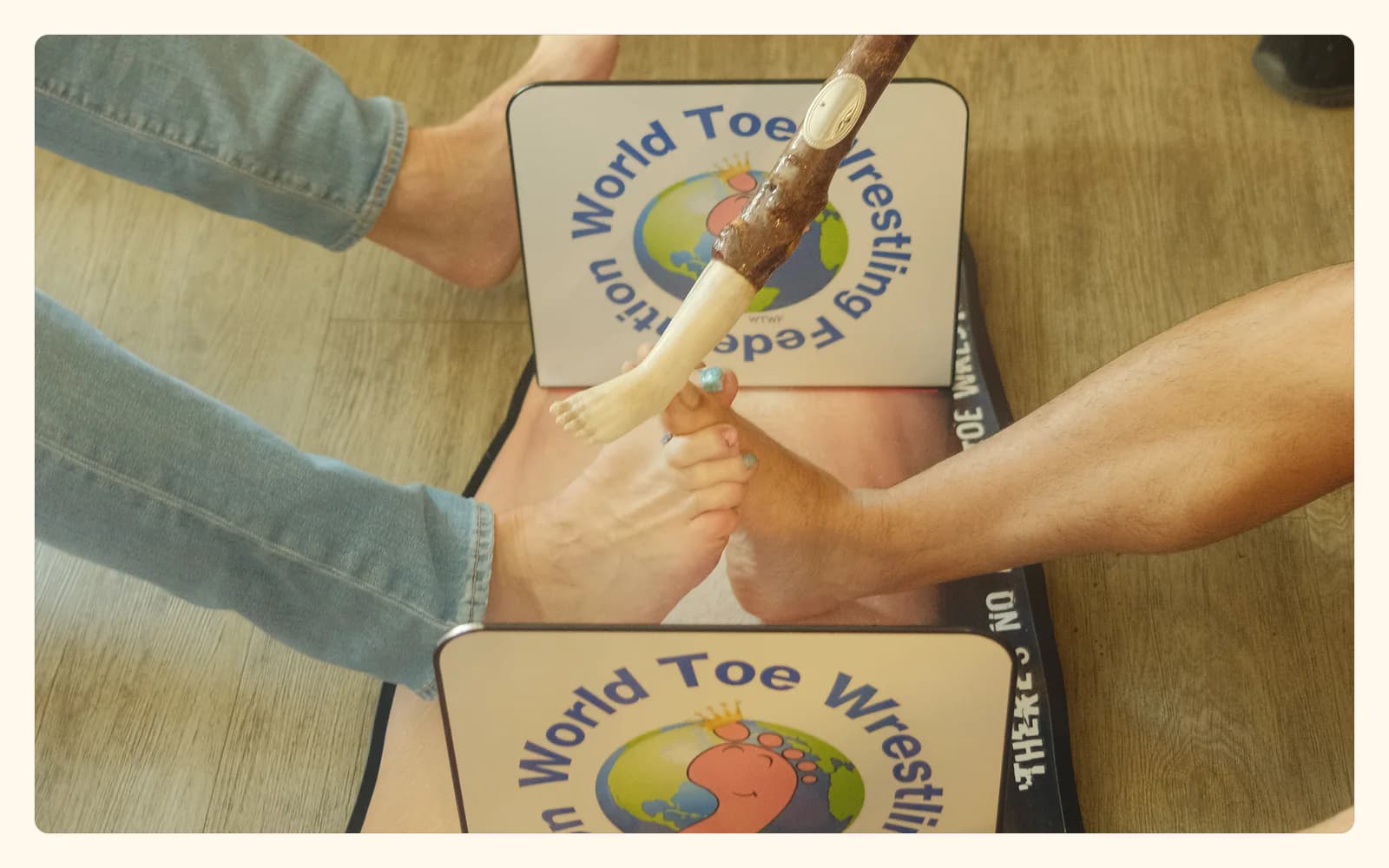
Toe wrestling players compete on a Toedium at the 2023 World Toe Wrestling Championship.
Photo: BigToeWrestler / Wikimedia Commons · CC BY-SA 4.0
Image adapted for this page.
Toe Wrestling Got the Full Championship Treatment in Ashbourne
In a Derbyshire market square, competitors locked big toes while referees, brackets, prize money, and a committed crowd treated every pin as serious sport. What holds the crowd is the mismatch: a tiny physical challenge surrounded by the ceremony of serious competition.
What actually happened
- Original event
- 2026 World Toe Wrestling Championship
- Date & time zone
- July 18, 2026 · Europe/London
- By
- World Toe Wrestling Federation
- Format
- Eccentric elimination tournament
- Entry
- Free spectators · competitor registration
What happened
On 18 July 2026, the World Toe Wrestling Championship returned to Ashbourne Market Place in Derbyshire. The official listing advertised free spectator entry and a £9,000 prize fund; the local Ashbourne guide listed adult women’s and men’s categories, with registration opening before the afternoon competition.
The rule is immediately readable. Two seated competitors interlock big toes and try to pin the other person’s foot against the side of a small wooden arena. Reuters filmed the 2026 matches at close range, including the concentrated faces, referee signals, and crowd gathered around the stage.
Kasey Brooks won the men’s title and Abigail Beech won the women’s title. The result mattered because the event gave the odd premise the full grammar of a championship: named divisions, officials, a bracket, prize money, winners, and a public square willing to watch.
See the event in motion
What draws people in
The contest can be understood in seconds. A spectator does not need to know a season’s statistics or a long rulebook to recognize the moment one side is pinned. That clarity lets the room move quickly from laughter at the premise to genuine investment in the result.
Its other strength is the contrast between scale and ceremony. The physical arena is tiny, but the framing is expansive. A referee, a title, a crowd line, and a decisive signal tell participants that the host has taken their few minutes seriously.
The independent version begins with a harmless micro-challenge that reads clearly from three rows back. A bracket, an entrance, commentary, and a prize worthy of a local legend supply the ceremony without copying the bodily contact.
If you host something similar
A low-contact challenge keeps the delight while making participation easier to supervise. Paper-plane accuracy, a one-handed object stack, a slow-motion tabletop race, or another venue-appropriate task still produces a visible win without asking guests to touch one another.
A spectator-view test, rules published before registration, and equally celebrated referee, commentator, scorekeeper, sign-maker, or entrance-announcer roles widen the ways to join. A short practice round and a graceful opt-out keep the championship playful even when the ceremony is grand.
The Ridiculously Serious Championship
Compete in—or help stage—a gloriously official championship built around one harmless challenge anyone can understand from across the room.
A deliberately tiny challenge receives full sporting ceremony: registration cards, seeded or random brackets, walk-on introductions, visible officiating, commentary, and a handmade title object.
Host a ridiculously serious micro-championship for 16–40 adults around one harmless, low-contact challenge, with a clear bracket, walk-on introductions, live commentary, and equally celebrated referee and scorekeeper roles.
Host checklist
- A venue-appropriate challenge with no body-to-body contact can preserve the spectacle while lowering the practical burden.
- A practice round and a visible rules card give competitors a chance to understand the task before joining the bracket.
- Referee, commentator, scorekeeper, and sign-maker roles can receive the same introduction and recognition as competitors.
- Stable equipment, a clear spectator line, an accessible playing height, and permission for sound or public-space use belong in the venue check.
The idea will be ready in the event creator.
Questions hosts ask
Does the new event need to use toe wrestling?
No. Give a very small, easy-to-read challenge the ceremony of a major championship. A low-contact task is usually easier for an independent host to run.
How do spectators stay interested between rounds?
Keep rounds short, display the bracket, introduce every participant, and let commentary explain the stakes without turning a guest into the joke.
What can guests do if they do not want to compete?
Offer meaningful crew roles: referee, commentator, timekeeper, scorekeeper, entrance announcer, sign maker, photographer, or title-object designer.
What would you make from this?
Share a local twist, a different format, or a gathering this story set in motion.