Photo details
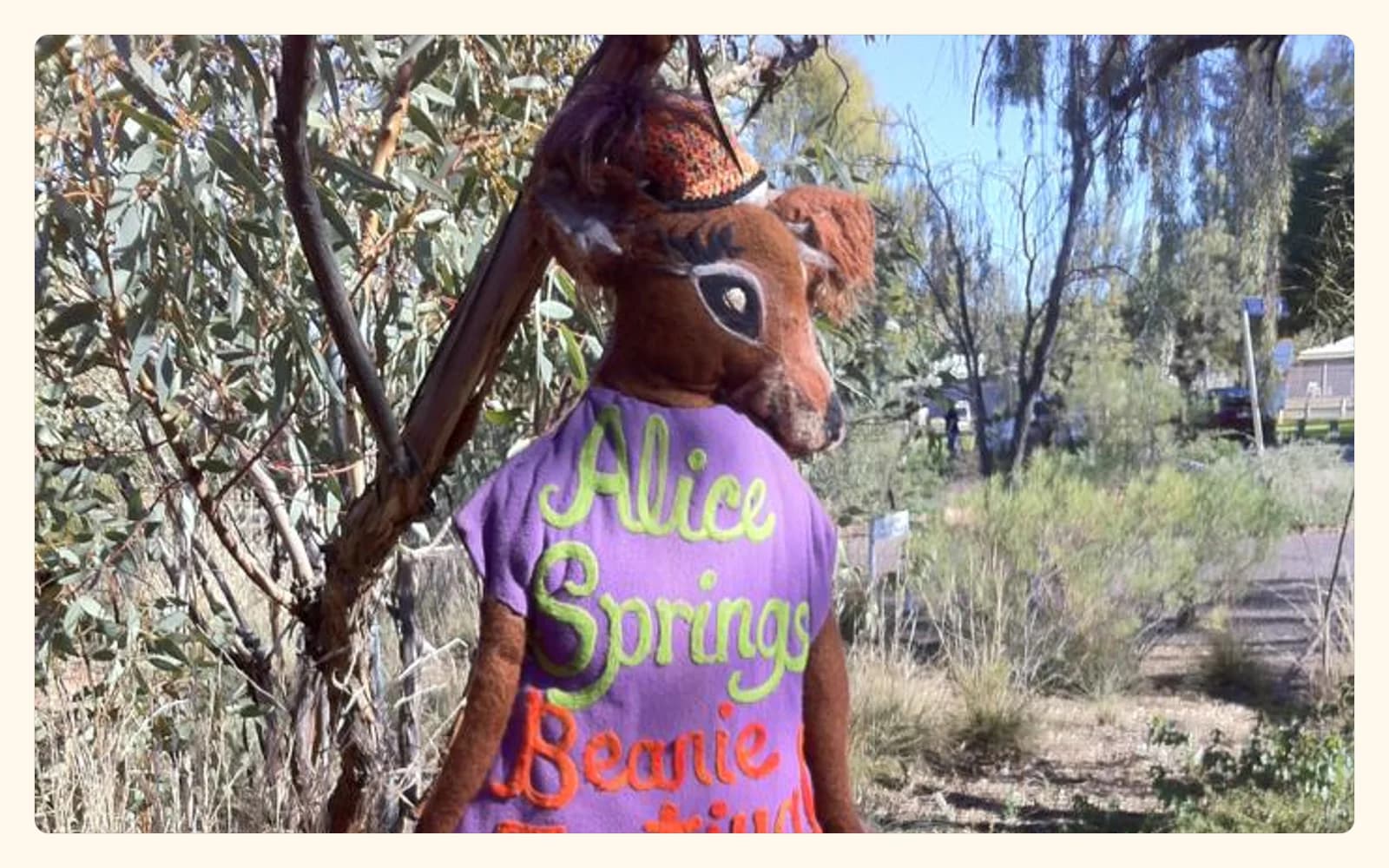
A kangaroo sculpture welcomed visitors to the Alice Springs Beanie Festival in 2013. The same annual festival held its 30th and final edition in 2026.
Photo: Aliceinthealice / Wikimedia Commons · CC0 1.0
Image adapted for this page.
Alice Springs Let 7,800 Beanies Take Over an Arts Centre
For four winter days, one familiar object became an exuberant public gallery: thousands of handmade beanies, a room full of makers, and visitors discovering just how far one shared form could stretch.
What actually happened
- Original event
- Alice Springs Beanie Festival 2026
- Date & time zone
- June 19–22, 2026 · Australia/Darwin
- By
- Alice Springs Beanie Festival
- Format
- Community textile festival and one-object exhibition
- Entry
- Festival attendance · entry terms not publicly stated
What happened
From 19 to 22 June 2026, the Alice Springs Beanie Festival filled Araluen Arts Centre with handmade headwear for its 30th and final edition. ABC News reported that more than 150 volunteers attached 7,800 beanies for display before the doors opened.
The shared form made the differences unusually visible. Visitors could move from practical wool hats to sculptural pieces, character-like forms, and experiments in colour and material without losing the thread that connected the room. Araluen described the festival as having grown from about 100 beanies in 1997 to roughly 8,000 in 2026.
The gathering was also a working marketplace and meeting point for makers. The festival later reported that 7,856 beanies were sold for a combined AUD 394,150. Workshops, live entertainment, and work by Indigenous women from remote communities placed the display inside a wider celebration of textile knowledge and women’s creative work.
See the event in motion
What draws people in
Every visitor knows what a beanie is, so no wall text is needed before curiosity begins. The pleasure comes from seeing how differently thousands of people answer the same compact brief. One repeated silhouette becomes a way to notice humour, skill, place, personality, and material choices.
Abundance matters too. A single eccentric hat is an object; several thousand together become a landscape. The display lets a guest scan from a distance, then lean in for one maker’s detail, story, or technique.
A recognizable base form makes the invitation legible before doors open. Once 30 or 50 versions share one composition, the contributions become the gathering rather than decoration added to it.
If you host something similar
Even 30 or 50 contributions feel abundant when the display becomes one composition rather than a row of unrelated stalls. Repeated hooks, shelves, labels, or suspended lines reveal the common form while leaving each maker enough room to be noticed.
One simple contribution rule, a few broad material boundaries, and clear display-only, swap, gift, or sale options give makers a shared frame. Maker names, prices, accessibility, fragile pieces, and handling or try-on permission are easiest to settle before installation day.
The One-Object Wonder Gallery
Walk into a room where one familiar object has been reinvented dozens of ways, then meet its makers, choose a favourite, and add a version of your own.
Every contribution begins with the same recognizable everyday object, so the room’s variety can be understood at a glance and explored one interpretation at a time.
Host a one-object wonder gallery for 20–80 guests where every participant brings or makes one imaginative version of the same everyday object, then joins a playful display, maker-story hour, and people’s-choice vote.
Host checklist
- A base object that is familiar, affordable, and open to many materials usually gives contributors room to surprise one another.
- Display-only, swap, gift, and sale pieces can use visibly different labels so guests understand what is available.
- Maker credit, price or commission terms, handling permission, and the return date are clearest when confirmed before objects arrive.
- A reachable display height, seating, wide routes, and a contribution method that does not depend on fine-motor craft can welcome more guests.
The idea will be ready in the event creator.
Questions hosts ask
Does every contribution need to be made during the event?
No. Collecting most pieces beforehand gives the host time to install a coherent display. A small same-day making table can still let new visitors add something.
What kind of object works best?
Choose something recognizable, affordable, easy to display, and open to many materials or stories. A cup, patch, postcard, paper hat, small box, or reusable bag can all work.
Can contributors sell their pieces?
Yes, if the invitation clearly explains prices, payment, any commission, handling, collection, and what happens to unsold work. Display-only, swap, and gift labels can sit beside sale labels.
What would you make from this?
Share a local twist, a different format, or a gathering this story set in motion.